


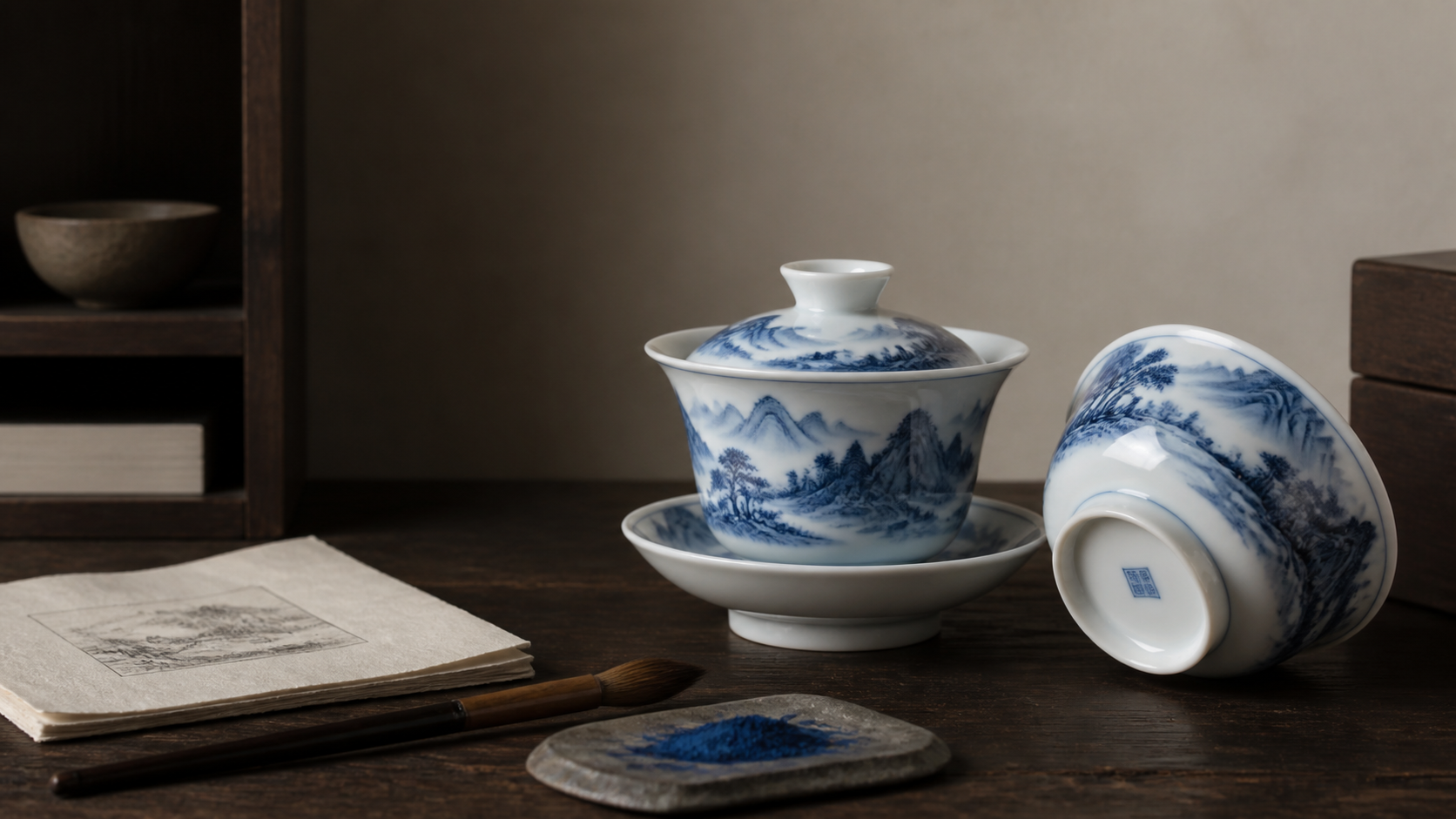
How to Spot Authentic Jingdezhen Porcelain in a World of Imitations
The word Jingdezhen now travels faster than the porcelain itself. It can be added to the title of a blue-and-white vase, a gaiwan, a bowl or a sculptural flower in seconds, often by someone far removed from the workshop that made it. Once attached, it seems to promise fine white porcelain, fluent brushwork and a direct line to one of China’s most important ceramic traditions.
Yet the word alone tells a buyer surprisingly little. It may describe where an object was made, the tradition that inspired it, a type of porcelain body, a decorative style or simply the atmosphere a seller hopes to create. Those are not equivalent claims.
So what does authentic Jingdezhen porcelain actually mean, and how can an ordinary buyer recognize it?
The honest answer is that there is no single test. Thinness is not proof. A clear ring is not proof. A six-character mark is not proof. Even visible brushwork cannot establish geographic origin on its own. Reliable judgment comes from several kinds of evidence considered together: provenance, materials, forming and decoration methods, firing and finishing, the underside of the piece, the credibility of the maker or workshop, and the precision of the seller’s description.
This guide is primarily about contemporary porcelain sold as Jingdezhen-made. Antique authentication is a separate, far more demanding field, addressed later in the article.
What Is Authentic Jingdezhen Porcelain?
Authentic Jingdezhen porcelain is porcelain genuinely produced in Jingdezhen, Jiangxi, China, and represented accurately in relation to its maker, methods, materials and date. It may be entirely handmade, partly handmade, studio-produced or industrially formed. Geographic authenticity does not by itself guarantee handwork, artistic quality, rarity, age or value.
That definition matters because “authenticity” is often asked to carry too many meanings at once. A buyer may really be asking five different questions:
-
Origin: Was the piece physically made in Jingdezhen?
-
Method: Was it thrown, hand-built, moulded, slip-cast, machine-formed or made through a combination of processes?
-
Decoration: Was it painted by hand, printed, decal-applied, screen-printed, hand-finished or produced through a mixed method?
-
Attribution: Can the named artist, studio, workshop or factory be connected to the object?
-
Age: Is the piece contemporary, a declared reproduction, vintage or genuinely antique?
A piece can be authentic in one sense and not another. A factory-made cup can be truthfully made in Jingdezhen without being handmade. A hand-painted vase made in another province can be a fine example of Chinese porcelain without being Jingdezhen-made. A contemporary reproduction can be honest and skillful, while still not being an antique. A moulded object can involve substantial artisan work.
Made in Jingdezhen vs. made in the Jingdezhen tradition
Made in Jingdezhen is a claim of manufacturing origin. The piece was produced in the city or its recognized production area.
Jingdezhen-style, Jingdezhen-inspired or made in the Jingdezhen tradition describes an aesthetic or technical relationship. Unless the seller also states the production location, those phrases do not establish that the piece was made in Jingdezhen.
There is nothing inherently inferior about work made elsewhere. The issue is accuracy. A porcelain object should be valued for what it truly is, not for a place name borrowed to increase its appeal.
Why Jingdezhen Became China’s Porcelain Capital
Jingdezhen’s importance is not the result of a single invention or an uninterrupted line of “master potters.” It grew from a ceramic system: raw materials, waterways, kiln design, imperial and commercial demand, and an unusually concentrated division of skilled labor.
UNESCO describes porcelain production in Jingdezhen as extending back more than 1,700 years. In 2026, it inscribed the Jingdezhen Handicraft Porcelain Industry Sites on the World Heritage List. UNESCO’s account traces a particularly consequential period from the 10th through the 19th centuries, encompassing the extraction and transport of raw materials, kiln innovation, and the social organization of production at enormous scale. The historic town brought imperial kilns, civilian kilns, guilds and merchant associations into the same ceramic economy. UNESCO’s account of the Jingdezhen handicraft porcelain industry sites also notes the development of a two-component porcelain recipe using kaolin and porcelain stone.
This matters because Jingdezhen was never only a cluster of individual potters working alone from clay to finished vase. Its strength lay in specialization. Formers, throwers, mould makers, trimmers, carvers, underglaze painters, enamel painters, glaze workers and kiln specialists could each develop uncommon control over one stage of production. A single object might pass through several expert hands.
During the Yuan dynasty, Jingdezhen potters refined porcelain bodies and firing practices that helped blue-and-white porcelain reach a new level of technical and visual authority. Cobalt decoration was painted onto the unfired body and covered with a transparent glaze before firing. The Victoria and Albert Museum notes both the refinement of clay recipes with kaolin and the mastery required to brush cobalt pigment across an uneven porcelain surface. The V&A’s history of Chinese blue-and-white ceramics also documents how widely such wares travelled and how extensively they were copied.
Imperial patronage raised expectations for material refinement, proportion, decoration and firing, but Jingdezhen was never exclusively an imperial manufacturing centre. Private and civilian kilns supplied domestic households, scholars, temples, merchants and international markets. By the late Ming, private kilns were also making sophisticated blue-and-white porcelains with imagery freer than standardized court patterns. Jingdezhen’s history therefore includes courtly precision, commercial ingenuity, export adaptation and everyday use.
Its fame should be understood as the achievement of an ecosystem. The city accumulated not one secret, but generations of interconnected knowledge.
How Can You Tell If Jingdezhen Porcelain Is Authentic?
You cannot confirm Jingdezhen origin from one visual clue. Begin with traceable provenance and a precise seller description, then assess the body, glaze, decoration, foot, marks, construction, handling and price as a connected body of evidence. For costly antiques, photographs and consumer checklists are not enough; specialist examination is required.
The following criteria will not turn a first-time buyer into an authenticator. They will, however, help you ask better questions, recognize vague claims and compare listings with much greater confidence.
1. Start with provenance, not appearance
For a contemporary purchase, provenance does not need to mean an aristocratic ownership history or a formal certificate. It begins with a credible account of production.
Ask:
-
Where, specifically, was the piece made?
-
Is the maker, studio, workshop or factory identified?
-
Which stages were performed by hand?
-
How was the form created?
-
Is the decoration fully hand-painted, printed, decal-applied, hand-finished or mixed?
-
What body and glaze were used?
-
Can the seller show photographs or video from the workshop when appropriate?
-
What does the base mark or inscription mean?
A credible seller may not be able to identify every worker involved in a multi-person workshop. That is normal. What matters is whether the seller can give concrete answers without retreating into phrases such as “ancient technique,” “imperial quality” or “master craftsmanship.”
Provenance is especially important online because photographs flatten evidence. Lighting can exaggerate translucency. Retouching can intensify cobalt. A carefully cropped base can hide a printed mark, a rough foot or a country-of-origin label. The story around the object should be as coherent as the object itself.
2. Examine the porcelain body
Fine Jingdezhen porcelain is often associated with whiteness, density, refinement and, in thin sections, translucency. Those qualities are real possibilities, not universal rules.
An eggshell-thin gaiwan and a large sculptural vessel solve entirely different technical problems. The gaiwan may be judged by wall control, lightness, rim refinement and the relationship among bowl, lid and saucer. A thick-bodied vase may be judged by structural stability, even drying, proportion and control through firing. A biscuit-porcelain flower needs enough strength at the joins to support petals that may be individually shaped.
When you can handle the piece, consider:
-
whether the body feels dense rather than chalky;
-
whether wall thickness is appropriate and controlled for the form;
-
whether the rim is finished cleanly;
-
whether the vessel feels balanced rather than unexpectedly top-heavy;
-
whether visible porcelain at the foot is fine-grained and consistent with the seller’s description.
Translucency can be meaningful in thin porcelain, but it is not a geographic fingerprint. Many porcelain traditions can produce translucent bodies, and thick Jingdezhen porcelain may transmit little or no light. Whiteness also varies with body recipe, glaze, firing atmosphere and artistic intention.
3. Look closely at the glaze
Glaze should be read in relation to the object, not against a fantasy of flawless glassiness.
On finely finished porcelain, look for a coherent relationship between glaze and body: even coverage where evenness is intended, clean color, controlled pooling around relief or carved areas, and a surface that supports rather than obscures the decoration. On some pieces, a slight bluish or warm cast is intentional. On others, crackle, mottling, matte surfaces or pronounced runs are part of the design.
Small pinholes, iron spots, kiln dust or slight glaze variation may occur in ceramic firing. Their significance depends on the period, technique, intended quality and location. A minor firing trace on an expressive studio vase is not judged in the same way as a sharp blister on the drinking rim of functional teaware.
Learn to separate character from poor control:
-
Character is consistent with the technique and the maker’s intention.
-
A defect interferes with use, durability or visual resolution.
-
Random flaws do not become evidence of authenticity merely because they look rustic.
The reverse mistake is equally common: assuming that a smooth, even glaze must be industrial. Highly skilled hand production can be exceptionally precise.
4. Study the painting and decoration
Decoration is one of the most revealing areas of a porcelain object, and one of the easiest for a listing to describe ambiguously.
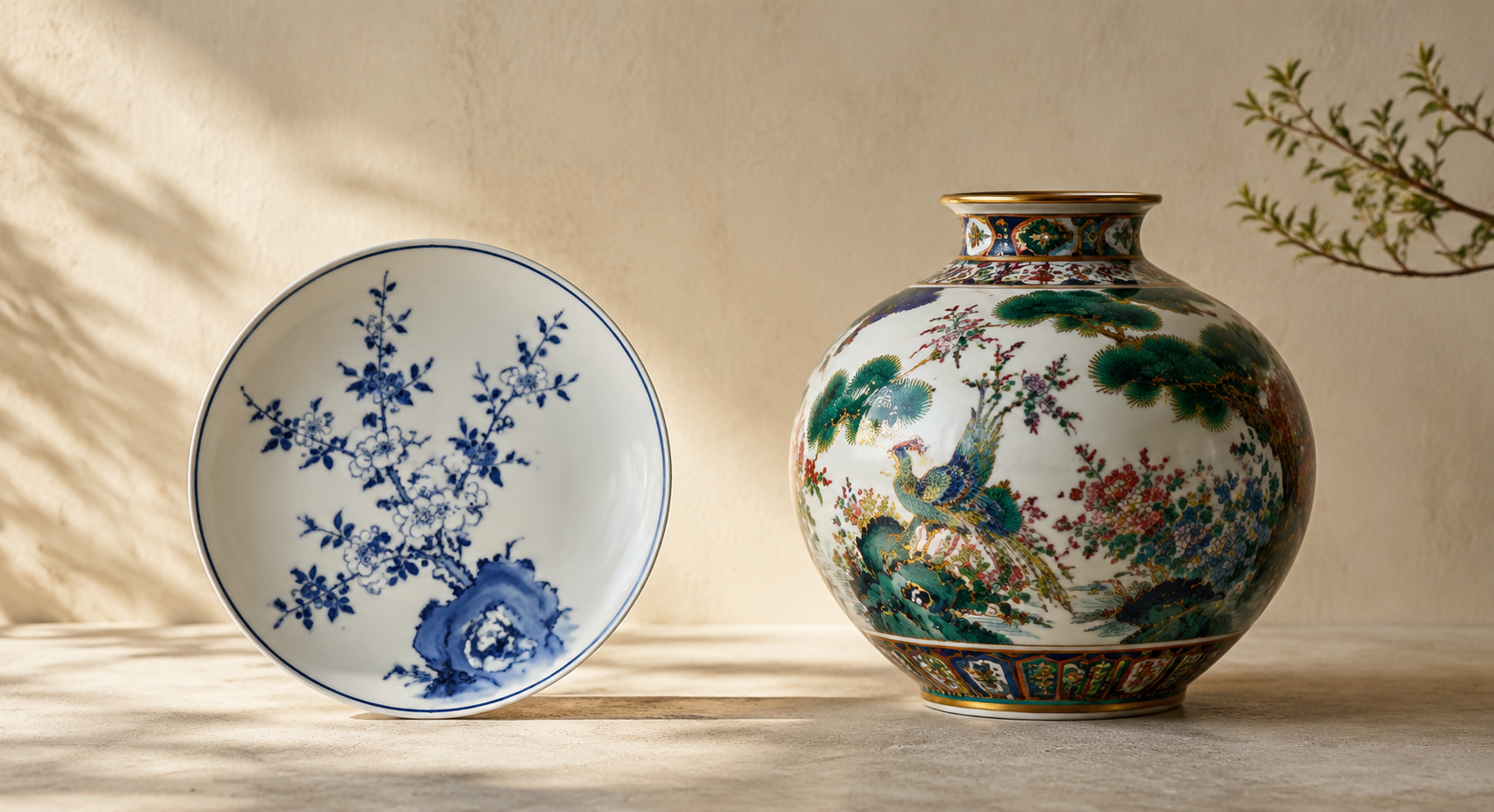
In classic blue-and-white porcelain, cobalt pigment is painted or otherwise applied before a transparent glaze and the principal firing. Overglaze enamels are applied above an already fired glaze and require one or more subsequent firings at lower temperatures. A single piece can combine underglaze blue with overglaze colors, as historic wucai and doucai wares demonstrate. Museum catalogues regularly describe Jingdezhen objects with both methods; for example, this Ming jar in The Metropolitan Museum of Art combines underglaze cobalt with overglaze polychrome enamels.
Those technical terms describe where color sits in relation to the glaze. They do not, by themselves, tell you whether the image was painted by hand.
Visual clues that may suggest hand painting
Under magnification or close inspection, genuine brushwork may show:
-
lines that widen and narrow as pressure changes;
-
pigment that becomes denser where a brush pauses or turns;
-
visible beginnings, endings and overlaps of strokes;
-
gradual washes rather than mechanically uniform fields;
-
small, meaningful differences between repeated leaves, petals, clouds or border units;
-
brush movement that responds to the curve of the vessel;
-
layered strokes in which outlines, washes and accents perform different tasks.
These are clues, not proof. An accomplished painter can repeat motifs with extraordinary consistency. A printed design can be altered by hand. Modern production can also simulate irregularity.
How common decoration methods differ
| Decoration method | What it means | What you may observe | What to ask |
|---|---|---|---|
| Fully hand-painted | A person applies the decorative image manually with a brush or other hand tool | Pressure-sensitive strokes, pigment modulation, responsive variation | Is every decorative stage painted by hand? |
| Underglaze hand painting | Hand-applied pigment sits beneath the transparent glaze | Design appears visually integrated below the glaze surface | Was the cobalt or other pigment brushed by hand before glazing? |
| Overglaze hand enamelling | Enamels are painted over the fired glaze and fired again | Color may sit perceptibly on the surface; fine outlines and layered enamel can be visible | Which colors or details were hand-enamelled? |
| Transfer printing | A design is transferred from an engraved or printed carrier | Repeated motifs may be extremely consistent; joins or loss of clarity can occur on curves | Is any part of the design transfer-printed? |
| Decal decoration | A pre-printed ceramic image is applied and fired onto the surface | Dot patterns, sharply uniform edges or identical placements may appear under magnification | Is “hand-finished” being used to describe a mostly decal-applied design? |
| Screen printing | Pigment is pushed through a patterned screen | Flat, even color and consistent repetition | Is the outline, fill or entire motif screen-printed? |
| Mixed decoration | Printed or machine-assisted elements are combined with hand painting | Printed outlines with individually varied washes or accents | Which exact stages are manual? |
A decal is not automatically poor, just as hand painting is not automatically accomplished. The essential question is whether the method is represented honestly and priced accordingly.
5. Turn the piece over and inspect the foot
Experienced ceramic buyers often look at the underside almost immediately because it records decisions that the front is designed to conceal.
Examine:
-
the shape and finish of the foot ring;
-
exposed porcelain at the contact surface;
-
trimming or cutting marks;
-
where the glaze ends;
-
whether the base is fully, partly or not glazed;
-
kiln grit, support traces or firing marks where relevant;
-
inscriptions, studio seals, impressed marks, labels and later additions;
-
evidence of grinding, restoration or artificial wear.
The foot can help you understand how a piece was formed and finished. On antique ceramics, the cutting, glazing and profile of a base can also contribute to dating because those practices changed over time. Christie’s collector guidance emphasizes that the base is important precisely because a convincing front can be copied from photographs while underside details are easier to misunderstand. Its guide to collecting Chinese ceramics also warns that learning to authenticate historical ceramics takes years.
For contemporary wares, a neat foot may indicate careful finishing, but it cannot prove Jingdezhen origin. A rough foot may reflect an intentional firing method, hurried finishing or poor quality control. Again, context decides.
6. Understand Jingdezhen porcelain marks
Does authentic Jingdezhen porcelain have a mark?
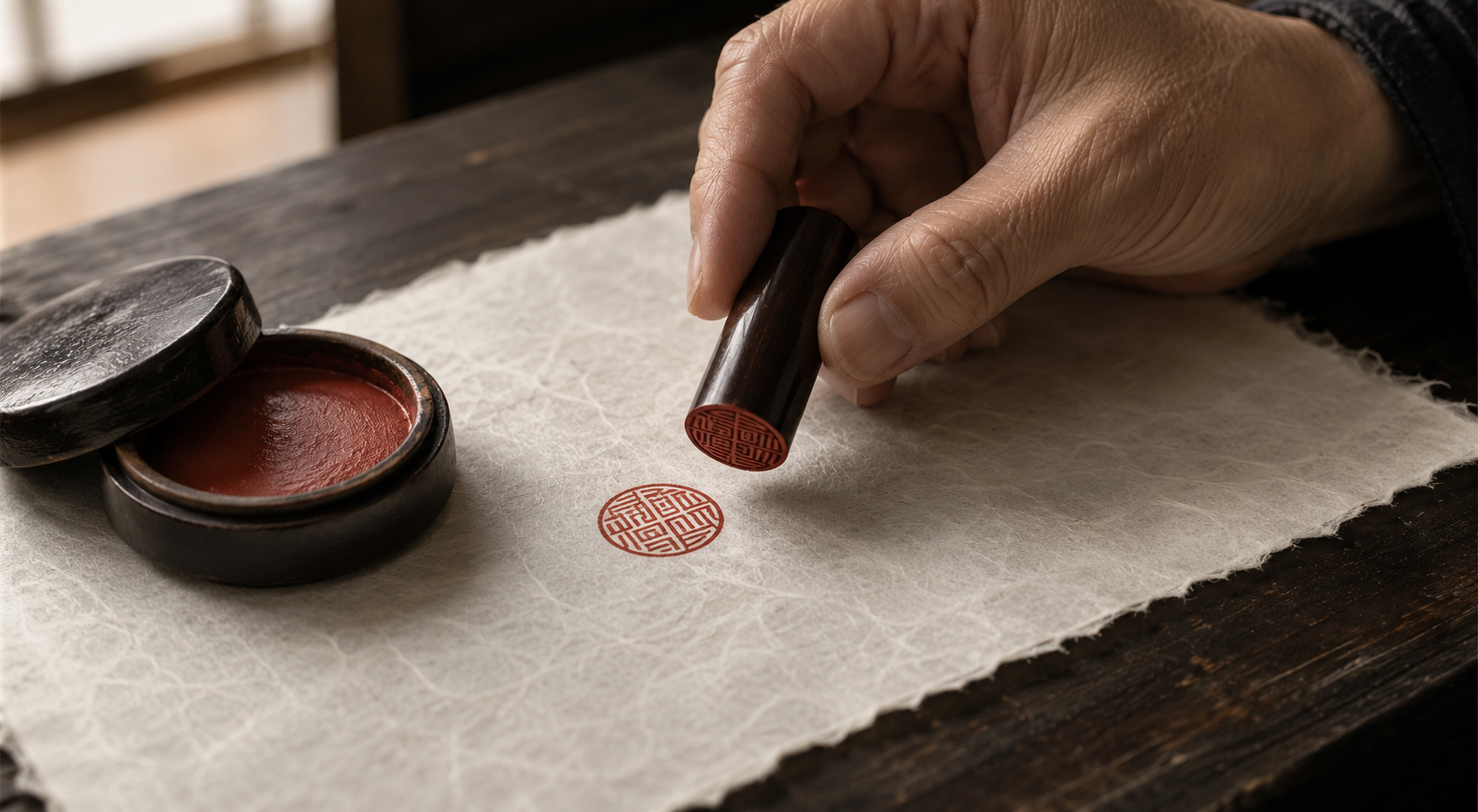
It may, but it does not have to. Contemporary Jingdezhen porcelain can carry an artist’s signature, studio seal, workshop or brand mark, decorative inscription, origin mark or a mark inspired by an earlier reign. Other genuine Jingdezhen pieces are unmarked. A mark alone does not prove where, when or by whom a piece was made.
Marks can identify or suggest:
-
an individual maker;
-
a studio or workshop;
-
a commercial brand;
-
the claimed place of manufacture;
-
a hall or patron;
-
a date or commemorative occasion;
-
an earlier imperial reign used as attribution, imitation or homage;
-
an auspicious phrase with no manufacturing information at all.
Historic reign marks commonly appear as four or six characters, often on the base, but the category is much more complicated than a logo system. Marks from admired earlier reigns were copied on later objects. Such apocryphal marks were not always intended to deceive; they could express reverence for a celebrated period or identify the style being emulated. Museums hold many later objects with earlier-style marks. The British Museum, for example, catalogues pieces explicitly as bearing apocryphal Chenghua, Xuande, Jiajing and other reign marks.
For this reason, specialists read the mark alongside the body, glaze, form, palette, painting, foot, condition and provenance. Christie’s guide to Chinese reign marks makes the same central point: a copied mark may be a later homage, a reproduction or a deceptive forgery, and the inscription cannot settle the question on its own.
On contemporary porcelain, ask what the mark is intended to mean. A seller should be able to distinguish “made by this studio” from “decorated with a historical-style reign mark.”
7. Look for evidence of the human hand, carefully
Hand involvement may appear in throwing lines, trimmed contours, carved recesses, incised marks, separately applied handles, modelled petals, brushwork or slight asymmetry. These traces can help reconstruct a process.
But do not turn them into a purity test.
Are imperfections proof that porcelain is handmade?
No. Some variations result naturally from handwork, but flaws do not authenticate an object. Deliberate irregularity can be designed into a mould or added during finishing, while elite hand craftsmanship can be remarkably exact. The meaningful evidence is not imperfection itself, but variation that corresponds coherently to a disclosed making process.
A hand-thrown bowl may still be symmetrical. A press-moulded relief may be sharpened, joined and painted by hand. A slip-cast vase may receive extensive trimming, carving, glazing and enamelling. Conversely, a lopsided rim or careless joint may simply be poor workmanship.
The most useful question is not “Can I find a flaw?” but “Can I see how the stated process shaped this object?”
8. Consider weight, balance and proportion
Well-made porcelain usually feels intentional in the hand. That does not mean uniformly light.
For teaware, examine the relationship among capacity, weight and use:
-
Is the rim refined without feeling fragile?
-
Does a gaiwan lid sit and travel smoothly enough for pouring?
-
Does the knob remain practical to hold?
-
Does the bowl balance comfortably between thumb and finger?
-
Does a teapot pour cleanly, and does the handle counter the filled body?
For decorative porcelain, consider visual balance, consistency of wall or component thickness where relevant, structural control, the security of applied elements and the finish of areas not immediately visible.
Handling many well-documented ceramics is one of the best forms of education. Weight and proportion can expose an implausible attribution, but they still cannot identify a city of origin by themselves.
9. Treat price as a clue, not proof
Price can reflect:
-
time spent forming, trimming, carving and polishing;
-
the number and skill of painters involved;
-
complexity of underglaze and overglaze decoration;
-
multiple firings and the risk of loss;
-
scale and structural difficulty;
-
materials and special glaze development;
-
the reputation of an artist or studio;
-
customization, low production volume or rarity;
-
retail service, documentation and quality control.
If a listing claims many hours of fully hand-painted work but is priced like an ordinary printed cup, ask how the economics are possible. The answer might involve workshop production, partial printing, simplified painting, a newer artist or direct sourcing. It may also reveal that the claim is exaggerated.
A high price proves even less. Branding, scarcity language and elaborate packaging can raise a price without improving provenance. Price should prompt questions, never replace them.
Handmade, Hand-Painted and Made in Jingdezhen Are Different Claims
This is the distinction buyers most need to remember:
| Claim | What it actually means | What it does not guarantee |
| Made in Jingdezhen | The object was produced in Jingdezhen | Entirely handmade, hand-painted, rare, antique or high quality |
| Handmade | Significant forming, assembly or finishing was performed by hand | Jingdezhen origin, artistic excellence or one-of-a-kind production |
| Hand-thrown | The primary form was created on a potter’s wheel by hand | Hand-painted decoration or exclusive use of hand processes afterward |
| Hand-painted | Decorative pigment or enamel was manually applied | The vessel itself was handmade or the piece was made in Jingdezhen |
| Hand-finished | A person completed certain finishing stages | That the principal form or decoration was made by hand |
| Jingdezhen-style | The object references Jingdezhen aesthetics or techniques | Production in Jingdezhen |
| Artisan-made | Skilled hand involvement is substantial | Antique age, uniqueness, named authorship or Jingdezhen origin |
| Studio-produced | A studio supervised or organized production | That one artist personally completed every stage |
| Workshop-produced | Several specialists may have contributed | Inferior quality or industrial manufacture |
| Antique | The object dates to an earlier historical period under the relevant market or legal convention | Correct attribution, untouched condition, Jingdezhen origin or value without further evidence |
| Reproduction | The object intentionally recreates an earlier form or style | Fraud, provided its modern date and nature are disclosed |
A responsible listing can use several of these terms together, but each should remain independently true.
Seven Common Myths About Jingdezhen Porcelain
Myth 1: Real Jingdezhen porcelain is always extremely thin
Reality: Jingdezhen produces eggshell porcelain, refined teaware, robust tableware, large vases, sculpture, relief work and many other bodies and forms. Thinness may demonstrate control in a piece designed to be thin, but it is inappropriate as a universal test. A large vessel made too thin for its structure would be badly designed, not more authentic.
Myth 2: Authentic porcelain always makes a bell-like sound when tapped
Reality: Resonance is influenced by material density, wall thickness, form, size, firing, glaze, cracks and even how the object is supported. A clear ring can suggest that a thin, well-vitrified piece is intact; it cannot identify Jingdezhen origin. Thick or sculptural porcelain may sound muted. Tapping also risks damage and should never be treated as an authentication ritual.
Myth 3: A Chinese mark on the bottom proves authenticity
Reality: Marks can be copied, printed, added later or used in homage to an earlier period. Some authentic Jingdezhen pieces are unmarked. Read a mark as one part of the object’s evidence, not as a certificate.
Myth 4: Handmade porcelain must have visible imperfections
Reality: Skilled handwork can be highly regular, while moulds and digital production can create controlled irregularity. Tool traces and variation are useful only when they correspond to the claimed process. Poor workmanship is not a hallmark of authenticity.
Myth 5: Expensive porcelain must be authentic
Reality: Price can reflect real labor, firing risk and reputation, but it can also reflect branding, scarcity tactics and seller margin. An unsupported claim does not become stronger when the price rises.
Myth 6: Anything made with a mould cannot be artisan-made
Reality: Moulds have long been part of ceramic production. Press-moulding, slip casting and sectional moulding can be followed by demanding hand assembly, carving, refinement, glazing and painting. Describe the process accurately rather than forcing every object into an all-handmade or all-machine-made category.
Myth 7: “Jingdezhen-style” means it was made in Jingdezhen
Reality: The phrase normally indicates visual or technical influence. Unless the place of manufacture is stated separately, do not treat it as a geographic claim.
Authentic Jingdezhen Porcelain vs. Mass-Produced Imitation
The usual two-column comparison is misleading because Jingdezhen itself contains artisan studios, specialist workshops and industrial producers. A mass-produced object can genuinely be made in Jingdezhen. The problem begins when origin or method is misstated.
| Factor | Traceable artisan or workshop Jingdezhen porcelain | Honest industrial or semi-industrial Jingdezhen porcelain | Misleading imitation or unclear-origin product |
| Geographic origin | Jingdezhen origin is stated and supportable | Jingdezhen origin is stated and supportable | Origin is omitted, obscured or replaced with “Jingdezhen-style” language |
| Forming | Specific method such as throwing, hand-building, moulding or mixed production is disclosed | Machine forming, slip casting or standardized moulding may be used and described | “Handmade” appears without an explanation of what was done by hand |
| Decoration | Genuine hand painting, carving or other manual work may be visible and described | Decals, transfers, printing or limited hand finishing may be used openly | Printed decoration is implied or stated to be fully hand-painted |
| Repetition | Natural, process-related variation is common | High consistency is expected | Identical pieces are marketed as individually unique without explanation |
| Finishing | Individual trimming, joining, glazing or inspection may be evident | Standardized finishing and quality control | Rough finishing is romanticized as proof of handwork |
| Maker information | Artist, studio or workshop may be named where appropriate | Factory or brand may be named | Maker and production source are absent despite elaborate heritage claims |
| Price | Often reflects skill, time, complexity, risk and low volume | Often reflects efficiency and volume | Price is disconnected from the claimed labor, whether implausibly low or inflated by unsupported stories |
| Seller language | Specific, limited and verifiable | Clear about industrial methods and product category | Generic luxury language substitutes for production facts |
Mass-produced does not automatically mean bad, and handmade does not automatically mean excellent. A durable, well-designed, honestly described factory-made cup may be a better purchase than a poorly painted “artisan” cup with invented provenance. Authenticity begins with truthful representation.
How to Spot Misleading Jingdezhen Listings Online
Online listings rarely announce that a claim is unreliable. More often, they use language that allows a buyer to infer more than the seller has actually said.
Watch for these patterns:
“Jingdezhen” appears in the title but nowhere in the production details
The term may function as a search keyword rather than a statement of origin. Look for an explicit sentence such as “made in Jingdezhen, Jiangxi, China,” then ask for clarification if needed.
“Jingdezhen-style” quietly becomes “Jingdezhen porcelain” later in the description
Changing terminology can blur influence and origin. Treat the narrowest, most qualified wording as the real claim until the seller confirms otherwise.
“Handmade” is never defined
Almost every ceramic object receives some human handling. That alone does not make the primary forming or decoration handmade. Ask which steps were manual.
“Hand-painted” imagery looks perfectly identical across a large inventory
Consistency alone is not proof of printing, especially with skilled workshop painters. But exact repetition in line placement, pigment density and tiny incidental details across dozens of pieces should prompt a question about decals, transfers or printed outlines.
Stock photographs appear across unrelated sellers
Reverse-image searching may reveal the same photograph attached to different origin stories, materials or prices. Shared manufacturing is possible, but contradictory descriptions weaken every attribution.
The underside is not shown
One omitted view is not an admission of deception. Still, a serious porcelain listing should generally show the base, foot and mark clearly enough to inspect.
The description gives poetry instead of process
Language about emperors, ancient secrets and master artisans is easy to reproduce. Useful information is harder: body type, forming method, decoration technique, firing sequence, workshop and expected variation.
The labor claim and price do not make sense together
An all-over famille rose vase said to be painted entirely by a senior artisan over many days should not be priced like a generic decal vase. Either the seller can explain the unusual value, or the production claim needs scrutiny.
A historical narrative is presented without evidence
Phrases such as “imperial kiln method,” “palace grade,” “reign-mark original” or “centuries-old family workshop” require support. A reign-style mark on a contemporary piece is not evidence of imperial connection.
The same description is copied across unrelated products
If a sculptural vase, a printed mug and a hand-painted gaiwan receive the same manufacturing story, the description is probably not object-specific.
None of these signs alone proves fraud. Together, they tell you how much further questioning is warranted.
Ten Questions to Ask Before Buying Jingdezhen Porcelain
Save this checklist for product pages, marketplace listings, galleries and direct workshop purchases:
-
Was this piece actually made in Jingdezhen, Jiangxi?
-
Who made it: an individual artist, studio, workshop or factory?
-
How was the body formed: thrown, hand-built, press-moulded, slip-cast, machine-formed or mixed?
-
Which stages, specifically, were completed by hand?
-
Is the decoration fully hand-painted, printed, decal-applied, hand-finished or a combination?
-
What type of porcelain body and glaze are used?
-
What firing or decorative process is relevant to the appearance of this piece?
-
Are workshop, process or detail photographs available?
-
Should buyers expect variation from one piece to another, and where?
-
What does the mark, seal or inscription on the base represent?
A knowledgeable seller may answer some questions with nuance rather than certainty. That is preferable to a confident fiction.
What About Antique Jingdezhen Porcelain?
Authenticating an antique Chinese porcelain is fundamentally different from checking whether a contemporary gaiwan was made in Jingdezhen.
For an antique, the question is not merely geographic origin. It may include period, reign, kiln, intended market, later decoration, condition, restoration and whether the object is a historical reproduction. A convincing judgment can require comparison with excavated material and published collections, along with close study of:
-
documented provenance and ownership history;
-
form and proportion in relation to period examples;
-
body composition and manufacture;
-
glaze texture, color and firing behavior;
-
pigments and enamel palettes;
-
brushwork and iconography;
-
foot construction and kiln supports;
-
reign, hall, studio and auspicious marks;
-
wear, burial effects, later alteration and artificial aging;
-
cracks, replaced sections, overpainting and restoration.
Scientific examination may assist in selected cases. Imaging can reveal construction or repair; elemental analysis may help characterize pigments and glazes; other dating methods may be relevant to particular ceramic bodies. No laboratory result should be treated as a complete attribution by itself, and not every test is suitable for high-fired porcelain.
Photographs can support an initial opinion, especially when they include the profile, mouth, body, base, foot, mark and condition under neutral light. They cannot reliably disclose every restoration, surface treatment or material characteristic. Christie’s notes that copied and apocryphal marks are common and that expertise develops through prolonged comparison and handling; major auction specialists likewise consider maker, origin, provenance, date, materials, rarity and condition together rather than relying on a single feature.
If an object is expensive because it is said to be antique, imperial or “mark and period,” consult a qualified Chinese ceramics specialist before buying. This article cannot authenticate it.
Why Authenticity Is About More Than a Place Name
Jingdezhen’s deeper value is not a word on a base. It is the concentration of people who know how porcelain behaves at every stage.
A thrower understands when a wall has reached its limit. A trimmer reads the leather-hard body by resistance. A cobalt painter anticipates how a subdued grey-blue mark will change in the kiln. An enamel painter works across already glazed surfaces, knowing that another firing can clarify one color and compromise another. A modeller considers how separate petals will shrink, join and bear weight. A kiln worker manages risk shared by every maker whose work enters the firing.
This division of expertise is historical, but it is not frozen in history. Contemporary Jingdezhen includes independent artists, family workshops, specialist decorators, design studios, educational institutions, factories, migrant makers and experimental ceramicists. Traditional tools coexist with electric kilns, digital design, mould systems and global collaboration.
The presence of modern methods does not erase the tradition. Nor does the word tradition excuse vague claims. Respect for Jingdezhen means describing its living production accurately: who contributed, what was done, where it was made and why the result is worth attention.
Buying Jingdezhen Porcelain From Oriental Artisan
Oriental Artisan curates handcrafted objects and living craft traditions from China and Japan under the philosophy Art of Quiet Living. For Jingdezhen porcelain, a place name is not enough. The object must earn attention through proportion, surface, skilled decoration, functional intelligence or the clarity of its making.
Our aim is to distinguish among handmade, hand-painted, hand-finished, studio-produced and other methods wherever that information is available. Some works emerge from an individual artist’s practice; others rely on the cooperation of specialist workshops. What matters is that the description reflects the object rather than forcing every piece into the same romantic story.
Within the collection, readers may encounter gaiwan and teacups, hand-painted porcelain, vases, decorative vessels, ceramic flowers and artisan teaware. Process photography and maker information are included where available, and questions about a particular piece are welcome. Careful curation should make inquiry easier, not unnecessary.
Discover the art of Jingdezhen at Oriental Artisan, and choose the piece whose origin, process and presence are all worth living with.
Frequently Asked Questions
What is Jingdezhen porcelain?
Jingdezhen porcelain is porcelain made in Jingdezhen, Jiangxi, China, a historic centre of Chinese ceramic production. The term can encompass contemporary studio work, workshop production, factory-made ware and antiques. It does not mean that every object is handmade, hand-painted, imperial or valuable.
Why is Jingdezhen porcelain famous?
Jingdezhen became famous through suitable porcelain materials, kiln innovation, imperial and commercial demand, and a highly specialized production system. Its potters played a major role in developing and supplying blue-and-white and other porcelains for Chinese and international markets.
How can you tell if Jingdezhen porcelain is authentic?
No single visual test can confirm origin. Combine seller transparency and provenance with examination of the body, glaze, decoration, foot, marks, forming method, finishing, handling and price. For valuable antiques, obtain an opinion from a qualified Chinese ceramics specialist.
Is all Jingdezhen porcelain handmade?
No. Jingdezhen produces fully handmade, partly handmade, moulded, slip-cast, machine-formed and industrial porcelain. A piece can be genuinely made in Jingdezhen without being handmade. Sellers should state which processes were performed by hand.
Is Jingdezhen porcelain expensive?
Prices vary widely. Factory-made tableware may be accessible, while complex hand painting, difficult forms, multiple firings, low-volume studio work and recognized artists can command much higher prices. Price is evidence of neither origin nor quality by itself.
Does authentic Jingdezhen porcelain have a mark?
Not necessarily. Genuine pieces may bear an artist signature, studio seal, workshop or brand mark, origin mark, inscription or historical-style reign mark. Others are unmarked. A mark must be interpreted with the rest of the object and its provenance.
What does a Jingdezhen mark look like?
There is no single universal Jingdezhen mark. Contemporary marks may be painted, printed, impressed, carved or stamped and can identify a maker, studio, brand or origin. Historical reign-style marks often use four or six Chinese characters, but their presence does not prove age or authenticity.
Is hand-painted porcelain more valuable?
It can be, because accomplished painting requires time and skill. Value also depends on the quality and complexity of the work, the painter or studio, the form, condition, rarity and provenance. Mediocre hand painting is not automatically more valuable than excellent printed design.
How can you tell if porcelain is hand-painted?
Look closely for changes in line width, brush pressure, pigment density, stroke beginnings and endings, layered washes, and natural variation among repeated motifs. Printed dots, identical repetitions or transfer joins may suggest mechanical decoration. High-quality mixed methods can be difficult to identify, so ask the seller directly.
What is the difference between Jingdezhen porcelain and ordinary porcelain?
The clearest difference is production origin: Jingdezhen porcelain was made in Jingdezhen. The city also offers an exceptional concentration of ceramic skills and historical techniques, but quality varies within every production centre. “Ordinary porcelain” is not a precise technical category.
Is Jingdezhen porcelain translucent?
Some thin-bodied Jingdezhen porcelain is notably translucent, but not all. Translucency depends on body recipe, thickness and firing. Thick vases, sculpture and relief-decorated pieces may transmit little light while still being genuine Jingdezhen porcelain.
Are imperfections a sign of handmade porcelain?
Not by themselves. Hand processes can produce slight variation, but flaws can also result from poor control or be added deliberately to machine- or mould-made objects. Skilled handwork may be extremely precise. Look for process-consistent evidence rather than generic imperfection.
What is the difference between Jingdezhen porcelain and Jingdezhen-style porcelain?
Jingdezhen porcelain makes a geographic production claim. Jingdezhen-style porcelain describes an aesthetic or technical influence and may be made anywhere. A seller should state origin separately and clearly.
Can you authenticate antique Jingdezhen porcelain from photographs?
Photographs can support preliminary assessment but rarely establish a high-value antique attribution on their own. Material, surface, weight, restoration and subtle manufacturing evidence may require handling, magnification, comparative scholarship or scientific examination.
Where can I buy authentic Jingdezhen porcelain?
Choose a specialist seller, gallery, studio or workshop that clearly states where the object was made and how it was produced. Look for base photographs, process details, maker or workshop information where appropriate, and a willingness to answer specific questions. Oriental Artisan curates Jingdezhen porcelain at oriental-artisan.com.

Hinterlasse einen Kommentar
Diese Website ist durch hCaptcha geschützt und es gelten die allgemeinen Geschäftsbedingungen und Datenschutzbestimmungen von hCaptcha.