


The Ultimate Art Lover’s Travel Guide to China: Museums, Ancient Crafts, Ceramic Towns and Contemporary Art
China cannot be understood through monuments alone. Its artistic history lives in imperial courtyards and archaeological collections, but also in the quiet concentration of a porcelain painter, the pressure of a knife against a seal stone, and the careful joining of a teapot’s handle to its body. A museum reveals what previous generations valued. A workshop shows how that value is made.
For an art lover, traveling through China means following materials as much as maps. Clay leads to Jingdezhen and Yixing; silk to Hangzhou and Suzhou; bronze to Beijing, Xi’an and Sichuan. A garden offers another kind of collection, assembled from rocks, water, architecture and changing light. Contemporary artists carry these conversations into sculpture, installation, photography and design.
This China art travel guide connects the major museums with the places where objects take shape. It is designed for travelers who would rather understand one exceptional vessel than hurry past a hundred, and for collectors who know that the most meaningful acquisition may begin with a conversation.
Understanding China Through Art
Chinese art is not a single visual style. Court patronage, religious devotion, commercial trade, regional identity and individual expression produced very different objects. An imperial porcelain bowl, a village wood carving and an experimental ceramic sculpture can share a material history without sharing a purpose. The most useful first question is therefore simple: who was this made for?
Ceramics and porcelain connect daily life with technical invention. Notice the clay body, glaze, firing and intended use before concentrating on decoration. Porcelain is a ceramic material, not a synonym for all pottery. Its whiteness and translucency vary, and some of China’s most admired vessels are opaque stonewares. A small tea cup can reveal as much artistic judgment as a monumental vase.
Ink painting and calligraphy reward attention to line, rhythm and empty space. Rather than expecting every landscape to reproduce an identifiable view, consider how the artist organizes movement through mountains and water. Inscriptions and seals may record authorship, friendship or collecting history. They belong to the work’s life, although a seal alone does not authenticate it.
Jade and bronze open conversations about ritual, authority and burial. Look at the relationship between material difficulty and finished form: hard stone patiently worked, or metal cast into a complex vessel. Buddhist sculpture adds another vocabulary of gesture, drapery and devotional presence, shaped by different periods and regional communities.
Lacquer, silk, embroidery, wood and bamboo make technical patience visible. Lacquer may build depth through repeated applications; embroidery creates an image through individual stitches; a woven surface depends on tension and structure. Scholar’s objects bring these disciplines together on the desk: brush rests, inkstones, seals and small vessels turn everyday actions into occasions for aesthetic attention.
Geography explains much of this diversity. Ceramic centers needed raw materials, fuel, water and routes to markets. Textile communities depended on skilled labor and trading networks. Capitals concentrated patronage and collections. Ports encouraged exchange. Read the journey as a network of these relationships, rather than a procession of isolated masterpieces.
The Essential Art Cities and Craft Destinations
The following destinations offer different kinds of depth. Choose the ones that match your interests; there is no need to include every city in one trip. Suggested stays assume meaningful sightseeing time and should be extended when arrival, departure or long transfers consume a day.
| Destination | Artistic focus | Best for | Suggested stay |
|---|---|---|---|
| Beijing | Imperial collections, archaeology, contemporary art | First-time art travelers | 3–4 days |
| Shanghai | Chinese art, design, architecture, contemporary institutions | Collectors and design lovers | 3–4 days |
| Jingdezhen | Porcelain, kilns, working studios | Ceramic enthusiasts | 3–4 days |
| Yixing | Zisha teapots and tea culture | Tea lovers and specialist collectors | 1–2 days |
| Hangzhou | Silk, tea, landscape and scholar culture | Textile and literati-art lovers | 2–3 days |
| Suzhou | Gardens, embroidery, architecture | Garden and decorative-art enthusiasts | 2–3 days |
| Nanjing | Regional collections and historical architecture | Museum-focused travelers | 2 days |
| Xi’an | Archaeology, Tang art and Buddhist traditions | Ancient-history enthusiasts | 3 days |
| Chengdu and Guanghan | Shu civilization, regional crafts | Bronze and archaeological-art lovers | 3–4 days |
| Guangzhou and Foshan | Lingnan architecture, export arts, Shiwan ceramics | Decorative-art specialists | 3 days |
Beijing — Imperial Art and Contemporary China
Beijing offers perhaps the broadest introduction to Chinese artistic history because the setting and the collections illuminate each other. At the Palace Museum, the Forbidden City’s sequence of gates, courts and halls establishes the scale of imperial life. Within that architectural order, decorative objects reveal a different scale: minute painted details, precise metalwork and the intimate pleasures of the court.
Do not treat the Palace Museum as a race from entrance to exit. Select the collections and exhibitions that interest you, then leave room for the architecture between them. Ceramics, painting, calligraphy and imperial decorative arts are central themes, but access to individual galleries and rotating works must be checked. The museum currently requires advance booking and normally closes on Mondays except statutory holidays. Use the Palace Museum’s official booking service.
Give the National Museum of China a separate half or full day. Archaeological material and historical objects help place court collections within a much longer chronology. Choose two or three themes rather than attempting every gallery. These institutions are close enough geographically to tempt an overfilled day, but each deserves sustained attention.
For contemporary art, build a visit around UCCA in the 798 Art District, then choose nearby galleries by their current programs. Its former industrial setting makes a productive contrast with imperial Beijing. Caochangdi is an optional specialist extension when a particular gallery confirms an exhibition; it should not be treated as a guaranteed circuit of open studios.
Hutong walks and traditional art-supply shops can introduce paper, brushes, seals and small crafts. Ask who made an object and where, since a historic neighborhood does not guarantee local manufacture. Beijing is especially rewarding for travelers who want a foundation before visiting specialist craft towns. Allow three to four days and look for relationships between institutions, not simply famous names.
Shanghai — Art, Design and Cosmopolitan Modernity
Shanghai connects historical collections with a city shaped by commerce, migration and architectural reinvention. Begin with the Shanghai Museum, but choose the correct branch for your interests. Its East museum and People’s Square museum have different programs and visitor arrangements. A familiar museum name is not enough: check where the collection or exhibition you want is actually displayed.
The Shanghai Museum East visitor page currently lists a Tuesday closure, an important exception to the common Monday museum pattern. Use the museum’s own exhibition information to plan your visit rather than relying on older floor plans. Bronze, ceramics and other historical arts provide a strong basis for later gallery visits.
The Power Station of Art offers a contemporary counterpoint in a former power station. Along the wider Huangpu riverfront, art institutions and new architecture show how cultural space has become part of the city’s identity. Choose exhibitions before plotting the route; the distances between appealing pins on a map can be substantial.
Spend another half day reading Shanghai through buildings: the Bund’s historic commercial facades, residential lanes and examples of Art Deco design. This is also a city for looking at the relationship between objects and interiors. A furniture gallery, a design bookshop and an exhibition may together provide more insight than another hurried museum stop.
Shanghai suits travelers interested in both established collections and present-day collecting. For purchases, favor galleries that provide artist biographies, dated invoices and clear edition information. “Antique market” is a retail description, not authentication. Three to four days gives the city enough space to unfold, with Suzhou or Hangzhou making a complementary next chapter.
Jingdezhen — The Porcelain Capital
Jingdezhen is one of the most compelling art destinations in China because porcelain is both its historical achievement and its everyday working language. More than a millennium of ceramic production has created a landscape of kilns, workshops, specialists and traders. The city’s significance extends beyond beautiful finished objects to the organization of making itself.
UNESCO’s account of the Jingdezhen Handicraft Porcelain Industry Sites connects mining, raw-material transport, kiln technology and urban production. This is an especially useful way to understand the destination: a painted vase is the visible endpoint of many linked skills, not necessarily the work of one person from beginning to end.
Start with the Jingdezhen Imperial Kiln Museum and the surrounding Taoyangli area. Archaeological fragments and reconstructed vessels invite close looking. A fragment can reveal a foot ring, a glaze boundary or a rejected result that a complete masterpiece conceals. The brick-vaulted museum also makes the history of firing part of the architectural experience. Check current district and museum admission arrangements separately; access to one should not be assumed to include everything nearby. The Imperial Kiln Institute visitor listing is a starting reference, with live booking information taking precedence.
Give the China Ceramics Museum its own place in the itinerary, then spend time in working areas. Taoxichuan introduces the reuse of industrial ceramic spaces and a newer creative economy. Sanbao offers another encounter with studios and ceramic life. Markets are useful for comparison, but their schedules and individual vendors change. The Pottery Workshop’s Jingdezhen itinerary published by MoCA/NY offers a practitioner’s introduction to this landscape; confirm every activity directly before visiting.
A good studio visit follows a specific question. How is the body formed? When is it trimmed? Which decoration sits beneath the glaze and which is added later? Who manages firing? A thrower, trimmer, painter and kiln operator may each contribute expertise. Collaborative workshop production has deep artistic value when those roles are described honestly.
Try a workshop if it interests you, while distinguishing a beginner experience from professional training. A short session may teach centering clay or painting a prepared blank. It cannot compress drying, glazing, firing and cooling into a few minutes. Ask whether the finished piece can be shipped, who pays for delivery, and what happens if it cracks during firing.
For collectors, reserve time to revisit a studio after seeing other work. Compare the same form across different makers: the lift of a bowl’s rim, the relationship between decoration and volume, the finishing of the base. Photography, with permission, helps you reflect without buying under pressure.
Is Jingdezhen worth visiting?
Yes. Jingdezhen is particularly worthwhile for ceramic lovers because it combines porcelain history, kiln archaeology, museums and a living studio community in one destination. Allow three to four days for a meaningful first visit. A single day can introduce the city, but leaves little time for workshops, comparison shopping or following an unexpected artistic interest.
Yixing — The World of Zisha Teapots
Yixing rewards a different kind of attention. Zisha teapots often rely on unglazed surfaces and restrained forms, so proportion, joining and material character become especially visible. The name “purple clay” is convenient shorthand, but Yixing clay traditions include a range of colors and compositions. A pot’s color alone does not establish its clay identity or provenance.
Concentrate your visit around Dingshu and the China Yixing Ceramics Museum, whose collections place zisha within a wider regional ceramic history. Arrange a workshop visit in advance rather than expecting access to a celebrated maker on arrival. The most useful demonstration may be the construction of a modest everyday pot.
Traditional zisha techniques include forming bodies from prepared clay slabs and carefully attaching components. Mold assistance and other production methods also exist. Ask exactly which stages were performed by hand. Test the pot’s comfort and pouring behavior with the seller’s permission, and consider capacity in relation to your tea practice. A famous form or stamped name does not prove authorship.
Allow one to two days for museums, studio appointments and tea. Collectors should prioritize documented workmanship over promises about miraculous clay or future investment returns. Our guide to Yixing zisha teapots provides further context for forms, clay terminology and collecting questions.
Hangzhou — Literati Culture, Silk and Refined Living
Hangzhou’s artistic appeal lies in the relationship between landscape and cultivated life. West Lake is not simply a scenic backdrop. Its causeways, framed views and associations with poetry make it a landscape experienced through art. UNESCO describes the West Lake Cultural Landscape in relation to its long influence on garden design and aesthetic ideals.
Pair a slow lake walk with the China National Silk Museum. Textiles offer an intimate record of taste and technical skill: structure, pattern and clothing all deserve attention. When buying silk, distinguish fiber composition from weave and decoration. “Silky” describes a feeling; it does not identify a material.
Tea culture gives Hangzhou another rhythm. Longjing-growing areas can complement a museum visit, but a tasting should be understood on its own terms. Ask about origin and processing rather than assuming every tea sold near the lake comes from the same gardens. Tea ware then becomes easier to read as equipment for a particular practice.
The Xiling seal-engraving tradition offers a link between writing, collecting and the scholar’s desk. UNESCO’s account of Chinese seal engraving provides helpful context. Allow two to three days. Hangzhou is ideal for travelers interested in how artistic judgment shapes landscape, dress, tea and everyday objects.
Suzhou — Gardens, Silk and the Art of the Scholar
Suzhou’s gardens are total artistic compositions. A window frames a rock like a painting; a corridor changes the pace of looking; a pond borrows the sky. The experience is sequential, so an attractive photograph captures only one moment in a carefully arranged movement through space.
Choose one major garden and one contrasting, more intimate garden rather than collecting entrances. The Humble Administrator’s Garden and the Master of the Nets Garden offer different scales of experience. Read UNESCO’s description of the Classical Gardens of Suzhou, then look for how architecture, planting and water work together.
The Suzhou Museum adds historical objects and a modern architectural interpretation of the city’s visual language. Confirm the branch and booking details for your intended visit. Museum time pairs naturally with an old-city walk, where materials and spatial proportions become as interesting as individual landmarks.
Embroidery merits a separate appointment. Ask whether a work is stitched by hand, whether the design is original, and how much work was done by the named artist versus a studio team. Look at transitions in tone, control of stitch direction and finishing. Two to three days suits garden lovers, textile collectors and architects who want time to look slowly.
Nanjing — Imperial History and Cultural Collections
Nanjing is a strong choice for travelers who enjoy substantial museum collections without needing every stop to be a world-famous icon. The Nanjing Museum provides a broad regional and historical foundation. Use its current gallery information to select themes such as ceramics, painting, decorative arts and Jiangsu’s material culture.
Beyond the museum, city walls and historical neighborhoods make architecture part of the visit. Nanjing’s successive political and cultural roles resist a single-period reading. Let a museum object lead your walk: a textile might prompt interest in weaving, while a painting may change the way you see the surrounding landscape.
Yunjin brocade is a worthwhile specialist interest, best pursued through a confirmed institutional display or workshop appointment. When shopping, ask whether a textile is handwoven and how the pattern was produced. Allow two days, especially if Nanjing sits naturally between other Jiangnan stops. It complements Suzhou’s intimate scholar culture with a broader historical register.
Xi’an — Archaeology and the Art of Ancient China
Xi’an offers scale and archaeological depth, but it should not end with the Terracotta Army. Qin imperial ambition is only one chapter. Han burial culture, Tang cosmopolitan life, Buddhist sculpture and the history of writing make the wider city rewarding for art lovers.
Plan the Terracotta Army as a substantial excursion, then give the Shaanxi History Museum a separate visit. Its official site distinguishes exhibitions and venues, so confirm your booking location. Look for the relationship between objects and their archaeological context rather than treating every artifact as a free-standing ornament.
Tang figures and ceramics suggest dress, movement and exchange; tomb art offers a different understanding of how people imagined the afterlife. Calligraphy enthusiasts can consider the Forest of Stone Steles, checking current access before booking. Remember that a stone inscription, a rubbing and an original brush-written work are related but different forms of evidence.
Allow about three days. Xi’an is especially valuable for travelers who want to understand ancient material culture before turning to later porcelain or scholar objects. Contemporary reproductions can be attractive purchases when clearly labeled. Archaeological appearance should never be mistaken for permission to acquire or export an ancient object.
Chengdu — Ancient Civilization Meets Contemporary Creativity
Chengdu is a gateway to the visual world of ancient Shu. The bronzes associated with Sanxingdui challenge any expectation that early Chinese art followed one uniform vocabulary. Their forms make a powerful argument for regional diversity and for approaching unfamiliar imagery with curiosity.
Begin with Sichuan Museum for regional context, then reserve a full excursion day for Sanxingdui Museum in Guanghan. Check the museum’s own booking channel, including arrangements for international visitors. Do not squeeze the excursion between two other major appointments simply because a map makes it appear nearby.
Important closure: Jinsha Site Museum’s official notice states that the entire museum is closed from December 5, 2025, through April 30, 2027, for upgrades. It remains important to the story of Shu, but should not be included as an accessible attraction during that period. Consult the Jinsha closure notice for updates.
For living craftsmanship, research Shu embroidery, lacquer and Sichuan bamboo work through confirmed demonstrations or appointments. The region’s teahouse culture gives these objects a social setting. Contemporary exhibitions can add another layer, chosen by current program. Three to four days allows archaeology, regional craft and the pleasure of an unhurried afternoon.
Guangzhou and the Greater Bay Area — Decorative Arts and Exchange
Guangzhou introduces the art of a trading region, where export markets and local traditions met. Canton porcelain, embroidery, carved architectural details and painted enamels are productive themes. Ask where an object was formed, decorated and sold: those places are not necessarily identical.
The Chen Clan Ancestral Hall is itself a lesson in decorative craft. Look above eye level, where carved and modeled details animate the architecture. The Greater Bay Area cultural portal’s account describes its wood, stone, brick, ceramic and other decorative work. Pair it with Guangdong Museum for a wider view of the region.
Foshan adds Shiwan ceramics and the Nanfeng Ancient Kiln area. Here the comparison with Jingdezhen is especially revealing: sculptural modeling, regional glaze traditions and architectural ceramics shift attention away from porcelain painting. Confirm demonstrations and firing events directly; a historic working kiln does not promise a firing on your chosen day.
Historical ivory carving may appear in museum narratives, but it is not an appropriate souvenir-shopping recommendation. Focus instead on documented contemporary ceramics, textiles and other suitable materials. Shenzhen offers contemporary art and design, while Hong Kong’s M+ adds visual art, architecture, design and moving image. Allow extra days for those extensions and check the entry requirements that apply to your route.
China for Ceramic Lovers: Which Towns Should You Visit?
Jingdezhen is the strongest first destination for porcelain; Yixing for zisha tea ware; Longquan for celadon; Dehua for white porcelain; and Foshan’s Shiwan area for regional pottery and ceramic sculpture. These traditions overlap in contemporary practice, but their historical strengths make the comparison useful.
| Destination | Famous for | Best for | Recommended stay |
|---|---|---|---|
| Jingdezhen, Jiangxi | Porcelain, blue-and-white decoration, imperial kiln history | A broad introduction and studio visits | 3–4 days |
| Yixing, Jiangsu | Unglazed zisha teapots | Tea practice and precision of form | 1–2 days |
| Longquan, Zhejiang | Celadon | Glaze, surface and kiln traditions | 1–2 days |
| Dehua, Fujian | White porcelain, often called blanc de Chine | Porcelain sculpture and refined white ware | 1–2 days |
| Shiwan, Foshan, Guangdong | Pottery sculpture and regional glazes | Figurative modeling and kiln heritage | 1–2 days |
In Longquan, study the relationship between glaze and shape. Celadon is not simply “green pottery”: its visual depth depends on materials, application and firing. UNESCO recognizes traditional Longquan celadon firing technology as intangible cultural heritage. A studio conversation about a glaze test can be as instructive as a display of finished bowls.
Dehua provides an illuminating contrast. White porcelain makes silhouette, drapery and small sculptural details especially important. The term blanc de Chine is historically associated with its white wares, but contemporary Dehua also includes new forms and experiments. Fujian’s account of Dehua’s white porcelain supplies cultural context. Arrange visits around a museum or confirmed studio rather than assuming all factories accept tourists.
Do not try to cover all five centers in a short journey. A comparison between Jingdezhen and Yixing alone can transform how you understand Chinese ceramic art. Add Longquan or Dehua when glaze or porcelain sculpture is a serious interest, and Foshan when southern China is already part of your route.
Traditional Chinese Crafts Worth Traveling For
The best craft experience makes a process understandable. Before booking, ask whether you will see production, a scheduled demonstration or a visitor activity. All three can be worthwhile, but they offer different kinds of access. A working studio is a workplace, so request permission before touching tools, filming people or photographing unfinished commissions.
| Craft | Where to begin | What to notice or ask |
|---|---|---|
| Porcelain painting | Jingdezhen | Brushwork, firing stages, hand painting versus transfer decoration |
| Zisha teapot making | Dingshu, Yixing | Body construction, joining, lid fit and finishing |
| Wood firing | Confirmed kilns in ceramic regions | Firing schedule, ash effects and the maker’s control of results |
| Seal carving | Hangzhou and specialist calligraphy shops | Script design, reverse cutting and the printed impression |
| Ink sticks and handmade paper | Huizhou-area ink traditions and Jing County, Anhui | Ingredients, preparation, drying and intended painting use |
| Calligraphy brushes | Shanlian, Huzhou | Hair selection, assembly and the brush’s intended behavior |
| Silk weaving and embroidery | Suzhou, Hangzhou, Nanjing and Chengdu | Fiber, weaving method, stitch work and division of labor |
| Lacquerware | Regional collections and specialist studios, including Fuzhou | Substrate, coating material and surface-building process |
| Bamboo weaving and carving | Specialist workshops in Zhejiang and Sichuan | Strip preparation, tension, joints and finishing |
| Wood carving | Huizhou and Lingnan architectural traditions | Timber, carving depth and whether the work is architectural or portable |
| Cloisonné | Beijing specialist workshops | Metal partitions, enamel filling and polishing |
| Jade carving | Established specialist studios and dealers | Stone identification, treatment disclosure and carving quality |
| Hand fans | Suzhou and Hangzhou craft shops | Ribs, paper or silk, opening action and decoration |
Brush, ink, paper and inkstone form the traditional “four treasures of the study.” Regional specialties are an excellent way to build a focused journey. A reported introduction to brush, ink, paper and inkstone craftsmanship helps connect names to places; access to individual producers still requires direct confirmation.
Wood firing deserves particular care in interpretation. Natural ash and flame can contribute to a surface, but an irregular result is not automatically a successful one. Ask what the potter intended, how the kiln was loaded and why this piece was retained. The same principle applies to hand fans and bamboo objects: material knowledge is visible in performance as well as appearance.
Pay fairly for demonstrations and teaching time. If a visit is arranged through a guide, ask whether the price includes a sales commission and whether purchasing is optional. A good encounter should leave you understanding the craft even if you leave without an object.
Contemporary Art in China: Tradition in New Forms
Chinese art did not end with imperial craftsmanship. Contemporary artists work across painting, video, installation, performance, photography and design. Some reinterpret ink, porcelain or lacquer; others address urban life, memory, technology or the environment without using a visibly traditional material.
Beijing and Shanghai make the strongest starting pair for a broad contemporary-art journey. UCCA and the Power Station of Art provide institutional anchors, while commercial galleries introduce individual practices. Use current exhibition listings to decide where to spend time. A district’s historical reputation does not guarantee that every gallery remains there or has an exhibition installed.
Shenzhen brings an interest in design, urban development and new cultural infrastructure. Pingshan is one possible focus, but the city’s distances make selective planning essential. Chengdu offers a useful regional counterpoint when an exhibition aligns with your interests. Hong Kong’s M+ widens the conversation into visual culture across media and borders.
Look for how an artist transforms a material’s meaning. Porcelain may evoke trade, repetition or fragility; ink can become spatial or conceptual; a familiar vessel can lose its function and become sculpture. Read the artist’s statement, but spend time with the work before accepting the explanation. The most rewarding comparison is often between a traditional process you have witnessed and a contemporary artist’s deliberate departure from it.
How to Buy Art and Craft in China
Buy the object, the workmanship and the documented story together. A purchase becomes more reliable when the seller can clearly explain materials, authorship, production and condition. Price, a prestigious address or an elaborate certificate cannot substitute for that information.
| Description | What it may mean | What to clarify |
|---|---|---|
| Handmade | Significant manual production | Which stages, by whom, and with what tools or molds? |
| Hand-finished | Manual work on an otherwise produced object | What was made beforehand, and what was added? |
| Studio-made | Work produced within a named studio | Artist involvement and assistants’ roles |
| Workshop production | Several specialists contribute | Who designed, formed, decorated and fired it? |
| Reproduction | A new work after an earlier design | Actual production date and whether alterations were made |
| Mass-produced souvenir | Repeatable commercial manufacture | Materials, durability and an honest description |
| Antique | A claimed historical object | Independent attribution, provenance and export eligibility |
Questions to ask before paying
Ask for the maker’s name in Chinese and English where available, the studio location, approximate production date and a description of materials. Ask whether the object is unique, part of a series or an edition. For collaborative work, record the roles rather than forcing every piece into a single-author story.
Inspect condition under good light. Look for repairs, chips, cracks, unstable joins and areas concealed by mounts. Request photographs of the exact object, including its base and any signature. If a certificate is supplied, find out who issued it and what it actually certifies. A studio certificate and an independent assessment serve different purposes.
For tea ware or tableware, ask about intended food use and relevant testing rather than treating appearance as proof of suitability. For jade or other valuable materials, request treatment disclosure and an appropriate independent report when the price warrants one. Avoid claims that cannot be tied to the specific item.
Shipping, commissions and export considerations
Before arranging shipping, obtain the total cost, packing method, insurance terms and damage-claim procedure in writing. Establish who is responsible if a commissioned piece differs from the agreed design. Keep dimensions, reference images and finish requirements together with the invoice. A large ceramic sculpture may require specialist packing that changes the economics of the purchase.
Do not assume a receipt makes a genuine antiquity exportable. China restricts the export of certain cultural relics, and destination-country rules also apply. Consult China Customs’ prohibited and restricted export guidance and obtain specialist advice before purchasing a potentially regulated object. Avoid relying on a seller’s informal promise that it will “pass customs.”
Exceptional contemporary craftsmanship can be collectible without being old. For many travelers, a well-documented new work offers a more satisfying connection to the place they visited: the maker is identifiable, the creative decisions can be discussed, and the object belongs to a living tradition.
How to Identify Authentic Chinese Craftsmanship
Handmade does not automatically mean high quality. Quality depends on material knowledge, technical mastery, proportion, artistic judgment and finishing. Equally, regularity does not disprove handwork: an experienced maker can produce extraordinary consistency.
Use visible clues as questions, not verdicts. Tool marks may reveal a process, but can also be reproduced. Small asymmetries may be intentional, incidental or poor workmanship. A signature may be genuine, copied or applied by a studio. No single detail should carry the entire attribution.
For porcelain, consider how the decoration follows the form and how the foot is finished. For a teapot, examine balance, joins and practical handling. In embroidery, study transitions and the relationship between stitch direction and image. A fan should open smoothly and feel structurally coherent. Judge the object against what it is intended to do.
The strongest evidence combines the object with a credible production history: a known workshop, clear documentation and a seller willing to answer specific questions. If you are new to a field, begin with an affordable contemporary work and spend more on learning before spending more on attribution.
Suggested China Art Itineraries
These routes favor depth and geographic logic. They assume arrival before the first main sightseeing day, or a flexible first day, and do not promise particular train services. Confirm the actual connection, station, luggage arrangements and museum calendar before booking. A transfer day should remain light.
7-Day Essential Art Journey: Beijing and Shanghai
| Day | Base | Suggested focus |
|---|---|---|
| 1 | Beijing | Arrival buffer, orientation and a light architectural walk |
| 2 | Beijing | Palace Museum and selected collections |
| 3 | Beijing | National Museum; optional short evening walk |
| 4 | Beijing to Shanghai | Transfer and rest; no fixed major museum booking |
| 5 | Shanghai | Shanghai Museum branch chosen by collection interests |
| 6 | Shanghai | Contemporary exhibition and riverfront architecture |
| 7 | Shanghai | Design or gallery visit, with departure buffer |
This sequence introduces historical art before contemporary responses and keeps hotel changes modest. If contemporary art is your priority, substitute 798 and UCCA for one Beijing museum day. Avoid adding Suzhou as a rushed day trip unless you extend the journey.
10-Day Art and Craft Journey: Shanghai, Suzhou and Jingdezhen
| Days | Base | Suggested focus |
|---|---|---|
| 1–3 | Shanghai | Arrival, historical collections, contemporary art and architecture |
| 4 | Suzhou | Transfer, then one garden |
| 5 | Suzhou | Museum and a confirmed embroidery or craft appointment |
| 6 | Travel to Jingdezhen | Allow for connections and local transfers |
| 7–9 | Jingdezhen | Imperial kiln area, ceramics museum and studio visits |
| 10 | Departure connection | Travel buffer to the appropriate onward gateway |
The journey moves from finished collections to designed landscapes and then to production. It gives Jingdezhen three substantial days rather than using the city as a shopping stop. If an international flight requires an overnight connection, add that night instead of cutting the workshop days.
14-Day Grand Art Lover’s Journey
| Days | Base | Suggested focus |
|---|---|---|
| 1–3 | Beijing | Arrival, imperial collections and either archaeology or 798 |
| 4 | Beijing to Shanghai | Transfer day |
| 5 | Shanghai | A major art collection or contemporary institution |
| 6–7 | Suzhou | Gardens, museum and textile craftsmanship |
| 8–9 | Hangzhou | West Lake, silk and tea culture |
| 10 | Travel to Jingdezhen | Transfer and orientation |
| 11–13 | Jingdezhen | Kiln heritage, museum and pre-arranged studios |
| 14 | Onward gateway | Departure connection; add an overnight if necessary |
This is an active itinerary. Its logic is imperial patronage, collecting, scholar culture, tea and finally porcelain production. Travelers who prefer longer stays should remove either Suzhou or Hangzhou and distribute the time between Shanghai and Jingdezhen. For zisha specialists, replace one Jiangnan stop with Yixing rather than adding another hotel change.
The Ceramic Lover’s Route: Porcelain, Zisha and Celadon
For a focused first ceramic journey, allow roughly twelve to fourteen days for Shanghai → Yixing → Hangzhou → Longquan → Jingdezhen → an onward gateway. This is a planning framework, not a claim of direct connections between every pair. Longquan in particular requires checking the complete transfer arrangement.
| Stop | Time allocation | Purpose |
|---|---|---|
| Shanghai | 2 days | Historical collections establish a visual vocabulary |
| Yixing | 2 days | Zisha museum, making and tea practice |
| Hangzhou | 1–2 days | Tea and a transition toward Zhejiang craft destinations |
| Longquan | 2 days | Celadon and a confirmed studio visit |
| Jingdezhen | 3–4 days | Porcelain, kiln heritage and collector appointments |
| Transfers and onward travel | Additional buffer within or beyond the total | Protect museum and workshop time |
If transfers make this too compressed, omit Longquan and keep the slower Yixing–Jingdezhen comparison. Dehua and Foshan are better treated as a separate southern ceramic journey or a longer extension. The aim is to notice meaningful differences, not to accumulate ceramic-town names.
Best Time to Visit China for Art Lovers
Spring and autumn often offer the most comfortable balance for journeys combining museums, gardens and craft towns. Conditions vary considerably by region. Indoor collections make art travel possible year-round, while garden walks, rural studios and kiln visits depend more on local weather.
Spring gives Jiangnan gardens fresh growth and an especially evocative setting for tea travel, though rain may shape the day. Summer can be hot and humid in much of eastern and southern China; plan demanding outdoor visits early and keep indoor alternatives. Autumn is often appealing for longer walks. Winter can suit museum-focused trips, but allow for colder conditions in Beijing and shorter comfortable outdoor sessions.
National holidays can transform a quiet cultural itinerary into a crowded one. Check the current holiday calendar, particularly around Lunar New Year, the May holiday period and National Day in October. Workshops may close while family members travel, even when major attractions remain open. School holidays can also affect museum availability.
For contemporary collectors, consult the organizers of West Bund Art & Design and ART021 when considering a Shanghai visit. Jingdezhen’s ceramic events and markets can be rewarding, but dates, venues and public access must be confirmed for the intended year. Do not book travel around a previous edition’s calendar.
Practical Planning for International Visitors
Build your museum calendar before finalizing hotel nights. Many institutions close one weekday, but the day is not universal. Keep your booking identity details consistent with your passport and carry the document required by the venue. Verify the correct museum branch, entry point and language arrangements.
Store each destination’s Chinese name and exact address. For studio appointments, request a map pin and a contact method that works locally. Ask whether interpretation is available: a bilingual guide familiar with ceramics or textiles can make a substantial difference to the quality of a visit.
Check visa or entry requirements through the relevant official authorities for your nationality and route. Arrange payment and mobile connectivity before relying on them for tickets or taxis. These details change, so they belong in a current pre-departure check rather than a permanent promise in a travel guide.
Finally, leave open time. The most memorable hour may be a second conversation with a maker, a return to a garden after rain or a quiet gallery you did not know existed. Art travel benefits from preparation, but it also needs room for attention.
Bringing the Journey Home
A useful object can preserve a journey without turning it into a souvenir display. A gaiwan recalls the movement of a tea host’s hands. A small vase brings porcelain into daily view. A seal connects a name to the history of writing, while a hand fan carries both a material tradition and a bodily gesture.
Choose an object you will continue to notice. Its meaning may come from the maker’s explanation, a form you learned to recognize or a material you understand differently after traveling. The purchase need not be large or old. The relationship is what gives it depth.
Oriental Artisan’s approach is to connect objects with their cultural setting and everyday use. Readers can continue exploring through our gaiwan collection, Yixing zisha teapots, artisan vases and hand fans. Each is an invitation to carry a thoughtful interest in craftsmanship beyond the journey, from the workshop into the contemporary home.
Frequently Asked Questions
What are the best cities in China for art lovers?
Beijing, Shanghai, Jingdezhen, Suzhou and Hangzhou make an excellent starting group because they offer distinct experiences: imperial collections, contemporary institutions, porcelain production, gardens and textiles. Add Xi’an for archaeology, Yixing for tea ware or Chengdu for Shu civilization. The best selection depends on what you want to understand, not on how many famous cities you can fit into a route.
What is China’s most famous art city?
There is no single answer across every discipline. Beijing has exceptional visibility for imperial collections and contemporary art, while Jingdezhen is especially renowned for porcelain. Shanghai is a major destination for museums, galleries and design. Choose a city by medium or period: “most famous” is less useful than deciding whether you want archaeology, ceramics, painting or current artistic practice.
What are the best museums in China for Chinese art?
The Palace Museum, National Museum of China, Shanghai Museum, Nanjing Museum and Shaanxi History Museum are strong starting points for historical art and material culture. Specialist interests may lead instead to Jingdezhen’s ceramic museums or the China National Silk Museum. Always check the relevant branch and current displays; a collection’s reputation does not mean every celebrated work is continuously exhibited.
Is Jingdezhen worth visiting?
Yes, especially if you are interested in porcelain, making processes or collecting. Jingdezhen combines museums and kiln heritage with studios and a contemporary ceramic community. Its value lies in the connection between historical objects and present-day skills. It is less suited to a rushed checklist visit than to a few days of looking, asking questions and comparing different kinds of work.
How many days should I spend in Jingdezhen?
Three to four days is a good first allocation. That allows time for the imperial kiln area, a broader ceramics museum visit and studio or workshop experiences. Add days for practical classes, specialist appointments or serious collecting. A one-day visit offers only an introduction, and arrival or departure days should not be counted as full days of ceramic exploration.
Where should ceramic collectors visit in China?
Start with Jingdezhen for porcelain and Yixing for zisha tea ware. Longquan adds celadon, Dehua offers white porcelain and sculpture, and Shiwan in Foshan introduces another regional pottery tradition. These centers are spread across different provinces. For a first journey, select two or three and allow time to revisit makers instead of attempting all of them in quick succession.
Where is Chinese porcelain made?
Porcelain is made in many parts of China. Jingdezhen is a particularly important historical and contemporary center, while Dehua is renowned for white porcelain. A product’s decoration, firing and sales location may differ, so ask where the specific object was actually made. Not every Chinese ceramic is porcelain: Yixing zisha, for example, belongs to a different material and production tradition.
Where can I see traditional artisans working in China?
Jingdezhen, Yixing and established textile or scholar-craft centers offer good starting points, but access varies by workshop. Arrange a visit directly or through a knowledgeable local guide. Clarify whether you will see active production, a demonstration or a visitor class. A respected workshop may be busy with commissions and unable to receive unannounced guests, regardless of its public reputation.
What traditional crafts is China famous for?
Chinese craft traditions include porcelain, zisha teapots, silk weaving, embroidery, lacquerware, jade carving, cloisonné, seal engraving, bamboo work, wood carving and the materials of calligraphy. Regional differences matter: a single national label can hide very different techniques. Choose a few crafts to study in depth and use museums to understand their historical purpose before shopping for contemporary examples.
What art should I buy in China?
Buy something that suits your interests, budget and ability to care for it. A documented contemporary cup, fan, embroidery or small sculpture can be more rewarding than an uncertain “antique.” Ask about maker, materials, production and condition, and consider shipping before paying. If you are new to collecting, start with a modest purchase and let knowledge develop alongside your collection.
How can I tell whether Chinese crafts are handmade?
Ask which stages were done by hand and by whom, then compare the explanation with the object and available documentation. Tool marks or slight variation can offer clues, but neither proves handwork. Skilled makers can achieve precision, and industrial objects can imitate irregularity. A credible workshop history and transparent description are more persuasive than any one visual test or marketing phrase.
Can tourists visit ceramic workshops in China?
Yes, some studios offer classes, demonstrations or appointments for visitors. Others are private workplaces. Book ahead and ask about language, duration, accessibility and what the session includes. If you make a piece, establish how glazing, firing and delivery will be handled afterward. A finished ceramic usually requires more processing time than the length of a short tourist workshop.
What is the best China itinerary for art lovers?
For seven days, Beijing and Shanghai provide a broad introduction. For ten days, Shanghai, Suzhou and Jingdezhen combine museums, gardens and making. With fourteen days, Beijing, Shanghai, Suzhou, Hangzhou and Jingdezhen create a fuller but active route. Specialist ceramic travelers should simplify the city list and allocate more time to Yixing and Jingdezhen, with additional transfer buffers.
What is the best time of year for cultural travel in China?
Spring and autumn often suit trips that combine indoor collections with gardens and outdoor craft destinations. Museums can support rewarding travel throughout the year, provided opening calendars are checked. Avoid assuming comfortable weather across the whole country in the same month. Public holidays, school vacations and workshop closures may matter as much as temperature when choosing the exact dates.
Where can I buy authentic Chinese craftsmanship?
Look for identifiable studios, transparent galleries and retailers that explain maker, materials and technique. Museum shops can be convenient, but their products may include reproductions and commercial merchandise alongside artisan work. A location alone does not authenticate an object. Wherever you buy, request a specific description and invoice, and prefer clear provenance to vague promises about rarity or prestige.
Can I bring Chinese antiques home?
Do not assume so. Some cultural relics are prohibited or restricted for export, and the rules of your destination country may add further requirements. Establish eligibility and any documentation before purchasing or shipping a potentially regulated object. A seller’s certificate is not automatically an export authorization. Contemporary works with clear provenance are often a more practical focus for travelers.
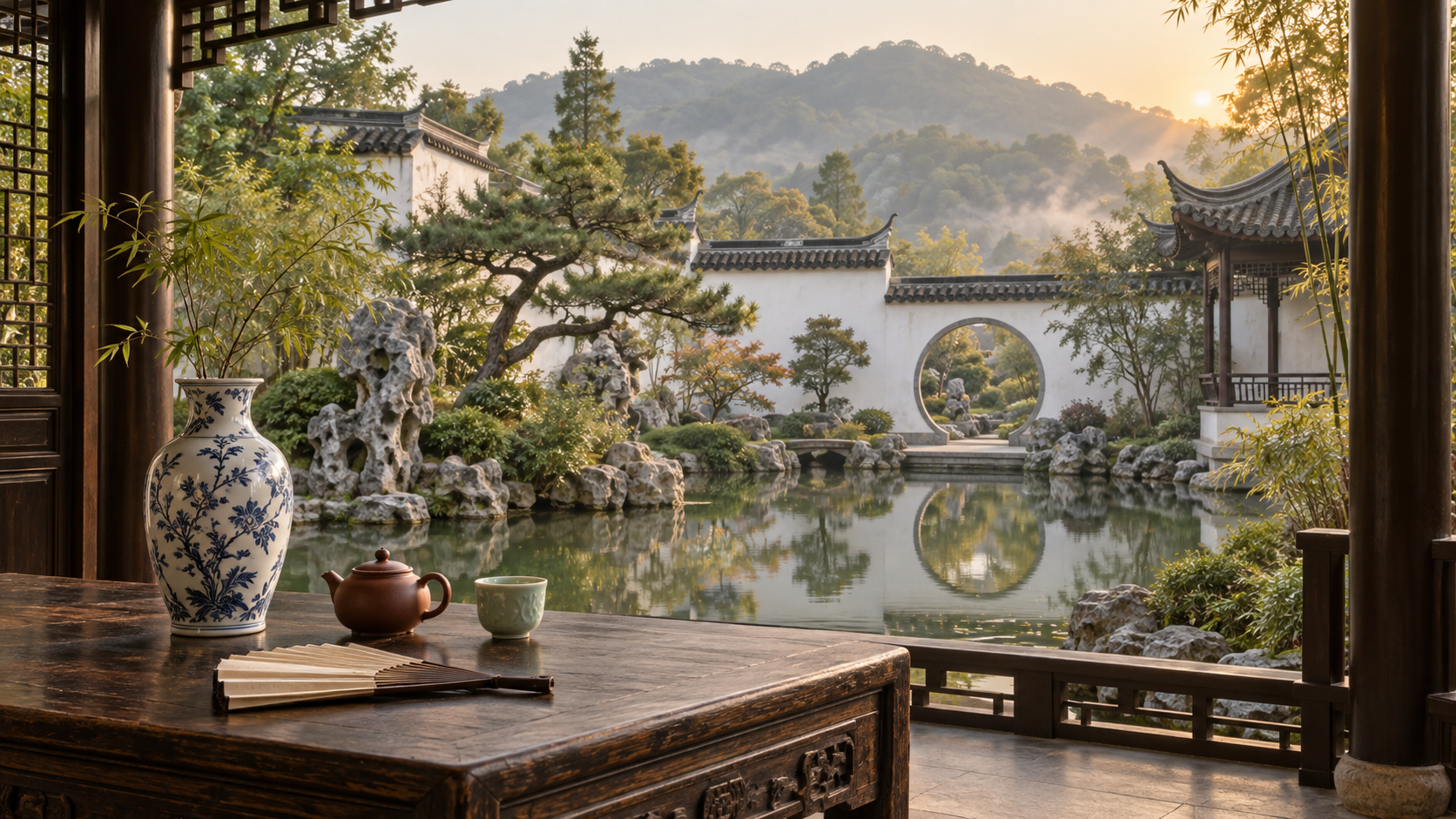
Editorial note: This guide combines cultural interpretation with selected official museum, heritage and visitor sources checked on September 5, 2026. It does not represent first-hand visits to every venue. Exhibitions, reservations, transport connections and workshop access should be reconfirmed before travel. The cover is an AI-generated editorial illustration of a scholar-garden setting, not a photograph of a specific attraction.


Leave a comment
This site is protected by hCaptcha and the hCaptcha Privacy Policy and Terms of Service apply.