


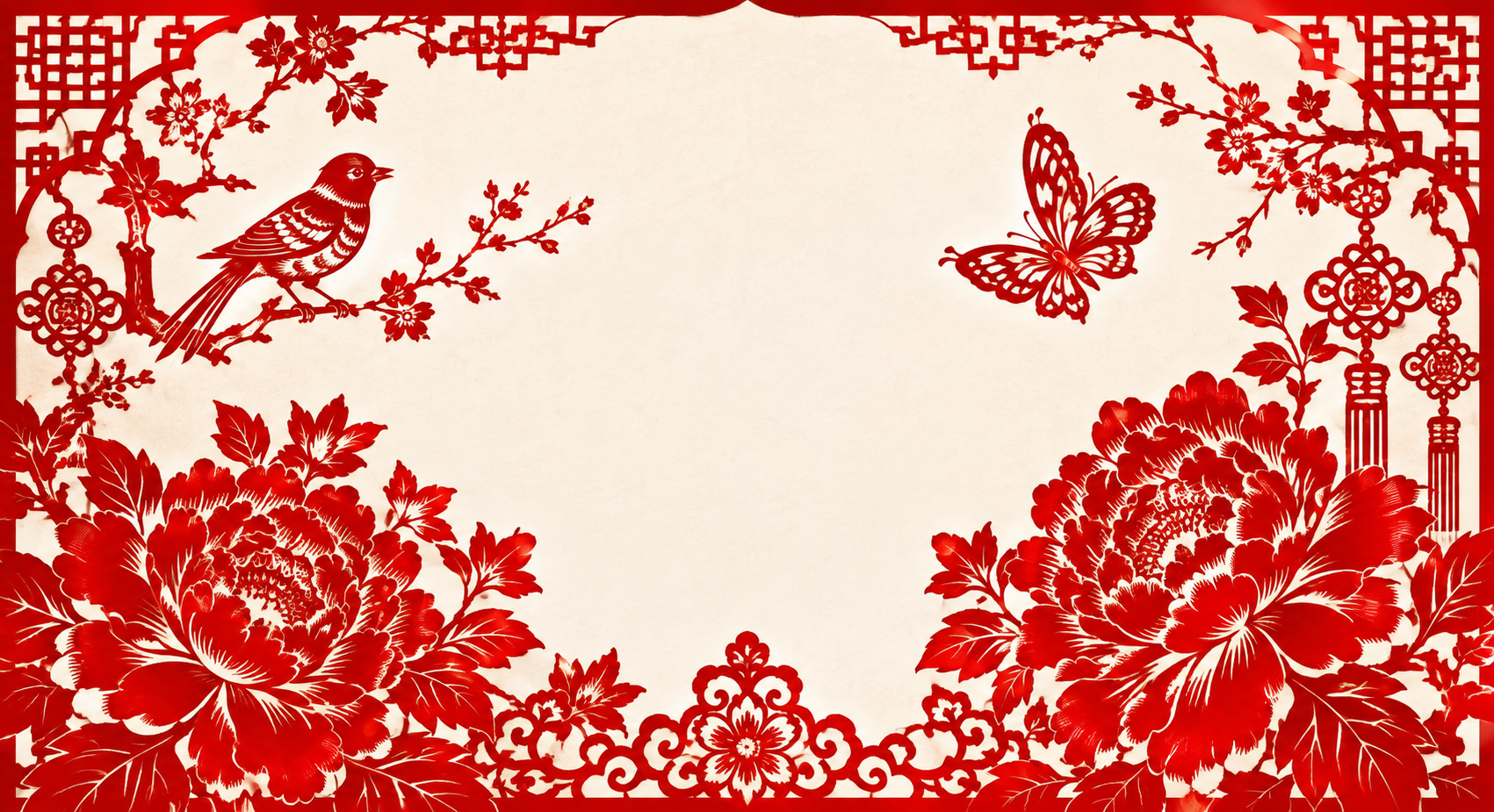
Chinese Paper Cutting: The Complete Guide to Jianzhi
A sheet of red paper rests across the artisan’s palm.
At first, it appears almost weightless: a simple plane of colour, thin enough to tremble with the movement of the air. Then the scissors begin. A crescent disappears. A narrow opening emerges. Petals unfold beside curling leaves; a fish takes shape beneath a lotus; a child appears holding a peach beneath the character for fortune.
When the paper is finally opened, what was once a flat, unmarked surface has become a world.
This is Chinese paper cutting, known in Mandarin as jiǎnzhǐ—剪纸, literally “cut paper.” It is one of China’s most recognisable folk arts and one of its most intimate. Paper cuttings have decorated windows during the Lunar New Year, blessed newly married couples, welcomed children, honoured ancestors, marked seasonal celebrations and carried private hopes from one generation to the next.
Although its principal material is humble, Chinese paper cutting is not a minor decorative craft. It is a visual language shaped by regional identities, oral traditions, religious customs, family relationships, agricultural life and the Chinese fondness for symbols, homophones and auspicious rebuses.
In 2009, Chinese paper-cut was inscribed on UNESCO’s Representative List of the Intangible Cultural Heritage of Humanity. UNESCO describes it not simply as an object-making technique but as a living cultural practice transmitted through communities and used to express moral values, philosophies, aesthetic ideals and hopes for a better life.
To understand Chinese paper cutting, therefore, is to understand far more than the act of cutting paper. It is to enter a world in which every flower, bird, animal and character may speak.
What Is Chinese Paper Cutting?
Chinese paper cutting is a traditional folk art in which artisans use scissors or knives to transform paper into decorative, symbolic or narrative designs.
The Chinese term 剪纸 is formed from two characters:
- 剪, jiǎn: to cut with scissors
- 纸, zhǐ: paper
The English spelling jianzhi is commonly used when discussing the tradition internationally.
A Chinese paper cut may be a small symmetrical window decoration, an intricate zodiac portrait, a wedding emblem, a narrative scene filled with human figures or a large framed composition requiring weeks or months of work. Some are made from a single colour—most famously red—while others are layered, painted, dyed or assembled from several sheets.
Paper cutting is considered folk art because it developed largely through community practice rather than through the formal academies that shaped court painting and scholarly calligraphy. Historically, techniques and motifs were often passed between relatives, neighbours and apprentices. Many practitioners learned by watching an older family member rather than by studying written manuals.
This domestic transmission is part of the tradition’s significance. Paper cutting was often made where life itself unfolded: beside the heated brick bed of a northern home, at a kitchen table before New Year, in a courtyard preparing for a wedding or among women exchanging embroidery patterns.
Is every Chinese paper cutting unique?
An artisan may repeat a traditional motif, but no two genuinely handmade works are precisely identical. Minute variations in pressure, rhythm, spacing and interpretation remain visible in the finished piece.
Even when several sheets are stacked and cut together, the position of each sheet, the movement of the knife and the later colouring or mounting process can introduce subtle differences. These are not defects. They are traces of the hand.
A History of Chinese Paper Cutting
The history of Chinese paper cutting begins with the history of paper itself—but the relationship is more complex than the familiar claim that one person suddenly invented paper in 105 CE.
Paper developed in ancient China during the Han dynasty. Cai Lun, an Eastern Han court official traditionally associated with its invention, is more accurately understood as an important figure in its improvement and formal documentation. Archaeological evidence indicates that forms of paper existed earlier, while Cai Lun’s contribution helped advance papermaking using plant fibres and other accessible materials.
Before paper became widely available, Chinese craftspeople were already cutting openwork patterns into thin materials such as leather, silk, leaves and metal foil. Paper made this visual practice more affordable, flexible and accessible.
The earliest surviving evidence
It is tempting to describe paper cutting as a fully formed Han-dynasty art. However, the material record requires greater care. Paper is fragile, and most early examples did not survive.
Among the earliest known excavated Chinese paper cuttings are symmetrical designs discovered in the Turpan region of present-day Xinjiang and dated to the period of the Northern and Southern Dynasties. These survivals demonstrate that sophisticated folded and cut patterns were already being produced by approximately the sixth century.
The distinction matters: paper cutting may have been practised earlier, but the earliest surviving physical evidence is later than the invention and spread of paper.
Paper cutting in the Tang dynasty
During the Tang dynasty, paper became deeply integrated into religious, artistic and ceremonial life. Surviving paper-cut flowers associated with Dunhuang illustrate how sheets could be folded, cut, painted, layered and pasted together.
The British Museum holds Tang-period paper-cut lotus and floral objects dating from approximately the ninth to tenth centuries. Some consist of five or six superimposed layers, with ink or colour added to strengthen their definition. These works demonstrate that early paper cutting could be dimensional, polychromatic and technically sophisticated rather than merely a flat silhouette.
Dunhuang was a major centre of religious and cultural exchange along the Silk Roads. Paper objects found there belong to a wider material world of manuscripts, paintings, printed texts and devotional offerings. Their survival offers a rare glimpse into the diversity of early Chinese paper arts.
Growth during the Song dynasty
During the Song dynasty, an expanding urban economy encouraged specialised trades, commercial workshops and popular decorative culture.
Paper patterns were used in relation to embroidery, ceramics, lanterns, textiles and festival decorations. Professional artisans supplied designs for everyday and ceremonial use, while domestic makers continued to create their own works.
The period also saw the growth of printing and the wider circulation of images. Printing on paper had already developed in China centuries earlier, and by the Song era, visual designs could travel more readily between regions and workshops.
Paper cutting nevertheless remained distinct from printing. A printed image reproduces ink from a prepared surface. A paper cut is created through the removal of material itself. The empty space is not incidental; it is part of the composition.
Refinement under the Ming and Qing dynasties
During the Ming and Qing dynasties, paper cutting became increasingly embedded in domestic decoration, life-cycle rituals and seasonal customs.
Cut-paper designs appeared on windows, doors, walls, lanterns and gifts. They served as patterns for embroidery and other crafts. Auspicious characters, flowers, animals, legendary figures and scenes from opera became part of a broad visual vocabulary understood across many communities.
Regional styles flourished. Some traditions favoured bold silhouettes and vigorous exaggeration. Others developed finely articulated flowers, birds and landscapes. Knife cutting, scissor cutting, colouring, layering and paper engraving were refined into recognisable local methods.
Many works remained unsigned. Their authority came not from an individual artist’s fame but from the continuity of a community’s symbolic language.
Twentieth-century change and revival
Industrialisation, urbanisation and changing domestic architecture altered the environments in which folk paper cutting had traditionally lived. Glass windows replaced some paper-covered windows. Factory-made decorations became widely available. Younger generations moved away from villages where family techniques had once been transmitted informally.
Yet the tradition did not disappear.
Artists, cultural researchers, museums, schools and local communities began documenting regional practices and identifying representative practitioners. Paper cutting entered exhibitions, cultural exchanges, contemporary illustration and formal art education.
The China Paper Cutting Museum in Yangzhou, founded in 2007, functions as a centre for collection, exhibition, research and the continued development of Yangzhou paper cutting. It also preserves the legacy of Zhang Yongshou, one of the twentieth century’s most influential Yangzhou paper-cutting masters.
UNESCO recognition in 2009
In 2009, Chinese paper-cut was added to UNESCO’s Representative List of the Intangible Cultural Heritage of Humanity.
The inscription recognises a collection of living traditions rather than a single fixed design style. The heritage resides in the knowledge, symbolism, social practices and methods transmitted by communities, as well as in the physical artworks they produce.
UNESCO recognition does not mean that every red machine-cut decoration is protected heritage. It draws attention to the human systems behind the craft: practitioners, teachers, families, rituals, regional aesthetics and cultural memory.
How Chinese Paper Cutting Is Made
Chinese paper cutting may look effortless when performed by a master. That impression is deceptive.
Every finished line depends on control of pressure, direction and sequence. An incorrect cut can sever a connecting bridge and detach an entire section. Because the work is made by removing material, errors are rarely reversible.
1. Selecting the paper
The artisan first chooses paper suited to the design and cutting method.
Important qualities include:
- Thickness
- Flexibility
- Fibre strength
- Colour consistency
- Surface texture
- Response to folding
- Ability to hold a fine cut without tearing
Thin paper allows several sheets to be stacked and cut simultaneously. Slightly heavier paper may be selected for large framed compositions or works requiring greater structural stability.
Red is the most familiar colour, but black, white, gold, blue and multicoloured papers are also used. In certain regional traditions, the design is cut first and coloured afterwards.
2. Developing the design
A design may be drawn directly onto the paper, transferred from a pattern or cut freehand.
Experienced artisans often think differently from painters. They do not merely ask what an image should depict. They must determine which areas will remain, which will be removed and how every element will stay connected.
A flower’s stem may support a bird. A cloud may connect two figures. A narrow line may preserve the structure of an entire composition.
The artisan is effectively designing both the image and the emptiness around it.
3. Folding for symmetry
Many traditional designs begin by folding paper into halves, quarters or more complex configurations.
When the folded paper is cut and opened, one action produces repeated or mirrored forms. This method is frequently used for:
- Window flowers
- Circular designs
- Snowflake-like arrangements
- Double Happiness characters
- Butterflies
- Flowers
- Paired animals
- Geometric borders
A British Museum example shows how folded squares could be cut and unfolded to create symmetrical floral designs before being layered together.
Folding saves time, but it also demands foresight. The artisan must visualise the final expanded composition while working on only a fraction of it.
4. Scissor cutting
In scissor cutting, the artist holds and turns the paper while opening and closing the scissors in a controlled rhythm.
The scissors may remain relatively stable as the paper moves around them. Long curves require fluid rotation; tiny internal shapes demand minute changes in pressure.
Scissor-cut works often possess a distinctive liveliness. Their curves may feel direct, spontaneous and closely connected to the movement of the hand.
Some masters work without a preparatory drawing. Years of repetition allow familiar flowers, animals and human figures to emerge almost instinctively.
5. Knife cutting
Knife-cut paper cutting is generally performed on a flat working surface. A fine knife allows the artisan to create tight corners, repeated details and complex internal openings.
Several sheets may be stacked so that one cutting sequence produces multiple copies. Depending on the regional practice, the stack may rest on a wax board, a specialised soft cutting surface or another material that accepts the blade without quickly dulling it.
Knife cutting is especially important in traditions requiring:
- Fine linear detail
- Dense patterning
- Repeated production
- Layered compositions
- Later hand colouring
- Complex narrative scenes
The knife is not simply a more precise substitute for scissors. It encourages a different relationship between hand, paper and surface.
6. Positive and negative cutting
Chinese paper cutting frequently uses two complementary approaches.
Positive cutting, sometimes described as yang cutting, preserves the principal lines or masses of the image while removing the surrounding space.
Negative cutting, sometimes described as yin cutting, removes lines or shapes from within a larger field of paper.
Many accomplished works combine both. Solid areas establish visual weight; fine openings produce texture, rhythm and lightness. The China Paper Cutting Museum describes Yangzhou artists combining outline-based and openwork methods to balance flowing lines with broader areas of form.
7. Layering and colouring
Not all paper cuts are monochrome.
An artisan may:
- Place differently coloured papers behind open sections
- Stack separately cut elements
- Apply pigment with a brush
- Dye areas through stencils
- Add ink details
- Combine paper cutting with painting or calligraphy
Yuxian paper cutting in Hebei is particularly known for knife-cut compositions that are subsequently coloured. Opera characters, flowers, animals and festive scenes may be rendered in vivid, contrasting hues.
Layering introduces depth, but it also creates additional conservation concerns. Adhesives, pigments and papers may age at different rates.
8. Opening, refining and mounting
Folded paper must be opened carefully to avoid tearing fine connections. Stacked sheets are separated, inspected and cleaned of loose fragments.
The finished cutting may be mounted against a contrasting backing, placed within a window, attached to another decorative object or prepared for framing.
A master does not judge the work only by the fineness of the cuts. The composition must feel alive when viewed as a whole. Dense areas need room to breathe. Empty areas must be shaped with as much care as the paper that remains.
The Tools of a Paper-Cutting Artisan
The traditional toolkit can appear surprisingly modest.
Scissors
Paper-cutting scissors should respond cleanly to small movements and retain a sharp point. Some artisans alter or sharpen their own tools to suit a personal method.
The relationship becomes intimate. The artisan learns the resistance of the hinge, the exact meeting point of the blades and the amount of pressure required for each paper.
Carving knives
Fine blades are used for internal openings, angular details and densely articulated compositions.
Different blade shapes may be selected for straight cuts, curves, corners or repeated patterns. A dull blade can drag fibres and produce rough edges.
Wax boards and cutting surfaces
Some knife-cutting lineages work over a traditional wax board made to accept the blade while supporting the paper stack.
Modern artisans may use specialised cutting mats or other resilient surfaces. The goal is to provide enough resistance for control without damaging the blade or causing the paper to shift.
Awls, needles and fine implements
Small piercing tools may help begin enclosed cuts or lift tiny sections. Tweezers can assist when separating stacked sheets or positioning delicate elements.
Paper and pigments
The paper is not merely a passive surface. Its thickness, fibre direction and elasticity shape the finished line.
When colour is added, the artisan must also understand how pigment spreads, dries and interacts with the paper. In some traditions, strong colours are used not to imitate natural appearance but to heighten theatrical expression and auspicious meaning.
Why tools cannot replace experience
Excellent tools improve control, but they do not determine composition, symbolism or emotional character.
A machine can reproduce a clean outline. It cannot independently inherit the memories associated with a wedding motif, understand why one animal should face another or recognise how a local opera figure is expected to move.
Mastery lies in judgement: knowing where to cut, where to stop and how much paper must remain.
Symbolism in Chinese Paper Cutting
Chinese paper cutting is often described as decorative, but its designs are rarely chosen for appearance alone.
Many motifs communicate through:
- Traditional stories
- Seasonal associations
- Homophones
- Visual puns
- Religious beliefs
- Wishes for prosperity, fertility or longevity
- Local legends and customs
A paper cut can therefore operate like a blessing written in images.
Meanings are not always fixed. A motif may carry different associations depending on its companion symbols, regional tradition and ceremonial context.
Dragon
The Chinese dragon is associated with vitality, transformation, auspicious power and command over water and weather. Historically connected with imperial authority, it also appears in folk art as a protective and celebratory creature.
In wedding imagery, a dragon may be paired with a phoenix to represent a harmonious union.
Phoenix
The Chinese phoenix, or fenghuang, is a composite sacred bird associated with peace, virtue, renewal and flourishing civilisation.
In marriage imagery, the dragon-and-phoenix pairing may represent complementary forces, conjugal harmony and a distinguished union.
Lotus
The lotus rises clean from muddy water and is therefore associated with purity, spiritual elevation and integrity.
Its name also participates in auspicious wordplay. Depending on the character and accompanying imagery, lotus motifs may suggest continuity, harmony, repeated success or the wish for children.
Peony
The peony is traditionally connected with material prosperity, distinction, beauty and honour. The Metropolitan Museum of Art describes the peony as a motif connoting prosperity and good fortune and, in other contexts, wealth and prestige.
In paper cutting, its layered petals also provide artisans with an ideal subject for demonstrating rhythm and precision.
Fish
Fish symbolise abundance, largely because the Chinese word for fish, yú—鱼—sounds like the word for surplus or abundance, yú—余.
The New Year expression niánnián yǒuyú, 年年有余, wishes that one may have abundance year after year. Lotus-and-fish compositions may construct this blessing through a combination of visual and spoken associations.
Butterfly
Butterflies may evoke joy, romance, transformation and long life. Their meanings often depend on their number and accompanying flowers.
Paired butterflies can suggest affection and conjugal happiness, while butterflies among blossoms frequently create an image of springtime vitality.
Crane
Cranes are among the best-known Chinese symbols of longevity. They are also associated with refinement, transcendence and the world of immortals.
Crane paper cuts are especially appropriate for birthdays, retirement gifts and wishes for a long, peaceful life.
Magpie
The magpie is associated with joy and the arrival of good news.
When shown on a plum branch, it can create the rebus xǐ shàng méishāo, 喜上眉梢—joy rising to the eyebrows, meaning visible happiness. A British Museum print identifies this meaning in a traditional magpie-and-plum composition.
Bat
In many Western contexts, bats may appear ominous. In Chinese decorative art, they are highly auspicious.
The word for bat, fú—蝠—sounds like the word for good fortune or blessing, fú—福. Five bats may represent the Five Blessings, commonly associated with longevity, wealth, health, virtue and a peaceful completion of life.
British Museum objects identify bats as symbols of long life, good fortune and happiness.
Children
Images of healthy, playful children express hopes for family continuity, fertility and domestic happiness.
A composition may show children holding lotus flowers, peaches, fish or musical instruments, each adding further layers of auspicious meaning.
Double Happiness: 囍
The Double Happiness character is created by joining two forms of 喜, meaning joy or happiness.
It is primarily associated with marriage and is commonly displayed at weddings, on invitations, in bridal rooms and on ceremonial gifts. In paper cutting, its symmetrical form can be surrounded by peonies, mandarin ducks, dragons, phoenixes or paired fish.
Fu: 福
The character 福 means good fortune, blessing or happiness.
Paper-cut versions of Fu may be constructed from flowers, zodiac animals, birds or scenes of family life. The character is frequently displayed during the Lunar New Year.
In some households, the character is placed upside down. This creates a spoken pun: “Fu is upside down” sounds like “fortune has arrived.” The practice is popular, although preferences about when and where to invert the character vary.
Zodiac animals
The twelve zodiac animals are recurring subjects because they connect individual identity with the cyclical calendar.
A zodiac paper cutting may commemorate a birth year, welcome a new Lunar New Year or serve as a personalised gift.
A Guide to Common Paper-Cutting Symbols
| Motif | Common associations | Popular occasions |
|---|---|---|
| Dragon | Vitality, authority, protection, auspicious power | New Year, weddings, housewarmings |
| Phoenix | Harmony, virtue, renewal, flourishing | Weddings, anniversaries |
| Lotus | Purity, continuity, harmony | Weddings, spiritual spaces, home décor |
| Peony | Prosperity, beauty, honour | Weddings, business openings, interiors |
| Fish | Abundance and surplus | Lunar New Year, business gifts |
| Crane | Longevity and refinement | Birthdays, retirement gifts |
| Magpie | Joy and good news | Celebrations, engagements, new homes |
| Bat | Blessings and good fortune | New Year, birthdays, housewarmings |
| Double Happiness | Marital joy and union | Weddings and anniversaries |
| Fu | Fortune and blessing | New Year, housewarmings |
| Children | Fertility and family continuity | Births, weddings, family celebrations |
| Zodiac animal | Identity, character and calendar year | Birthdays and Lunar New Year |
These meanings should be read as cultural associations rather than rigid translations. Chinese decorative art is combinatory: the relationship between motifs often matters more than any one symbol viewed alone.
Regional Styles of Chinese Paper Cutting
There is no single visual style that can represent all Chinese paper cutting.
China’s regional traditions developed in different climates, economies, religious environments and local cultures. Materials, architecture, opera, embroidery and agricultural life all influenced what artisans made.
A broad distinction is sometimes drawn between the bold, expressive character of northern paper cutting and the fine, elegant character of southern paper cutting. The China Paper Cutting Museum uses this comparison when presenting Yangzhou as an important southern tradition.
The distinction is helpful, but it should not become a rule. Northern artists can produce extraordinary delicacy, and southern traditions can be vigorous and monumental.
Shaanxi
Shaanxi paper cutting is frequently associated with the loess plateau and the visual culture of northern rural life.
Works may feature:
- Farmers and animals
- Fertility figures
- Protective creatures
- Folk deities
- Zodiac animals
- Grain, flowers and domestic scenes
- Local storytelling traditions
The forms are often bold and emotionally direct. Exaggerated hands, eyes, bodies or animals give the work expressive force rather than anatomical realism.
Ansai paper cutting, associated with Yan’an in northern Shaanxi, is particularly admired for its confident silhouettes and imaginative treatment of daily life. Contemporary practitioners continue to use red paper cuttings for New Year, weddings, births, housewarmings and business openings.
Shanxi
Shanxi has numerous local paper-cutting traditions rather than a single uniform school.
Motifs may be drawn from opera, legends, agricultural customs, religious practices and rites of passage. Some works are strong and graphic; others contain remarkably dense internal detail.
The province’s long-established communities of paper cutters demonstrate how regional history and local folk culture shape both subject matter and style.
Hebei and Yuxian
Yuxian County in Hebei is famous for a distinctive method combining knife cutting with hand-applied colour.
Rather than relying exclusively on the silhouette of red paper, Yuxian artisans cut detailed designs and add vivid pigments. Opera characters, masks, flowers, birds and festive scenes are common.
The tradition is closely connected with window decoration, local opera and seasonal celebration. Yuxian work is especially recognisable for its theatrical colour and carefully preserved areas of paper that receive later dyeing.
Jiangsu and Yangzhou
Yangzhou paper cutting is one of the most celebrated southern traditions.
It is known for:
- Fine, flowing lines
- Elegant flowers and birds
- Carefully organised compositions
- Delicate landscapes
- Controlled relationships between solid and open space
The apparent refinement should not be mistaken for fragility of conception. Yangzhou masters can build complex scenes through hair-thin lines and broad planes, balancing precision with movement.
The city’s museum collection preserves both historic regional work and the achievements of modern masters.
Fujian
Paper cutting in Fujian includes traditions associated with places such as Zhangpu and Zherong.
Designs may be connected with ritual life, seasonal celebration, embroidery, ancestral custom and local religious practice. Coastal exchange and the province’s distinctive folk cultures contributed to a varied decorative vocabulary.
Fujian traditions are among the communities represented within China’s broader paper-cutting heritage.
Guangdong
Guangdong paper cutting includes several local approaches shaped by the region’s dense urban craft culture and ceremonial traditions.
Some works combine cutting with colour, lining, metallic paper, engraving-like detail or other decorative techniques. Motifs may relate to flowers, birds, opera, festivals and blessings for commercial success.
Contemporary Guangdong artisans also experiment with large-scale installations and dimensional compositions while retaining the visual grammar of traditional openwork.
Ethnic minority traditions
Paper cutting is not limited to Han Chinese communities.
Among some ethnic groups, paper-cut patterns are closely connected with textile design, ritual clothing, legends and ancestral narratives. Miao paper-cutting traditions, for example, may serve as templates for embroidery while preserving stories communicated through animals, deities and abstract patterns.
The Museum of Ethnic Cultures at Minzu University of China documents Miao practitioners who learn family traditions from childhood and translate oral narratives into cut-paper designs.
Chinese Paper Cutting in Festivals and Family Life
Paper cutting traditionally belongs to moments when ordinary space becomes ceremonial space.
A window is not simply covered; it is prepared to receive a new year. A bridal room is not merely decorated; it is filled with wishes for harmony and continuity.
Lunar New Year
The Lunar New Year is the occasion most strongly associated with red Chinese paper cutting.
Decorations may include:
- The year’s zodiac animal
- Fu characters
- Fish and lotus
- Peonies
- Children holding treasures
- Spring flowers
- Scenes of reunion
- Agricultural abundance
- Protective animals
Placed on windows, these works are often called chuānghuā, 窗花, meaning “window flowers.”
Light passing through the openwork brings the composition to life. From inside, the red paper glows; from outside, it announces that the household is prepared for celebration.
Weddings
Wedding paper cuttings usually emphasise pairing, union and fertility.
Common images include:
- Double Happiness
- Dragon and phoenix
- Paired mandarin ducks
- Two fish
- Lotus and children
- Peonies
- Pomegranates
- Intertwined flowers
The design may appear on doors, windows, mirrors, gift boxes or the wall behind the bridal bed.
Lantern Festival
Paper-cut elements may be applied to lanterns or used alongside lantern displays.
The openwork is particularly effective when illuminated. Light converts cut edges into glowing lines and makes negative space an active part of the image.
Birth celebrations
For the birth of a child, motifs may express protection, good health, intelligence and family continuity.
Zodiac animals create a personal connection to the child’s birth year. Tigers may appear on children’s objects and decorations as protective symbols.
Housewarmings
Housewarming paper cuts often feature Fu, fish, peonies, magpies or images suggesting a flourishing household.
A carefully chosen work can communicate the wish that the new home will gather happiness rather than simply occupy space.
Ancestor worship and ritual practice
Historically, cut paper has also served ritual and devotional functions. Depending on the community, paper forms may be offered, burned, displayed or incorporated into ceremonial objects.
Such uses should not be treated as interchangeable decorative customs. Ritual practices vary considerably by region, religion and family tradition.
Why is Chinese paper cutting usually red?
Red is associated in Chinese culture with happiness, vitality, celebration and auspiciousness. It is therefore appropriate for weddings, New Year festivities, births and other joyful transitions.
Red paper also creates powerful visual contrast against pale windows, white walls and neutral mounting papers.
However, authentic Chinese paper cutting is not always red. White paper may appear in contexts of mourning or ritual. Black paper can create strong graphic compositions. Multicoloured papers are central to several regional practices.
Colour must be interpreted in context.
Chinese Zodiac Paper Cuttings
The Chinese zodiac is a repeating twelve-year cycle represented by twelve animals.
Paper cutting is particularly suited to zodiac imagery because each animal can be surrounded by symbols reflecting its traditional qualities, the season or the recipient’s personal wishes.
| Zodiac animal | Common positive associations |
| Rat | Ingenuity, alertness, adaptability |
| Ox | Diligence, steadiness, reliability |
| Tiger | Courage, strength, protection |
| Rabbit | Gentleness, sensitivity, longevity |
| Dragon | Vitality, ambition, auspicious power |
| Snake | Intelligence, intuition, renewal |
| Horse | Energy, movement, success |
| Goat | Harmony, kindness, artistic sensitivity |
| Monkey | Cleverness, curiosity, resourcefulness |
| Rooster | Confidence, vigilance, punctuality |
| Dog | Loyalty, sincerity, protection |
| Pig | Generosity, contentment, abundance |
These associations are interpretive traditions, not predictions of personality.
Why zodiac paper cuts make meaningful gifts
A zodiac work can recognise:
- A birth year
- A child’s arrival
- A milestone birthday
- A Lunar New Year
- A family connection
- An interest in Chinese culture
A composition made from all twelve animals may express completion, continuity and the passage of time. Some artists arrange the animals around the character Fu, transforming the blessing itself into a miniature visual archive of the zodiac.
Collecting a complete zodiac series
Collectors may acquire one animal each year or display all twelve as a set.
A complete series is most coherent when the works share:
- The same artisan or regional tradition
- Consistent dimensions
- Related mounting materials
- A unified level of detail
- Comparable colour and paper quality
The series can be installed in a grid, a horizontal sequence or a circular calendar-like arrangement.
Chinese Paper Cutting as Home Décor
Traditional paper cuttings were not designed for museums. They lived in rooms.
That domestic origin makes them remarkably adaptable to contemporary interiors. Their silhouettes are visually strong, while their material presence is quiet and lightweight.
Living rooms
A large narrative paper cutting can function as a focal artwork above a console, sideboard or seating area.
Choose a design with sufficient scale to be read from a distance. Dragons, phoenixes, floral medallions, zodiac compositions and scenes of communal celebration work particularly well.
Entryways
The entryway is symbolically suited to images of fortune, welcome and protection.
Fu characters, magpies, peonies and fish can create a meaningful first impression without feeling overtly ceremonial when mounted with restraint.
Tea rooms
Lotus, bamboo, flowers, birds and scenes of scholars complement the contemplative character of a tea room.
A monochrome work against a warm neutral background can create visual depth without competing with teaware or natural materials.
Studies and libraries
Narrative paper cuts, landscapes and works incorporating calligraphic characters suit studies and reading rooms.
Their combination of image and emptiness echoes the relationship between ink and unpainted paper found in Chinese calligraphy.
Dining rooms and restaurants
Fish, grain, pomegranates, flowers and scenes of harvest or reunion connect naturally with dining spaces.
For hospitality interiors, provenance and regional relevance can create a richer story than generic “Asian-inspired” decoration.
Boutique hotels
Paper cutting can help a hotel express place, season or local cultural identity.
A series may be commissioned around:
- Regional architecture
- Native plants
- Local legends
- Tea culture
- Festival customs
- The property’s surrounding landscape
Such work should be commissioned in genuine collaboration with artisans rather than copied as surface ornament.
Contemporary minimalist interiors
The delicacy of paper cutting works beautifully against stone, limewash, natural wood and plain textiles.
A black, white or deep-red work in a spacious frame can feel strikingly contemporary. The key is to preserve generous breathing room around the design.
Framing styles
Three approaches are especially effective:
Traditional contrast mounting: Red paper against white or cream backing.
Floating presentation: The paper cut appears suspended within a deeper frame, allowing its physical edges to be seen.
Layered shadow framing: A slight distance between the cut paper and backing creates shadows that emphasise depth.
Any mounting method should be structurally safe and reversible. Highly delicate work should be installed by a framer experienced with art on paper.
Why Handmade Paper Cutting Is Valuable
The value of handmade Chinese paper cutting does not come from expensive raw material.
It comes from concentrated human knowledge.
Time
A small folded decoration may be completed quickly by an experienced practitioner. A large narrative work with hundreds of figures and internal openings may require weeks or months.
The relevant question is not simply, “How many hours did this take?” It is also, “How many years were required to make those hours possible?”
Precision
Every remaining bridge of paper must support the surrounding design.
An artisan may create lines only a few millimetres wide while maintaining continuity across a composition. The slightest uncontrolled movement can sever an important element.
Cultural knowledge
The artisan must understand more than technique.
A traditional wedding composition requires knowledge of pairing and auspicious symbolism. A zodiac scene may combine the animal with plants, characters or objects appropriate to the recipient. A regional opera figure must be recognised through costume and posture.
Individual interpretation
Traditional motifs do not prevent originality. They provide a language through which originality becomes legible.
Two artisans may cut the same peony. One may emphasise abundance through rounded petals; another may create refinement through thin, flowing contours.
Provenance
Information about the maker, region, date, subject and method contributes to cultural and collectable value.
An unsigned folk work can still be authentic, but documented authorship and provenance help future owners understand what they are preserving.
Emotional connection
Paper cutting has long accompanied weddings, births, reunions and New Year celebrations.
To own a handmade paper cut is often to own an image designed not merely to be looked at, but to carry a wish.
Handmade Paper Cutting vs. Machine-Cut Decoration
| Characteristic | Handmade paper cutting | Machine-cut decoration |
| Edges | May show minute changes in pressure and direction | Usually extremely uniform |
| Repetition | Similar works contain subtle variations | Copies can be identical |
| Design logic | Informed by the artisan’s method and symbolic knowledge | May reproduce a digital file without cultural understanding |
| Production | Scissors, knife or hand-guided processes | Laser, die cutting or automated blade |
| Provenance | Can be connected to an artisan, region and tradition | Often anonymous or industrial |
| Customisation | Can incorporate personal symbols and wishes | Usually limited to editable templates |
| Cultural value | Embodies transmitted skill and human interpretation | Primarily decorative unless artist-designed |
| Price | Reflects labour, skill, rarity and documentation | Often reflects scale and manufacturing cost |
Machine cutting is not inherently poor. It can produce attractive decorative objects and make festive imagery widely accessible.
The problem arises when industrial work is presented as a handmade heritage object.
How to Identify Authentic Chinese Paper Cutting
Authenticity should be assessed through a combination of physical examination, documentation and seller transparency.
Examine the cut edges
Hand-cut edges may show subtle changes in angle or pressure. Curves may possess minute variations rather than mathematical uniformity.
Do not confuse poor workmanship with handwork. A skilled handmade piece can be extraordinarily clean.
Look for structural intelligence
A genuine paper-cutting design must remain physically connected unless it is intentionally assembled from separate layers.
Observe how leaves, clouds, clothing and borders function as bridges. Skilled artisans often make these structural necessities appear natural within the image.
Compare repeated elements
In a machine-cut work, repeated petals or border units may be perfectly identical.
In handmade work, closely related elements often retain small differences in width, curvature or spacing.
Inspect both sides when possible
The reverse may reveal:
- Differences in pigment penetration
- Mounting methods
- Traces of drawing
- Layered construction
- Variations created by stacked cutting
Do not remove a work from professional framing merely to examine it.
Ask about the technique
A knowledgeable curator or seller should be able to explain whether the work was:
- Scissor cut
- Knife cut
- Folded
- Layered
- Hand coloured
- Cut in a stack
- Created freehand or from a drawing
Vague claims such as “traditional handmade art” are less useful than specific information.
Ask about the artisan
Useful provenance may include:
- Artisan’s name
- Place of practice
- Training or lineage
- Years of experience
- Regional style
- Meaning of the design
- Approximate creation date
- Whether the design is original or traditional
Not every authentic work will be signed. Historically, many folk paper cuts were anonymous or community-made.
Consider the paper
Paper quality should suit the level and intended use of the work.
Extremely thin paper is not necessarily cheap; it may be chosen for precise stacked cutting. Heavier paper is not automatically superior. Evaluate whether the material supports the composition and has been handled carefully.
Be cautious with artificial ageing
Discolouration does not prove age.
Tea staining, smoke exposure and tinted backing paper can create an appearance of antiquity. Serious antique purchases should be supported by provenance and, when appropriate, specialist advice.
Buy the story you can verify
The most trustworthy purchase is not always the most elaborate. It is the work whose maker, method, symbolism and origin can be explained clearly.
Caring for Chinese Paper Cuttings
Paper is sensitive to light, moisture, pollutants, acidic materials and careless handling.
Museum-level preservation may require specialised environmental controls, but collectors can greatly extend the life of a paper cutting through thoughtful display and storage.
Use archival framing materials
Ask for:
- Acid-free or conservation-grade mat board
- Chemically stable backing
- Reversible mounting methods
- Appropriate spacers
- UV-filtering glazing
Preservation framing is designed to reduce risks from light, moisture, pollutants, dust and unstable surrounding materials. The Library of Congress recommends that all materials within a preservation frame package be chemically stable.
Keep the paper away from the glazing
The artwork should not be pressed directly against glass or acrylic.
Spacers or a mat create separation, reducing the risk of adhesion, condensation damage and abrasion.
Avoid pressure-sensitive tape
Ordinary household tape can stain paper and become difficult to remove.
Delicate or valuable work should be attached using reversible conservation methods by a qualified paper conservator or specialist framer.
Limit light exposure
Do not hang paper cutting in direct sunlight.
UV-filtering glazing is useful, but it does not make unlimited exposure safe. All light—not only ultraviolet light—can damage paper and pigments over time. Museums therefore rotate light-sensitive works and limit their display periods.
For valuable works, consider seasonal rotation rather than permanent display.
Maintain stable humidity
Paper expands and contracts as it absorbs and releases moisture.
High humidity encourages mould and pest activity. Very low humidity can contribute to brittleness. Rapid fluctuations can cause distortion.
For domestic collections, a stable, moderate environment is generally more important than pursuing a perfect number. Smithsonian guidance for paper-based archival collections recommends approximately 30–50% relative humidity, with avoidance of extremes and rapid changes.
Avoid kitchens, bathrooms and exterior damp walls
Steam, grease, smoke and temperature fluctuations create unnecessary risk.
Do not hang an important paper cutting directly above a kettle, fireplace, radiator or air-conditioning outlet.
Clean the frame, not the artwork
Dust the exterior of the frame with a soft cloth.
Never wipe, brush, vacuum or apply cleaning products directly to a fragile paper cut. Loose sections can catch instantly.
If debris or insects appear inside the frame, consult a conservator.
Store unframed works flat
Use an acid-free folder or archival box. Place a chemically stable interleaving sheet between works when appropriate.
Do not fold a paper cutting along lines that were not part of its original construction.
Avoid attics, garages and basements, where temperature and humidity changes are often severe.
Chinese Paper Cutting in the Modern World
Chinese paper cutting now exists simultaneously as folk custom, collectable craft, contemporary art and international visual language.
Museums and cultural preservation
Museums collect historic works, document practitioners and provide spaces for demonstrations and teaching.
Institutions such as the China Paper Cutting Museum preserve regional traditions while presenting paper cutting as a field worthy of research and curatorial attention.
Contemporary art
Modern artists have expanded paper cutting beyond conventional window decorations.
Some create monumental installations, sculptural environments, political narratives or works combining cut paper with drawing, photography and digital media.
The technique remains traditional; the subject does not have to be.
Illustration and publishing
Paper-cut aesthetics are increasingly used in picture books, editorial illustration and animation.
Artist Yu Rong, for example, has combined paper-cutting traditions inspired by Shaanxi with pencil drawing to retell the story of Hua Mulan for international readers.
Interior and hospitality design
Designers are rediscovering paper cutting as a way to introduce cultural specificity without relying on heavy ornament.
Patterns can inform screens, lighting, textiles, architectural panels and wall installations. Ethical adaptation requires acknowledgement of the source tradition and meaningful collaboration with artisans.
Cultural diplomacy and international exhibitions
Because paper cutting can communicate without extensive written explanation, it is frequently used in workshops, exhibitions and cultural exchanges.
Contemporary delegations of artisans continue to present regional Chinese paper cutting internationally, demonstrating both traditional methods and modern subjects.
Digital technology
Digital archives enable museums and researchers to preserve images of works that remain physically vulnerable.
Laser cutters and design software also create new possibilities, but they raise questions about authorship and classification. A digitally designed, machine-cut artwork may be artistically significant, yet it should not automatically be described as traditional handmade jianzhi.
The future of the tradition depends not on rejecting technology, but on maintaining clarity about process and preserving the human knowledge that technology cannot replace.
Frequently Asked Questions About Chinese Paper Cutting
What is Chinese paper cutting?
Chinese paper cutting, or jianzhi, is a traditional folk art in which paper is cut with scissors or knives to create decorative, narrative and symbolic designs.
Is Chinese paper cutting handmade?
Traditional Chinese paper cutting is handmade. Artisans may use scissors, fine knives, folding, stacked cutting, layering and hand colouring.
Some contemporary decorations are produced by lasers or industrial cutting machines. These may imitate the appearance of jianzhi but should not be represented as handmade works.
Why is Chinese paper cutting usually red?
Red symbolises happiness, vitality and auspiciousness in Chinese culture. It is particularly suitable for Lunar New Year, weddings, births and housewarming celebrations.
Chinese paper cutting can also be white, black, gold, blue or multicoloured.
How old is Chinese paper cutting?
Paper developed in China during the Han dynasty, and cutting techniques may have emerged as paper became more accessible.
The earliest surviving paper cuttings are generally associated with the Northern and Southern Dynasties, while layered paper-cut flowers from the Tang period survive in museum collections.
How is Chinese paper cutting made?
The artisan selects suitable paper, develops or transfers a design and cuts away areas using scissors or a fine knife.
The paper may first be folded to create symmetry. Some works are layered, dyed, painted or mounted over a contrasting background.
How long does a paper cutting take?
A simple folded decoration may take minutes or hours. A large narrative composition can require weeks or months.
The completion time depends on scale, number of figures, density of detail, paper thickness, colouring and the artisan’s method.
What does Chinese paper cutting symbolise?
The meaning depends on the design.
Fish may represent abundance, peonies prosperity, cranes longevity, magpies joyful news, bats good fortune and Double Happiness marital union. Zodiac animals connect a work with the traditional twelve-year calendar cycle.
What does Double Happiness mean?
Double Happiness, written 囍, joins two forms of the character 喜, meaning happiness or joy.
It is primarily a wedding symbol representing shared happiness and harmonious union.
Is every handmade paper cut unique?
Yes. Even when an artisan repeats a traditional design, small differences in cutting, spacing, colouring and mounting make each handmade work distinctive.
Several sheets may be cut in a stack, producing closely related pieces, but later handling and finishing can still create variations.
Can Chinese paper cutting be framed?
Yes. Framing is one of the best ways to display and protect it.
Use acid-free materials, reversible mounting, spacers and UV-filtering glazing. Keep the work away from direct sunlight and unstable humidity.
Is Chinese paper cutting a good gift?
It can be a highly meaningful gift when the motif matches the occasion.
Double Happiness suits weddings; cranes are appropriate for longevity wishes; fish express abundance; peonies suggest prosperity; and zodiac animals can mark birthdays or Lunar New Year.
What makes authentic paper cutting valuable?
Important factors include craftsmanship, complexity, condition, time investment, artisan reputation, regional importance, provenance and cultural significance.
The value is not determined by paper cost alone.
Why did UNESCO recognise Chinese paper cutting?
UNESCO recognised Chinese paper-cut in 2009 because it is a living heritage practice transmitted through communities and connected with social customs, cultural values, artistic expression and collective identity.
Where can I buy authentic Chinese paper cutting?
Look for a curator or specialist who can identify the artisan, region, technique, symbolism and materials of the work.
Oriental Artisan curates handcrafted Chinese paper cuttings selected for their cultural meaning, workmanship and decorative presence. Rather than treating the tradition as anonymous ornament, the collection seeks to connect each piece with the human knowledge and heritage behind it.
Choosing a Chinese Paper Cutting for Yourself or as a Gift
Begin with meaning rather than size.
For a wedding, consider Double Happiness, paired birds, dragon-and-phoenix imagery or peonies.
For a new home, Fu, fish, magpies and flourishing flowers express welcome and abundance.
For a birthday, a zodiac animal creates a personal connection. Cranes, peaches and pine are especially appropriate for longevity.
For an interior, consider how the design will behave at a distance. Dense narrative pieces reward close viewing, while strong symmetrical compositions create greater architectural presence.
Ask four questions before acquiring a work:
- Who made it?
- How was it made?
- What does the design mean?
- How should it be preserved?
A thoughtful curator should be able to answer all four.
A Living Inheritance Cut from Paper
A paper cutting is built from absence.
The artisan does not add paint until an image appears. She removes fragments until the image has nowhere left to hide.
The resulting work may weigh almost nothing, yet it can hold the memory of a wedding, the hope surrounding a newborn child, the identity of a village or the accumulated knowledge of several generations.
This is why Chinese paper cutting has endured.
Its materials are modest. Its language is vast.
Within a single sheet of paper, a fish can promise abundance. A magpie can deliver joyful news. A lotus can rise beyond hardship. Two characters can join as one and bless a marriage. Twelve animals can turn around the circle of time.
At Oriental Artisan, Chinese paper cutting is approached as living cultural heritage rather than temporary festive decoration. Each work is considered for its craftsmanship, symbolism, regional character and ability to carry a traditional visual language into a contemporary home.
To live with such a piece is not merely to display an intricate object. It is to preserve a blessing shaped by human hands—and to allow an ancient art to continue speaking.


Leave a comment
This site is protected by hCaptcha and the hCaptcha Privacy Policy and Terms of Service apply.