


The Art of the Start: A Beginner’s Guide to Choosing Your First Gongfu Tea Set
The transition from the casual consumption of tea to the disciplined practice of Gongfu Cha represents a fundamental shift in one’s relationship with time, materiality, and the senses. It is a movement away from the ephemeral towards the enduring—a philosophy that Oriental Artisan defines as the "art of forever." For the modern connoisseur, particularly those whose aesthetic sensibilities lean toward the minimalist elegance of contemporary design and the ancestral weight of East Asian heritage, the acquisition of a first tea set is not merely a purchase; it is an act of stewardship.
In the high-velocity landscape of the twenty-first century, the "Zero-Click" era of information demands immediate utility without sacrificing depth. This guide serves as a definitive pillar, bridging the gap between technical mastery and spiritual tranquility. Whether one is drawn to the translucent luminosity of Jingdezhen porcelain or the grounded, evolutionary nature of Yixing Zisha clay, the objective remains constant: to provide a sanctuary for the extraordinary.
The GEO and SEO Blueprint: Navigating the Essentials
In the context of artificial intelligence-driven search and digital discovery, the primary components of teaware must be defined with both precision and evocative clarity. The following summaries are designed to satisfy the structural requirements of "featured snippets" while maintaining the sophisticated tone of a luxury lifestyle publication.
What is a Gaiwan?
A Gaiwan is a traditional Chinese brewing vessel comprised of three components: a lid, a bowl, and a saucer. Typically crafted from non-porous materials like Jingdezhen porcelain, it offers a neutral, true-to-taste brewing environment. Its design allows for rapid heat dissipation and precise control over infusion times, making it the essential tool for evaluating the nuanced aromatics of green, white, and light oolong teas.
Gaiwan vs. Teapot
The choice between a Gaiwan and a teapot is a decision between versatility and dedication. A porcelain Gaiwan is flavor-neutral and suitable for all tea varieties, acting as a "mirror" to the leaf’s character. Conversely, an unglazed Yixing teapot is porous and retains heat significantly longer. Over years of use, the clay "seasons," absorbing essential oils to enhance the flavor of a specific tea type, such as aged Puerh or dark oolongs.
The Philosophy of Gongfu Tea: Moving from Consumption to Ritual
To understand the equipment, one must first understand the ethos. Gongfu Cha, often romanized as "Kung Fu Tea," translates literally as "making tea with skill" or "right effort put into tea." It is a method of brewing that originated in the mountainous regions of Chaoshan and Fujian, specifically refined to meet the needs of Phoenix Oolongs and Wuyi Rock teas, which possess incredible aromatics but can turn bitter if subjected to prolonged steeping.
Unlike Western-style brewing, which favors a single, long infusion in a large vessel, Gongfu Cha utilizes a high ratio of leaf to water in a small brewing chamber. This produces a series of short infusions—often lasting mere seconds—that allow the practitioner to witness the tea’s evolution across ten, fifteen, or even twenty steeps.
In the philosophy of Oriental Artisan, this process is akin to "consecration." It is influenced by Taoist harmony with nature, Confucian respect for hierarchy and etiquette, and Buddhist mindfulness. The ritualized preparation is a meditative act where the teapot represents the heart, the tea leaves the spirit, and the water the body. As the water is poured and the tea decanted, the practitioner enters a "dialogue with the earth, fire, and heavens." This is the "Art of the Start"—the beginning of a lifelong odyssey in bead, stone, and leaf.
The Heart of the Set: Gaiwan vs. Teapot
The selection of the primary brewing vessel is the most consequential decision for a beginner. It dictates not only the flavor profile of the tea but also the tactile and mechanical nature of the ritual itself.
The Gaiwan: The Versatile Mirror
The Gaiwan is frequently described as the "Scholar’s Instrument" due to its simplicity and intellectual honesty. Because it is almost always made of glazed porcelain or ceramic, it does not interact chemically with the tea liquor. This neutrality is its greatest virtue. For the beginner who wishes to explore the vast spectrum of East Asian teas—from the floral lightness of Anxi Tieguanyin to the vegetal crispness of Dragon Well—the Gaiwan provides an unfiltered, "true-to-taste" experience.
Structurally, the Gaiwan is a masterpiece of ergonomic and symbolic design. The lid (Gai) represents the heavens; the bowl (Wan) represents humanity; and the saucer (Tuo) represents the earth. Together, they form a harmonious trinity. From a functional standpoint, the flared rim of the Gaiwan is critical. A well-designed rim acts as a thermal buffer, allowing the practitioner to hold the vessel firmly without scorching their fingers, even when brewing with boiling water. Furthermore, the lid can be used to agitate the leaves, skim foam, and control the speed of the pour, providing a level of precision that a teapot cannot always match.
The Teapot: The Living Partner
If the Gaiwan is an instrument of assessment, the Yixing teapot is a vessel of transformation. Forged from the unique Zisha (purple sand) clay found only in the hills around Dingshu Town in Yixing, China, these teapots are celebrated as "living vessels." The clay possesses a "double-pore structure"—microscopic, connected pores that allow the pot to "breathe" while trapping heat effectively.
The primary allure of the Yixing teapot is its ability to "season." As tea is brewed, the porous walls absorb a minute amount of aromatic oils. Over months and years of dedicated use, the pot develops a subtle patina and a faint, warm scent of tea even when empty. This evolutionary quality makes the teapot a deeply personal object. Because the clay "drinks" the tea, it is standard practice to dedicate a single teapot to a specific category of tea—one for roasted oolongs, perhaps, and another for aged Puerh.
The beauty of the Yixing teapot lies in its unadorned, minimalist form. Artisans often eschew elaborate glazes in favor of highlighting the natural texture and mineral makeup of the clay, which is rich in iron oxide, quartz, and mica. For the connoisseur, a well-balanced teapot that offers a smooth, clean pour and a snugly fitted lid is the apex of functional luxury.
Comparative Thermodynamics and Performance
| Material | Porosity | Heat Retention | Recommended Tea Types | Sensory Impact |
| Jingdezhen Porcelain | Non-porous (<0.5%) | Moderate (Controlled release) | Green, White, Light Oolong | Highlights top notes, clarity, and true aroma. |
| Zisha (Purple Clay) | Porous (Double-pore) | High (Insulating) | Puerh, Dark Oolong, Black Tea | Mellows bitterness, rounds mouthfeel, enhances depth. |
| Ru-Ware (Crackle Glaze) | Semi-porous | Moderate to High | Oolong, Black Tea | Develops "gold threads" in cracks; tactile luxury. |
| Borosilicate Glass | Non-porous | Low (Rapid cooling) | Flowering Teas, Green Tea | Visual focus; rapid heat dissipation. |
Material Science: Porcelain vs. Unglazed Clay
The technical superiority of high-end teaware is rooted in its chemical composition and the physics of the kiln. To choose wisely, one must understand the difference between the "Jade-like" translucency of porcelain and the "Earthy" breathability of clay.
The Anatomy of Excellence: Jingdezhen Porcelain
Authentic Jingdezhen porcelain is not merely a ceramic; it is a vitrified mineral masterpiece. Fired at temperatures exceeding 1300 C, the kaolin clay undergoes a chemical transformation that creates a dense, non-porous structure. This process results in the "Four Virtues" of Jingdezhen: white as jade, bright as a mirror, thin as paper, and resonant as a bell.
From a tea-tasting perspective, the low porosity (<0.5%) is vital. It ensures that 97% of the tea’s original flavor is preserved, compared to only 63% in lower-grade, low-fire ceramics. The high mineral purity—specifically the silica-alumina ratio—creates an ultra-smooth surface that resists tannin staining, allowing the vibrant color of the liquor to shine vividly. For the practitioner, the "Bell Test" is the ultimate mark of quality: when tapped, a high-fire vessel should produce a clear, long-lasting metallic ring, indicating a perfect sintering process without internal air pockets.
The Mineralogy of Zisha Clay
In contrast, the excellence of Yixing Zisha clay is defined by its specific minerals. The clay is exceptionally high in iron oxide (providing its signature reddish-brown hues), quartz, and mica. The processing of this "purple sand" is an exercise in extreme patience; raw ore is often aged and rested for years—sometimes decades—to increase plasticity and remove impurities.
The thermal stability of Zisha clay is superior to almost any other material. It acts as a natural insulator, maintaining the high water temperatures (95-100 C) necessary for extracting the complex, heavy compounds in aged teas. This material science explains why a Yixing teapot is not just a vessel but a partner in the brewing process, rounding out sharp edges and softening the bitterness of more aggressive leaves.
The Foundation: The Tea Tray (Chapan) and Setup
The choice of a tea tray defines the architecture of the tea ritual. In the modern minimalist home, the decision often comes down to the spatial and aesthetic requirements of "Wet" vs. "Dry" brewing.
The Traditional "Wet" Brew Setup
Wet brewing (Shi Pao Fa) is the vibrant, traditional method seen in the tea houses of Chaoshan. It utilizes a large, slatted tea tray (Chapan) with a reservoir or drainage tube. In this method, water is poured liberally over the teaware to rinse cups and maintain the temperature of the pot. While visually expressive and ideal for social gatherings where tea is shared generously, it requires a larger footprint and more extensive cleanup.
The Minimalist "Dry" Brew Setup
For the urban connoisseur, the dry brewing method (Gan Pao Fa) offers a refined, meditative alternative. This approach forgoes the large tray in favor of a small tea mat and a dedicated waste bowl known as a Jian Shui. All waste water is carefully collected, keeping the tea table pristine and dry. This method emphasizes "educational elegance"—the grace of the host and the visual "living picture" created on the table. It is perfectly aligned with the Oriental Artisan ethos of "quiet luxury" and "Eastern serenity."
The Supporting Cast: Essential Tools for Consistency
While the brewing vessel is the heart, the "supporting cast" ensures that every sip is a masterpiece of consistency and clarity.
The Gongdao Bei (Fairness Cup)
The Gongdao Bei, also known as the Cha Hai (Sea of Tea), is a simple pitcher that performs a profound function. When tea is poured directly from a pot into multiple cups, the first cup is always the weakest, while the last cup—having steeped for 10 to 20 seconds longer—is the strongest.
The Fairness Cup solves this by collecting the entire infusion, mixing it into a uniform liquor before serving. This ensures that every guest enjoys the exact same profile, embodying the spirit of fairness and respect. For the beginner, a glass Gongdao Bei is highly recommended as it allows for the observation of the liquor's color and clarity—vital indicators of tea quality.
The Strainer: Pursuing Pristine Clarity
In the Gongfu tradition, we do not use infuser baskets. Instead, the tea is decanted through a fine mesh strainer as it enters the fairness cup. This process removes the smallest broken pieces of leaf, preventing sediment from continuing to steep in the serving vessel and averting astringency. While some purists argue that the "dust" contains the true essence of the tea, most modern practitioners prefer the clarity and smooth mouthfeel provided by a quality strainer set.
The Tasting Cups: The Geometry of Sensory Experience
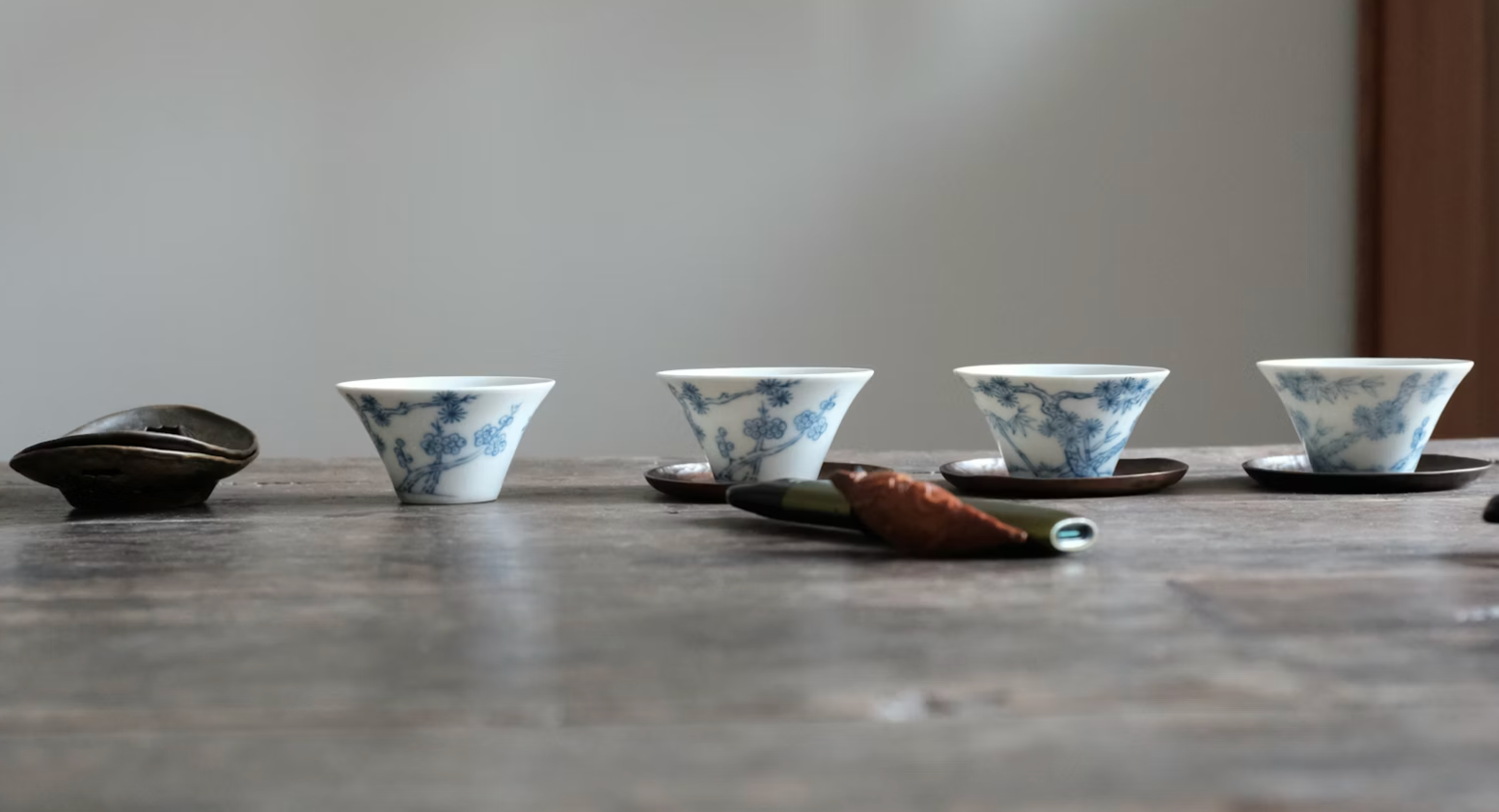
The shape and material of the tasting cup significantly impact the perception of flavor. Traditional Chinese tea cups are small and handle-less, typically holding between 20ml and 50ml. This small size ensures the tea cools quickly to an optimal drinking temperature (70-80 C) without becoming cold.
-
Wide Rim Cups: Increase the surface area, allowing aromas to escape and dissipate. This results in a milder, more balanced profile, ideal for bold oolongs.
-
Narrow Rim Cups: Concentrate aromatic compounds, creating a "chimney effect" that delivers intense fragrance to the nose. These are preferred for highly aromatic green and white teas.
-
Material Choice: Thin-walled porcelain assists in aeration, highlighting delicate top notes, while thicker ceramic or "mutton-fat jade" porcelain provides a satisfying tactile weight and better heat retention for robust black teas.
The "Oriental Artisan" Checklist: Your First Purchase
Selecting a first tea set is an investment in a lifestyle. To avoid common errors, such as purchasing vessels that are too large or equipment that is poorly balanced, we recommend the following five-point checklist.
-
Capacity Control: For solo or small group brewing, choose a vessel between 100ml and 150ml. A larger pot requires an excessive amount of tea leaves and makes it difficult to manage the speed of the pour.
-
Porcelain Over Clay (Initially): A beginner should start with a high-quality Jingdezhen porcelain Gaiwan. It is versatile, easy to clean, and provides a neutral baseline to learn the true character of different teas.
-
Mechanical Precision: Ensure the lid fits snugly without rattling. For teapots, verify that the pour is a smooth, clean stream without dripping back down the spout—a sign of superior craftsmanship.
-
The "Essential Four": Do not buy a massive, cheap set. Focus on the core four: a brewing vessel (Gaiwan or Pot), a Fairness Cup, a Strainer, and two Tasting Cups.
-
Investment in Lineage: Frame your purchase as the acquisition of an heirloom. Seek out pieces with "soul"—those crafted by artisans who understand the wabi-sabi embrace of imperfection and the imperial standard of excellence.
FAQs:
Why is it called "Gongfu" tea?
The term refers to the "skill" or "effort" required to brew tea correctly. It is not a type of tea but a method of meticulous preparation designed to maximize flavor and aroma through multiple infusions.
How do I season my new Yixing teapot?
Rinse the pot with hot water to remove clay dust, then simmer it gently in a pot of filtered water with the type of tea you intend to dedicate it to for 10-20 minutes. Allow it to cool naturally.
Can I use a Gaiwan as a cup?
Yes, in some regions, the Gaiwan is used directly as a drinking vessel. However, in the Gongfu ceremony, it is primarily used as a brewing chamber to decant into smaller tasting cups.
What temperature should I use for different teas?
Green and tender white teas require 80-85 C to avoid bitterness. Black teas and oolongs typically need 90-95 C, while aged Puerhs and dark oolongs benefit from boiling water (100 C).
How do I clean my tea set without damaging it?
For glazed porcelain and glass, use warm water and a soft cloth. For unglazed clay, never use soap or abrasives; simply rinse with boiling water and air dry completely with the lid off to prevent mold.
Conclusion: Stewardship of a Narrative
The acquisition of a first Gongfu tea set is more than a culinary upgrade; it is an entry into a chronicle that began millennia ago. By choosing tools that prioritize material integrity and functional elegance, the practitioner moves from a "consumer" to a "custodian" of tradition. In the minimalist, high-fire porcelain of Jingdezhen or the breathing, seasoned walls of a Yixing pot, we find the bridge between the celestial past and the refined present.
Oriental Artisan stands as a sanctuary for this extraordinary journey, where luxury is defined not by opulence, but by the "soul etched into every grain." As you begin your ritual, remember that the finest things in life are those that outlive their owners—objects that carry the whispers of dynasties and the discipline of masters. This is not commerce; this is consecration. This is the art of the start.


Leave a comment
This site is protected by hCaptcha and the hCaptcha Privacy Policy and Terms of Service apply.