


What Is a Hanko? The Beautiful Japanese Seal With a Personal Story
A Name, Carved Into Something Lasting
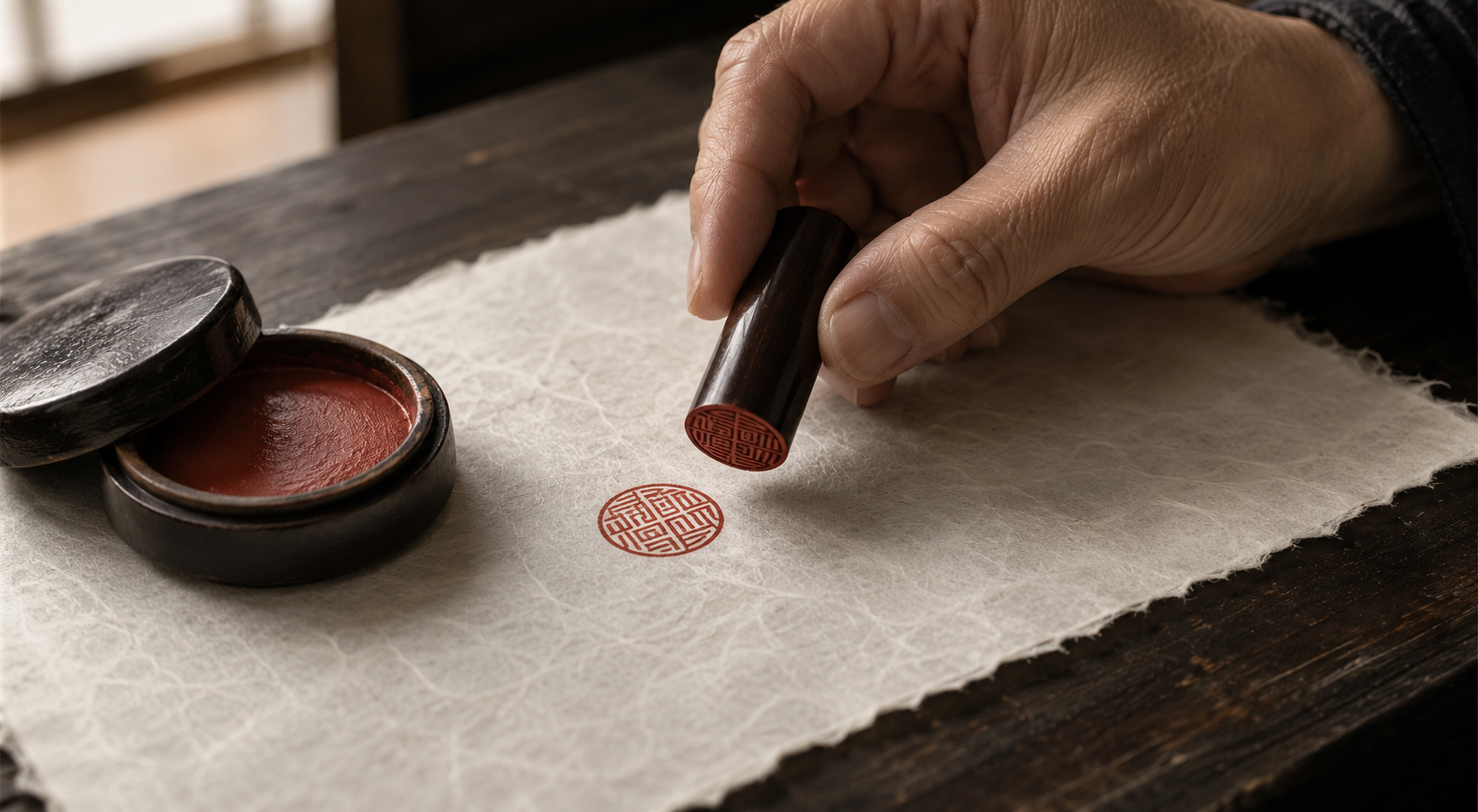
The seal touches the vermilion ink lightly. It is aligned, pressed with even pressure, then lifted. What remains is a small red impression: a name reduced to line, balance and space.
In Japan, identity has long been expressed not only by handwriting, but by something carved, held and impressed. A Hanko (判子) is the physical personal seal used to stamp a name or identifying mark onto paper. Depending on the seal and the situation, its impression may acknowledge a delivery, identify an artist, confirm a bank instruction or support an important transaction. In formal settings, a registered seal and its certificate can serve as powerful evidence of identity and intent.
The Hanko also brings together language, composition, carving and touch. Made for one name and one hand, it can become a signature with physical presence.
So what is a Hanko, exactly, and why can such a small seal carry so much meaning?
What Is a Hanko?
A Hanko is a personal seal or stamp used in Japan to create an identifying impression, usually of a person’s name. The seal face is carved in reverse. When it is touched to shuniku (朱肉), a vermilion seal paste or ink pad, and pressed onto paper, the characters appear in the correct orientation.
The word Hanko commonly refers to the object in the hand. The formal term inshō (印章) also means the physical seal, while in’ei (印影) is its impression. Inkan (印鑑) is widely used for the seal itself, but also has a narrower sense connected with an impression kept for comparison.
An everyday seal, a seal registered with a municipality and an artist’s mark may all be called Hanko, but they perform different work.
Hanko vs Inkan: What Is the Difference?
In everyday Japanese, Hanko and Inkan are often used interchangeably. Insisting that they always refer to entirely separate things makes ordinary usage sound tidier than it really is.
The useful distinction is one of emphasis. Hanko is the familiar word for the seal you hold. Inkan sounds more formal and can mean a seal or, more narrowly, a recorded impression used for verification. The stamped mark is an in’ei. Japanese dictionaries preserve both meanings of Inkan, which explains the conflicting explanations online.
| Term | Japanese | Most useful meaning | Nuance |
|---|---|---|---|
| Hanko | 判子 | A seal or stamp, especially the physical object | Common, conversational term |
| Inshō | 印章 | The physical seal | More formal technical term |
| In’ei | 印影 | The impression left after stamping | The red mark on paper |
| Inkan | 印鑑 | Commonly a seal; more narrowly, a registered or recorded impression used for comparison | Often interchangeable with Hanko in everyday speech |
In official contexts, follow the terminology used by the municipality, bank or institution involved.
A Brief History of Personal Seals in Japan
Japan’s seal culture belongs to a larger East Asian history of marks used for authority, authorship and ownership. One early object is the gold seal associated with the King of Na. Thought to have been bestowed by the Chinese emperor Guangwu in 57 CE, it was found on Shikanoshima Island in 1784 and is now a National Treasure in the Fukuoka City Museum. It was an emblem of authority, not a personal Hanko in the modern sense.
Government seals later entered Japan’s administrative order. Over time, warriors, religious figures, artists and merchants employed seals for different purposes. Written signatures and stylized monograms called kaō also existed; documentary culture was never simply “stamps instead of signatures.”
By the Edo period (1603–1868), seals appeared throughout commercial and household documentation. Late-Edo records from Kōfu, in present-day Yamanashi, show an established trade in seal carving. The modern registration framework took shape in the Meiji period; an 1873 proclamation helped standardize registered personal seals for important documents.
The path was gradual: an emblem of authority became an administrative instrument, then a widely owned marker of identity.
Why Did Japan Use Hanko Instead of Signatures?
The simplest answer is that a seal produces a stable image that can be compared with a specimen already on file. In a paper-based administrative system, that repeatability made the seal useful for authentication.
A recognized seal could indicate approval, acknowledge receipt, mark ownership or connect a person to a document. In formal situations, the impression could be checked against a municipal, institutional or bank record.
The contrast with signatures should not be overstated. Japan has long used written names and signatures alongside seals. Nor is a Hanko immune to misuse: possession matters, which is why important seals are stored carefully and registered seals may be accompanied by certificates. Authority comes from the surrounding system, not from vermilion ink alone.
The Three Main Types of Personal Hanko
The familiar three-part classification describes a seal by the role assigned to it, rather than by material alone.
Jitsuin (実印): The Registered Seal
A Jitsuin is a personal seal registered with the owner’s municipality. The owner can request an inkan shōmei-sho (印鑑証明書), or seal-registration certificate, connecting the impression to the registered person.
Jitsuin are used where a procedure calls for a registered seal and certificate. Eligibility, names, dimensions and materials are governed locally. Hiroshima, for example, prescribes size and name conditions, a border, and a material that does not deform easily. Local rules must be checked.
Ginkō-in (銀行印): The Banking Seal
A Ginkō-in is a seal recorded with a financial institution. Traditionally, the bank compared new impressions with its specimen.
Some accounts and app-based services now operate without seals, while other banks and procedures still refer to one. Ginkō-in is a functional category, not a universal requirement.
Mitome-in (認印): The Everyday Seal
A Mitome-in is an unregistered seal for routine acknowledgment where the receiving party accepts it. Ready-made seals bearing common surnames have often served this purpose.
Its acceptability depends on the task. Self-inking or easily deformable stamps are convenient but commonly excluded from municipal registration.
| Type | Japanese | Traditional purpose | Registration | Typical formality |
|---|---|---|---|---|
| Jitsuin | 実印 | Important procedures or transactions requiring a registered personal seal | Registered with a municipality | Highest |
| Ginkō-in | 銀行印 | Bank-account authentication and related procedures | Recorded with a bank or financial institution | Medium to high |
| Mitome-in | 認印 | Routine acknowledgment and everyday paperwork | Usually not registered | Everyday |
These are roles, not guarantees. Ask the relevant institution what it accepts.
Are Hanko Still Used in Japan Today?
Yes, Hanko remain in use, but their role is narrower and less uniform than it once was.
Municipal registration systems still operate, and some property, vehicle, inheritance, corporate or financial procedures may call for a registered seal and certificate.
The administrative landscape has nevertheless changed. Japan’s Financial Services Agency removed seal requirements from a range of procedures in 2020 and 2021. Electronic signatures, online identity systems, remote work and app-based banking have reduced the need for a physical seal elsewhere.
The result is a change in emphasis, not disappearance. Administrative necessity has declined in some areas; cultural and craft value remain.
How a Traditional Hanko Is Made
The making of a hand-carved seal begins before the first cut.
The artisan prepares the seal face until it is level. The characters are researched and arranged within a circle, oval or square. This seal draft must work as language and image: every stroke needs strength to print cleanly, while open space must remain legible.
The design is transferred in reverse. In Yamanashi’s traditional Kōshū process, the artisan divides the surface, writes mirrored characters, rough-carves the surrounding areas, corrects the strokes, evens the ground and tests the impression. A fraction removed from one curve can change the whole name.
Material changes the technique. Boxwood and horn can be cut with pushed and pulled blades; crystal requires chisels and a small hammer. The final test is whether the impression feels balanced.
Hand carving designs an image that only fully appears after the object has been inked and pressed.
The Art of Seal Carving
A good seal has two bodies: the object itself and the impression it leaves.
On paper, the composition resolves. Red line and white ground define one another. A border holds the characters together; small openings let the design breathe.
Carvers do not merely shrink handwriting. They adapt calligraphic strokes to a constrained field and the demands of printing, using formal seal script, a legible style or a freer artistic arrangement.
The result unites typography, calligraphy, relief carving and identity design.
What Are Hanko Made From?
Each Hanko material changes its touch, carving precision and aging.
- Wood: Boxwood is valued for its fine, close grain and warm touch. Other woods offer distinctive color and figuring. Wood should be protected from prolonged moisture and extreme heat.
- Stone and crystal: Stone can carry natural veining and a satisfying weight. Hardness varies greatly, affecting both detail and resistance to chipping. Crystal has an important place in Yamanashi’s seal-making history.
- Horn and animal-derived materials: Horn has historically produced durable, polished seals. Ivory was also used, but elephant-ivory trade is restricted under CITES and national laws; verified modern alternatives are the responsible choice.
- Resins and synthetics: These can be stable, affordable and consistent, especially for everyday use.
- Metals and composites: Titanium and engineered materials offer durability and a modern character.
Rarity is no substitute for workmanship or responsible sourcing.
What Can Be Carved on a Hanko?
Personal seals commonly use a surname, given name or full name in kanji. Kana and Roman letters are also possible, while artists may choose a studio name, initials or personal mark.
Long names may require abbreviation, stacked lettering or a larger face. The characters must fit and remain balanced when printed.
For official use, creative freedom is limited. A municipality may require a name recorded on the resident register and reject initials, mixed scripts or decorative motifs.
Can a Foreigner Have a Hanko?
Yes. Anyone can own a Hanko, regardless of nationality. It may be commissioned for correspondence, books, artwork or personal enjoyment.
Foreign residents may also register a seal if they meet municipal conditions. Permitted lettering generally depends on the name, alias or katakana name in the resident record. Toshima City, for example, does not accept improvised phonetic kanji absent from that record. Rules vary locally.
Ownership and official registration are separate. A personalized Hanko can be meaningful without being a Jitsuin.
Turning an English Name Into a Japanese Hanko
The right method depends on whether the seal is practical, artistic or commemorative.
- Katakana: Represent the name by sound in the script commonly used for foreign names.
- Roman letters: Compose initials or a short name directly in the Latin alphabet.
- Meaningful kanji: Select characters for sound, meaning or visual character. This is a creative interpretation, not an official translation.
- A personal mark: Design a monogram, studio name or brief idea for art, letters or books.
For official use, begin with the authority’s rules. For personal use, begin with the story the impression should carry.
Editorial invitation: Discover personalized Hanko at Oriental Artisan, including hand-carved name and artist seals designed for personal, creative and gifting use.
Why a Personalized Hanko Feels So Personal
A signature is made anew each time. A Hanko gathers that gesture into an object.
Its face carries a name reconsidered as proportion, texture and space. Open the case, touch the ink, align, press and lift: a modest ritual that makes attention visible.
That quality belongs to Oriental Artisan’s Art of Quiet Living: noticing how things are used. A personal seal gives the act of marking paper quiet weight.
Hanko as a Meaningful Japanese Gift
A personalized Hanko suits a birthday, graduation, wedding, anniversary, housewarming or professional milestone. It is also thoughtful for a writer, calligrapher, artist or collector.
Its value comes from specificity: the recipient’s name must be considered before the object can exist. The impression then finds a life inside books, beneath artwork, on letters or in a journal.
For a wedding, two related seals can acknowledge distinct identities. For a graduate, a name seal can mark a new public life. A protective case, sample impression and explanation of the characters complete the gift.
How to Choose a Hanko
Begin with purpose. An art seal can be expressive; a registered seal must satisfy local rules.
- Purpose: Decide whether the seal is for official registration, banking, everyday acknowledgment, art, books, collecting or gifting.
- Name format: Confirm the exact name, initials, kana, kanji or Roman letters, and ask how creative kanji were chosen.
- Size and shape: A larger face holds more characters but should remain easy to position.
- Material: Consider touch, durability, provenance and care, not rarity alone.
- Carving method: Look for clarity about what is drawn, carved or finished by hand.
- Impression design: Judge balance, line and negative space in the printed mark.
- Case and presentation: A fitted case protects the face; a proof impression helps gift presentation.
- Official suitability: Never assume that any custom seal can be registered as a Jitsuin. Verify the municipality’s current rules before ordering.
Hand-Carved vs Machine-Made Hanko
Machine-made seals can be efficient, consistent and suitable for routine use. The meaningful difference is intention.
| Consideration | Hand-carved Hanko | Machine-made Hanko |
|---|---|---|
| Design | Individually composed and adjusted | Often template- or font-based |
| Character | Small irregularities reveal the maker’s decisions | High repeatability and uniformity |
| Production | Slower; requires skilled manual work | Faster and scalable |
| Price | Usually higher | Usually more accessible |
| Best suited to | Craft appreciation, distinctive impressions, collecting and gifts | Convenience, routine use and common names |
Some seals combine digital layout or machine rough-cutting with hand finishing. Ask which stages were shaped by the artisan and look for those decisions in the impression.
How to Use a Hanko Properly
- Place the document on a firm, slightly resilient stamping mat or a small stack of smooth paper.
- Touch the seal face evenly to the shuniku. Do not flood the recesses with ink.
- Check the seal’s orientation and position it above the intended space.
- Press vertically with controlled, even pressure. Avoid sliding or twisting.
- Lift the seal straight up.
- Inspect the impression for complete lines and a clean border.
- Blot residual ink from the face with soft, lint-free paper after use.
Common errors are over-inking, using a surface that is too hard, misalignment and moving the seal on the page. Practice on scrap paper.
How to Care for a Hanko
Remove fresh ink gently without scraping recesses with a pin or blade. Use a soft cleaning brush only if suitable for the material.
Keep it dry and away from prolonged sunlight, heat and humidity changes. Store it in a fitted case. Stone and crystal can chip; wood can move with moisture. Follow the maker’s material-specific guidance.
Protect a registered or banking seal as an identity instrument, and follow the institution’s procedure if it is lost.
Choosing a Hanko at Oriental Artisan
At Oriental Artisan, we are drawn to seals because something remarkably small can hold an extraordinary amount of human intention.
The current Hanko collection includes hand-carved personalized seals in stone, jade and horn, with options for names, initials, kanji, artist signatures and short inscriptions. Product pages specify material, size, personalization and presentation. The collection draws from Japanese Hanko use and the broader East Asian art of seal carving, so each piece should be understood by its stated origin and purpose.
These seals suit personal, artistic, collecting and gifting use. For a Jitsuin or bank seal, confirm requirements before ordering.
Explore the Art of the Japanese Seal
The enduring appeal of a Hanko is not that it resists the digital world. It is that it offers something the digital world rarely asks of us: to pause, align a name carefully and leave a mark with the hand.
Frequently Asked Questions
What does Hanko mean in Japanese?
Hanko (判子) is the familiar Japanese word for a seal or stamp. It usually refers to the physical object pressed onto paper. The more formal term inshō (印章) also means the seal itself, while in’ei (印影) means the resulting impression.
Is Hanko the same as Inkan?
In ordinary conversation, the terms frequently overlap. Hanko is the everyday word for the seal. Inkan is also commonly used for the object, but can have a narrower meaning: an impression recorded for verification, especially in formal or registration contexts. Usage is nuanced rather than absolute.
Do Japanese people still use Hanko?
Yes, but usage varies. Registered seals remain relevant for some municipal, property, vehicle, corporate and financial procedures, while electronic signatures and administrative reforms have removed many former stamping requirements. Everyday practice differs by institution, employer, bank and generation.
Does everyone in Japan have a Hanko?
No universal rule requires every person to own or use the same types of Hanko. Many residents have one or more seals, but others may complete much of daily life through signatures, cards, apps and electronic authentication. Need depends on personal circumstances and institutional requirements.
Can foreigners get a Hanko?
Yes. Anyone may own a personal or artistic Hanko. A foreign resident who wants to register one as a Jitsuin must meet the local municipality’s requirements. Acceptable lettering is usually tied to the person’s name, alias or katakana name as recorded on the resident register.
Can I put my English name on a Hanko?
Yes. A personal Hanko can use Roman letters, initials or a katakana rendering of an English name. A longer name may need careful abbreviation or composition. For official registration in Japan, confirm the permitted name format with the municipality before commissioning the seal.
Can I choose kanji for my Hanko?
For an artistic seal, kanji can be selected for sound, meaning and visual balance. This is a creative interpretation, not an official translation of an English name. Municipalities may reject phonetic kanji that do not appear in a foreign resident’s official record, so do not assume an artistic seal is registrable.
Is a Hanko legally binding?
Not automatically. Legal and evidential effect depends on the document, the parties, the type of seal and surrounding proof. A Jitsuin is a seal registered with a municipality, and its impression may be supported by a registration certificate. An ordinary Mitome-in does not carry the same evidential function.
What is the difference between Jitsuin and Mitome-in?
A Jitsuin is registered with a municipality and can be connected to a seal-registration certificate. A Mitome-in is generally unregistered and used for routine acknowledgment. The terms describe function and status, not simply the material or appearance of the seal.
What ink is used with a Hanko?
Hanko are commonly used with shuniku (朱肉), a vermilion seal paste or ink pad formulated to produce a dense, clean impression. Apply it lightly and evenly. Using too much can fill fine recesses and blur the characters.
Are Hanko good gifts?
Yes, particularly when the recipient will appreciate personalization, calligraphy or Japanese craft. A well-chosen seal can mark books, letters, journals or artwork. For the most thoughtful result, explain the name treatment or selected characters and include a protective case and sample impression.
How much does a handmade Hanko cost?
There is no standard price. Cost depends on the material, size, design complexity, the artisan’s role, carving and finishing time, presentation case and provenance. Compare the stated process and a proof impression rather than assuming the most expensive or rarest material produces the best seal.


Leave a comment
This site is protected by hCaptcha and the hCaptcha Privacy Policy and Terms of Service apply.