


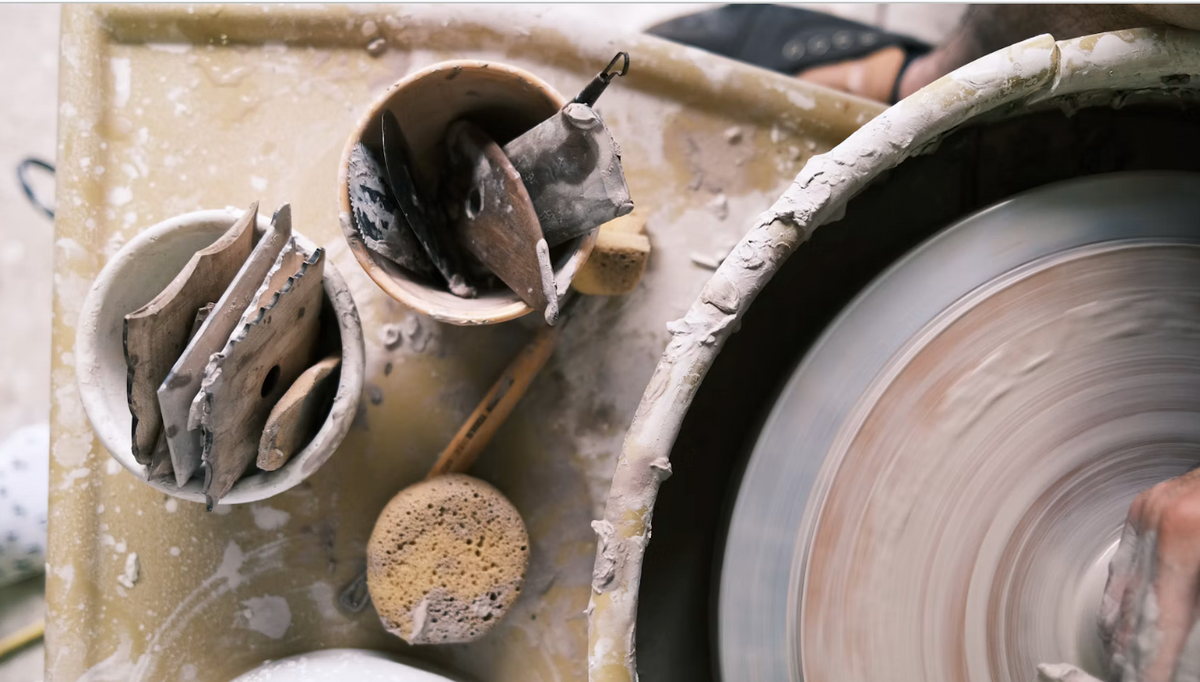
Best Gifts for Potters Who Already Have the Basics
Ask a potter to show you a favorite bowl and watch what happens. Someone who loves throwing may run a thumb around the foot. A decorator might turn the bowl toward the light until you see the lines cut through a layer of slip. A handbuilder may point out the tiny join where a handle seems to grow out of the wall. Each gesture gives you a better gift idea than the general fact that this person likes pottery.
The best gift for a potter who already owns a starter kit is a tool for a task they repeat. Choose a trimming tool for a wheel thrower, a carving needle for a sgraffito artist, a soft brush for someone who paints ceramics, or a selection of ribs for a slab builder. If you have only seen the finished work, start with its most distinctive feature. The foot, the silhouette, the painted surface and the modelled details each point toward a different part of the studio.
This guide is for the person doing the giving. You can make a good choice without knowing how to center clay or pronounce every glaze ingredient. You need one observation about the maker, a budget, and enough information about the product to tell what the selected option includes. Prices cited here are in US dollars and may change. Explore tools in The Artisan’s Studio.
A quick gift finder for ceramic artists
| What they make or talk about | A useful gift | Why it belongs in their studio |
|---|---|---|
| Bowls with carefully finished interiors | Dual-ended trimming and burnishing tool | Combines controlled removal with a smoother finishing action |
| Slab trays, boxes and vases | Ten-piece steel rib and scraper set | Different edges follow broad surfaces, curves and corners |
| Mugs with lines drawn through color | Sgraffito needles | Fine points suit incised marks and small areas of detail |
| Painted plates and underglaze decoration | Ceramic painting brushes | Brush choice changes the width and character of a mark |
| Small figures, faces or applied details | Sculpting and texture tools | Several profiles help at the joins and transitions a fingertip cannot reach |
| Repeated runs of wheel-thrown pots | Five-piece carbide trimming set | A selection of cutting profiles serves several recurring cuts |
How to discover what they would use without spoiling the gift
Ask to see something they made recently. A question as simple as “Which bit took longest?” opens up the conversation without sounding like a shopping survey. If the answer is trimming, ask what they were trying to achieve: a lighter base, a crisp ring, a particular curve inside a bowl. If the answer is the decoration, find out whether they painted those lines on or cut them through another color. Those two answers already narrow the catalogue considerably.
A photo of work in progress is especially revealing. Notice the tools lying within easy reach and the pieces arranged beside the wheel. Several similar bowls suggest repetition, which makes an upgrade to a familiar tool more attractive. A cluster of different little animals suggests a maker experimenting with detail and expression. A table covered in test tiles may belong to someone who enjoys color. One fact about their current project is worth more than guessing from the number of years they have been making pots.
Studio arrangements matter too. A member of a community studio might have access to a cupboard of shared tools but prefer a personal brush that keeps its point or a trimming profile that is always available. A home maker may already keep favorite tools at several workstations. Ask where they usually work and what travels with them. A gift slim enough to fit in a class bag can get considerably more use than a large case the maker never wants to carry.
If you can speak to a studio friend, ask for one missing capability. “Does she already have something she likes for the insides of those little bowls?” is easier to answer than “What equipment does she need?” It also leaves room for a very useful answer: she already loves the tool she uses. In that case, choose a complementary gift for another stage or invite the maker to choose a specialist profile with you.
For the potter who finishes every bowl by hand
The last marks on a bowl can be the ones its owner feels every morning. A smooth transition from the inner wall to the base makes a cup pleasant to wash and a small dish satisfying to pick up. A maker interested in these transitions often spends as much time refining a shape as establishing it on the wheel. This is the first person to consider for the dual-ended pottery trimming and burnishing tool. See the dual-ended finishing tool.
One end offers a serrated trimming loop and the other a smoother working surface. Think of the difference between changing a contour and attending to the surface that remains after the cut. Someone correcting a little excess in an open bowl may want both actions within reach. A maker who is already happy with the curvature and wants only to soften a mark may reach directly for the smoother end. The appeal of the design lies in that change of action.
Check access before purchasing for miniature work. A tool can look narrow in a product photograph yet be awkward inside a tiny cup whose rim curves inward. The opening has to accommodate the head at the angle used in the work. An open dessert bowl offers space for hand movement; a bud vase restricts both access and sight. If the recipient makes narrow-necked bottles, a general shaping rib for the outside may fit their practice more readily than an interior finishing tool.
What does “burnishing” mean on a gift listing? In pottery it can refer to smoothing and compressing a suitable unfired clay surface to develop a sheen. The result depends on the clay, its condition and the subsequent firing. For a buyer, a product description that promises a working action is more useful than an imagined finish. Choose this tool for a potter who likes refining the surface by hand. The $39 price also makes it an approachable individual gift.
For the slab builder who likes a clean silhouette
Imagine making a rectangular vase from four flat sheets of clay. The job involves much more than joining four edges. Broad faces need to read as planes, corners must feel deliberate, and seams need attention where the light travels across them. A set of ribs gives a maker different edges for controlling these surfaces. A straight edge can help establish a clean line, while a curved profile can follow the shoulder where a flat face rounds into a neck.
Oriental Artisan’s ten-piece stainless steel pottery scraper and rib set brings several shapes together at $39. It makes sense for someone who moves between slabs and rounded forms or enjoys trying marks at different scales. Look at the profiles in the photograph as if they were silhouettes of possible pots. The one that seems to echo the outline of your friend’s work may tell you more about the choice than the total number of pieces. Explore the stainless steel rib and scraper set.
Ribs are also interesting to the potter who throws much of their work. A maker can refine a run of cups with a consistent outer profile or smooth an irregularity before the clay has firmed. If the person loves visible throwing rings, they may deliberately leave much of the surface untouched. Ask where they like to see evidence of the hand. The answer may point toward a clean foot and a lively wall, an excellent argument for buying the trimming tool first.
For a maker focused on texture, examine the marks they already use. Fine parallel lines on a broad platter have a different rhythm from a single incised drawing. A textured or serrated edge can repeat a mark across an area, whereas a fine needle gives the maker freedom to change direction from one moment to the next. If the work resembles drawing, start with carving tools. If its detail travels in regular bands, a selection of ribs is worth considering.
For the ceramic artist who draws through color
Sgraffito is an easy technique to recognize once someone points it out. A potter applies a contrasting layer, often colored slip or underglaze, and scratches through it to reveal what lies beneath. On a dark mug, the resulting lines might be the pale body of the clay. From several feet away they can look like painted strokes. Up close, a shallow recess catches the light. For a gift buyer this distinction matters because it identifies the tool responsible for the drawing.
Precision carving and sgraffito needles suit artists who make narrow lines, lettering, small feathers, scales or closely spaced hatching. The range starts at $49.90. Look at the tips and choose the option that matches the scale of the work. The recipient who draws the eyelashes on a tiny portrait tile may care more about a fine, predictable point than the maker carving a bold landscape across a serving platter. Compare the carving and sgraffito needle options.
A carving gift does not have to duplicate the ordinary needle that may have arrived in a first pottery kit. That basic needle often does several jobs, including marking clay and checking thickness on the wheel. A maker who decorates for an hour at a time may value a dedicated point for that activity. Think about the difference between keeping one pencil in the kitchen drawer and choosing a particular drawing pencil for a sketchbook. The dedicated tool earns its place through the frequency of use.
There is one reason to choose another category. Deeply carved channels, broad recesses and sculptural relief call for moving more material than a fine point ordinarily handles. Ask whether the artist describes the work as incising, carving channels or modelling raised details. You can simply ask about the finished pattern without using those terms. “Did you cut the flower out, draw it in, or build it up?” will usually lead you toward needles, a shaped cutter or sculpting tools.
For the maker who paints plates and cups
The brush is a wonderfully personal studio gift because its mark is visible in the finished pot. A broad passage of blue sweeping around a dinner plate records the width of the brush and the way it released liquid. A small leaf at the edge of a cup depends on a different movement. When shopping for brushes, take one photo of the maker’s work with you. Let the painted areas tell you what scale of tip to investigate.
The soft-bristle ceramic glazing and underglaze brushes begin at $13. Choose a broader option for covering ground or a more controlled tip for smaller motifs where the available shapes support those uses. Check whether the option includes one brush or several. A studio friend may be able to identify the workhorse size immediately. If the maker often paints near the handles of mugs, access around a curve may matter as much as the width of the finished stroke. Shop ceramic glazing and painting brushes.
Buy a brush for someone who applies color with a brush. Some potters dip or pour their glazes and leave the surface decoration to the clay itself. Others use brushes at several stages, applying underglaze to a design and later adding glaze in selected areas. A brief question about how they got that particular blue ring around a bowl can save you from buying for a technique they rarely use. It might also prompt a story you can put in the card.
What makes a brush worth giving to someone who already owns several? It may offer a width they have wanted to try, allow them to keep a separate brush for a recurring color, or spare them from borrowing a shared studio brush for detail work. Decide which of those benefits you are buying. A gift of two sizes makes sense if they serve different marks. For a painter who works almost entirely at one scale, a single thoughtfully chosen brush can be the more useful present.
For someone who makes animals, figures or relief work
Watch the joins. A sculptor spends a surprising amount of time easing a change in direction: where the ear meets the head, where a tail folds against a body, where a relief flower meets the wall of a vase. A fingertip is an excellent modelling tool until it becomes larger than the feature itself. A narrower or differently shaped end lets the maker approach that join while keeping adjacent details intact.
The seven-piece clay sculpting and texture tool set is a good candidate for a potter who returns to these transitions. At $98 it fits a personal or small group gift. Look for evidence that the maker would explore more than one working end. Tiny figures with fur, folds and rounded forms offer a stronger case than a collection of perfectly smooth slab boxes. Tell the recipient which piece of their work made you think of the set. See the seven-piece sculpting and texture set.
A broader sculpting assortment can be useful for someone still developing a vocabulary of marks. The Artisan’s Pottery Tool Set includes a 32-piece configuration with assorted detailing tools. Count the actual contents of the configuration you select. A large kit earns its keep when working ends do genuinely different things for the artist. If you know the one head they need to blend a miniature face, the narrower purchase is easier to make personal. Compare the pottery sculpting kit options.
A helpful way to choose between the two sets is to picture a complete piece being made. For a small animal, the artist might shape the main volume by hand, attach an ear, define an eyelid and add a few lines of texture. Which tools can you see them reaching for at each stage? If several profiles have an obvious role, a set offers welcome variety. If every answer is a tiny point, consider a dedicated detail tool and save the remaining budget.
For the wheel thrower ready to upgrade to carbide
A carbide trimming set is a generous gift for a potter who trims regularly enough to notice differences between cutting profiles. Trimming is the stage when a thrown pot has firmed and the maker refines the base and lower walls. A well-cut foot ring can visually lift a bowl; a heavy base can make an otherwise elegant cup feel awkward. Makers who return to the same forms develop strong opinions about where a cutting edge should meet the curve.
The five-piece tungsten carbide pottery trimming set is listed at $199. It offers several wooden-handled tools for the person who shapes different feet, walls or transitions during a working session. Carbide’s resistance to wear can appeal to a frequent trimmer, but the working profile still has to fit the cut. If the recipient talks about one specific corner of a blade, show them the photographs before ordering a costly surprise. Examine the five-piece carbide trimming tool set.
A broader edge can be useful along an open outside curve. A smaller working corner can reach the transition beside a foot. The maker who trims bowls for two hours at a stretch may switch between those tasks many times. The maker of a single sculptural vase may care much more about the precise head they can guide around one tight radius. Those are different reasons to buy. Ask about the cut, then decide whether a complete set or one specialist profile makes more sense.
Think about storage, too. Carbide is hard and can be vulnerable to chips from impacts. A maker who carries tools loose in a class bag may want a way to keep working ends separated. Find out how they store favorite tools and whether the purchase includes the protection you expect. For maintenance, follow the instructions for the specific head. The recipient will appreciate being given the product details along with the object, especially if they later want to identify a profile or ask about care.
Three real-world budgets for a pottery gift
A small thank-you, around $15–$40. For a teacher who demonstrated a beautiful brush stroke, choose a ceramic painting brush in a size they use. For the friend who helped you through a first bowl, the $39 dual-ended finishing tool carries a direct connection to that lesson. If you know the maker works from slabs, the $39 rib set offers several possibilities without requiring you to guess a precise carving width. Choose one strong connection and explain it in the note.
A personal gift, around $50–$100. Start with the artist’s decoration. Fine carved drawings point toward the sgraffito needle options. Modelled, dimensional work points toward the seven-piece sculpting set. If your budget sits between the prices of two configurations, look at which working ends the maker would genuinely use. A smaller selection with the correct tip is a better purchase for this person than a larger collection bought simply because the wrapping will feel more substantial.
A milestone or group gift, around $200. Ask for input before spending on the five-piece carbide set. A production-minded wheel thrower or an experienced maker building a more personal studio may welcome it. If several people are contributing, one person can quietly establish the desired profiles while the others prepare a card with photographs of their favorite pieces by the recipient. That little history gives a technical tool emotional meaning without asking the tool itself to be decorative.
Buying for a studio teacher, a returning potter or a serious hobbyist
A teacher may already have several examples of every basic tool. Find out whether the gift is for their teaching kit or their own bench. A set of clearly different profiles can be useful for demonstrating marks to a class. A personally chosen brush may be more welcome at home, where they can reserve it for their own work. Teachers spend their days helping other people make things. A note that recognizes their individual work can make the gift particularly thoughtful.
A returning potter presents a different case. After several years away, they may remember exactly which tool they loved yet be unsure what they want to make next. A rib set or a finishing tool can support several projects while they settle back into a rhythm. Before buying an expensive upgrade, ask what has changed about their access to a wheel or workspace. Their old preferences may be intact even though the studio they now use has a different setup.
An enthusiastic hobbyist may take extraordinary care over just a few pieces. Volume of production is only one reason to buy a specialist tool. Someone who spends an evening drawing a single design into a mug may get enormous pleasure from a fine point that feels right. Listen for the moment they describe with affection. Buying for the hour they most enjoy, even if it produces very little finished pottery, is a sound way to choose a meaningful gift.
Four studio photographs and what they tell a gift buyer
Picture a photograph of six tea bowls drying upside down on a board. Their feet have all been trimmed to a similar diameter, and little curls of clay lie near the wheel. The maker is working on consistency across a group. A trimming upgrade is plausible here. What you still need to learn is which cut they repeat most often. If they regularly borrow one studio tool for that final pass, find out the profile before deciding between a single tool and the five-piece set.
In a second photograph a mug has an illustration halfway around its wall. The artist has laid a sheet of paper underneath to catch tiny colored trimmings. Here the evidence points toward carving through a surface layer. Ask for a close view of the actual line. A narrow crisp line supports the case for a fine needle, while wider grooves may call for another shape. The color of the finished pot is less informative to this purchase than the scale of the material removed.
In a third photograph the artist is standing above a platter covered in broad overlapping strokes. A jar beside it holds several brushes of different widths. Ask how they made the soft edges where colors meet. You might learn that the large brush in the background is used for a single ground layer and the favorite smaller brush does every visible mark. If you are buying a gift connected to the finished design, choose the tool responsible for the mark they care about.
Finally imagine a workbench full of tiny houses made from clay slabs. You can see straight walls, rounded windows and textured roofs. Three categories could reasonably serve this maker: ribs for the walls, modelling tools for the windows, or textured edges for the roof. Ask which feature takes the longest. The answer turns a beautiful photograph into a buying decision and suggests a gift message specific enough that the recipient knows you really looked at their work.
How to choose a gift for a potter who makes mugs
A shelf of handmade mugs can disguise half a dozen different interests. Pick one up and look at the handle first. A hand-modelled fox curled around the side points toward sculpture. A restrained handle joined so neatly that you barely see the seam suggests a maker who enjoys a clean transition. A handle painted with a narrow band of blue points toward brushwork. The word “mug” describes what all three pots do, but the artist may have enjoyed a different hour of work on each one.
Turn the mug over next. If the foot is carefully defined and the underside has been trimmed into a deliberate curve, the maker may spend time studying how a vessel sits on the table. A photo of that foot, shown to a studio mate, can help identify which tool profile they already own and which one they have wanted to try. Some makers leave a generous, flat base on purpose. Ask what they like about it before choosing a tool intended to make the pot lighter.
Finally, consider how the design would change if the artist made twelve of those mugs. For one piece, borrowing a shared tool can be easy. Across twelve pieces a maker might value a brush that keeps the band width consistent, a rib that helps repeat the curve, or a particular cutter kept at their own bench. If you have heard your friend say they want to make a matching set for the first time, that small ambition can guide the gift more precisely than any general label about their skill level.
Questions people ask before buying pottery tools as gifts
What is the safest choice when I know they take pottery classes?
Learn whether the class is wheel throwing, handbuilding or ceramic decoration. For a wheel class, a rib or finishing tool may complement shared supplies. For handbuilding, ask about slab work or sculpting. For painting prepared ceramics, go straight to brushes. A class title can resolve most of the uncertainty in one conversation. Match the price to how often they attend and how much personal equipment they want to carry.
What if the artist already owns a tool that looks similar?
Compare the working ends and intended marks. Two tools can look almost identical in a drawer yet leave different radii on a bowl. Conversely, a new handle color may disguise an end the maker already owns twice. When you cannot establish a useful difference, move one stage along in their process. A finishing tool can complement an existing cutter, and a brush can complement a carving project that also uses applied color.
Do I need to know whether they work in porcelain or stoneware?
Knowing the clay helps, particularly for a specialist cutter, but the action and scale are the first filters. A smooth porcelain cup and a textured stoneware bowl may call for different finishes even when both are wheel thrown. Ask what the artist most wants the final surface to feel like. If a tight interior or a particular cutting edge is involved, compare the actual tool dimensions with the forms they make.
How can I present a practical studio gift beautifully?
Give the tool with a photograph or sketch of the work that inspired it and one sentence in your own voice. “I thought of the lines on the little bird cup you made for me” is enough. Keep the product name or order details available in case the artist wants the same profile later. When a gift shows that someone has paid close attention to the making, even a simple studio brush feels entirely personal. Find their next studio tool.


Hinterlasse einen Kommentar
Diese Website ist durch hCaptcha geschützt und es gelten die allgemeinen Geschäftsbedingungen und Datenschutzbestimmungen von hCaptcha.