


Artikel: Chinese Seals vs. Japanese Hanko: A Guide to Form, Meaning and Choosing a Personal Mark
Chinese Seals vs. Japanese Hanko: A Guide to Form, Meaning and Choosing a Personal Mark
A seal is a small object with a large presence. Pressed into red paste and lifted from paper, it leaves a mark that is at once practical, graphic and intimate. In Chinese artistic practice, a seal can complete a painting or calligraphic work; in Japan, a hanko has long been used as a personal identifier in everyday transactions. They belong to related East Asian traditions, but they should not be treated as interchangeable.
The shortest answer is this: a Chinese seal, often called a yinzhang or yin, has a long history in official, artistic and personal contexts, while a Japanese hanko is a personal seal used in a range of administrative and daily-life settings. Both can be beautifully hand carved. Their differences lie in language, inscription, format, use and the cultural setting around them.
First, use the right words
“Seal” is the broad English word. It can describe the carved object itself, the red impression it makes, or even the act of authenticating a document. That flexibility is useful in English, but it can blur meaningful distinctions.
In Chinese, a carved seal may be called yinzhang; the art and study of seal carving is zhuanke. In a Chinese painting context, a seal impression can function like a visual signature, but it may also carry a studio name, a phrase, a collector’s mark or an appreciative note. The mark is part of the composition, not merely a substitute for a handwritten name.
In Japan, hanko and inkan are commonly used for personal seals. The terms overlap in everyday conversation, although their exact usage can vary. A personal seal can be used for ordinary confirmations, while certain registered seals have more formal legal significance. This is why a decorative or gift seal should never be presented as a replacement for official registration requirements.
A shared material language, different uses
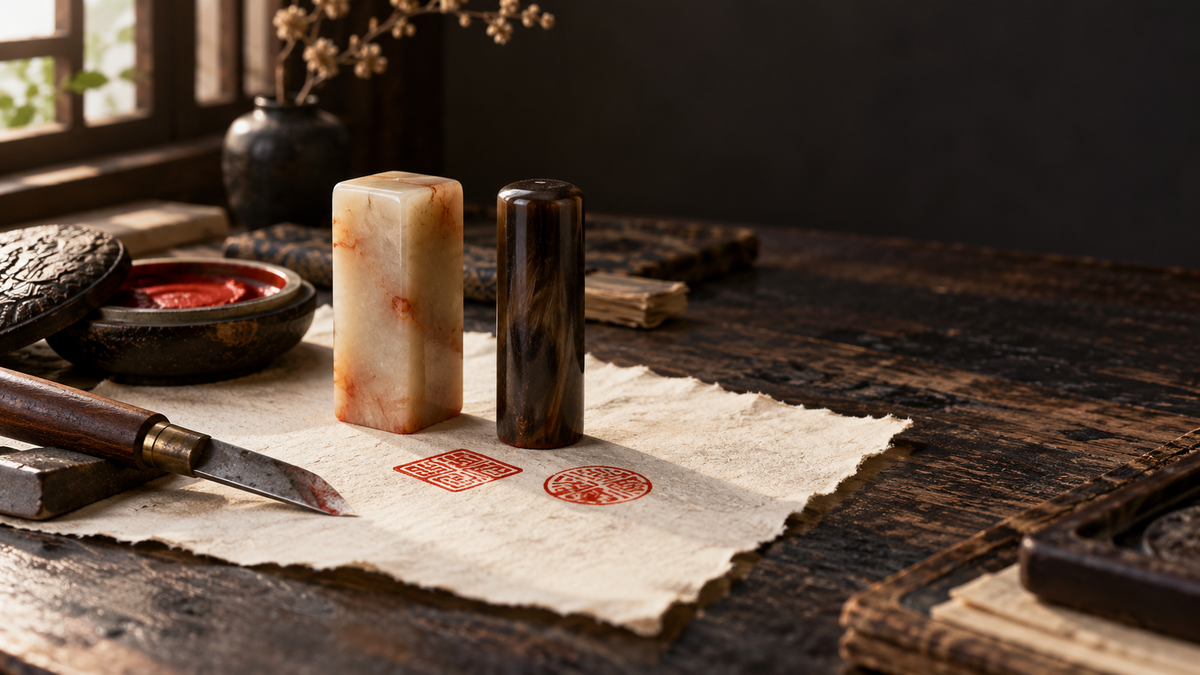
Stone, horn, wood, metal and composite materials have all been used for seals. The material changes the experience of the object: a soft, translucent stone invites attention to colour and carving; polished horn offers a denser, darker presence; wood can feel warm and direct. None of these materials automatically makes a seal more authentic. The quality of the carving, the suitability of the material and the clarity of the intended use matter more.
Chinese seals are often square or rectangular, though round and irregular forms also exist. Their handles may be carved as animals, landscapes or abstract forms. Japanese hanko are frequently cylindrical or round in cross-section, designed for a practical, repeatable impression. These are tendencies rather than hard rules. Shape should be chosen for the inscription and use, not as a costume-like signal of a culture.
The result of a seal is a reversal: the carved face is a mirror image of the final impression. Carvers work with two broad visual modes. In zhuwen—often called “red characters”—the characters remain raised, so they print in red. In baiwen—“white characters”—the surrounding ground is raised, leaving the characters unprinted against the red field. This contrast is one reason seal impressions have such visual force beside ink painting and calligraphy.
What a personal seal can say
A seal does not have to reproduce a legal name. It may contain a name, a pen name, a studio name, a short phrase, a date, or a symbol meaningful to its owner. The best inscription is usually the least forced one. A clear name in an appropriate script has more longevity than a borrowed phrase whose meaning has not been checked.
For a gift, begin with three questions. Whose name or text will appear? Which language or script is appropriate? Will the object be used for art, correspondence, books, packaging, or simply kept as a personal object? Those answers determine scale, character count and material.
People who do not read Chinese or Japanese should be particularly careful about character selection. A sound-based transliteration, a name adapted for legibility, and a separate meaningful phrase are different choices. They should be discussed with a knowledgeable carver rather than guessed from a translation app. Cultural specificity is part of the value of a hand-carved seal.
Chinese seal and Japanese hanko: a practical comparison
| Consideration | Chinese personal or art seal | Japanese hanko |
|---|---|---|
| Typical context | Art, calligraphy, collecting, correspondence, personal identity | Everyday identification, personal use, and in some cases registered administration |
| Common format | Square, rectangular, round or sculptural | Often round or cylindrical |
| Inscription | Name, studio name, phrase, collector’s mark or artistic text | Usually a personal or family name, depending on intended use |
| Ink | Often vermilion seal paste for artistic impressions | Stamp pad or seal ink depending on context |
| Best first use | Art, books, letters, a meaningful personal gift | Personal marking and a practical name-stamp gift |
The table is a guide, not a legal manual. In particular, rules concerning registered hanko depend on the municipality, document type and current Japanese administrative practice. A handcrafted seal bought as art or a gift should be described honestly as such.
How to choose the right size
Scale is not decorative trivia. A seal that is too large can overwhelm a bookplate or letter; one that is too small can make a complex inscription unreadable. For a simple personal name, a compact square or round seal is often more elegant than an oversized statement piece. For a studio name or a longer phrase, more surface area may be necessary.
Think of the paper first. A small seal beside a signature has a different role from a larger mark at the edge of a print. If the seal will be used on gift tags, envelopes or bookplates, test the intended area on a piece of paper with a pencil square. That simple exercise prevents the most common buying mistake: choosing a beautiful object that produces an impractically large impression.
The relationship between seal and ink
Seal paste is part of the object’s visual language. Traditional vermilion paste creates a textured, saturated impression that reveals the smallest decisions of a carving. It should be applied with a light, even touch rather than pressed onto the seal as though it were a modern office stamp.
To make an impression, place the paper on a firm, stable surface. Ink the face evenly, set the seal down without rocking, apply controlled pressure and lift straight up. A slight, deliberate rocking motion is used by some practitioners, but the goal is always a complete impression without smudging. Practice on ordinary paper before marking a finished drawing, edition or letter.
After use, wipe loose paste gently from the carved face. Do not scrape it with metal tools, soak stone or horn in water, or leave the seal pressed into paste. Store it away from extreme heat, long direct sun and abrupt shifts in humidity. A small cloth pouch or box protects both the carving and the object’s finish.
Why hand carving matters
A hand-carved seal carries decisions that a machine-made stamp usually removes: the depth of a line, the edge left by a blade, the adjustment made for the grain or translucency of the material. This is not an argument that every mark must be handmade. Digital and rubber stamps have their own useful role. It is an argument for choosing the right object for the right relationship.
If the seal is meant to commemorate a graduation, a studio, a new home, a creative practice or a meaningful name, hand carving can make sense because the object itself becomes part of the story. If it is needed only to process repetitive paperwork, a practical modern stamp may be more suitable. Good collecting starts with that honesty.
Choosing a personal seal from Oriental Artisan
For a stone-led, gift-ready object, the Custom Hand-Carved Balin Pink Stone Seal offers square and round options with cord or tassel details. The Custom Black Buffalo Horn Round Seal is a more restrained choice for someone who prefers a dark, polished material and a compact round form. For a more colourful personal object, the Custom Hand-Carved Yellow Jade Personal Seal offers several size and finishing options.
Before commissioning any seal, confirm the exact text, language, script and intended use. A good personal seal should feel legible, appropriate and deeply yours long after the first impression dries.
FAQ
Is a Chinese seal the same as a Japanese hanko?
No. They share related traditions of carved personal marks, but their common forms, inscriptions and social uses differ. Choose the term and format that suits the specific context.
Can I use a custom seal as an official signature?
Do not assume so. Official use depends on local rules and the document involved. A decorative or artistic seal is best treated as a personal object unless formal registration has been separately confirmed.
What should I put on a first seal?
A short, verified form of your name is usually the most durable first choice. A studio name or phrase can be an excellent second seal once its meaning and script have been carefully checked.
How do I clean a seal?
Remove residual paste gently with a soft dry cloth after use. Avoid abrasive cleaners, prolonged water exposure and sharp tools around the carving.

Hinterlasse einen Kommentar
Diese Website ist durch hCaptcha geschützt und es gelten die allgemeinen Geschäftsbedingungen und Datenschutzbestimmungen von hCaptcha.