


Tea Cup Size Guide: How to Choose the Right Cup for Every Tea
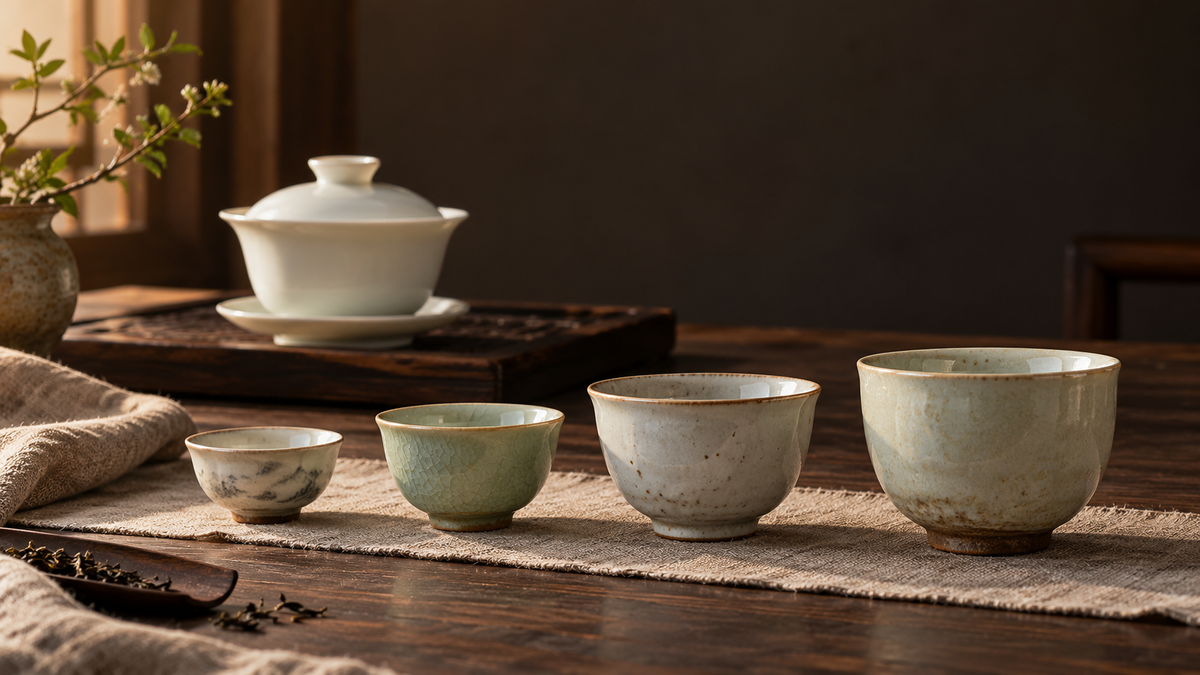
The smallest tea cup on a tea table can look almost implausibly small: a quiet porcelain bowl that holds barely more than a generous sip. Yet that little vessel makes a precise argument. Tea is not always meant to be consumed by the mugful. Sometimes it is meant to be noticed in successive pours—first the fragrance, then the temperature, then the way a leaf changes after it opens.
So what size tea cup should you choose? For Gongfu-style tasting, a cup of roughly 30–60 ml is usually the most practical range. For relaxed daily tea, 90–180 ml is often more comfortable. Larger cups work beautifully when you prefer a longer, less ceremonial drink. The right answer depends less on a universal rule than on the tea, the brewing vessel, and the rhythm you want the cup to create.
This guide explains how cup volume, shape, material and proportion affect the experience of tea. It is designed for people choosing their first cups as well as collectors refining a tea table one useful object at a time.
Begin with the question behind the size
“What size tea cup do I need?” is rarely only a question about millilitres. It often means one of four things:
- Will this cup make the tea too hot to drink?
- Will it fit the way I actually brew—one pot, one gaiwan, or a bag in a mug?
- Am I setting a table for myself, two people, or several guests?
- Do I want a quick daily cup, or a slower tasting ritual?
Those questions matter because tea cups are part of a system. A 45 ml cup paired with a 100 ml gaiwan is proportionate: two people can each receive a small, fresh pour, and the tea can be revisited as it evolves. The same cup can feel impractical beside a large pot intended to serve a room. Conversely, a 300 ml mug can be ideal for an easy breakfast infusion and entirely wrong for a concentrated high-mountain oolong brewed in short infusions.
The useful unit is not size by itself, but pour size: the amount you want to drink while the tea is at its best temperature, aroma and texture.
The quick tea cup size chart
| Cup capacity | Best for | What it feels like |
|---|---|---|
| 20–35 ml | Formal tasting; very concentrated tea; comparison sessions | A measured sip, fragrant and focused |
| 35–60 ml | Gongfu tea with a gaiwan or small teapot | The classic tasting-cup range: intimate, practical and repeatable |
| 60–90 ml | Solo tea; small shared sessions; aromatic oolongs | More generous without losing the rhythm of multiple infusions |
| 90–180 ml | Everyday leaf tea; office or afternoon use | Comfortable, versatile and easy to live with |
| 180–300 ml | Long, casual infusions; herbal tea; tea with breakfast | Relaxed and sustaining, closer to a modern mug experience |
| Over 300 ml | Large-format tea, iced tea or café-style service | Useful when volume matters more than tasting progression |
These are working ranges, not standards enforced by tradition. Handmade ceramic cups also vary slightly in capacity, and that variation is part of their character. A cup should be measured when exact pairing matters, but it should also be held. Does it sit securely between your fingers? Does the rim feel pleasant? Can you finish the pour before it cools too far? Those are equally valid tests.
Why small cups make sense for Gongfu tea
Gongfu tea is a style of attentive brewing rather than a single fixed ceremony. Leaves are often brewed in a relatively small vessel with a higher leaf-to-water ratio and several short infusions. Each infusion has its own temperature, concentration and aromatic profile. Small cups make that sequence legible.
In practical terms, a small cup protects the pace. It lets a guest drink the tea while it is still warm and fragrant, then makes room for the next infusion. It also makes sharing simple. A 100–120 ml gaiwan, after accounting for leaves and a little retained liquid, can comfortably yield two 35–50 ml servings. With three or four people, either choose smaller cups, brew more frequently, or use a larger vessel.
Small cups are not a test of expertise. They are simply functional. The Metropolitan Museum of Art’s Song-dynasty Jian ware tea bowl is much larger than a modern Gongfu tasting cup, reminding us that tea vessels have always taken different forms for different preparations and moments. A vessel’s dimensions arise from use, material and local practice—not from a single hierarchy of “correct” tea drinking.
The 30–45 ml cup: concentrated and aromatic
Choose this range when you like close attention to fragrance and texture. It is especially good for small servings of aromatic oolong, Dancong, Wuyi rock tea, high-quality black tea, aged dark tea and comparative tastings. Because the pour disappears in a few sips, it gives you frequent opportunities to reset your attention.
The trade-off is obvious: it can feel too formal for someone who simply wants to sit down with a book. It is also less forgiving if the brewing vessel is large, because the tea may be gone before everyone receives an equal pour.
The 45–60 ml cup: the most versatile Gongfu choice
For many tea drinkers, this is the sweet spot. It retains the clarity and temperature control of a small cup while giving the hand a slightly more substantial object to hold. If you are buying one first set of cups to use with a gaiwan, this range is a sensible place to begin.
A cup around this size works particularly well with a 100–120 ml gaiwan for one or two people. It is also generous enough for a solo session: brew, pour, pause, repeat. Rather than treating the next infusion as an interruption, the cup makes it the structure of the experience.
The 60–90 ml cup: less formal, still precise
This range is excellent for drinkers who enjoy Gongfu tea but do not want to be confined to tiny servings. It suits less concentrated brews, lighter roasted oolongs, white tea and easy afternoon sessions. The larger surface can reveal fragrance well when the cup is shallow and open, while the added volume gives a little more time between pours.
If your gaiwan is small, though, an 80 ml cup may leave very little tea for a second person. Size is always relational. Match cup capacity to the output of the brewing vessel and the number of cups on the tray.
Everyday tea cups: 90–180 ml is often enough
The everyday tea cup occupies a different part of the day. It is for a desk, a quiet breakfast, a call with a friend, a page of reading. You are less likely to be assessing the fourth infusion of a tea and more likely to want a cup that holds enough liquid to settle in.
A 90–120 ml cup is a graceful bridge between tasting cup and mug. It works well for Chinese green tea, white tea, lighter oolongs and any tea brewed in a personal pot. It is also a lovely size for people who find standard Western mugs cumbersome or who prefer their tea refreshed more often.
At 120–180 ml, the cup becomes truly all-purpose. This is a practical capacity for black tea, herbal infusions, rooibos and gentler everyday leaf tea. It is also a good choice for a household with mixed tea habits: one person can pour a long-steeped black tea while another uses the same cup for a less formal oolong session.
There is no need to force an everyday drink into a tiny vessel in the name of authenticity. Tea traditions include bowls, cups, covered cups and pots of many scales. The point is to choose a form that makes you want to use good tea more often.
Large tea cups and mugs: when more volume is the right choice
Large cups are sometimes dismissed as less refined, but that is a category error. A 250 ml cup can be perfect for a loose herbal blend, a robust breakfast tea, tea with milk, or an unhurried infusion when you do not plan to re-steep the leaves several times. Volume changes the ritual; it does not diminish it.
Choose 180–300 ml when:
- You make tea once and drink it over a longer period.
- You prefer lower-concentration brewing with more water.
- You often add milk, lemon or ice.
- You are serving a meal rather than conducting a tasting.
- You want a cup that is easy to use outside a dedicated tea setup.
One caveat: a very large cup can let delicate tea go lukewarm before it is finished. If that happens, do not assume you need a hotter brew. Try a slightly smaller cup, a pre-warmed vessel, or a tea that suits a longer drinking window.
Match the cup to the tea—not to a label
Tea names can be useful, but leaf style and brewing method are more helpful than a rigid catalogue of pairings. Start with the tea’s intensity, temperature and aroma.
Green tea
Many green teas reward a cup that lets the tea cool a little before drinking. A 60–120 ml porcelain or thin ceramic cup is often pleasant, especially when brewing in small pours. If you are drinking a long-steeped green tea casually, a 150 ml cup can be more practical. Avoid choosing only by colour or origin; what matters is whether the cup gives you enough time to enjoy a softer, lower-temperature infusion.
White tea
White tea can be delicate, textured and surprisingly expansive. For Gongfu brewing, 45–70 ml cups make it easy to notice a progression across infusions. For bowl-style or relaxed brewing, 90–150 ml provides more of the tea’s easy, lingering character. A pale porcelain interior is useful if you enjoy observing the liquor, but it is never compulsory.
Oolong tea
Oolong is where small cups are often most rewarding. Floral, roasted and mineral aromas are easier to revisit in 35–60 ml servings, particularly when a gaiwan is used. An open cup can emphasize perfume; a slightly narrower cup can keep warmth and aroma closer. For a calmer, less technical session, 60–90 ml is a generous alternative.
Black tea and dark tea
Black tea can move comfortably between worlds. A small cup is beautiful for a Gongfu-style infusion, while a 120–180 ml cup is ideal for daily drinking. Dark teas, including ripe pu-erh, may feel especially satisfying in a cup with some thermal mass, but thick walls are a preference—not a rule. Consider whether you want to drink the tea quickly and fresh, or slowly and warm.
Herbal infusions
Herbal blends often benefit from the larger end of the scale: 180–300 ml, sometimes more. Their flavour usually remains pleasant as they cool, and their brewing is often less dependent on multiple short infusions. A larger cup gives the aroma room without making the drink feel like a tasting exercise.
Shape changes more than you expect
Capacity tells you how much tea a cup holds; shape tells you how it behaves. Two 60 ml cups can offer very different experiences.
Open, shallow cups
An open cup exposes more surface area. This helps the tea cool and can make fragrance feel immediate. It is a fine choice for aromatic tea and for people who like to observe the liquor’s colour. The drawback is heat loss: tea cools quickly, so it is best when you plan to drink it without delay.
Tall, narrow cups
A narrower profile directs aroma upward and retains warmth longer. In some Gongfu tea settings, a tall fragrance cup may be used to appreciate aroma before tea is transferred to a drinking cup. For daily use, a moderately narrow cup can be a good choice if you dislike tea cooling too quickly.
Rounded cups
Rounded forms are comfortable in the hand and can make a modest amount of tea feel generous. They often suit aged tea, roasted oolong and evening sessions, where warmth and tactility matter as much as a highly precise aromatic reading.
Footed cups
A small foot lifts the bowl from the table and gives your fingers a cooler place to hold. This is especially welcome with thin porcelain and hot tea. The foot also affects the visual balance: a cup can appear lighter and more composed even when it is materially substantial.
Porcelain, stoneware and glass: choose by behaviour
Material affects heat, weight, visual clarity and care. It does not determine whether a cup is “serious.”
Porcelain is often an excellent first choice because it is relatively non-porous, easy to clean and visually neutral. Thin porcelain lets you sense temperature through the wall and makes colour easy to read. A white interior is particularly useful when learning, because it gives you a clear view of the liquor.
Stoneware has more weight and often retains warmth longer. Its glaze and clay body can create a grounded, tactile experience. It is especially attractive for tea drinkers who value a cup as an object in the hand, not just a transparent tool for tasting.
Glass lets you see the tea completely, which can be useful for watching leaves unfurl or appreciating colour. It is most comfortable for teas that are served at moderate temperatures, or for drinkers who do not mind a cooler outer surface.
Glazed ceramics bring the widest visual range. If you choose a richly coloured or patterned interior, remember that it may make subtle colour assessment harder. That is not a flaw; it simply means a white porcelain cup may be helpful as a second, more analytical cup.
A practical formula for pairing gaiwan and cups
For a shared Gongfu session, use this simple calculation:
Brewing vessel capacity ÷ number of drinkers = target cup capacity.
Then leave a little margin for leaves and retained liquor. A 120 ml gaiwan serving two people suggests cups around 40–50 ml. A 150 ml pot serving three people suggests cups around 35–45 ml. If you want generous 70 ml servings for two, use a larger brewing vessel or accept that the tea will be divided across more than one infusion.
This formula is not about strict precision. It simply prevents the common beginner frustration of buying a beautiful set that cannot pour evenly. A tea session feels more relaxed when the proportions already work.
For a solo session, choose by desired pace. A 45 ml cup encourages multiple small moments. A 90 ml cup is a comfortable middle path. A 150 ml cup makes the session feel easy and continuous.
How many tea cups should you own?
Start with fewer than you think. Two matching or harmonious cups can cover most shared tea sessions, and one additional cup is useful when a guest joins. A compact first collection might include:
- Two 40–60 ml cups for Gongfu tea.
- Two 100–150 ml cups for everyday tea.
- One larger cup or mug for herbal infusions and long mornings.
This small range gives you options without turning tea into a storage problem. Over time, you may add a cup because of a particular glaze, a maker, a memory or the way it suits one tea. Collecting becomes more meaningful when every piece has a role.
Care: let the cup age through use, not neglect
Handmade cups do not require complicated rituals, but they reward ordinary care. Rinse after use, wash gently with warm water and mild soap when needed, and dry fully before storing. Avoid abrupt temperature shifts: do not pour boiling water into a cup taken directly from a very cold cabinet or refrigerator.
Pre-warming is both practical and pleasurable. Add hot water, let the cup warm for a few seconds, then discard it before pouring tea. This softens the temperature shock and helps a small serving stay warm long enough to enjoy.
For cups with gilt decoration, delicate enamel or a very fine rim, hand washing is the safer default unless the maker explicitly states otherwise. Do not use abrasive pads. A cup’s fine surface is part of its function as well as its finish.
A buying guide: five details to check before you choose
Shopping for cups online can make every vessel look more or less the same. Photographs flatten scale, and a dramatic glaze can distract from a rim that is too thick, a base that is awkwardly wide, or a capacity that does not fit your brewing vessel. Before choosing, use these five checks.
1. Check capacity, then ask how it was measured
Capacity can refer to a cup filled to the rim, rather than a comfortable serving line. In use, you will rarely fill a hot cup to its absolute edge. Treat a stated 60 ml capacity as an approximate maximum; the practical pour may be closer to 45–50 ml. That margin is helpful. It reduces splashing and gives your fingers a little distance from hot tea.
If you are buying a set, compare capacity across every cup rather than assuming that a matching group has matching volume. Handmade work can have small variations. Usually they add charm; for a shared tasting, they are worth noticing.
2. Look at the rim
The rim is where the object becomes tactile. A finely finished rim can make even a simple cup feel considered. A gently flared rim sends tea across the mouth more broadly, while a narrower opening concentrates the first aromatic impression. There is no objectively superior choice, but there is a clear difference in sensation.
For very hot tea, a cup with a slightly flared rim is forgiving. It lets the tea cool more quickly and is easier to sip from without touching the hottest interior surface. For fragrant oolong, a narrower rim may make aroma feel more contained. If the listing provides side views, use them; a top-down image alone does not reveal this part of the design.
3. Consider wall thickness and thermal comfort
Thin porcelain is responsive. It allows you to feel the heat, makes small pours elegant, and often creates a clean visual setting for tea. Its sensitivity can also be demanding if you pour near-boiling water and prefer to hold a full cup immediately.
Thicker stoneware is more insulated and reassuring in the hand. It can make a cup feel quieter and more settled, particularly during an evening session. The trade-off is that very thick walls may blunt some of the immediacy of temperature and visual delicacy. Choose by temperament, not by prestige: a cup should make you comfortable enough to use it.
4. Notice the interior colour
An ivory or white interior is the easiest surface against which to see tea colour. This is useful when learning the difference between a pale first infusion and a darker later one, or when adjusting a steep time. It is also helpful for seeing whether a cup is fully clean.
Dark interiors, celadon glazes, speckled surfaces and painted decoration offer something else: atmosphere. They can make a familiar tea feel warmer, richer or more intimate. Many experienced drinkers keep both—a plain pale cup for close tasting and a more expressive cup for pleasure. You do not have to choose a side permanently.
5. Think about the saucer, tray and table around it
A cup is rarely alone. Does it sit securely on the tea tray? Is there enough space between cups for a guest’s hand? Does the base ring protect the table? A saucer is not essential in every tea tradition, but it can be a practical addition for a desk or a living-room setting.
If you use a tea tray, measure its usable surface before purchasing a large set. Six small cups may occupy less visual room than two broad ones. Small adjustments in diameter matter more than they appear in a product photograph.
What different cup sizes feel like across a tea session
The same tea can feel dramatically different when its serving size changes. Imagine a lightly roasted oolong brewed in a gaiwan. In a 30 ml cup, the tea arrives as a quick sequence: fragrance, first sip, aftertaste, then the anticipation of the next pour. In a 75 ml cup, the same infusion becomes more conversational; you can rest the cup on the table, return to it, and take in a broader movement from hot to warm. In a 150 ml cup, the tea becomes more like an everyday drink—still nuanced, but less divided into chapters.
None of these is more sophisticated. They simply ask different things of the tea. Small cups tend to foreground change. Medium cups balance observation and ease. Large cups foreground comfort and continuity.
This is useful if you often feel that a tea is “not working” at home. Before changing leaves, water or technique, try changing the cup. A too-large cup can make a finely brewed tea feel thin by the time you finish it. A too-small cup can make a generous, easy tea feel fussy. The right vessel is sometimes the simplest adjustment.
Hosting tea: choose equality over ceremony
When serving tea to guests, the first requirement is not a perfect table photograph. It is that everyone receives tea at a similar strength and temperature. Matching cups make that easier, but matching capacities matter even more.
For two people, two 45–60 ml cups with a small gaiwan are a reliable arrangement. For three or four, smaller cups or a larger teapot may be more comfortable. If you are using a gaiwan, a fairness pitcher—often called a gong dao bei—can be helpful. Tea is poured from the brewing vessel into the pitcher, then distributed among cups, helping each person receive a similar brew rather than the first cup being lighter and the last cup being stronger.
For a casual meal, larger cups are often kinder. Guests should not need to wait for frequent refills while eating. A 120–180 ml cup allows tea to accompany conversation without asking everyone to adopt your brewing rhythm. Hosting well means making the vessel suit the occasion, not forcing the occasion to suit the vessel.
Building a tea-cup collection slowly
The temptation is to buy a complete set immediately. A better approach is to build a small group around real use. Begin with two cups in the size you will reach for most often. Use them for several weeks with different teas. You will discover whether you miss a larger serving, a paler interior, more heat retention or a second style for guests.
Then add deliberately. One small porcelain cup may become your reference cup for tasting. One textured stoneware cup may be the one you use at night. One larger vessel may handle the infusions that do not need an elaborate setup. This is a more useful collection than a shelf full of untouched matching sets.
It is also a more honest way to appreciate handmade work. Small differences in glaze, trim and foot ring become familiar over repeated use. A cup becomes connected to the tea you have shared from it, not only to the day it arrived.
Common mistakes—and easy corrections
Buying cups that are too large for the gaiwan
If two 90 ml cups are paired with a 100 ml gaiwan, neither person receives a full serving. The tea can feel meagre despite using beautiful vessels. Correct this by choosing smaller cups or using a larger brewing vessel. Do not try to solve it by overfilling a gaiwan; that makes pouring less controlled and the tea more likely to spill.
Equating a thicker cup with better quality
Thickness is a design decision, not a quality score. A well-made thin porcelain cup can be durable and wonderfully precise; a well-made thick stoneware cup can be grounding and resilient. Judge the finish, balance, comfort and suitability for your tea instead.
Choosing only by appearance
Glaze should give pleasure, but a cup that is awkward to hold will remain in the cupboard. Whenever possible, check diameter, height and capacity. In photographs, use a human hand, a tea tray or a gaiwan for scale—not only a close crop of the object.
Treating all Asian tea vessels as interchangeable
Different forms have different names, histories and uses. A Chinese gaiwan is not simply a “Japanese tea cup with a lid,” and a Japanese chawan is not just a larger tasting cup. Learning the proper term is a small but meaningful part of respectful collecting.
Ignoring the way you actually drink tea
The best cup for a weekend tasting may not be the best cup for a weekday morning. It is reasonable to own more than one scale. Let your habits decide what is essential.
A note on respectful appreciation
Tea vessels carry local histories, but they are not costumes. A gaiwan, a Jingdezhen porcelain cup, a Japanese chawan and a modern studio mug come from different contexts and should not be flattened into a single aesthetic category. Learn the name of the object you have, understand how it was meant to be used, and then use it with attention.
The most respectful approach is often the simplest: avoid invented claims, credit a named tradition when you know it, and let the object do its work. A well-chosen cup should make tea feel more present—not make the drinker feel as though they are performing someone else’s culture.
Choosing a cup from Oriental Artisan
If you are building a first Gongfu setup, begin with a versatile porcelain gaiwan and two small cups rather than a large, elaborate set. The Personalized Dehua White Porcelain Gaiwan Tea Set is especially relevant for readers who want a white porcelain starting point and a personal gift option. For a more decorative tea table, the “Golden Thread Peony” Flint-Red Sancai Gaiwan offers a different visual register while retaining the compact gaiwan format.
To see a broader range of brewing vessels, explore the Oriental Artisan Gaiwan collection. Let the tea you drink most often lead the decision. The best cup is not the smallest, rarest or most ornate; it is the one that brings the tea to a satisfying temperature and makes you pour another infusion.
Frequently asked questions
What is the best tea cup size for beginners?
For a beginner using a gaiwan, 45–60 ml is a forgiving, versatile size. For everyday tea without a dedicated Gongfu setup, choose 100–150 ml.
How many ounces is a 50 ml tea cup?
Fifty millilitres is approximately 1.7 US fluid ounces. It is a common size for a small tasting cup.
Are small tea cups only for Chinese tea?
No. Small cups are useful whenever you want to drink tea in fresh, temperature-controlled pours. Different tea traditions use different vessel types, and many people simply enjoy small cups for their own daily practice.
Should tea cups match the teapot or gaiwan?
They can, but they do not need to. Matching capacity and function matters more than a perfect visual match. Complementary glazes, materials and proportions often make a tea table feel more personal.
Is porcelain better than ceramic for tea?
Porcelain is a type of ceramic. For a first cup, glazed porcelain is often practical because it is easy to clean and makes tea colour easy to see. Stoneware and other ceramics may be preferable if you value warmth, weight and tactile texture.
Why do some tea cups have no handle?
Handleless cups keep the form compact and let the drinker feel the cup’s temperature directly. In small sizes, a handle is often unnecessary. A foot, a slightly flared rim or thicker walls can make a cup easier to hold.
Should I pre-warm a tea cup?
Usually, yes—especially for small porcelain cups and for tea served hot. A quick rinse with hot water warms the vessel, reduces temperature shock and gives the first pour a more even temperature. Discard the warming water before serving. It is a small step, but it is one of the easiest ways to make a carefully brewed tea feel more settled in the cup.
Pre-warming is not mandatory for a casual cold-brewed tea, but it is useful whenever temperature, fragrance and the first sip are part of the pleasure.
As with cup size itself, the aim is not ritual for ritual’s sake; it is a better, more comfortable drink.


Hinterlasse einen Kommentar
Diese Website ist durch hCaptcha geschützt und es gelten die allgemeinen Geschäftsbedingungen und Datenschutzbestimmungen von hCaptcha.