


Famous Japanese Pottery Kilns: A Collector’s Guide to Japan’s Ceramic Traditions
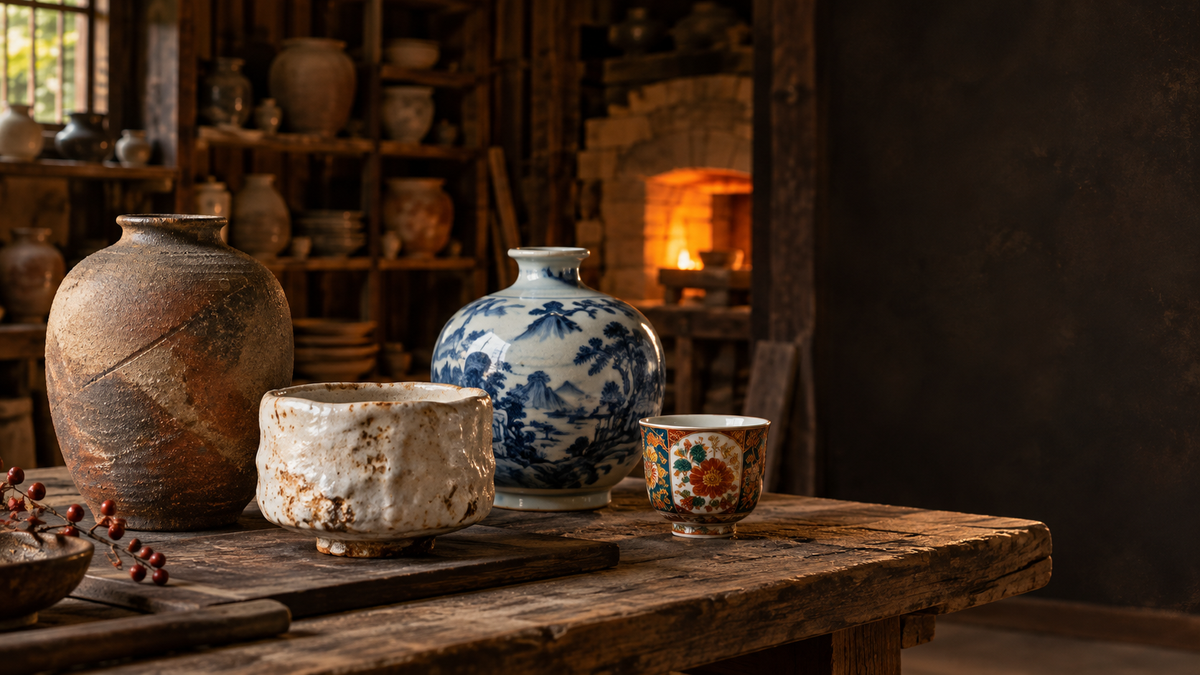
Before a Japanese pot emerges from a kiln, it has already accumulated choices: a local clay body, the pressure of a hand, the thickness of a glaze, the placement of wood and flame. Firing completes the argument. In a wood-fired kiln, ash may settle on an unglazed shoulder and melt into a natural glassy skin; in a porcelain workshop, a painted line may sharpen after the final fire. The finished object records those decisions without explaining them loudly.
That is why “Japanese pottery” is too broad a label to be useful to a collector. Japan’s ceramic traditions are regional, material and historical. Seto is not Bizen; Arita porcelain is not a Hagi tea bowl; a historic kiln, a production region, a family workshop and an individual maker are related but different things. This guide separates those categories, introduces the Six Ancient Kilns, and offers a practical way to look, buy and live with Japanese ceramics.
The short answer: what makes Japanese pottery kilns famous?
Japan’s best-known ceramic traditions became important through the combination of local raw materials, long-lived production centers, technical innovation and sustained cultural use. Tea culture, domestic dining, religious practice, export trade and contemporary studio pottery have all shaped what was made and valued. A famous Japanese pottery kiln is therefore rarely famous for one visual style alone: it is famous for a continuing relationship between place, firing practice, makers and users.
For collectors, the key question is not “which ware is best?” but “what does this object reveal about its tradition, and does that tradition suit the way I will use it?”
The Six Ancient Kilns of Japan
The term Nihon Rokkoyō, or the Six Ancient Kilns, refers to six medieval production centers with especially long and significant ceramic histories: Seto, Tokoname, Shigaraki, Echizen, Tamba and Bizen. It identifies historic ceramic regions, not six individual kilns.
| Tradition | Region | Typical character | Collector’s starting point |
|---|---|---|---|
| Seto ware | Aichi Prefecture | Glazed ceramics; broad historical range | Everyday tableware and glazed vessels |
| Tokoname ware | Aichi Prefecture | Iron-rich clay; renowned tea wares | Unglazed teapots and sculptural vessels |
| Shigaraki ware | Shiga Prefecture | Coarse clay, ash effects, warm orange tones | Vases, jars and expressive tea objects |
| Echizen ware | Fukui Prefecture | Robust unglazed stoneware | Storage jars and restrained functional forms |
| Tamba ware | Hyōgo Prefecture | Earthy stoneware; ash and slip effects | Everyday jars, cups and tableware |
| Bizen ware | Okayama Prefecture | Unglazed, wood-fired stoneware | Sake cups, flower vessels and tea objects |
Seto: the language of glaze
Seto is significant because its history encompasses a wide range of glazed ceramics. The Japanese word setomono has even been used broadly for ceramics, a reminder of the region’s long cultural presence. For a buyer, Seto is a useful entry point because it resists a single stereotype: forms can be modest or highly decorated, traditional or contemporary. Look for coherent glaze, balanced proportion and a maker or workshop whose information is clearly identified rather than relying on the regional name alone.
Tokoname: clay shaped for tea
Tokoname is particularly associated with tea vessels, including unglazed teapots made from iron-rich clay. The material and form are inseparable: a good teapot should pour cleanly, sit steadily and feel proportionate in the hand. Collectors should distinguish between a general Tokoname-style object and a piece with a documented maker. The latter may matter greatly for connoisseur collecting; the former can still be a wonderful daily vessel.
Shigaraki: clay, ash and the visible kiln
Shigaraki stoneware is often celebrated for surfaces that make firing visible. Coarse clay, feldspathic inclusions and wood-fired ash can create warm orange, cream, grey and green effects. No two firings are identical. That variability is not a license to call every rough surface “wabi-sabi”; it is a technical result that must be matched by strong form and sound finishing. Shigaraki is compelling for a single vase, a tea caddy or a quiet sculptural vessel.
Echizen and Tamba: the strength of utility
Echizen and Tamba traditions are a useful corrective to the idea that collecting ceramics must mean collecting precious display objects. Their historic stoneware production included everyday vessels, storage forms and durable domestic wares. Contemporary makers working in these regions continue that logic in cups, bowls and jars. Collect these traditions for their clarity of form, usable scale and material honesty.
Bizen: the kiln as collaborator
Bizen ware is usually unglazed and wood fired. Clay, flame, ash and placement in the kiln produce effects often described through named firing phenomena, but a collector need not memorize every term to look well. Notice whether the surface feels integral to the form rather than applied as spectacle. A Bizen sake cup can make a modest ritual—one pour, one small meal—feel more deliberate. Its appeal is not that it is universally expensive; it is that firing remains legible on the clay.
Beyond the Six: celebrated Japanese ceramic traditions
Arita and Imari: Japanese porcelain’s international vocabulary
Arita, in Saga Prefecture, became a major center of Japanese porcelain production. “Arita ware” refers to a regional porcelain tradition; “Imari” commonly describes export-oriented wares shipped from the nearby port, and is not a synonym for every piece made in Arita. Blue underglaze decoration, overglaze enamel, gold and richly patterned compositions all appear across its history. For first collectors, choose a piece whose decoration is well resolved and whose porcelain body is cleanly finished rather than buying solely for visual density.
Kutani: colour as structure
Kutani ware, associated with Ishikawa Prefecture, is known for bold overglaze decoration and a wide range of styles. It can be exuberant, graphic, finely painted or quietly modern. Arita and Kutani are often compared, but the useful distinction is not a simplistic “blue versus colour.” Ask how decoration relates to form, whether the palette is controlled, and whether the foot, rim and underside receive the same care as the painted surface.
Mino: Shino, Oribe and Kiseto
Mino ware encompasses multiple traditions in Gifu Prefecture and is especially important to tea culture. Shino is associated with soft white glazes and iron decoration; Oribe with asymmetry, green glaze and energetic design; Kiseto with warmer yellowish glaze families. Mino demonstrates why a regional label is only a starting point. A collector should learn the language of the specific style, then look at how a contemporary maker adapts it.
Hagi, Karatsu and Raku: tea vessels as encounters
Hagi ware is prized by many tea practitioners for soft-looking glazes and tactile, understated surfaces. Karatsu is admired for expressive, often rustic forms and glazes. Raku ware is inseparable from the history of the tea bowl and the Raku family lineage in Kyoto. These traditions should not be reduced to “imperfect beauty.” Their forms are disciplined, their surfaces are purposeful, and their cultural meanings deserve specificity.
Mashiko and Kyo ware
Mashiko is closely associated with twentieth-century studio pottery and the mingei or folk-craft movement; its modern identity is shaped in part by the work and influence of Shōji Hamada. Kyo ware and Kiyomizu ware refer to Kyoto’s diverse ceramic heritage, including refined painted and decorative work. Each makes a different appeal: Mashiko for studio process and functional vitality; Kyoto ceramics for breadth, technique and formal refinement.
Kilns, workshops and makers worth knowing
Collectors should use categories carefully. The Raku family kiln is a hereditary Kyoto workshop associated with tea bowls. Kakiemon and Imaemon are historic porcelain lineages in the Arita area, each with distinctive decorative histories. Fukagawa Seiji and Kōransha are porcelain manufacturers with documented institutional identities. Shōji Hamada was an individual studio potter, not a regional tradition. These examples demonstrate why a label alone cannot establish authenticity or value.
When considering a named workshop or maker, verify the spelling, location, declared lineage and current status through an official site, museum record, gallery or reputable specialist. A retailer’s product title may be useful, but it is not sufficient evidence for a historical attribution.
How to identify Japanese pottery: marks, signatures and evidence
Maker’s marks can be stamped, incised, painted, impressed or written on a base. A mark might identify a factory, a workshop, a retailer, a studio, a series or an individual artist. It may also be absent. No single rule makes a signed piece authentic or an unsigned piece inferior.
Start with the whole object: clay body, glaze, foot ring, construction, decoration and wear. Then inspect the mark. Is it consistent with the stated maker and period? Does it look integrated into the firing and finish? Is there documentation, a box inscription, a gallery label or a credible chain of ownership? A signature without provenance is a clue, not a conclusion.
For expensive acquisitions, seek a specialist opinion. Avoid cleaning marks aggressively, adding labels of your own, or treating online image comparison as conclusive authentication.
Handmade and mass-produced: a more useful distinction
“Handmade” and “factory-made” are not moral categories. A workshop may combine hand throwing, mold forming, hand glazing and controlled firing. A historic porcelain manufacturer may make work of extraordinary quality. Conversely, an object described as handmade may still be weakly designed or poorly finished.
Instead, assess the degree of maker involvement, the evidence of craft skill, material quality, consistency appropriate to the tradition, and whether the price reflects what is actually being offered. Slight variation can be meaningful; it is not automatically proof of quality. Repeatability can be excellent when it comes from a skilled workshop.
What makes Japanese pottery valuable?
Value comes from a combination of maker or workshop reputation, condition, rarity, historical importance, craftsmanship, provenance, artistic quality and market demand. A chipped masterwork may be less desirable than a pristine everyday piece; a modest local potter may make a more satisfying object for use than a famous name. Price is information, not a verdict.
Buy the best condition you can afford, unless wear is documented and appropriate to the object’s age. Ask about repairs. Look closely at rims, handles, feet and lids. Most importantly, buy with a specific use in mind. A tea bowl that fits your hands and makes you brew tea is more valuable to daily life than a prestigious object that never leaves a shelf.
Choosing Japanese pottery for your collection
For a first purchase, choose one functional object from a named tradition: a Mino cup, an Arita small plate, a Bizen sake cup or a Tokoname teapot. For tea, prioritize shape, pouring and comfort before rarity. For sake, consider how the cup’s rim and weight suit the drinker. For interiors, a single Shigaraki or Bizen vase can carry a room more elegantly than a crowded display.
For a meaningful gift, a Japanese mug, pair of cups or small bowl is often more useful than a highly specialized object. Select it for the recipient’s habits, not for a vague idea of luxury. A well-chosen ceramic object becomes persuasive through use.
A collector’s field guide: what to look for before you buy
The fastest way to become a more confident collector is to slow down before assigning a name to an object. Begin with the visual and physical facts in front of you, then connect them to a region, a workshop or a maker only when the evidence supports that connection.
Look at the material first. Porcelain is usually dense, pale and finely grained; at a thin unglazed edge it may appear slightly translucent. Stoneware is often more visibly granular and carries a warmer, earthier body. Earthenware can be more porous and lower-fired. These are useful observations, not absolute tests: glaze, firing and the maker’s choices can make any simple rule less reliable.
Turn the object over. The foot ring is often where construction becomes easiest to read. Notice whether it has been neatly trimmed, whether glaze has been wiped away with care, and whether the base sits flat. A small spur mark, a pinhole or a trace of kiln shelving can be part of ordinary firing history. What matters is whether the finish feels intentional and whether any flaw affects stability or use.
Follow the form. A cup should be comfortable at the rim and in the hand. A lidded vessel should sit well when closed. A teapot should pour without a constant dribble. Decoration can be memorable, but form decides whether an object earns a place in daily life. When choosing a bowl, imagine it filled; when choosing a vase, picture the weight and line of stems it will hold.
Read the surface in relation to the form. In a wood-fired Bizen or Shigaraki vessel, ash, flashing and color variation should appear as part of the firing rather than as random novelty. In painted porcelain, examine how line, color and empty space guide the eye around a curve. In a glaze-led Mino object, look for a relationship between thickness, pooling, texture and the contours of the pot. A dramatic surface is most convincing when it makes the form clearer.
Ask for the story in writing. For any purchase described as vintage, antique, signed or from a named kiln, request the maker’s name, approximate period, dimensions, condition notes and any provenance or original packaging. A retailer or gallery that can explain what it knows—and what it does not know—is more useful than one offering a confident but vague label. For a significant purchase, compare that information against a museum, official workshop or established specialist before deciding.
Building a collection with a point of view
A collection does not need to begin with a masterwork. It benefits more from a clear question. You might collect tea bowls that feel good to hold, blue-and-white porcelain for a dining table, or small sake cups that show different clay and firing approaches. A narrow starting point makes comparison possible: you begin to notice proportions, foot rings, glaze edges and the way makers solve the same functional problem differently.
One practical approach is to build in three layers. Start with one daily-use piece: a cup, rice bowl or small plate that lets you learn through repetition. Add one comparison piece from a different tradition, such as a translucent Arita porcelain cup beside a more tactile Mino or Bizen vessel. Finally, add one focal piece—perhaps a Shigaraki vase or a carefully chosen plate—that can stand alone on a shelf or table. This rhythm avoids both the pressure to buy rare objects immediately and the habit of acquiring pieces with no relationship to one another.
Collectors often ask whether it is better to choose old or contemporary work. Neither is inherently superior. Historical ceramics carry the appeal of survival, context and scarcity, but condition and attribution demand care. Contemporary work lets you support living makers and usually offers clearer information about authorship and use. A thoughtful collection can include both, as long as each object is represented honestly.
Care, storage and use: protecting ceramics without making them precious
Ceramics are durable, but the vulnerable points are predictable: rims, handles, lids, foot rings and abrupt temperature changes. Hand-wash valuable, handmade or metallic-decorated pieces with a soft sponge and mild detergent. Avoid stacking unprotected cups or plates, especially if their rims are thin or their glazes are textured. A square of felt, linen or plain paper between display pieces is enough to reduce friction.
Do not assume that every ceramic object is microwave- or dishwasher-safe. Gold or silver decoration should not go in a microwave. Hand-painted surfaces, low-fired earthenware, crackle glazes and repaired objects deserve gentler treatment. Avoid pouring boiling water into a cold vessel or moving a hot dish directly onto a cold surface; gradual changes in temperature are kinder to any ceramic body. When a maker provides care instructions, those instructions should override general advice.
For long-term storage, keep a written record of where and when you acquired important pieces, together with photographs of the mark and overall condition. This does not turn an object into an investment—it simply preserves useful knowledge for you, a future owner or an insurer. If an older piece develops a crack, avoid home adhesives; a qualified ceramic conservator can advise whether repair is appropriate and how it should be disclosed.
Japanese pottery and quiet living
Ceramics change a day in small, repeatable ways. A tea bowl asks for two hands. A sake cup slows a pour. A plate makes the first arrangement of food feel considered. A vessel placed alone on a shelf creates a point of rest. This is the practical heart of Oriental Artisan’s Art of Quiet Living: not accumulating symbols of culture, but choosing objects that make attention easier.
For readers ready to explore, Oriental Artisan’s Japanese ceramics collection, sake ware, and ramen bowl sets offer a useful route from learning to daily use. Shop by form and material, then return to the regional story behind the object.
FAQs
What are the Six Ancient Kilns of Japan?
They are Seto, Tokoname, Shigaraki, Echizen, Tamba and Bizen—historic ceramic production centers recognized for their long medieval and continuing traditions.
Which Japanese pottery is most famous?
There is no single answer. Arita porcelain, Kutani ware, Bizen stoneware, Raku tea bowls and Mino styles such as Shino and Oribe are among the most widely recognized, for different reasons.
What makes Bizen pottery special?
Bizen is typically unglazed, wood-fired stoneware. Its surface is shaped by clay, flame, ash and kiln placement, making firing effects central to each object’s appearance.
What is the difference between Arita and Kutani ware?
Arita is a porcelain tradition centered in Saga Prefecture, while Kutani is associated with Ishikawa Prefecture and is especially known for overglaze decoration. Both include many styles.
Are all Japanese ceramics handmade?
No. Production can range from individual studio work to workshop and factory processes. Quality should be assessed through materials, workmanship, design and documentation rather than a single label.
How can I identify a maker’s mark?
Inspect the base and any documentation, then compare with official maker, museum or specialist resources. A mark alone rarely proves authenticity.
Which Japanese pottery is best for tea?
The best choice depends on brewing style. Hagi, Raku, Mino and Tokoname traditions all offer relevant forms, but comfort, heat handling and function should guide the purchase.
Are Japanese ceramics good investments?
Some documented works by sought-after makers have collector markets, but pottery should not be bought as a guaranteed financial investment. Buy for quality, condition and lasting personal use.
What is the difference between pottery and porcelain?
Pottery is a broad everyday term for fired clay objects. Porcelain is one ceramic category, generally made from a refined body and fired to a dense, vitrified finish. Many Japanese traditions are stoneware rather than porcelain, so “Japanese pottery” can include both.
Are kiln marks always present on Japanese ceramics?
No. A mark may identify a maker, workshop, factory, retailer or series, but many objects are unsigned. Absence of a mark is not proof of poor quality, and the presence of one is not proof of authenticity.
Can Japanese ceramics go in a dishwasher or microwave?
It depends on the maker, clay body, glaze and decoration. Avoid microwaving pieces with metallic decoration, and hand-wash valuable, handmade, repaired or uncertain pieces. Follow maker-specific care guidance whenever it is available.
What is a good first Japanese ceramic to collect?
A cup, small bowl or plate from a clearly identified tradition is an excellent starting point. Choose something you will use frequently: familiarity teaches more than a display-only purchase.


Hinterlasse einen Kommentar
Diese Website ist durch hCaptcha geschützt und es gelten die allgemeinen Geschäftsbedingungen und Datenschutzbestimmungen von hCaptcha.