
How to Choose an Incense Burner for a More Beautiful Daily Ritual
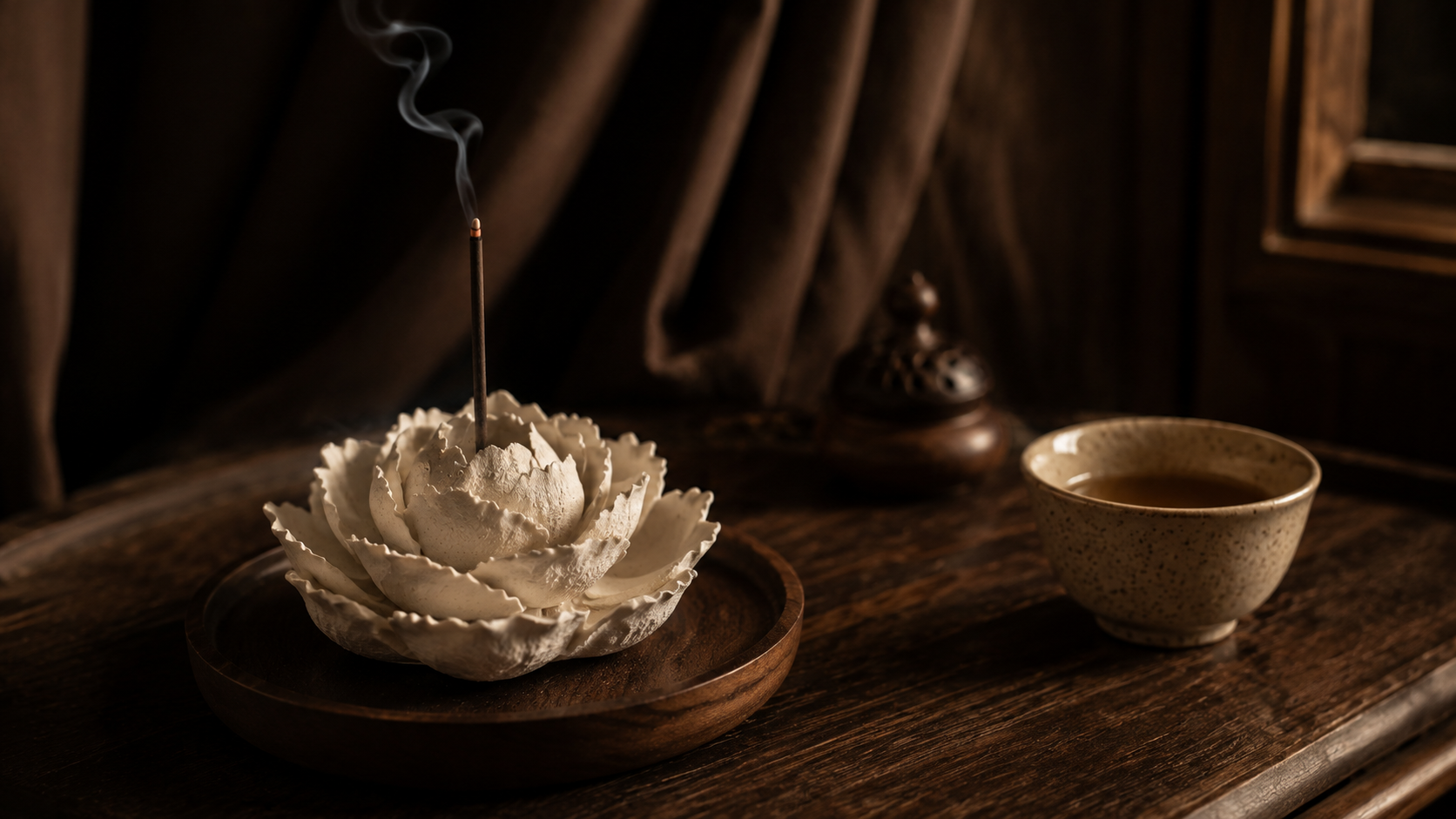
In the stillness of early morning, a single thread of smoke rises beside a cup of tea. Light catches it for a moment; then it loosens into the room. The incense burner beneath it is small enough to rest in one hand, yet it quietly changes the atmosphere around it.
Choosing an incense burner is not simply a matter of finding an object that can hold incense. The right piece affects how the incense burns, where the ash falls, how safely the ritual can be enjoyed, and how naturally it belongs in the room when nothing is burning.
The best incense burner is therefore not a universal model. It is the one that suits both the incense you burn and the way you want to live with it.
What Is an Incense Burner?
An incense burner is a heat-appropriate vessel or object designed to support the burning of incense and, depending on its form, contain ash, embers, or charcoal. It may be made for incense sticks, cones, coils, loose incense, or powdered incense.
The terms around these objects often overlap:
- An incense holder usually describes a simpler support for a stick, cone, or coil.
- An incense burner is the broadest everyday term and may refer to either an open holder or an enclosed vessel.
- A censer generally suggests a vessel used for burning incense, often with historical, ceremonial, or religious associations.
- An incense vessel is a flexible descriptive term, especially useful for artistic or traditional forms.
Terminology varies among makers and traditions. What matters most is whether the object is designed for your chosen incense and burning method.
Start With the Incense You Actually Burn
The type of incense should usually determine the burner before aesthetics do. Each format produces heat and ash differently, and each needs a compatible support.
| Incense type | Recommended burner | What to look for |
|---|---|---|
| Stick | Incense holder or ash catcher | Stability, correct hole size, and enough area for falling ash |
| Cone | Heat-resistant burner | A suitable resting surface, heat protection, and airflow |
| Coil | Wide, fire-resistant vessel | Adequate space, secure support, and airflow |
| Loose incense | Censer or specialized burner | Heat resistance and the correct ash, charcoal, or heating method |
| Incense powder | Burner or incense-seal vessel | A level ash bed and dimensions suited to the trail or seal |
Incense Burners for Sticks
The best incense holder for incense sticks keeps the stick secure and catches the ash along its full path. Check the diameter and angle of the opening: a hole that is too wide may allow the stick to lean, while one that is too narrow may not accept the bamboo core or fine Japanese-style incense you use.
Vertical holders occupy little space, but the ash-catching surface must be wide enough for the stick. Angled holders can direct ash predictably only when the tray extends beyond the burning tip. Enclosed burners also need enough interior clearance and airflow for the specified stick.
Incense Burners for Cones
An incense burner for cones needs a heat-resistant resting point because the base of the cone becomes hot as it burns. A shallow ceramic, stone, or metal dish may work when it has been made for this purpose; delicate decorative plates and unknown finishes should not be assumed suitable.
Open designs are easy to monitor and clean. Enclosed designs need functional vents. Backflow cones are a separate format and require a burner engineered with a smoke channel.
Incense Burners for Coils
Incense coils require a broad, non-combustible area and a support that prevents the glowing portion from resting on an unsuitable surface. The burner should accommodate the coil without crowding it, and air must be able to circulate around the ember.
Because coils can burn for a long time, choose a vessel made for the coil's diameter and follow both makers' instructions.
Burners for Loose Incense
Loose incense is not one standardized product. Resins, woods, herbs, and blended aromatic materials may be warmed over an electric heater, placed on a prepared charcoal, or used through another tradition-specific method. The appropriate censer therefore depends on the heat source as much as on the aromatic material.
Charcoal methods can generate intense heat and require a burner made for that use, often with insulating ash or another specified medium. Never place hot charcoal in a vessel merely because it is ceramic or metal; learn with equipment designed as a complete system.
Incense Seals and Incense Trails
In an incense-seal ritual, fine incense powder is shaped into a continuous pattern or trail on a level bed of prepared ash. It burns gradually along that path. This method requires a sufficiently broad, stable vessel and suitable tools for levelling the ash and forming the design.
A decorative stick holder is not a substitute. Beginners should choose a purpose-made incense seal set whose dimensions and tools work together.
How to Choose an Incense Burner: A Five-Part Framework
To choose an incense burner, consider five things in order: incense type, material, safety and function, size and placement, and finally the aesthetic experience. This sequence prevents a beautiful but incompatible object from becoming an expensive ornament.
- Identify the incense format. Do you burn sticks, cones, coils, loose incense, or powder? If you use more than one, choose a burner explicitly designed for multiple formats or use separate pieces.
- Choose an appropriate material. Look for a maker's clear statement that the burner and its relevant surfaces are intended for the heat and ash produced by that format.
- Examine function and safety. Consider stability, airflow, ember containment, ash direction, and how the burner protects the surface beneath it.
- Measure the setting. A burner for a narrow shelf has different requirements from one placed at the center of a tea table.
- Choose the visual and tactile character. Once the practical questions are answered, decide whether the ritual calls for quiet porcelain, earthy stoneware, aged bronze, carved stone, or another expression.
For a beginner, choose an open, stable, easy-to-clean holder made for one familiar incense format, with generous room for ash.
What Is the Best Material for an Incense Burner?
There is no single best material for every incense burner. Ceramic, porcelain, metal, and stone can all be excellent when properly designed for the intended use; wood and mixed materials require particular care around heat and embers.
Ceramic and Porcelain Incense Burners
A ceramic incense burner unites thermal practicality with artistic possibility. Clay can be wheel-thrown, hand-built, carved, pierced, molded, or sculpted. Glaze may create a lucid surface or a quiet depth of color; unglazed areas retain the direct texture of clay.
Porcelain supports crisp edges, delicate carving, subtle relief, and forms that appear light despite their solidity. A contemporary porcelain incense burner need not imitate an antique to carry the intelligence of Chinese or Japanese ceramic traditions.
Ceramics made for incense are often heat resistant in their intended configuration, but “ceramic” is not an automatic safety guarantee. Body thickness, glaze, construction, internal supports, firing, and the method of burning all matter. Confirm that the piece is intended for your incense format, especially when charcoal or prolonged heat is involved.
A handmade ceramic incense holder can remain visually complete after the ash is cleared, revealing the marks of throwing, carving, glazing, and firing on closer inspection.
Brass, Bronze, and Other Metal Incense Burners
Metal censers carry strong historical associations. In China, incense burners were sometimes created in forms that reinterpreted ancient ritual bronzes; surviving examples show how makers transformed older vessel shapes for new functions. The Metropolitan Museum of Art, for example, describes Song- and Yuan-dynasty burners that adapted earlier bronze forms while changing their scale, decoration, and tactile qualities.
Brass and bronze offer durability, visual weight, and finely cast detail. They also conduct heat, so use the piece as specified and let it cool before moving or cleaning it.
Stone Incense Holders
Stone gives an incense holder a calm physical presence. Its natural pattern and weight can make even a very simple form feel intentional, while a substantial base may improve stability for sticks.
Stones differ in their response to heat, staining, and cleaning. Choose a holder made for the relevant format; visual solidity alone does not prove heat suitability.
Wood and Mixed-Material Designs
Wood can bring warmth and beautiful joinery to incense accessories, but combustible material should not be exposed to a live ember or hot ash. A mixed-material incense holder may use a metal or ceramic insert to isolate the burning point from its wooden tray or base.
Check that the heat-resistant insert is secure and large enough to contain ash throughout the burn.
Chinese Incense Burners and the Culture of Fragrance
Across different eras and settings, fragrance in China has appeared in religious observance, domestic life, hospitality, scholarly pursuits, and the cultivation of atmosphere. Incense could accompany reading, poetry, calligraphy, contemplation, or tea, although meanings and methods varied.
Chinese makers worked in bronze, ceramic, stone, cloisonné, and other materials, shaping censers as tripods, archaic-inspired vessels, animals, mountains, and architectural forms. Museum collections show both continuity and reinvention: a Yuan bronze might evoke an ancient food vessel, while a Ming bird-shaped censer releases smoke through its open beak.
Today, a Chinese incense burner may draw on this history through proportion, tripod feet, pierced covers, monochrome glaze, painted porcelain, or sculptural symbolism. It need not reproduce a palace object to bring ceremony to an ordinary table.
Japanese Incense Holders and the Beauty of Restraint
Japanese incense appreciation likewise has its own histories and practices. Kōdō, often translated as “the way of incense,” is a disciplined culture of fragrance appreciation rather than simply another name for lighting a scented stick. Japanese government cultural material describes incense vessels as having roles in Buddhist ritual, kōdō, and ornament, a reminder that use and meaning depend on context.
Everyday Japanese incense holders are often restrained: a small ceramic rest, a shallow ash-filled vessel, or a clean-lined covered burner. Material, emptiness, shadow, and seasonal detail may carry more weight than elaborate decoration.
A hand-pinched clay rest, precise porcelain form, and iron vessel may all work in minimalist or Japandi rooms while expressing restraint in different ways.
Chinese and Japanese incense objects can sit comfortably in the same thoughtful collection, but their traditions should not be collapsed into a vague “Asian” aesthetic. Look for specific information about origin, maker, material, and intended practice.
What Makes a Handmade Incense Burner Different?
A handmade incense burner carries the accumulated decisions of its maker: where to leave weight, how thinly to turn the rim, how to place an opening, when to stop carving, which glaze will settle into a recess, and how the form may change in the kiln.
Depending on the piece, the process may include:
- hand-building or wheel throwing;
- trimming and refining the foot;
- piercing vents or carving relief;
- sculpting individual elements;
- applying slips, pigments, or glaze;
- firing once or several times;
- polishing, assembling, and inspecting by hand.
Kiln variation can give related pieces differences in color and surface. Fingerwork may leave a softness that industrial tooling would remove.
But handmade does not mean careless. An unstable base, poor ash path, sharp edge, or incompatible opening is not transformed into virtue by the word “artisan.” The finest work balances individuality with precision.
Function Comes Before Decoration
A decorative incense burner should still work beautifully. Before buying, examine six practical qualities.
Stability
The burner should sit securely. A long stick creates leverage, so the base must be steady; feet should be even, and lids or inserts should seat properly.
Heat
The area beneath the ember, cone, charcoal, or ash must suit that use. Because the burner may transfer heat to the table, use a protective surface when recommended.
Ash
Imagine the entire burn. A good ash catcher is proportioned to the incense and contains the path of a vertical or angled stick.
Airflow
Cones, coils, charcoal, and enclosed burners need enough oxygen. Vents must be functional as well as ornamental, while external drafts should not disturb ash.
Cleaning
Pierced covers, narrow chambers, textured glaze, and sculptural recesses may retain residue. Follow the maker's guidance, and avoid soaking porous or mixed-material pieces unless instructed.
Scale
Check the burner's measurements against the incense's length, angle, and ash path. A tiny holder may look exquisite yet be impractical for a long stick.
How to Choose an Incense Burner for Your Interior
An incense burner can support the atmosphere of a room without matching every object in it. Think in terms of material, proportion, and visual rhythm rather than rigid style rules.
Minimalist Interiors
Choose a simple ceramic or porcelain form with a controlled silhouette and restrained palette: white, ink-black, celadon, or earth-toned.
Wabi-Sabi Interiors
Look for natural clay, quiet glaze variation, and surfaces that reveal firing. Authentic irregularity comes from process, not decorative damage.
Japandi Spaces
Sculptural simplicity and natural materials work well. Pale stoneware complements wood and linen; dark metal can give the room visual gravity.
Contemporary Luxury Interiors
Treat the burner as a small work of art. Sculptural ceramic flowers, architectural forms, and abstract porcelain can hold their own beside books and collectible design.
Traditional Chinese-Inspired Interiors
Consider tripod forms, monochrome ceramics, pierced lids, or vessels informed by historic bronze proportions. One well-made object with a legible craft lineage brings depth without excess.
Contrast can be sophisticated: a spare porcelain holder may calm an ornate room, while a dark censer defines a pale setting. Ask not “Does it match?” but “Does it belong?”
Where Should You Place an Incense Burner?
Place an incense burner on a stable, level, heat-resistant surface where it cannot be knocked over and where smoke will not be trapped around people. Keep it away from curtains, paper, dried flowers, overhanging shelves, drafts, children, and pets, and never leave burning incense unattended.
A tea table, reading corner, study, entry console, or meditation space can work when the burner has generous clearance, a protected surface, and adequate ventilation.
Do not burn incense while sleeping or in a small, poorly ventilated room. Incense smoke contributes particulate matter to indoor air; the U.S. Environmental Protection Agency advises proper ventilation. People sensitive to smoke may choose not to burn incense. During wildfire smoke or poor outdoor-air events, avoid adding further smoke indoors.
Good placement considers people as well as objects. Do not use incense where smoke sensitivity, building rules, alarms, or shared-space etiquette make it inappropriate.
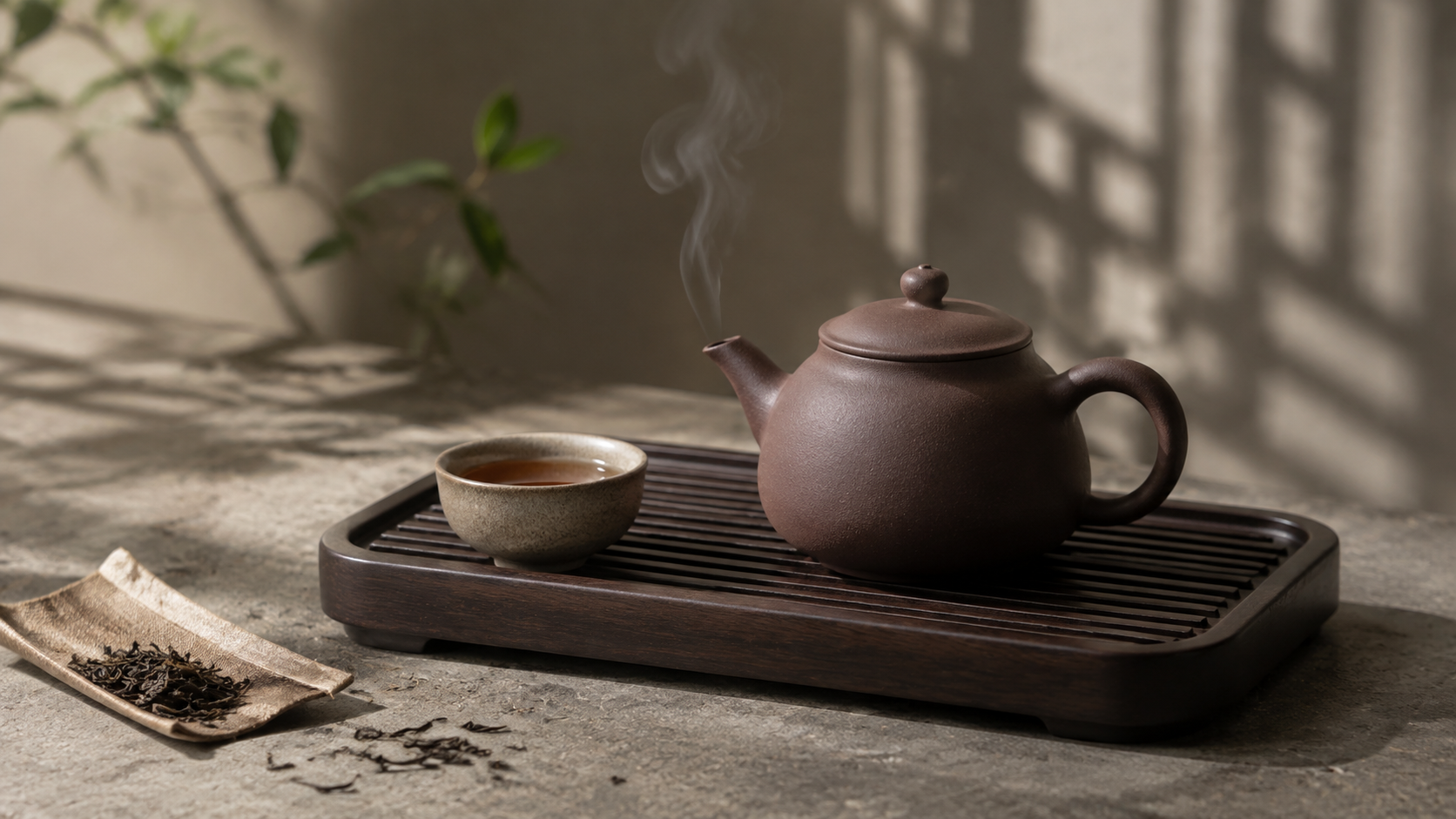
Incense and Tea: Two Quiet Rituals
Tea and incense reward many of the same qualities: attention, patience, sensory awareness, beautiful tools, and repetition. Neither requires spectacle. Their value often lies in how a familiar sequence becomes more precise over time.
Imagine warming a pot and pouring the first water while a restrained fragrance moves at the edge of perception. Incense should not overwhelm the tea; it marks a transition into attentive time.
A balanced teapot, thin porcelain cup, and well-made burner give the hands a task and the eye a place to rest. Used repeatedly, they gather memory.
This is the essence of Oriental Artisan's Art of Quiet Living: not withdrawal from everyday life, but the decision to experience it more fully through objects that reward care.
The Incense Burner as an Object of Art
A beautiful incense burner should remain visually meaningful when no incense is burning. Its form may recall a historical censer, unfold like a ceramic flower, suggest a miniature building, or reduce itself to a circle of clay with one perfectly placed opening.
Sculptural ceramic flowers soften an architectural room; lidded censers reveal smoke through patterned openings; minimal holders make the stick and its line of ash the image.
This is where functional design becomes collectible. The object does not abandon utility; it gives utility a richer presence. The finest pieces live comfortably between utility, ritual, and art.
How to Choose an Incense Burner as a Gift
An incense burner can be a thoughtful gift for a housewarming, wedding, birthday, host, tea enthusiast, meditation practitioner, design lover, or collector. It offers something sensory without being consumed immediately and something decorative without being merely ornamental.
If you know the recipient's preferred incense, choose for that format. Select an ample ash catcher for sticks, a purpose-made heat-resistant dish for cones, or a specialized set only for someone whose loose-incense method you understand.
If you do not know their preference, give a clearly described stick holder with compatible incense, or a fragrance object that does not involve combustion. Include instructions; avoid charcoal equipment for beginners.
A compact piece suits apartment living; a sculptural burner may delight a ceramics collector. Provenance and a short note about the maker add meaning.
How Much Should You Spend on an Incense Burner?
Incense burners range from basic functional holders to collectible decorative arts. Spend according to the quality of function, material, workmanship, and meaning you value—not according to price alone.
A simple holder may be inexpensive because it uses little material and is produced at scale. Studio ceramics cost more when a maker throws, trims, glazes, fires, and inspects each piece. Sculptural porcelain, carving, metal casting, special glazes, limited production, and documented provenance add labor and cost.
Expensive does not automatically mean superior. A modest, well-proportioned holder used every evening may offer more value than an elaborate censer that never feels convenient.
How to Identify a High-Quality Artisan Incense Burner
When purchasing online, look for evidence rather than adjectives: compatibility, stability, careful finishing, and clear description.
Use this checklist:
- Material quality: Is the clay, porcelain, metal, stone, or mixed construction identified? Does the maker explain the intended burning method?
- Stability: Does the base appear broad and even? Are the feet, lid, and inserts properly aligned?
- Finish: Are edges considered and surfaces complete? Intentional texture should not conceal cracks, sharp areas, or careless assembly.
- Glaze quality: Look for clear photographs and honest notes about expected kiln effects.
- Proportion: Is the ash-catching area suitable for the length and angle of the incense?
- Functional design: Are heat, airflow, ash, and cleaning addressed—not merely the shape?
- Craftsmanship: Do close images show thoughtful carving, joining, trimming, glazing, or finishing?
- Artisan provenance: Is the maker, workshop, region, or process identified? Vague “heritage” language is not provenance.
- Compatibility: Does the listing explicitly state stick, cone, coil, powder, loose incense, or charcoal use?
Also check dimensions, included tools, care instructions, variation notes, and photographs from several angles.
Common Mistakes When Buying an Incense Burner
The most common mistake is choosing entirely by appearance. A beautiful burner can be disappointing—or unsafe—if it is incompatible with the incense, too small for the ash, unstable, difficult to clean, or not designed for sustained heat.
Avoid these errors:
- Buying the wrong burner for the incense format. Stick, cone, coil, powder, and loose-incense methods are not automatically interchangeable.
- Ignoring ash direction. Measure where ash will fall, especially with long or angled sticks.
- Ignoring heat transfer. A heat-resistant burner can still make the furniture beneath it hot.
- Choosing an unstable form. Tall incense amplifies movement; a narrow or uneven base increases the risk of tipping.
- Forgetting airflow. Enclosed burners need functional vents and enough internal clearance.
- Overlooking cleaning. Intricate perforations and textured recesses can collect residue.
- Assuming every ceramic or metal object is a burner. Decorative bowls and sculptures may not be engineered for embers, cones, or charcoal.
- Confusing aroma diffusers with incense burners. Essential-oil diffusers and unheated ceramic fragrance objects may not be suitable for combustion.
- Using one vessel for every method. Charcoal and loose incense can demand very different equipment from a stick.
- Treating “handmade” as proof of quality. Ask how the piece is made and how its function has been tested or specified.
Why Oriental Artisan Celebrates the Incense Ritual
Oriental Artisan approaches an incense burner not simply as a fragrance accessory but as an object that participates in daily life. We are drawn to pieces in which material, craftsmanship, and use have been considered together: a ceramic form shaped by hand, a surface changed by fire, a traditional technique carried into a contemporary room.
What unites Chinese and Japanese craft traditions with contemporary fragrance objects is not one style, but the belief that useful things can hold cultural memory, reveal their makers' intelligence, and remain beautiful beyond function.
An incense burner may be active for only a few minutes each day. For the rest of the time, it lives among the room's books, tea wares, flowers, and light. Choosing it carefully is part of the Art of Quiet Living.
Frequently Asked Questions About Incense Burners
What is an incense burner?
An incense burner is a vessel designed to support burning incense and manage its heat, embers, or ash. Different burners serve sticks, cones, coils, loose incense, powder, or charcoal methods. “Incense holder” often means a simple support, while “censer” may carry ceremonial or historical associations. The terms overlap, so intended use matters more than the label.
How do I choose an incense burner?
Choose by incense type first, then assess material, stability, heat protection, ash, airflow, size, and cleaning. The burner should explicitly suit your stick, cone, coil, powder, or loose-incense method. Once those needs are met, select a form that belongs naturally in your space.
What is the best incense burner for beginners?
For a beginner, choose an open, stable, easy-to-clean holder for one incense format. For sticks, use a broad ash catcher with the correct hole size; for cones, a heat-resistant dish made for them. Avoid charcoal and complicated burners until you understand their heat and preparation requirements.
What is the difference between an incense burner and an incense holder?
An incense holder often describes a small support for a stick, cone, or coil; a burner may be a larger vessel that contains ash or a heat source. The terms are often interchangeable. Read the product's stated use and dimensions rather than relying on its title.
What burner should I use for incense sticks?
Use a holder that grips the stick and catches ash along its full length. Fine coreless Japanese incense may need a different opening from a thicker bamboo-cored stick. Check the angle, tray length, base stability, and nearby clearance; longer sticks need larger ash catchers.
Can I burn cones in an incense holder?
Only if the holder is designed for cones. Their bases become hot and need a heat-resistant surface with airflow. A stick holder, wooden base, or unknown dish may not be suitable. Backflow cones need a dedicated burner with a smoke channel.
What is the best material for an incense burner?
The best material is one engineered for the intended incense and heat source. Ceramic offers sculptural range, metal offers durability, and stone offers weight and natural texture. Construction matters as much as material, so confirm intended use—especially for charcoal or long-burning coils.
Are ceramic incense burners good?
Yes. A purpose-made ceramic incense burner can be durable, beautiful, and varied in shape, glaze, and carving. But not every ceramic object suits every burning method. Check whether it is designed for sticks, cones, coils, or charcoal and whether it requires a mat or insulating medium.
How do I safely use incense indoors?
Use a stable, heat-resistant surface away from flammable materials, drafts, children, and pets; never leave incense unattended. Follow both makers' instructions and ventilate appropriately. Do not burn incense while sleeping, during poor-air events, in restricted settings, or around people sensitive to smoke.
Where should an incense burner be placed?
Choose a level, heat-resistant surface where the burner cannot be knocked over and smoke can disperse. A tea table, study, meditation area, or console can work with generous clearance from paper, fabric, plants, shelves, and other combustible objects. Avoid drafts, narrow ledges, and unattended bedrooms.
How do I clean an incense burner?
Let the burner cool, then remove ash according to its care instructions. Glazed ceramic may be wipeable; porous clay, stone, patinated metal, wood, and mixed materials may need specialized cleaning. Never plunge a hot burner into water, abrade delicate finishes, or soak a piece without permission.
Why are handmade incense burners more expensive?
Handmade burners may require individual forming, trimming, carving, glazing, firing, finishing, and inspection. Multiple components, firing losses, limited output, maker skill, and provenance add cost. Handmade is not automatically superior, so assess function and finish as carefully as artistic character.
Can incense burners be used as home décor?
Yes. Ceramic flowers, abstract forms, traditional censers, and minimalist holders can function like small sculptures when not in use. Decoration should never obscure function: use the burner only with the incense formats and heat sources for which it was designed.
What makes Chinese incense burners distinctive?
Chinese incense burners span many materials, periods, and uses. Historic examples include bronze-inspired tripods, ceramic censers, animal forms, mountain-shaped vessels, and pierced covers. Contemporary pieces may reference them through proportion, glaze, or construction. Seek specific information about region, material, maker, and reference rather than a generic “Chinese-style” claim.
What should I look for when buying an artisan incense burner?
Look for clear materials, incense compatibility, stability, airflow, sufficient ash containment, careful finishing, accurate dimensions, and meaningful provenance. Photographs should show the base, openings, interior, and glaze. The best artisan holder unites character with precision: distinctive in the room and dependable in use.
Making Space for a Quieter Moment
A beautiful incense burner does not need to dominate a room. It may sit quietly on a tea table, shelf, or desk for most of the day, holding its shape in changing light.
Then, for a few minutes, it becomes the center of a ritual. Incense is lit, the flame extinguished. Smoke rises; fragrance moves through the space; attention gathers around an action small enough to repeat.
Choosing an incense burner is ultimately about more than selecting an accessory. It is a way of deciding how we want to experience the everyday: with greater care for material, atmosphere, safety, and the objects our hands return to.
Discover Oriental Artisan's collection of handcrafted incense burners and ceramic fragrance objects, created for quieter rituals.
Oriental Artisan — Art of Quiet Living.
Editorial Sources
- The Metropolitan Museum of Art: Song-dynasty incense burner
- The Metropolitan Museum of Art: Yuan-dynasty tripod incense burner
- The Metropolitan Museum of Art: Ming-dynasty goose-shaped incense burner
- Government of Japan: Kutani-yaki and incense vessels
- U.S. EPA: Sources of indoor particulate matter
- U.S. EPA: Reduce your smoke exposure

Hinterlasse einen Kommentar
Diese Website ist durch hCaptcha geschützt und es gelten die allgemeinen Geschäftsbedingungen und Datenschutzbestimmungen von hCaptcha.