

The Ultimate Guide to Yixing Zisha Teapots: Clay, Craftsmanship, Tea and Collecting
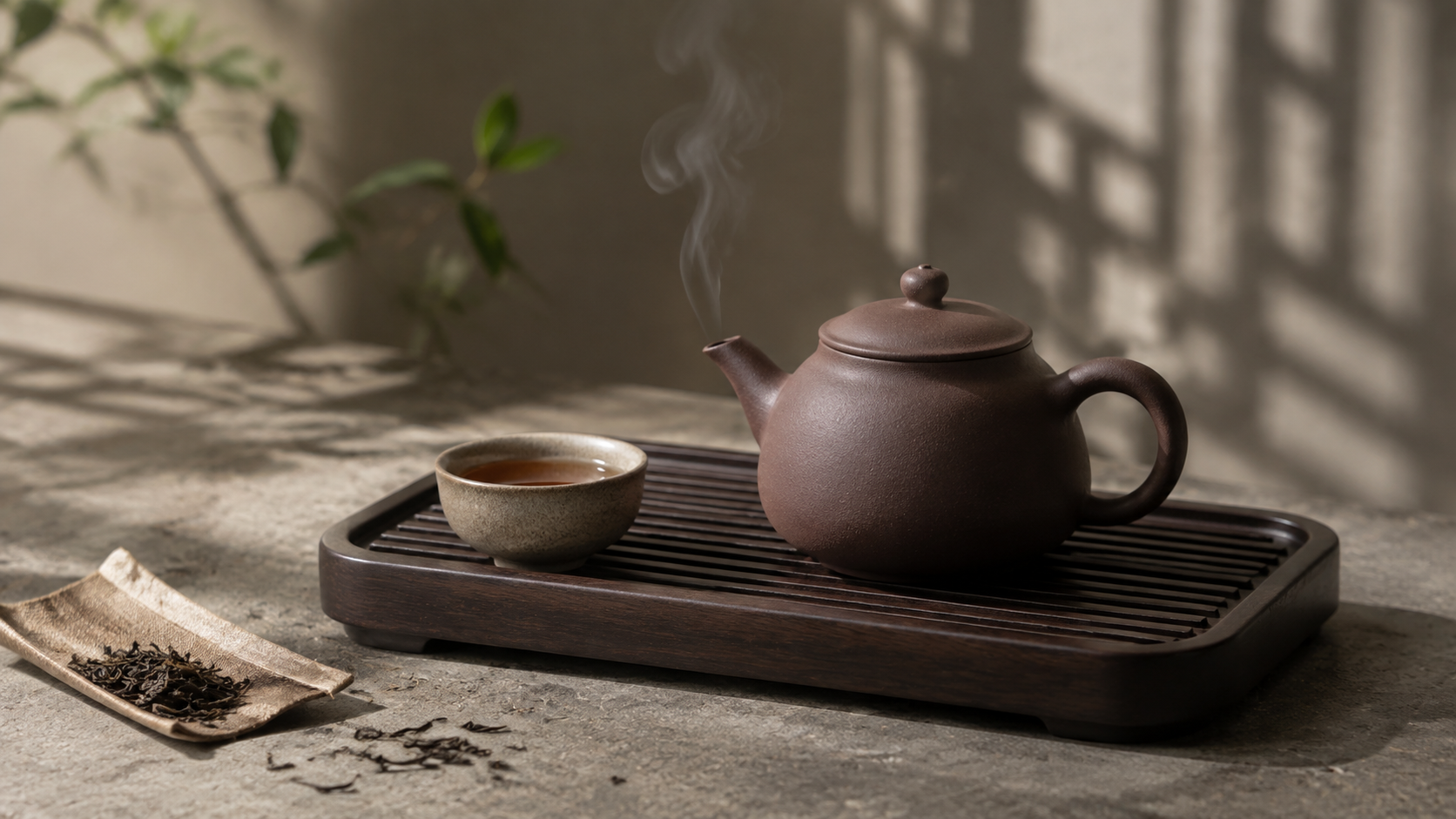
A small teapot sits beside the tea tray. It is neither glossy nor brightly painted. Its color belongs to the clay itself: perhaps the muted brown-purple of zini, the warm vermilion of zhuni, or the quiet straw tone of duanni. Hot water passes over its unglazed surface. Steam rises. Inside, a few grams of leaf unfurl through a series of brief infusions.
Used attentively, the pot changes. Its surface becomes softer in appearance, its handling more familiar, and its relationship with its owner more personal. This gradual transformation is one reason a fine Yixing teapot is unlike almost any other piece of Chinese tea ware. It is not merely purchased and displayed; it is completed through use.
Yet admiration has also produced confusion. The market is crowded with uncertain clay names, copied seals, artificial patinas, romantic legends, and supposed authenticity tests that prove very little. To understand a Yixing Zisha teapot (宜兴紫砂壶), it is necessary to begin not with mythology, but with place, material, technique, function, and provenance.
Why has one city in Jiangsu produced some of the world's most admired teapots for centuries? The answer lies in an unusually fertile meeting of local geology, changing tea habits, skilled craft communities, and the aesthetic imagination of Chinese potters and scholars.
Key Takeaways
- Yixing is a real place, not simply a style: a city in southern Jiangsu with a long ceramic tradition centered especially around Dingshu.
- Zisha (紫砂, zǐshā) is best understood as a family of mineral-rich clay materials, not one uniformly purple clay.
- Traditional Yixing teapots are generally slab-built and assembled, not wheel-thrown in the conventional sense.
- Fully handmade (全手工) and semi-handmade (半手工) describe forming methods; neither label alone proves clay quality, function, or artistic merit.
- No single home test can authenticate a teapot. Good judgment considers clay, workmanship, function, maker, documentation, seller transparency, and price together.
- Clay-to-tea pairings are useful traditions, not absolute scientific rules. Shape, capacity, wall thickness, leaf, water, and technique may matter just as much.
Part I — Understanding Yixing
Where Is Yixing?
Yixing (宜兴, Yíxīng) is a county-level city in southern Jiangsu Province, west of Lake Tai, within the Yangtze River Delta. Its best-known pottery community is concentrated around Dingshu, where local clay resources, kilns, workshops, markets, and generations of specialist makers formed a living ceramic ecosystem.
The wider Taihu region has long connected agriculture, commerce, scholarship, tea drinking, and craft production. Yixing's importance therefore cannot be reduced to a deposit of useful earth. Raw materials mattered, but so did access to consumers, accumulated kiln knowledge, networks of artisans, and the tastes of scholars and tea drinkers in nearby Jiangnan cultural centers.
To call every small brown Chinese teapot “Yixing” is to erase this geography. Yixing denotes an origin and a craft culture before it denotes a look.
Why Is Yixing Famous for Teapots?
Yixing became famous because local stoneware clays could be formed into refined, unglazed vessels that suited the emerging practice of steeping loose-leaf tea. From the Ming dynasty onward, specialized potters developed distinctive methods, while scholars helped turn the teapot into a medium for proportion, inscription, calligraphy, seal carving, and personal taste.
The result was a rare union of utility and authorship. A Yixing teapot could be small, restrained, and practical, yet also bear the conceptual weight of a scholar's object. Museum collections show how early makers explored geometric bodies, naturalistic forms, inscriptions, and unglazed surfaces rather than treating the teapot as a reduced porcelain ewer. The Metropolitan Museum of Art notes that Yixing potters are often credited with adapting earlier wine-vessel forms to the needs of sixteenth-century tea drinkers using steeped leaves.
Yixing remains a living center rather than a vanished historical school. Its streets, studios, clay-working traditions, and contemporary makers continue to evolve. UNESCO's recognition of the conservation of Yixing's Gunan Street Historic Block is a useful reminder that the tradition belongs to a community and an urban landscape, not only to objects in display cases.
Part II — A Short History of the Yixing Teapot
Ceramics had been produced in the Yixing area long before the classic Zisha teapot emerged. The decisive period for teapot culture, however, was the Ming dynasty (1368–1644). Changes in imperial policy and taste helped move elite tea culture away from preparing powdered or compressed tea toward steeping loose leaves. A vessel designed for infusion became increasingly important.
By the sixteenth and early seventeenth centuries, named Yixing makers appeared in written histories and surviving works. Gong Chun (供春) is traditionally placed near the beginning of the canonical story, although objects attributed to him require especially cautious scrutiny. Shi Dabin (时大彬) is far more securely central to early Zisha history; museums hold teapots associated with him in compact, sculptural, and geometric forms. The National Museum of Asian Art, for example, records Ming-period unglazed stoneware works attributed to Shi Dabin, while also cataloguing later pots bearing false marks—material proof that copied names are not a modern problem.
During the Qing dynasty (1644–1911), the field broadened. Naturalistic vessels imitated fruits, branches, nuts, and organic textures. Refined geometric forms continued. Potters such as Chen Mingyuan (陈鸣远) became celebrated for technical versatility and lifelike modelling. Literati collaborations brought inscriptions, calligraphy, painting, poetry, and seal-carving aesthetics directly onto the clay.
The early nineteenth-century Mansheng teapots (曼生壶) offer an especially important model of collaboration. The scholar-official and artist Chen Mansheng designed or inspired forms and inscriptions, while accomplished potters executed the vessels. In such works, maker, designer, calligrapher, carver, clay, and user all participate in meaning. This is why the finest Zisha occupies a compelling middle ground between functional Chinese tea ware and literati art.
In the twentieth century, political disruption, factory organization, art education, and later market revival changed how teapots were made and circulated. Masters including Gu Jingzhou (顾景舟) helped establish modern standards of form and workmanship. Contemporary Yixing now encompasses studio art, recognized masters, skilled independent artisans, factory production, mold-assisted ware, industrial goods, experimental ceramics, and large quantities of misleading merchandise. “Modern” is not a synonym for inferior; it simply makes documentation and connoisseurship more important.
Part III — What Exactly Is Zisha (紫砂)?
What Is Zisha Clay?
紫砂 (zǐshā), literally “purple sand,” refers to a family of iron-bearing, mineral-rich clay materials traditionally associated with the Yixing region. It is not one standardized clay and does not always fire purple. Different raw ores, preparation methods, particle sizes, blends, firing schedules, and kiln atmospheres can produce brown, red, orange, buff, yellow, gray, or muted greenish results.
“Purple clay” is convenient English, but misleading when treated as a literal color guarantee. In everyday trade, Zisha may function as an umbrella term, while names such as zini, zhuni, and duanni identify broad material categories. Historical vocabulary, mine-local terminology, factory recipes, artisan usage, and modern marketing do not always align. Two sellers may use the same name for materially different clay, or different names for related blends.
Scientific characterization of clays from deposits around Huanglong Mountain has found distinct mineralogical and elemental groupings. Studies of historical Zisha bodies also identify a deliberately processed, iron-rich ceramic with characteristic pore structures. In accessible terms, the material contains clay minerals together with quartz, iron-bearing phases, and other mineral components. During firing, chemical and structural changes create a hard stoneware body with its natural color extending through the material rather than sitting on top as glaze.
Several qualifications matter:
- Iron content influences color, but color is not determined by iron alone.
- Particle structure and firing influence porosity, but a teapot is not a sponge.
- Aging the prepared clay can improve workability and consistency; it does not confer mystical energy.
- Natural variation is normal, yet visible speckling alone does not prove authenticity.
- Additives and blends exist, historically and today. Their presence, purpose, safety, and disclosure matter more than simplistic ideas of absolute purity.
Zisha's practical appeal comes from the combination of a relatively fine working body, structural strength after firing, unglazed tactile character, and the control it gives a skilled maker. Claims that minerals automatically detoxify water, cure illness, or transform any tea should be rejected unless supported by credible evidence.
Part IV — Major Yixing Clay Types
Clay classifications are best treated as informed categories, not immutable chemical species. Natural deposits vary, processing alters the body, and commercial terminology is often loose.
Zini (紫泥)
Zini (紫泥, zǐní) is the foundational “purple clay” category of Zisha. Depending on the material and firing, it may appear purple-brown, chestnut, dark brown, or reddish brown rather than vividly purple. It is generally workable, structurally dependable, and versatile, which helps explain its central place in traditional Yixing production.
Tea practitioners often choose zini for roasted oolongs, Wuyi rock tea, pu-erh, black tea, or aged white tea. Those are conventions rather than guarantees. A thin, small zini pot and a thick, large one will manage heat very differently.
Zhuni (朱泥)
Zhuni (朱泥, zhūní), literally “vermilion clay,” is admired for its fine texture, warm red-orange fired color, crisp expression of form, and demanding behavior during drying and firing. Its comparatively high shrinkage and sensitivity can make successful production more difficult.
Well-made zhuni pots often feel taut and precise, with thin walls and a clear visual rhythm. Tea drinkers frequently pair them with aromatic oolongs such as Dancong, Tieguanyin, or Wuyi teas, especially in smaller capacities.
The term is also heavily misused. Bright red color does not prove zhuni; pigments, blended bodies, surface treatments, and photography can all mislead. Nor does every authentic zhuni pot have the same hue or sound.
Zhuni vs Hongni (朱泥 vs 红泥)
Hongni (红泥, hóngní) means “red clay” and is generally a broader category of red-firing Yixing material. Zhuni is treated by collectors and makers as a more specific material tradition with finer texture and distinctive working and shrinkage behavior. The boundary is not always consistently applied in commerce, so a serious description should give more than a color name.
Duanni (段泥)
Duanni (段泥, duànní) encompasses naturally occurring or prepared Zisha materials that often fire buff, beige, yellow, tan, gray, or subdued greenish brown. Its appearance can be softly granular and visually complex, making it especially attractive in restrained geometric forms.
The category includes considerable mineral and visual variation. Pale color does not automatically mean rarity, and “duanni” should not be assumed to describe one recipe. Many tea drinkers use it for lightly roasted oolong, raw pu-erh, white tea, or black tea, but pale clay can show staining sooner and benefits from careful rinsing.
Lüni and Benshan Lüni (绿泥 / 本山绿泥)
Lüni (绿泥, lǜní) means “green clay,” while Benshan Lüni (本山绿泥) refers to a valued material historically associated with the local “original mountain” deposits. The raw mineral's name does not mean that a naturally fired teapot should be emerald green. Finished colors are more often pale yellow, oatmeal, beige, buff, or quietly green-gray.**
Bright candy-green pots deserve questions about pigments, blends, and surface treatment. Genuine material can be scarce and terminology unreliable, so “rare green clay” should never be accepted without documentation.
Jiangponi (降坡泥)
Jiangponi (降坡泥, jiàngpōní) is a comparatively modern clay name associated with material encountered during slope-lowering road works in the Dingshu area. Its naturally mixed mineral character can fire in variegated reddish brown, orange-brown, yellow-brown, or muted earthy tones, sometimes with visible granulation.**
Because the term has become popular, not every pot sold as jiangponi can be linked to the original material. It is better to ask how the clay was sourced and prepared than to rely on a romantic discovery story.
Other Zisha Terms
Buyers may encounter Qingshuini (清水泥), often used for a comparatively straightforward zini body; Dicaoqing (底槽青), a prized zini-related material term; Hongpao (红袍) or Dahongpao (大红袍), used inconsistently for vivid red materials; and numerous mine, layer, recipe, or period-specific names. The more extraordinary the name, the greater the need for evidence.
| Clay | Chinese name | Typical fired color | General character | Production difficulty | Common tea use |
|---|---|---|---|---|---|
| Zini | 紫泥 | Purple-brown to chestnut | Versatile, grounded, often moderately textured | Moderate | Pu-erh, Yancha, black tea, aged white tea |
| Zhuni | 朱泥 | Red-orange to vermilion | Fine, taut, often crisp and thin | High; shrinkage and firing sensitivity | Dancong, Tieguanyin, aromatic oolong |
| Hongni | 红泥 | Red to reddish brown | Broad red-clay category; properties vary | Variable | Oolong, black tea |
| Duanni | 段泥 | Buff, beige, tan, yellow-gray | Pale, softly granular, highly variable | Variable | Lighter oolong, raw pu-erh, white tea |
| Benshan Lüni | 本山绿泥 | Oatmeal, pale yellow, green-gray | Fine pale material; terminology often abused | Often demanding; credible material may be scarce | Lighter aromatic teas, depending on form |
| Jiangponi | 降坡泥 | Mixed red-, orange-, or yellow-brown | Variegated, mineral, earthy | Variable | Broadly versatile; roasted oolong and pu-erh are common |
Tea-pairing caveat: these are practitioner preferences, not fixed scientific rules. Pot geometry, wall thickness, firing, capacity, water, and technique may affect a brew as much as the clay label.
Part V — How a Yixing Teapot Is Made
Preparing the Clay
Traditional preparation begins well before forming. Ore is selected, weathered or allowed to break down, crushed, screened, refined, mixed with water, and worked into a usable body. It may then be rested or aged. Exact processes vary between workshops and materials. Responsible sellers should distinguish a meaningful account of provenance from claims that every batch came from an impossibly famous old stockpile.
Forming the Body
Traditional handmade Yixing teapots are not normally wheel-thrown like a conventional round vase. The maker first pounds and rolls prepared clay into slabs and strips of controlled thickness.
For rounded bodies, 打身筒 (dǎ shēntǒng) may be translated as “paddling the body cylinder.” A clay slab is joined into a cylinder, then gradually beaten and shaped with a wooden paddle while supported and controlled from within. For angular or geometric bodies, 镶身筒 (xiāng shēntǒng) is an assembling method in which cut slabs are joined to construct the form.
The apparent simplicity of a sphere, pear, or low rectangle conceals difficult judgments: how much the clay will shrink, how the walls will move, where visual weight should sit, and how the completed pot will feel when filled.
Spout, Handle, Lid and Assembly
The spout and handle are made separately, then joined to the body with carefully prepared clay slip. Their placement must work visually and mechanically. The handle should balance the filled pot; the spout must support a clean flow; the lid must relate convincingly to the body's curve or geometry.
A good maker thinks in lines. The top of the spout, the knob, and the handle may establish an intentional visual relationship. On a strong teapot, no component looks pasted on or merely decorative.
Surface Refinement and Seals
Wood, bamboo, horn, metal, and other specialist tools are used to compress, scrape, smooth, define, and finish the surface. Subtle traces inside the pot can sometimes reveal how it was formed, but they require informed interpretation. They are not a do-it-yourself certificate.
Maker's seals or chops may appear beneath the base, inside the lid, under the handle, or elsewhere. They can record authorship or workshop identity. They can also be copied, transferred, used with permission, or falsely applied. A seal is evidence to investigate—not proof by itself.
Firing
The assembled pot must dry evenly before firing. Temperature, kiln atmosphere, placement, clay preparation, and cooling affect shrinkage, color, warping, texture, and the survival of precise joints. Zhuni's reputation for difficulty is tied partly to its movement during drying and firing. A successful pot is therefore not only well-shaped clay; it is a form that has survived transformation by heat.
Part VI — Fully Handmade, Semi-Handmade and Industrial Teapots
What Does 全手工 Mean?
全手工 (quán shǒugōng), or fully handmade, normally means that the body is formed from clay slabs by hand without using a mold to determine its principal form. The maker may still use templates, gauges, paddles, scrapers, and many specialized tools. “Fully handmade” does not mean “made without tools.”
This method allows sensitive variation and demands close control of thickness, symmetry or deliberate asymmetry, joining, and shrinkage. It often supports stronger claims to individual authorship, but the label is not a quality guarantee.
What Does 半手工 Mean?
半手工 (bàn shǒugōng), or semi-handmade, usually describes mold-assisted production in which slabs are pressed or worked against a form, while assembly, finishing, spout, handle, lid, and other operations retain varying degrees of handwork. A skilled maker can produce an excellent, functional semi-handmade pot.
The mold improves repeatability and production efficiency. It does not automatically make the teapot bad, just as the absence of a mold does not automatically make it beautiful.
| Feature | Fully handmade | Semi-handmade / mold-assisted | Industrial |
|---|---|---|---|
| Forming method | Slabs shaped without a body mold | Slabs shaped with molds or form aids | Pressing, casting, machine forming, or high-volume processes |
| Artisan involvement | High; one maker may control most stages | Moderate to high; varies by workshop | Low to variable; divided production common |
| Variation | Individual variation expected | More consistent repeated forms | High uniformity |
| Production volume | Low | Moderate | High |
| Collectibility | Potentially high when maker, form, clay, and provenance justify it | Can be collectible, but usually valued more for function and workmanship | Usually functional or decorative rather than author-based |
| Typical price logic | Labor, skill, authorship, rarity, provenance | Clay, finish, function, workshop quality | Volume, branding, decoration, retail channel |
A sound purchase evaluates clay, proportion, workmanship, function, maker, transparency, and price together. “Handmade” printed on a listing is not enough.
Part VII — Famous Yixing Teapot Shapes
- Xishi (西施): A rounded, full-bodied form with a compact silhouette, traditionally associated by name with the legendary beauty Xi Shi. Its generous belly suits leaves that need room, while the soft profile feels intimate in the hand.
- Shipiao (石瓢): Literally “stone ladle,” usually a low, triangular or trapezoidal body with a restrained bridge handle and decisive spout. It is architectural, stable, and one of the great tests of proportion.
- Shuiping (水平): The “level” pot is closely associated with southern Gongfu tea. Compact, balanced, and practical, it was designed to behave well in small-vessel brewing and when hot water is poured over the exterior.
- Fanggu (仿古): A broad, rounded, compressed form whose name suggests modelling after antiquity. Its strong shoulder and calm symmetry can give it substantial visual presence.
- Duoqiu (掇球): A composition of gathered or stacked spheres. Body, lid, and knob continue a rhythm of rounded volumes, making alignment especially important.
- Jinglan (井栏): The “well railing” form evokes traditional well architecture. It is typically cylindrical and structurally quiet, with a scholarly, understated character.
- Qin Quan (秦权): Inspired by an ancient Qin counterweight, this form usually rises from a grounded base toward a narrower top. It feels historical and sculptural without requiring surface ornament.
- Wendan (文旦): A graceful, fruit-like form related to pomelo or citrus imagery, often with a poised oval body. It can combine softness with a slightly more lifted posture than Xishi.
- Longdan (龙蛋): The “dragon egg” is an oval, egg-like form valued for its compact unity and tactile warmth.
- Mengchen-style pots: Small pots linked by name and collector tradition to Hui Mengchen (惠孟臣) and later southern Gongfu practice. The term is used broadly today, so it should not be mistaken for a claim of historical authorship.
Shape is not merely visual. A broad opening makes loading large leaves easier; a compact round body can support heat retention; a fast, direct pour suits short infusions; and a thin wall may protect high aromatics better than a thick, heat-heavy body.
Part VIII — Why Tea Enthusiasts Love Yixing Teapots
Zisha is valued because material, scale, and handling work together. A small pot concentrates attention. The brewer learns its speed, weight, heat, and angle. The unglazed surface offers tactile warmth rather than porcelain gloss, while the sculpted handle and lid make each infusion a physical act.
Depending on wall thickness and form, Yixing stoneware can retain heat effectively for teas brewed at high temperature. Spout geometry and filter design influence flow. A well-balanced handle makes precise pouring easier. Small capacities suit Gongfu tea, in which a relatively high leaf-to-water ratio and repeated short infusions reveal change over time.
Do Yixing Teapots Absorb Tea?
Zisha is unglazed and contains pores, so its surface can retain small amounts of tea compounds over repeated use. This contributes to scent memory and gradual patina, but the pot should not be imagined as a sponge that permanently absorbs every infusion. The practical effect depends on clay body, firing, surface, cleaning, and use.
Scientific studies support the presence of pore structures in historical and experimental Zisha bodies. They do not prove every popular claim about flavor. Experienced drinkers may perceive a rounding of texture or moderation of sharp notes, but results vary. A good pot does not “magically improve” every tea, and some teas may taste clearer in porcelain.
Part IX — Which Tea Is Best for a Yixing Teapot?
There is no universal best pairing, but these starting points are practical:
| Tea | Useful pot characteristics | Common clay preferences |
|---|---|---|
| Ripe pu-erh | Good heat retention; easy-clean opening; medium or compact body | Zini, dark zini, jiangponi |
| Aged raw pu-erh | Balanced heat; moderate wall; controlled pour | Zini, duanni, jiangponi |
| Wuyi rock tea / Yancha | Small-to-medium capacity; fast pour; good heat | Zini, zhuni, hongni |
| Dancong | Thin-to-medium wall; quick pour; aroma-conscious shape | Zhuni, hongni; porcelain is also excellent |
| Tieguanyin | Round body for rolled leaf; relatively fast pour | Zhuni, hongni, lighter duanni |
| Black tea | Moderate heat and open shape; avoid stewing fine leaf | Zini, hongni, jiangponi |
| Aged white tea | Good heat for compressed or mature leaf | Zini or duanni; larger opening helps |
For fresh green tea and very delicate white tea, porcelain, glass, or a thin-walled gaiwan often offers easier temperature control and greater aromatic clarity. A thin, wide Yixing pot can still work, but “Yixing is always superior” is the wrong premise.
Shape, wall thickness, capacity, pour speed, and brewing technique can matter as much as clay type. Begin with the tea you drink most, then choose a pot whose geometry supports it.
Part X — Do You Need One Yixing Teapot for Every Tea?
No. A beginner does not need a separate Yixing teapot for every tea. It is sensible to dedicate an unglazed pot to one broad tea family—such as roasted oolong or pu-erh—especially when those teas have strong, persistent aromas. Closely related teas can usually share a well-rinsed pot without difficulty.
Dedication is partly practical and partly ritual. Avoid moving a pot repeatedly between strongly flavored ripe pu-erh, perfumed tea, and delicate oolong. If you explore many tea styles, use a porcelain gaiwan as a neutral reference and reserve your Yixing pot for the family it handles best.
Part XI — How to Identify a High-Quality Yixing Teapot
1. Examine the Clay
Natural Zisha usually has visual depth rather than flat plastic uniformity. Under close light, fine mineral variation may appear. The surface should feel coherent with the form—not chalky, greasy, heavily lacquered, or artificially glittering. Yet texture and speckles can be imitated; photography also distorts color.
Ask for the clay name in Chinese, its source or workshop description, whether it is blended, and whether colorants were used. A transparent “we do not know” is more trustworthy than an impossible pedigree.
2. Judge Proportion
Look at the pot as a silhouette. Does the spout continue the body's energy? Does the handle balance it? Is the knob appropriately scaled? Does the lid feel integrated rather than added? Famous forms are easy to copy superficially and difficult to resolve convincingly.
3. Understand Lid Fit
A well-made lid should seat securely, turn or lift appropriately for the design, and avoid excessive wobble. It need not be laboratory-airtight. Clay shrinks in firing; gallery-grade precision is admirable, but zero movement is neither universal nor proof of authenticity.
4. Test the Pour
The stream should suit the pot's intended use: coherent, controllable, and reasonably quick. Check dripping, stopping behavior, lid security, filter resistance, and whether the air hole functions. A tiny final drip is not automatically a defect; persistent running, choking, or poor balance deserves attention.
5. Hold the Handle
Assess the pot when filled, not empty. The handle should give control without forcing the fingers into an awkward angle or bringing them too close to hot clay. Comfort matters more than a dramatic flourish.
6. Read the Surface and Interior Carefully
Aggressive machine polishing, waxy coatings, simulated dirt, and excessively uniform “antique” wear are warning signs. Internal seams, slab joins, tool traces, and finishing can offer clues about manufacture, but authentic makers can refine traces away and counterfeiters can add them. No single mark decides the case.
7. Treat Artisan Marks as One Piece of Evidence
Compare seal placement, carving, published examples, chronology, workmanship, and provenance. A famous name on a mediocre pot should increase skepticism, not value.
8. Demand Coherent Provenance
For contemporary work, provenance may include the maker's identity, studio, clay description, construction method, dated certificate, photographs, invoice, and a seller willing to answer specific questions. For historic pieces, ownership history, old publications, excavation context, scientific analysis, and specialist opinion may matter. Provenance is a chain of evidence, not a decorative certificate.
Part XII — Common Myths About Yixing Teapots
| Myth | More reliable view |
|---|---|
| “Real Zisha must absorb water instantly.” | Wetting behavior varies with firing, surface finishing, temperature, cleanliness, and the water itself. It is not an authentication test. |
| “Cover the spout and the lid must never fall.” | Airflow behavior depends on vent, fit, water level, and design. This trick proves neither age nor clay. |
| “A ringing sound proves authenticity.” | Sound changes with shape, thickness, firing, cracks, and how the pot is struck. Striking can damage the pot and proves little. |
| “Brighter color means better clay.” | Vivid color may come from lighting, editing, firing, blends, or additives. Natural quality cannot be ranked by saturation. |
| “Old-looking means antique.” | Artificial patina, wax, staining, burial, abrasion, and copied seals can create age effects. |
| “All handmade pots are valuable.” | Poor proportion and function remain poor even when made by hand. Authorship and execution matter. |
| “A famous seal proves the maker.” | Famous marks have been copied for centuries. Museums catalogue false marks on Yixing ware. |
| “Expensive means authentic.” | Price can reflect branding, scarcity narratives, or speculation. Evidence must support the claim. |
| “One clay is objectively best for one tea.” | Pairing is contextual and partly personal. Geometry and technique are equally important. |
The deeper lesson is simple: authenticity is cumulative. It emerges from a coherent set of material, technical, stylistic, documentary, and commercial facts—not a party trick.
Part XIII — Why Are Yixing Teapots So Expensive?
A Yixing teapot can be expensive because good clay preparation, low-volume slab construction, precise assembly, firing risk, skilled authorship, and credible provenance require time and knowledge. Prices rise further when a recognized maker, exceptional artistry, rarity, publication history, or historical importance is involved. Not every authentic pot, however, should cost thousands.
It is helpful to separate four markets:
- Functional Yixing teapot: made for daily brewing, often industrial or mold-assisted, with value concentrated in safe material, usable proportions, and honest description.
- Artisan teapot: low-volume work with meaningful hand finishing, stronger form, better function, identified maker or workshop, and more considered clay.
- Collectible contemporary work: individual authorship, technical or artistic distinction, documented provenance, limited production, and a market for the maker.
- Important historical work: evaluated through scholarship, condition, stylistic analysis, provenance, and sometimes scientific testing; prices may enter an entirely different category.
There is no honest universal price for a “genuine” pot. At the lowest end, extremely cheap claims of rare clay, full handwork, famous authorship, and antique age cannot all be credible at once. At the upper end, a large price tag is not evidence. Buy the level of authorship and documentation you can actually verify.
Part XIV — How to Care for a Yixing Teapot
First Cleaning
Rinse a new pot thoroughly with clean warm water. Inspect it for dust, loose particles, waxy coatings, chemical odors, or damage. A simple soak and several rinses are usually sufficient. Boiling the pot with tofu, sugarcane, or tea is not necessary and may cause cracking, staining, or contamination.
Brewing and Rinsing
Preheat gently rather than shocking a cold pot with extreme temperature changes. After tea, remove the leaves promptly and rinse with hot water. Use a soft cloth only on the exterior. Avoid perfumed detergent for routine cleaning because an unglazed surface and inaccessible spaces can retain odor; if sanitation genuinely requires detergent, use a minimal unscented product and rinse exceptionally well.
Drying and Storage
Let the body and lid dry completely, separately, in moving air. Do not close a damp pot and leave it in a cabinet. That is the simplest way to create mold and stale odors. Store away from cooking fumes, perfume, incense smoke, and direct greasy contact.
What Is 养壶 (Yang Hu)?
养壶 (yǎng hú), literally “nurturing the pot,” is the gradual care of a Yixing teapot through clean, repeated use. Tea and handling can deepen the surface's appearance over time, creating a restrained patina. The goal is not a greasy shine: wax, oil, heavy tea coating, and aggressive polishing produce an artificial surface and may trap odors.
If mold appears, stop using the pot, rinse and gently clean it, use hot water as appropriate, and allow complete drying. Persistent odor, unknown coatings, or suspicious materials justify retiring the pot until it can be assessed.
Part XV — Yixing Teapots as Collectible Chinese Art
Exceptional Zisha is collected because it condenses sculpture, design, material knowledge, tea culture, and authorship into an intimate object. The best geometric pots achieve tension through millimeters: the lift of a spout, the compression of a belly, the space beneath a handle, the continuation of a lid line. Naturalistic pots can transform clay into bamboo, fruit, bark, or seedpod without losing function.
Inscriptions add another layer. A few carved characters can join vessel and poem; calligraphic line must respond to a curved, resistant surface. Seal carving links authorship to the broader culture of the scholar's studio. Collaborative works may unite designer, potter, calligrapher, and carver.
Collectors therefore consider more than age. They study form, clay, technique, artistic identity, rarity within an artist's work, inscriptions, condition, publication, exhibition, and provenance. A superb contemporary teapot may be more significant than an undistinguished older one. Investment appreciation is never guaranteed and should not replace connoisseurship.
Part XVI — Yixing in Contemporary Luxury Living
A classic Yixing pot can feel strikingly contemporary because it rarely depends on ostentation. Its unglazed surface, compressed geometry, earth color, and small scale sit naturally within minimalist, wabi-sabi, Japandi, and contemporary Chinese interiors. Yet reducing it to décor misses its deepest quality.
The teapot earns beauty by working: filled, poured, rinsed, dried, and returned to its place. Over months and years, the owner learns its balance and the clay develops a quieter surface. This is luxury as knowledge and continuity rather than display.
That relationship expresses Oriental Artisan's philosophy, Art of Quiet Living. The object matters because it changes the quality of an ordinary act.
Part XVII — How to Buy a Yixing Teapot Without Getting Misled
Before buying, ask:
- What clay is claimed, and is its Chinese name given?
- Was the pot made in Yixing, and can the seller explain the workshop or maker?
- Is it fully handmade, semi-handmade, or industrially produced?
- Who made it, and what exactly does the certificate establish?
- Is clay or production provenance available?
- Were pigments, chemical colorants, coatings, or waxes used?
- What is the capacity, empty weight, wall character, and pour time?
- Which tea and brewing style will it serve?
- Are photographs clear, color-consistent, and detailed inside and out?
- Does the seller distinguish facts from tradition and opinion?
- Are claims of rarity, age, old-stock clay, or famous authorship supported?
- Is the price coherent with the labor, maker, material, and documentation claimed?
- What is the return policy if the pot is materially misdescribed or unusable?
For a first pot, function and transparency matter more than an exotic clay name. Choose a moderate capacity suited to how many people you serve, a shape that is easy to load and clean, and a tea family you already enjoy. A good first teapot should make you want to brew, not make you afraid to touch it.
Part XVIII — The Oriental Artisan Approach to Yixing
Oriental Artisan approaches Yixing as a living discipline rather than a merchandise label. Our curation considers the credibility and character of the clay, clarity of construction, proportion, lid and pour, tactile balance, artisan identity, and the way a vessel may mature through long use.
We also believe description is part of connoisseurship. A teapot should not be elevated by mythology that cannot be supported. Fully handmade work deserves to be identified accurately; fine mold-assisted work should not be disguised or dismissed; a clay name should be presented with appropriate context; and seals should never substitute for provenance.
The aim is not simply to sell “purple clay teapots,” but to connect international tea drinkers and collectors with the extraordinary material intelligence of Yixing. We invite you to explore Oriental Artisan's curated Yixing Zisha teapot collection with the same questions this guide encourages: What is this clay? How was this form made? How does it pour? Who stands behind it? And how might it become part of your own tea life?
FAQ — Yixing Zisha Teapots
1. What is a Yixing teapot?
A Yixing teapot is an unglazed stoneware teapot associated with Yixing in Jiangsu Province, especially its Dingshu pottery community. Classic examples are made from Zisha clay and formed from slabs rather than conventionally wheel-thrown. They are valued for Gongfu tea, tactile surfaces, specialized craftsmanship, and, at the highest level, artistic authorship and collectibility.
2. What does Zisha mean?
Zisha (紫砂, zǐshā) literally means “purple sand.” In practice, it refers to a family of iron-rich mineral clay materials used in Yixing pottery. It is not one single purple-colored clay. Zini, zhuni, duanni, and related materials can fire in purple-brown, red, orange, buff, tan, gray, and other subdued earth colors.
3. Where are Yixing teapots made?
They are associated with Yixing, a city in southern Jiangsu Province near Lake Tai, with production concentrated historically and today around Dingshu. A teapot that merely imitates the appearance of Yixing ware but is made elsewhere should not be presented as having Yixing origin without clear qualification.
4. Why is Yixing clay special?
Yixing's Zisha materials can be refined into strong, unglazed stoneware with distinctive natural colors, textures, and pore structures. They also suit the slab-forming and detailed finishing methods developed by local potters. Their importance comes from the union of material properties, centuries of accumulated technique, tea use, and artistic culture—not minerals alone.
5. Are Yixing teapots really made from purple clay?
Some are made from zini that fires purple-brown, but “purple clay” is an imperfect umbrella translation. Authentic Zisha can be red, orange, brown, beige, yellow-gray, or muted greenish. A bright purple color is neither necessary nor sufficient for authenticity.
6. What is the difference between Zini and Zhuni?
Zini is the broad foundational purple-brown clay category and is generally versatile and comparatively workable. Zhuni is a fine red-firing material tradition known for warm vermilion color, greater shrinkage, and demanding firing behavior. Commercial usage is inconsistent, so color alone cannot establish either identity.
7. Is Zhuni rarer than Zini?
Credible high-quality zhuni material and well-fired zhuni workmanship can be scarcer than ordinary zini, but “rarer” requires context: deposit, period, recipe, source, and survival rate all matter. The term zhuni is widely overused in retail. A rarity claim without traceable material information should not command trust or a premium by itself.
8. What is Duanni?
Duanni (段泥) is a varied group of Zisha materials that often fires pale buff, tan, yellow, gray, or subdued greenish brown. Its mineral makeup and appearance vary considerably. Tea drinkers often use duanni pots for lighter oolongs, raw pu-erh, white tea, or black tea, though pot design matters more than the label alone.
9. What is Jiangponi?
Jiangponi (降坡泥) is a modern Yixing clay term linked to mixed mineral material found during slope-lowering road works near Dingshu. It can produce layered earthy colors and visible granulation. Because the name is popular, buyers should ask whether the seller can explain the specific source and preparation rather than relying on the name alone.
10. Why are Yixing teapots expensive?
Prices can reflect clay preparation, low-volume hand forming, assembly skill, firing risk, functional refinement, authorship, reputation, provenance, rarity, and historical significance. A well-described functional pot need not cost thousands. Conversely, famous seals and rare-clay stories do not justify high prices unless craftsmanship and evidence agree.
11. How can you tell if a Yixing teapot is authentic?
There is no decisive home test. Evaluate whether the clay, forming method, proportions, interior traces, function, seal, maker history, documentation, seller knowledge, and price tell a coherent story. For important historical or high-value works, consult specialists and consider scientific analysis. Water absorption, ringing sounds, and airtight-lid tricks are unreliable.
12. What does a fully handmade Yixing teapot mean?
Fully handmade, or 全手工, generally means the principal body was formed from slabs without a mold defining its shape. The maker still uses many traditional tools and templates. Full hand construction increases labor and individual control, but does not guarantee elegant form, good clay, a clean pour, or collectible value.
13. Is a semi-handmade Yixing teapot bad?
No. A semi-handmade or 半手工 pot uses molds or form aids for part of the construction, while substantial assembly and finishing may still be done by hand. Skilled mold-assisted work can be beautiful, functional, and excellent value. The problem is misrepresentation, not the method itself.
14. Which Yixing clay is best for pu-erh?
Zini is a reliable starting point, especially for ripe or aged pu-erh, because many zini pots combine useful heat retention with versatile forms. Duanni or jiangponi may also work well. Choose according to the tea's age and compression, and prioritize capacity, wall thickness, opening size, and pour over clay mythology.
15. Which Yixing teapot is best for oolong?
For aromatic Dancong or Tieguanyin, many brewers prefer a small, thin-to-medium zhuni or hongni pot with a fast pour. For Wuyi rock tea, zini and zhuni are both popular. A round body helps rolled leaves expand; a compact pot supports heat. Porcelain remains valuable for comparing aroma and learning a tea.
16. Do Yixing teapots absorb tea flavor?
Their unglazed, porous surfaces can retain small amounts of tea compounds and aroma over time, but not as dramatically as popular stories suggest. Effects vary with clay, firing, cleaning, and use. Dedication to a tea family is sensible, especially for strongly scented teas, but a pot should always be emptied, rinsed, and dried.
17. Do I need one Yixing teapot for each tea?
No. Dedicate a pot to a broad tea family rather than a single named tea—for example, roasted oolongs or pu-erh. Avoid mixing highly perfumed tea or ripe pu-erh with delicate aromatic tea in the same unglazed vessel. A porcelain gaiwan is the most flexible companion when you brew widely.
18. How do you clean a Yixing teapot?
Remove leaves promptly, rinse thoroughly with hot water, and let the body and lid dry separately. Avoid perfumed detergent for routine care and never leave wet leaves sealed inside. Do not use abrasive pads, oil, wax, or artificial patina products. Persistent mold or unknown coatings require more cautious cleaning or professional advice.
19. Should you season a new Yixing teapot?
Elaborate seasoning is unnecessary. Rinse the pot, soak it in clean warm water if desired, inspect for residue or odor, and brew tea. Boiling it with tea, tofu, sugarcane, or other ingredients adds risk without proven benefit. Natural 养壶 comes from clean use, complete rinsing, and thorough drying.
20. Where can I buy an authentic Yixing Zisha teapot?
Buy from a seller or specialist who identifies the clay and construction method carefully, provides maker or workshop information where available, shows detailed photographs, answers technical questions, avoids magical claims, and offers a clear return policy. Oriental Artisan curates artisan Yixing teapots with emphasis on material transparency, form, function, and long-term beauty.
Conclusion: A Vessel Made More Complete by Use
The lasting importance of Yixing does not rest on a secret mineral or a single famous name. It comes from an ecosystem: regional earth, highly specialized making, changes in Chinese tea, literati imagination, generations of workshop knowledge, and the daily intelligence of the hand.
A strong Yixing teapot makes all of these histories present without becoming theatrical. It sits quietly, pours cleanly, and asks to be understood over time. Choose one with clear information, coherent workmanship, and a form suited to your tea. Then use it well. Its most convincing beauty will not be the shine of novelty, but the depth that arrives through attention.

Hinterlasse einen Kommentar
Diese Website ist durch hCaptcha geschützt und es gelten die allgemeinen Geschäftsbedingungen und Datenschutzbestimmungen von hCaptcha.