
Tibet and Tibetan Mala Beads: History, Meaning, Materials and the Art of Choosing One
Editorial note: Religious practices differ among Tibetan Buddhist schools, lineages, teachers, and practitioners. Material identifications, dates, and provenance claims should be evaluated object by object. This guide distinguishes documented facts from traditional associations and modern commercial language wherever possible.
Introduction: Beyond the Beads
A strand of beads passes slowly through the fingers. Stone touches wood. A softened edge catches the light; a surface carries the polish of repeated handling. What first appears to be jewelry reveals an object shaped by counting, belief, craftsmanship, exchange, and time.
What can a simple strand of Tibetan mala beads tell us about the culture, craftsmanship, spirituality, and material history of Tibet?
Quite a great deal—provided we resist easy stories. A mala may be a counting instrument, devotional object, heirloom, bead craft, or contemporary design. Yet not every darkened bead is ancient, every patterned agate an old dzi bead, or every turquoise in Tibetan jewelry a stone mined in Tibet.
To understand Tibetan mala beads, we must consider the plateau and its communities, religious practice, pastoral life, trade, artisans, and far-traveled materials. We must also understand what happens in a market where “authentic,” “temple,” “old,” and “blessed” are often used more freely than evidence permits.
This guide moves from Tibet through religious function, materials, construction, authenticity, wear, care, and collecting. Its purpose is not to make the mala more mysterious, but more legible—and therefore more meaningful.
Part I: Understanding Tibet
Where is Tibet?
Tibet can refer to the Tibet Autonomous Region of China or, in a broader cultural and historical sense, to Tibetan regions and communities extending across the Tibetan Plateau and the Himalayan world. These meanings overlap, but they are not identical.
The Tibet Autonomous Region occupies much of the western and central Tibetan Plateau. The wider Tibetan cultural world is often discussed through the historical-geographic regions of Ü-Tsang in central and western Tibet, Kham in the east and southeast, and Amdo in the northeast. Today, parts of Kham and Amdo fall within several provincial-level jurisdictions in China, including areas of Qinghai, Sichuan, Gansu, and Yunnan. Tibetan communities also live across Himalayan and trans-Himalayan areas, including parts of India, Nepal, and Bhutan, as well as in a global diaspora.
Language, dress, jewelry, local histories, religious institutions, and craft traditions vary across regions. The Tibetan and Himalayan Library accordingly documents Amdo, Kham, and Ü-Tsang without treating the plateau as culturally uniform.
For a guide to material culture, the most important point is simple: “Tibetan” may refer to geography, ethnic or cultural identity, religious use, artistic tradition, or market classification. A responsible description should make clear which meaning is intended.
The landscape and material culture of Tibet
Tibetan material culture was shaped by high altitude, pastoral and agricultural life, monastic institutions, regional workshops, and long-distance exchange connecting the plateau with China, Mongolia, Nepal, India, Central Asia, and beyond.
The plateau’s ecology affected what could be grown, raised, and made locally. Wool, leather, felt, wood, clay, and animal materials entered regional economies, while monasteries commissioned paintings, sculpture, textiles, manuscripts, and ritual implements. Household objects could be practical, devotional, and status-bearing at once.
Trade and pilgrimage moved people, techniques, and materials across great distances. Coral, turquoise, conch shell, amber, glass, metal, pigments, and textiles entered Tibetan settings through exchange. An object can therefore be culturally Tibetan while containing far-traveled materials.
Museum collections make this material range visible. A Tibetan necklace dated 1875–1925 in The Metropolitan Museum of Art combines glass, silver, turquoise, stone, coral, cobalt, amber, ivory, and cotton. Such an object is not evidence that every material was local. It is evidence of selection, circulation, wealth, taste, and the ability of Tibetan makers and wearers to create coherence from far-traveled substances.
Tibetan Buddhism and the world of sacred objects
In Tibetan Buddhist contexts, material objects can support religious practice, instruction, visualization, offering, memory, and the accumulation or expression of merit; their significance depends on how they are made, consecrated, understood, and used.
Tibetan Buddhism developed from Indian Buddhist traditions and took distinctive forms in Tibet over many centuries. Its material world includes malas, prayer wheels, thangka paintings, sculpture, manuscripts, incense, offering vessels, ritual instruments, textiles, reliquaries, and many other objects. These are not interchangeable decorations. A thangka may serve as an aid to teaching or visualization; an offering vessel participates in an act of giving; a prayer wheel and a mala each relate to devotional repetition in different ways.
Meaning is contextual. A motif or material may have a specific ritual role in one tradition and a broader auspicious association elsewhere. Sacred objects should not be reduced to inventories of symbols. Ask what an object does, for whom, and within which context—not merely what its colors supposedly “mean.”
Part II: What Are Tibetan Mala Beads?
What is a mala?
A mala is a strand of prayer beads used to count repeated recitations, including mantras and other devotional practices. In Tibetan Buddhist contexts, malas are commonly associated with mantra recitation and may contain 108 beads, although configurations and counting conventions can vary.
The word comes from Sanskrit mālā, meaning a garland or wreath. Related forms of prayer beads appear across Buddhist and other South Asian religious traditions. The English phrase “meditation beads” captures part of their contemporary use but can obscure their specific devotional function: a mala is fundamentally a counting instrument embedded in religious practice.
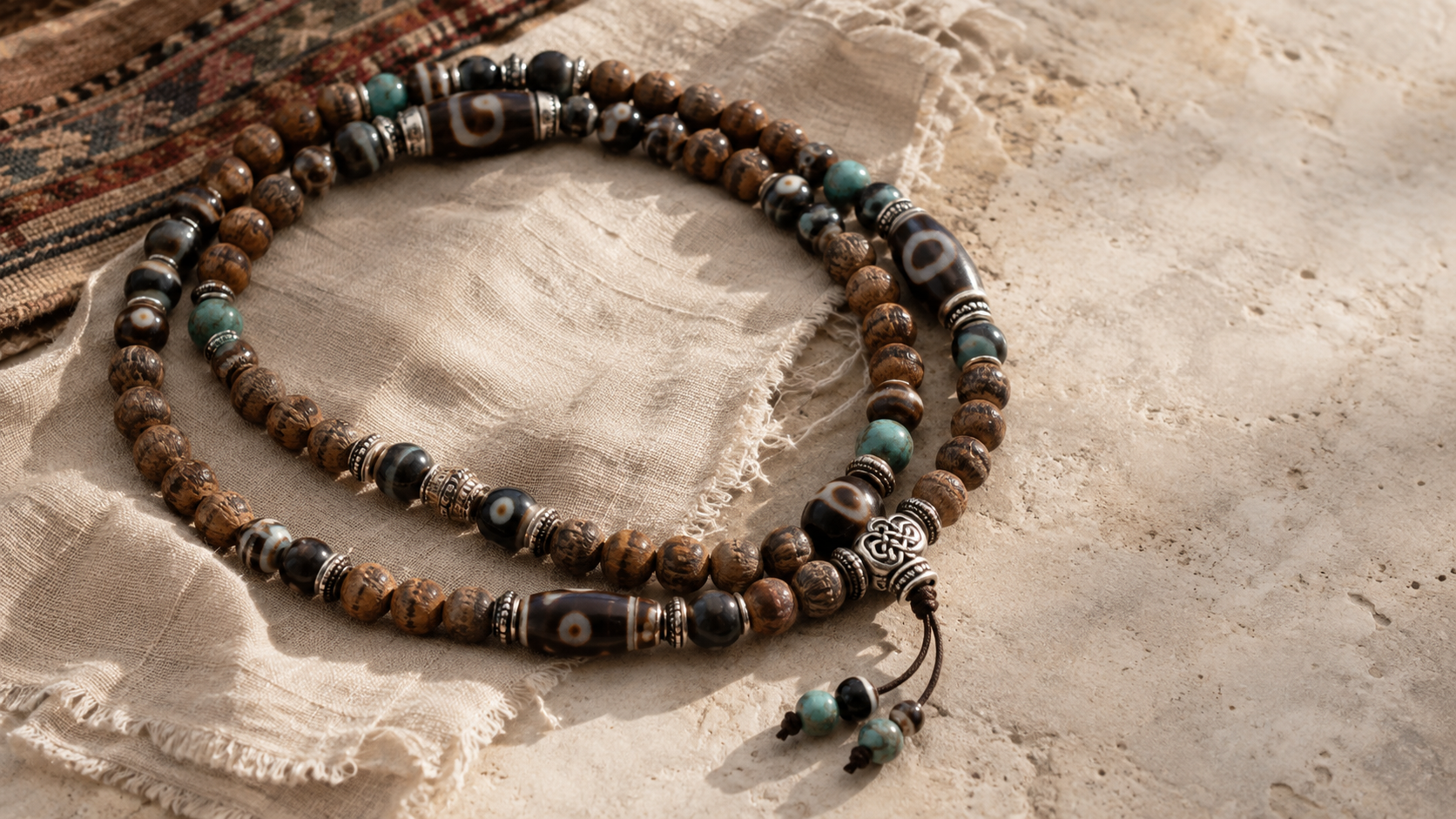
A full mala forms a loop of main beads with a distinctive terminal bead and may include dividers, counters, metal ornaments, or a tassel. Designs range from restrained seed or wood strands to complex arrangements of stone, bone, shell, and silver.
The Rubin Museum of Himalayan Art describes a nineteenth-century Tibetan strand of turquoise, bone, and silver as a personal religious object used to count prayers and mantras. Its luxury materials also reflected the status and taste of its owner, a princess of Derge. This is an important reminder: function and beauty, devotion and social identity, were not necessarily opposites.
Why do malas have 108 beads?
Many Buddhist malas contain 108 counting beads because 108 has long held religious and cosmological significance across Indian and Buddhist traditions. There is no single explanation accepted everywhere, and shorter malas may use divisions or other significant counts.
Online accounts often offer one definitive reason for 108, linking it to afflictions, teachings, texts, or cosmic relationships. Some explanations are tradition-specific; others have uncertain sourcing. The defensible conclusion is that 108 is a long-established sacred and mnemonic number with multiple interpretations.
In practice, full malas commonly contain 108 main beads. Some traditions count a cycle as 100 completed recitations, allowing additional repetitions for error or omission. Shorter strands may contain 54, 27, or another number related to the full count, while wrist malas may be designed for portability rather than replicating a full strand exactly. Counting methods should be learned from the relevant teacher or lineage when the mala is used for formal religious practice.
What is the guru bead?
The guru bead is the distinctive bead that marks the beginning and end of a circuit on many malas. It is usually not counted as one of the 108 main beads, although names, symbolism, and construction vary among traditions.
It may differ in size, shape, or material and may be paired with a collar bead. Other English terms include head, mother, or meru bead. Some practitioners associate it with the teacher, Buddha, or awakened qualities, but a seller should not assign precise doctrine without knowing the design’s tradition.
Part III: How Tibetan Mala Beads Are Used
Tibetan prayer beads are used primarily to keep count during repeated recitation, allowing the practitioner to maintain rhythm and attention without relying on mental arithmetic. They may also accompany prostrations, preliminary practices, or other forms of disciplined repetition.
During mantra recitation, one main bead generally corresponds to one repetition. The thumb advances the strand bead by bead until the practitioner returns to the head bead. Attached counters can record completed circuits or larger totals. The exact hand, finger, direction, and method may vary according to teaching, lineage, or type of practice; a general lifestyle guide should not present one method as universally authoritative.
Repeated use gives a mala its intimacy: organic materials may darken, stone softens in sheen, cord relaxes, and edges become comfortable. These changes can record a relationship with practice, but they do not prove great age. Patina is evidence of surface history, not a date certificate.
Malas may be kept private, worn, carried in a pouch, placed near a home shrine, or stored with other devotional objects. Customs differ. When someone intends to use a mala within Tibetan Buddhist practice, guidance from a qualified teacher is more reliable than generalized instructions attached to a product page.
Part IV: Materials—Why Tibetan Malas Look So Distinctive
Tibetan malas can be made from seeds, wood, stone, shell, bone, coral, turquoise, glass, and metal. Material choices may reflect religious recommendations, availability, trade, social status, tactile preference, durability, and personal taste.
No material has one universal meaning. The same substance can be devotional in one setting, ornamental in another, and collectible in a third. A careful buyer considers both cultural association and material facts.
| Material | Why it is used | What a buyer should verify |
|---|---|---|
| Seeds | Light weight, tactile texture, organic change through use | Botanical identification, coatings, durability |
| Wood | Warm hand-feel, low weight, aroma in some species | Actual wood species, fragrance treatments, dryness or cracking |
| Agate | Durability, polish, natural banding | Natural versus dyed or altered material; age claims |
| Turquoise | Strong Tibetan visual association; color and rarity | Geological origin if claimed, treatment, stabilization, dyeing |
| Coral | Historical prestige and vivid color | Species, legality, documentation, whether natural or imitation |
| Dzi-style agate | Pattern, cultural association, collectibility | Manufacturing method, age evidence, provenance |
| Bone | Historical ritual and practical uses in some contexts | Species, legality, ethical sourcing, exact provenance |
| Silver and other metals | Counters, spacers, structural and decorative work | Metal fineness if claimed, casting versus handwork, repair history |
Bodhi and other seeds
Seed malas are light, warm quickly in the hand, and provide enough surface texture for counting without sight. “Bodhi seed” is a devotional and commercial category applied to seeds from more than one plant; it should not automatically be understood as seed from the historical Bodhi tree species under which the Buddha is traditionally said to have awakened.
Seed types vary in density, pattern, and moisture resistance. Look for clean drilling, stable material, and honest botanical identification when a species is claimed.
Wood
Wooden malas are light and warm in the hand. “Sandalwood” is sometimes applied loosely to scented or unrelated woods, although species affects durability, conservation status, and price. Look for smooth holes, natural grain, and restrained finishing; a strong, uniform perfume may be added fragrance. Dark wood is not necessarily old, nor fragrant wood necessarily sandalwood.
Agate
Agate is a form of chalcedony valued for toughness, fine polish, translucency, and banded or clouded pattern. It has a long history in bead-making across Asia and is especially important to discussions of dzi beads.
Appearance alone cannot establish an agate bead’s origin or age. Agate can be heated, dyed, etched, abraded, repolished, or artificially weathered. Drill form, tool marks, surface alteration, and comparison with securely dated examples matter more than any single visual “test.”
Turquoise
Turquoise is strongly associated with Tibetan and Himalayan adornment, but “Tibetan turquoise” often describes cultural use or market style rather than a scientifically established Tibetan mine origin.
Turquoise appears in jewelry, ritual objects, and prayer beads, ranging from blue to green or yellow-green with varied matrix. Tibetan objects accommodate more variation than the uniform blue prized in some modern markets.
Turquoise circulated from multiple sources, so a Tibetan-made object need not contain geologically Tibetan stone. China is now a major producer, especially Hubei; other sources include Iran and the American Southwest. GIA’s guide notes that source-like color names may be used regardless of origin—an important warning for “Tibetan turquoise.”
Porous turquoise may be waxed, resin-stabilized, dyed, or impregnated. Treatment can improve color and durability and does not erase value, but it should be disclosed; reliable identification may require laboratory methods.
Coral
Coral has a documented history in Tibetan jewelry and ritual objects, but it is an animal-derived marine material whose trade can raise conservation, legal, and ethical concerns.
Red and orange coral brought intense color and prestige to the plateau through trade. Its presence in Tibetan objects demonstrates access to distant marine networks, not local origin. Historic strands may also contain glass, shell, resin, dyed material, or other substitutes that resemble coral.
Before buying purported natural coral, ask for material identification, species information, ownership history, and cross-border documentation. Rules vary by taxon and jurisdiction; consult the CITES species checklist and destination-country authorities. Where documentation is absent, responsibly made imitation coral may be the more ethical choice.
Dzi beads
A dzi bead is a patterned agate bead associated with Tibetan and Himalayan culture, often understood as an amulet or auspicious object. The term now covers genuinely old beads, later traditional examples, and a vast market of modern reproductions.
Dzi beads are generally agate or chalcedony with contrasting “eyes,” bands, waves, or other geometry. Chemical and heat processes can alter near-surface color to create pattern. Dating techniques and production histories remain specialist questions, while origin legends often exceed the evidence.
Museum classification itself can be cautious. The British Museum describes several banded agate beads as probably amulets because their shape, form, and material are allied to Tibetan dzi beads, rather than making an absolute identification. See, for example, its polished brown-and-white banded agate bead.
Patterns are often assigned protective or auspicious meanings. Present these as cultural or lineage-specific interpretations, not scientifically demonstrated effects. The number of “eyes” cannot authenticate age.
For collectors, the central distinction is between:
- beads with credible evidence of age and ownership history;
- later or vintage beads made and used within Tibetan or Himalayan contexts;
- contemporary handmade dzi-style beads;
- mass-produced modern replicas;
- artificially aged pieces presented as ancient.
All can possess aesthetic value. They do not possess the same historical or market value. A contemporary bead honestly described is preferable to a reproduction supported by an invented monastery story.
Bone and other animal materials
Bone has been used in Tibetan ritual and personal objects, sometimes in contexts that invoke impermanence or particular categories of practice. Yet material and religious meaning cannot be inferred from appearance alone. Yak or other animal bone may be used in contemporary malas because it is durable, light, and culturally resonant.
Claims of human bone demand exceptional evidence and should never be made casually. The Rubin Museum holds a Tibetan strand catalogued as finger-bone prayer beads, but a museum record for a specific object does not validate similar claims made for unrelated market pieces.
Ask which species is represented, how it was sourced, and whether sale and import are legal. Avoid ivory and protected wildlife materials without required provenance and permits; ethical standards may be stricter than the legal minimum.
Silver and metal components
Metals can form spacers, counters, clips, ornaments, and structural fittings. “Tibetan silver” is often a style term for white-metal alloys, not a guarantee of sterling or a specific fineness. Solid-silver and purity claims need testing or reliable maker specifications; casting, solder, repairs, and wear should be disclosed.
Part V: How a Mala Is Made
A well-made mala begins with material selection and matching, then depends on accurate drilling, careful finishing, balanced stringing, appropriate tension, and a final assembly that moves comfortably through the hand.
Selecting, sorting, and matching beads
The maker evaluates diameter, weight, color, surface, hole size, and character. Matching distributes strong colors, matrix, and visual weight across the loop. Historic or collected beads may favor harmonious survival over perfect symmetry.
Drilling and finishing
Bead holes reveal practical quality: rough edges abrade cord, while misaligned drilling creates fragile walls. Finishing should suit the material. Excessive polishing can erase tool marks and old wear, so historic beads should be conserved and documented rather than made to look new.
Stringing and tension
Cord may be natural or synthetic, braided or single, visible or concealed. The correct choice depends on bead weight, hole diameter, intended use, and the desired balance between flexibility and strength.
A functional mala should not be strung so tightly that beads cannot move, nor so loosely that long gaps expose and stress the cord. Knots may separate every bead or appear only at structural points. Either approach can be well made if it suits the intended practice. Heavy stone malas require particularly strong cord and careful reinforcement near metal components.
Final assembly
The head bead, collar, tassel, counters, spacers, and metalwork complete the strand. Each element should have a reason to be present. Counters should operate; tassels should be secured; clips should not cut adjacent cord; large pendants should not pull the strand out of balance.
Decoration is not the enemy of function. Historic elite malas could be sumptuous. The standard is coherence: beauty should arise from material, proportion, craftsmanship, and use rather than from the indiscriminate addition of symbolic parts.
Part VI: What Makes a Tibetan Mala Valuable?
Why are some Tibetan mala beads expensive?
Tibetan mala beads can be expensive because of rare or high-quality materials, skilled workmanship, age, condition, documented provenance, historic association, artistic quality, and the desirability of individual beads. Price alone does not establish authenticity.
Value may reside in one exceptional dzi bead, finely worked silver counters, documented ownership, or an unusually coherent set of turquoise beads. A contemporary mala can be valuable for superb drilling, hand-forged fittings, responsible material sourcing, and skilled assembly without claiming antiquity.
Condition must be judged in relation to age and function. Wear can be desirable when it is consistent with documented use, but cracked beads, weakened cords, invasive repairs, or replaced components may affect value. Conversely, restoration can preserve usability while reducing the object’s integrity if poorly documented.
Most importantly, age should never be inferred simply from wear, patina, color, surface irregularity, or a seller’s use of “old,” “ancient,” “antique,” or “temple.” These are claims requiring evidence, not visual moods.
Part VII: Authenticity—A Collector’s Guide
What does “authentic Tibetan mala” actually mean?
An “authentic Tibetan mala” might mean a mala made in Tibet, made by a Tibetan artisan, made in a Tibetan cultural tradition, historically used in Tibetan Buddhist practice, or simply designed with Tibetan-associated materials. These claims are not interchangeable.
An accurate listing should specify which of the following can be supported:
- Place of production is documented as Tibet.
- The maker identifies as Tibetan.
- Construction follows a named Tibetan or Himalayan craft tradition.
- The strand has documented historical use in Tibetan Buddhist practice.
- Materials are traditionally associated with Tibetan objects.
- The piece is a contemporary design inspired by Tibetan visual culture.
A contemporary Nepal-made mala inspired by Tibetan Buddhist forms can be both beautiful and honest. It should not be relabeled “antique Tibetan” to make it sound more valuable.
Antique, vintage, and contemporary
“Antique” usually implies substantial age, but legal and market definitions vary. “Vintage” is broader and often less precise. “Contemporary” means recently made and should be used proudly when it is true.
For any age claim, ask: What is the proposed date range? What evidence supports it? Does the claim apply to the full strand or only certain reused beads? Has the object been restrung or assembled from components of different periods? A newly assembled mala containing several old beads is not necessarily an antique mala.
Provenance
Provenance is the documented history of an object’s ownership, custody, discovery, production, or use. Useful evidence can include dated invoices, collection records, export documents, old photographs, artisan attribution, field notes, publication history, and scientific testing.
Continuous history is uncommon for modest personal objects, so uncertainty is normal. Missing evidence calls for a narrower description, not a more dramatic narrative.
Warning signs
Approach the following claims with care:
- extraordinary age without ownership history or specialist analysis;
- identical “ancient” beads sold in large quantities;
- artificial dirt, abrasion, staining, or chemically induced patina;
- vague stories involving an unnamed monastery, lama, excavation, or family;
- promises of guaranteed healing, protection, wealth, or supernatural power;
- rare coral, turquoise, bone, ivory, or precious-metal claims without disclosure;
- stock photographs that do not show the exact object;
- reluctance to provide bead counts, dimensions, weight, repairs, or close views of holes.
Good sellers do not need certainty about everything. They need precision about what they know, what they infer, and what remains unknown.
Part VIII: Can You Wear Mala Beads as Jewelry?
Is it disrespectful to wear mala beads?
Wearing mala beads is not governed by one universal rule across all Buddhist communities. Context, intention, treatment of the object, and the guidance of a person’s own tradition matter.
Malas have long existed as personal objects that can communicate devotion, identity, status, and taste. Contemporary strands may be made expressly for meditation, wearing, or both. A non-Buddhist can approach such an object respectfully by learning what it is, avoiding false claims of spiritual authority, and not treating sacred imagery as a merely exotic costume.
If a mala has been consecrated, used in private practice, or inherited from a practitioner, its owner may choose to handle or display it differently from a fashion-oriented contemporary piece. When in doubt, ask the maker or relevant teacher. Respect is better expressed through attention than through rigid rules invented for the entire Buddhist world.
Part IX: How to Choose a Tibetan Mala
Choose a Tibetan mala by clarifying its intended purpose, then evaluating material, bead size, comfort, construction, disclosure, provenance, and personal connection. The most meaningful strand need not be the rarest.
1. Define the purpose
Is the mala intended for formal Buddhist practice, secular meditation, wearing, collecting, gifting, or appreciation as bead craft? A heavy coral-and-silver strand may be compelling to collect but less comfortable for long counting sessions. A simple wood or seed mala may be better for daily practice.
2. Choose material by fact, not mythology
Consider weight, warmth, texture, durability, maintenance, and documented cultural use. Treat claims such as “this stone guarantees protection” as belief or sales language, not measurable performance. If natural turquoise, coral, sandalwood, bone, or precious metal affects the price, request clear disclosure and supporting evidence.
3. Consider bead diameter
Small beads create a lighter, more discreet strand but can be harder to advance for large hands. Larger beads offer stronger tactile separation and visual presence, while substantially increasing weight and overall circumference. Ask for diameter in millimeters, total length, weight, and exact bead count.
4. Examine craftsmanship
Look for:
- smooth, centered holes;
- no sharp edges against the cord;
- secure and appropriate stringing;
- enough flexibility for counting;
- balanced weight and thoughtful spacing;
- well-finished metal components;
- honest disclosure of repairs, replacements, and treatments.
Handmade does not mean flawless. It should mean that variation has been understood and resolved by a maker.
5. Evaluate provenance and language
Prefer a modest, specific description over an extravagant story. “Contemporary hand-strung mala made in Nepal with stabilized turquoise and silver-plated fittings” is more useful than “ancient sacred Tibetan treasure.” If provenance is limited, the seller should say so.
6. Allow personal connection
A mala becomes meaningful through relationship: touch, practice, memory, or the story of a gift. Rarity can matter to a collector, but it is not a prerequisite for significance. Choose the strand you will understand and use—not the one carrying the most mythology.
Part X: Tibetan Mala Beads in Contemporary Life
In contemporary life, mala beads can serve as devotional instruments, meditation aids, personal ritual objects, collectible craft, meaningful gifts, or wearable art—provided their cultural and material descriptions remain accurate.
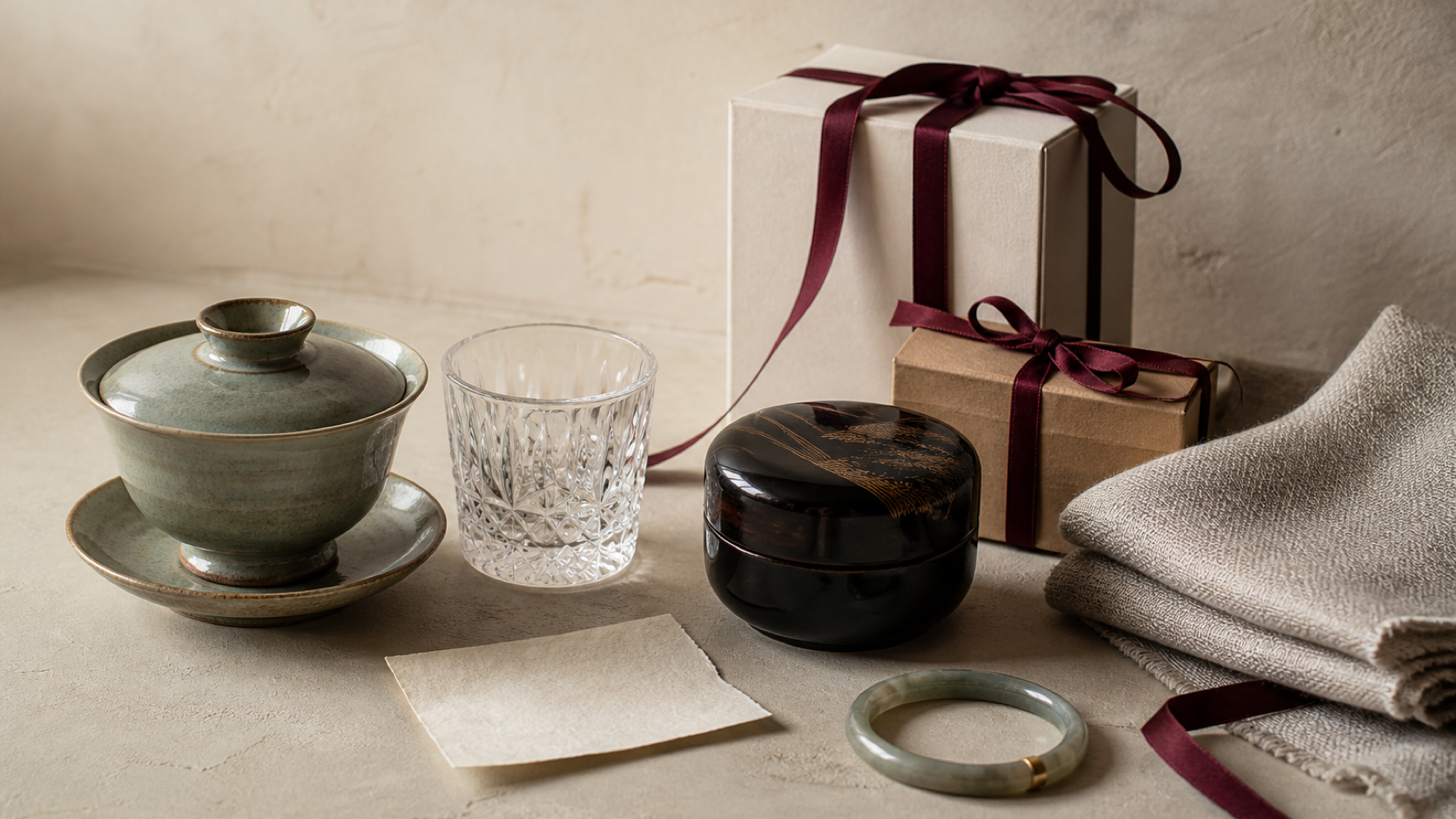
A mala may rest beside books, ceramics, incense, and tea; it may be carried while traveling or used each morning. These settings do not reproduce monastic life. They create a personal framework for attention.
This is where Tibetan mala beads meet Oriental Artisan’s philosophy, Art of Quiet Living. Quiet living is not an aesthetic of owning more spiritual-looking objects. It is the practice of choosing fewer things with intelligible origins, using them with care, and allowing meaning to accumulate through repetition.
As a gift, a mala can mark a practice, journey, or commitment; its note should describe maker and material rather than promise a destiny. As a collectible or jewelry, it can carry visual force while inviting study of stone, trade, metalwork, and provenance.
Part XI: Caring for Mala Beads
Care for a mala according to its most sensitive material: keep it away from unnecessary moisture, chemicals, perfume, extreme heat, prolonged strong light, and abrasive cleaning; inspect the cord regularly and store the strand without strain.
- Seeds and wood: Keep dry, avoid soaking, and wipe gently with a clean soft cloth. Sudden humidity changes can encourage cracking or swelling. Do not repeatedly oil unless the maker recommends a suitable product.
- Turquoise: Avoid perfume, cosmetics, acids, oils, steam, ultrasonic cleaners, and high heat. GIA notes that chemicals and skin oils can discolor turquoise and that heat or solvents can damage treated material.
- Agate and many hard stones: Wipe with a slightly damp soft cloth, then dry. Protect from impacts even when the stone itself is relatively durable; drilled edges remain vulnerable.
- Coral: Keep away from acids, heat, chemicals, and ultrasonic cleaning. For valuable historic coral, seek specialist conservation advice.
- Bone and shell: Avoid soaking and aggressive bleaching. Clean dry or barely damp unless a conservator advises otherwise.
- Silver: Use minimal, material-appropriate cleaning. Tarnish may be removed carefully on contemporary pieces, but aggressive polishing can erase surface evidence on collectible metalwork.
- Cord: Check for fraying, flattening, discoloration, loosened knots, and wear near metal fittings. Restring before failure, and document the original arrangement of an important strand.
Store the mala flat or in a soft pouch with enough room to avoid kinking. Keep heavy pendants from pulling continuously on the cord. Natural patina can be part of an object’s biography; cleanliness should not become erasure.
Part XII: Oriental Artisan and the Art of Responsible Curation
Responsible curation asks not only whether an object is beautiful, but who made it, how it was made, which materials it contains, what tradition informed it, and which claims can genuinely be supported.
For Oriental Artisan, cultural respect can become part of luxury itself. A strong description names the maker or workshop when known, separates place of production from stylistic inspiration, identifies materials and treatments, records dimensions and repairs, and gives an honest account of provenance.
Where an item is contemporary, it should be described proudly as contemporary. Where a mala is made in a Tibetan cultural tradition outside the Tibet Autonomous Region, the place and maker should be named. Where a bead is dzi-style rather than demonstrably old dzi, that distinction should be clear. Where turquoise is stabilized or its geological origin is unknown, disclosure builds confidence rather than diminishing beauty.
This approach does more than protect the buyer. It respects artisans by locating value in their real skill rather than in borrowed legends. It also allows collectors to compare objects intelligently and creates records that can travel with an object into the future.
The finest mala is not necessarily the one surrounded by the most dramatic story. It is the one whose material presence, workmanship, function, and history can withstand close attention.
Explore the Oriental Artisan Tibetan Mala Collection as a starting point for choosing a strand with care—an object not simply to possess, but to understand and live with.
Frequently Asked Questions
1. What are Tibetan mala beads?
Tibetan mala beads are prayer beads used in Tibetan Buddhist contexts to count mantras and other repeated devotional recitations. A full mala commonly has 108 main beads, plus a distinctive head or guru bead, though configurations vary. Tibetan malas may be made from seeds, wood, agate, turquoise, bone, shell, coral, and metal. Some are active religious objects; others are contemporary jewelry or collectibles inspired by Tibetan traditions.
2. What does “mala” mean?
Mala derives from the Sanskrit word mālā, meaning a garland or wreath. In religious contexts, it refers to a loop or strand of beads used for counting repeated prayers, names, or mantras. Mala traditions are not exclusively Tibetan or Buddhist; related counting strands are used across several South Asian religions and Buddhist cultures. The precise bead count, structure, and method of use differ among traditions.
3. Why do malas have 108 beads?
Many malas have 108 beads because 108 is a sacred and cosmologically significant number across several Indian and Buddhist traditions. Multiple explanations connect it to categories of teachings, afflictions, phenomena, or textual groupings, but no single explanation applies universally. Tibetan Buddhist practitioners may also treat a 108-bead circuit as 100 completed recitations, allowing for errors, although instructions vary by teacher and lineage.
4. Are all Tibetan malas made with 108 beads?
No. Full Tibetan malas commonly have 108 main counting beads, but shorter malas may contain 54, 27, or other counts, and wrist malas can be designed for portable practice. Some strands include divider beads, attached counters, or additional structural elements not counted among the main beads. A nonstandard count does not automatically make a mala inauthentic; its intended tradition and function should be documented where possible.
5. What are Tibetan mala beads traditionally made from?
Materials include seeds, wood, agate and other stones, turquoise, bone, shell, coral, glass, and silver or other metals. Choice can reflect tactile function, availability, trade, religious guidance, status, and taste. Materials in Tibetan objects may have originated far beyond Tibet. Modern buyers should ask whether stones are treated, whether animal materials are legal and ethically sourced, and whether metal-purity or species claims are documented.
6. What is a guru bead?
The guru bead is the larger or distinctive bead marking the beginning and end of a counting circuit on many malas. It is usually separate from the 108 main beads and is not counted. It may also be called a head, mother, or meru bead. Symbolic interpretations vary: some associate it with the teacher, the Buddha, or awakened qualities, while its universal practical role is to orient the hand.
7. What are dzi beads?
Dzi beads are patterned agate or chalcedony beads strongly associated with Tibetan and Himalayan culture. They often feature pale and dark geometric designs, including circles described as “eyes.” Dzi beads may be understood as auspicious or protective amulets within cultural traditions. The modern term covers a wide range—from rare old beads with meaningful provenance to contemporary handmade examples and mass-produced replicas—so description and age evidence matter greatly.
8. Are all dzi beads ancient?
No. Most dzi-style beads offered online are modern or relatively recent. Genuine old examples are scarce, difficult to date, and often expensive. Pattern type, surface wear, color, or claims of “temple origin” cannot establish age by themselves. Collectors should seek documented ownership history, specialist comparison, high-resolution views of holes and surfaces, and, for high-value purchases, independent examination. Contemporary dzi-style beads can still be beautiful when honestly described.
9. Why is turquoise common in Tibetan jewelry?
Turquoise has long been prized in Tibetan and Himalayan adornment for its vivid blue-to-green color, visual contrast with coral and metal, and cultural associations. It arrived through regional and long-distance trade as well as from sources within present-day China. “Tibetan turquoise” may describe cultural use or style rather than geological origin. Buyers should ask about mine origin only when it can be documented and request disclosure of stabilization, dye, or other treatment.
10. How are Tibetan mala beads used?
Practitioners commonly move one bead for each mantra or devotional recitation, using the strand to maintain count and rhythm. Attached counters can record completed rounds or larger totals. Exact instructions—such as which hand and finger to use, how to move the beads, and what to do at the guru bead—can differ according to lineage and practice. Formal guidance should come from a qualified teacher rather than a generalized product description.
11. Can non-Buddhists wear mala beads?
Yes, many non-Buddhists wear contemporary malas as meditation aids, meaningful jewelry, or works of craft. Respectful use begins with understanding that malas can be devotional objects rather than merely an “exotic” style. Avoid claiming religious authority or supernatural benefits, learn the significance of prominent symbols, and distinguish a newly made wearable mala from a consecrated, inherited, or historically used religious object.
12. Is wearing mala beads disrespectful?
Not inherently. There is no single rule shared by all Buddhist communities. Intention, context, and treatment of the object matter. Wearing a contemporary mala with informed appreciation is different from trivializing sacred imagery or inventing a spiritual history for it. If a mala was consecrated, inherited, or made for a specific practice, consult the maker, owner, or relevant teacher about appropriate handling.
13. How can I identify a high-quality mala?
Look for smooth, centered drill holes; bead edges that will not cut the cord; comfortable movement; secure knots or tension; balanced weight; honest material disclosure; and carefully finished counters or metalwork. Ask for bead diameter, weight, count, full length, close-up images, and treatment information. High quality can include natural variation. “Handmade” should describe skilled selection and assembly, not excuse fragile construction or unsupported origin claims.
14. How can you tell whether Tibetan beads are antique?
No single visual sign proves antiquity. Genuine age is evaluated through provenance, construction, drill technology, surface history, comparable documented objects, repair evidence, and sometimes laboratory analysis. Patina, dark color, chips, irregularity, or worn holes can occur naturally, be added artificially, or belong to reused components in a new strand. For an expensive object, obtain a written condition report and independent specialist opinion.
15. Why are some Tibetan mala beads expensive?
Price may reflect rare materials, excellent individual beads, fine metalwork, skilled stringing, age, condition, historic ownership, documentation, and artistic coherence. An old dzi bead or well-provenanced group of turquoise beads can dominate a strand’s value. Contemporary malas may also be costly because of high-quality natural materials and artisan labor. Expense alone never proves authenticity, sacred status, or age.
16. How should mala beads be cleaned?
Use the gentlest method appropriate to the most sensitive material. A soft dry cloth is safest for many mixed-material strands. Keep wood and seeds from soaking; keep turquoise, coral, bone, and shell away from perfume, acids, steam, ultrasonic cleaners, and harsh chemicals. Clean valuable old beads only after specialist advice. Inspect cord wear while cleaning and document the bead order before restringing.
17. Can mala beads be given as gifts?
Yes. A mala can be a thoughtful gift for a practitioner, traveler, collector, or someone beginning a reflective routine. Choose according to the recipient’s beliefs, comfort, and intended use. Include accurate information about the maker, materials, bead count, care, and cultural context. Avoid promising healing or protection as a guaranteed property. Personalization should not overwrite sacred inscriptions or alter an older object without careful thought.
18. Where can I buy authentic Tibetan mala beads?
Buy from a specialist who states what “authentic” means for each object: place of production, artisan identity, cultural tradition, age, prior use, and material. Look for exact photographs, dimensions, treatment disclosure, provenance, condition, return terms, and willingness to acknowledge uncertainty. Oriental Artisan’s Tibetan Mala Collection can be explored with the same questions; accuracy should be part of the value offered by any curator.
Selected editorial references
- Rubin Museum of Himalayan Art, Prayer Beads, Tibet, 19th century
- Rubin Museum of Himalayan Art, Finger Bone Prayer Beads
- The Metropolitan Museum of Art, Necklace, Tibet, 1875–1925
- British Museum, Banded agate bead related to Tibetan dzi beads
- Gemological Institute of America, Turquoise sources, treatments, and care
- Gemological Institute of America, Technical identification of resin-filled turquoise
- U.S. Fish and Wildlife Service, CITES overview
- CITES, Checklist of protected species
- Tibetan and Himalayan Library, Regional cultural resources

Hinterlasse einen Kommentar
Diese Website ist durch hCaptcha geschützt und es gelten die allgemeinen Geschäftsbedingungen und Datenschutzbestimmungen von hCaptcha.