


Arita vs. Kutani Ware: Two Japanese Porcelain Traditions, One Beautiful Choice
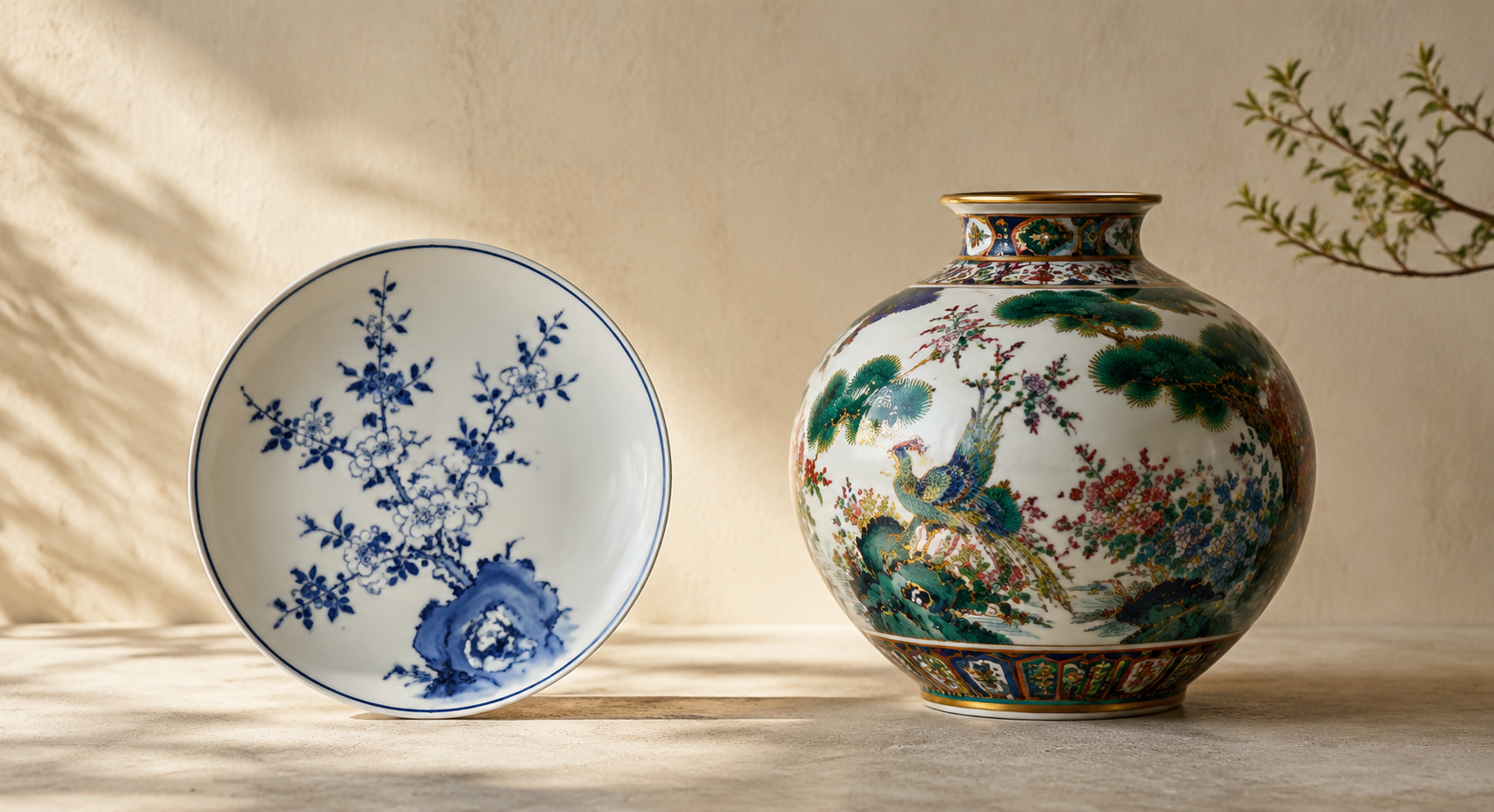
Place two pieces of Japanese porcelain beside one another.
One is luminous and restrained: a fine white surface carrying a few measured lines of cobalt blue, with enough undecorated space for the form itself to be felt. The other commands the eye through saturated enamels, intricate brushwork and perhaps a glint of gold. Its surface seems less like ornament than a painting given volume.
Both are unmistakably Japanese. Yet they represent two very different centers of ceramic imagination: Arita ware, or 有田焼 (Arita-yaki), from Saga Prefecture; and Kutani ware, or 九谷焼 (Kutani-yaki), associated today with Ishikawa Prefecture.
If both are extraordinary, what actually separates Arita from Kutani—and which belongs in your home?
The Short Answer: What Is the Difference Between Arita and Kutani Ware?
Arita ware is a porcelain tradition centered in and around Arita in Saga Prefecture, renowned for technical refinement, finely made bodies and a wide decorative range that includes blue-and-white, Kakiemon-style enamels and more opulent polychrome work. Kutani ware is a tradition associated with present-day Ishikawa Prefecture and is especially celebrated for expressive overglaze painting, strong color and pictorial decoration. These are useful tendencies, not rules: Arita can be lavish, Kutani can be spare, and both traditions encompass many kilns, periods and individual artists.
| Feature | Arita Ware | Kutani Ware |
|---|---|---|
| Japanese name | 有田焼 (Arita-yaki) | 九谷焼 (Kutani-yaki) |
| Main region today | Saga Prefecture, Kyushu | Ishikawa Prefecture, Hokuriku |
| Famous for | Porcelain technology, refined forms and diverse decoration | Overglaze enamel painting and strong pictorial identity |
| Typical impression | Crisp, luminous, precise | Expressive, colorful, decorative |
| Common colors | Cobalt blue and white; red, gold and varied enamels also appear | Green, yellow, purple, blue and red are traditionally associated with the Kutani palette; modern work varies widely |
| Often chosen for | Tableware, tea ware, serving pieces and refined collections | Statement tableware, sake ware, vases and collectible art |
| A useful shorthand | Form, clarity and controlled detail | Painting, color and expressive surface |
What Is Arita Ware?
Arita ware is porcelain made in Arita and surrounding areas of Saga Prefecture on the island of Kyushu. Porcelain production emerged there in the early seventeenth century, making the area central to the development of Japan’s porcelain industry. Over four centuries, Arita has produced everything from informal domestic dishes to technically exacting presentation ware and objects designed for European export.
The development of Arita porcelain depended on a convergence of material, skill and infrastructure. Korean potters brought to Japan around the turn of the seventeenth century played a foundational role in Hizen ceramic production. Suitable porcelain stone was found in the Arita area—Izumiyama became the best-known source—and climbing kilns made sustained high-temperature firing possible. The result was a vitrified, resonant body capable of carrying both underglaze cobalt and finely controlled overglaze enamel.
Arita did not develop a single visual language. Early wares, often grouped under the term Early Imari, could be relatively thick and freely painted in blue. Later production included the spacious compositions and soft enamel palette associated with Kakiemon, the disciplined refinement of Nabeshima traditions elsewhere in the Hizen ceramic sphere, and the dense red, blue and gold of kinrande. Contemporary Arita makers continue to work across restrained, decorative and experimental modes.
What connects this diversity is not one pattern but a powerful regional knowledge of porcelain: how to prepare the material, form it cleanly, fire it reliably and create surfaces in which painting and vessel become inseparable.
What Is Kutani Ware?
Kutani ware is a Japanese ceramic tradition associated with the Kaga region and, today, southern Ishikawa Prefecture. It is best known for overglaze enamel decoration in which color and painting give the surface unusual visual presence. Kutani is not one uniform look; it includes several historical schools and a broad contemporary range.
The earliest chapter is known as Ko-Kutani, or Old Kutani, conventionally dated to the second half of the seventeenth century. Its history requires care. A kiln was active near Kutani village in the Kaga domain, yet archaeological and scientific research has led scholars to attribute many celebrated pieces once called Ko-Kutani to kilns in the Arita region. Rather than treating the question as settled, it is more accurate to understand Ko-Kutani as both a historic designation and an area of continuing attributional debate.
After the early production ended, ceramic activity was revived in the Kaga region during the nineteenth century. Kilns and styles including Kasugayama, Yoshidaya, Iidaya and others developed distinctive approaches. Some favored dense red linework; some emphasized areas of green, yellow, purple and blue; others incorporated gold or responded to export taste. This variety is essential to understanding Kutani.
The phrase Kutani gosai, or “five Kutani colors,” usually refers to green, yellow, purple, blue and red. It is a useful introduction, but not a checklist for every authentic piece. Aode, or “green Kutani,” commonly emphasizes green, yellow, purple and blue while avoiding red; akae traditions can be dominated by extremely fine red drawing. Modern Kutani artists may use a still wider palette. What makes the tradition compelling is not color alone, but the way color is organized—through line, transparent or opaque enamel, pictorial rhythm and the curvature of the vessel.
Arita vs. Kutani: The Eight Most Important Differences
1. Geography
Arita belongs to the Hizen porcelain world of Kyushu, centered in Saga Prefecture; Kutani belongs to the Kaga and Ishikawa ceramic world on the Sea of Japan side of Honshu. Regional labels matter because they describe communities of material knowledge, workshops, kilns and artistic inheritance—not merely patterns.
2. Historical Development
Arita emerged as Japan’s first major porcelain-production center in the early seventeenth century and quickly served domestic and export markets. Kutani’s early history is more discontinuous: Old Kutani is associated with the seventeenth century, production ceased, and distinctive regional traditions were revived and expanded in the nineteenth century.
3. Porcelain Body and Production
Arita is especially identified with porcelain manufacture itself: the preparation of porcelain stone, precise forming, glazing and high-temperature firing. Kutani is also widely known as porcelain, but its historical identity is particularly bound to decorative workshops and overglaze painting. Depending on period and producer, making the blank body and decorating it could involve different specialists or locations.
4. Decoration
Arita offers an unusually broad spectrum. Sometsuke uses cobalt beneath a transparent glaze; Kakiemon-style decoration places colored motifs within generous white space; kinrande can cover surfaces with red, blue and gold. Kutani is most immediately recognizable through overglaze painting that treats the vessel as a pictorial field, although its schools range from bold color blocking to minute red linework.
5. Color
Blue and white is one of Arita’s clearest visual signatures, but it is not the whole tradition. Polychrome enamels and gold have long histories there. Kutani is celebrated for powerful enamel color, particularly green, yellow, purple, blue and red, yet the balance varies by style and maker. Color identifies a tendency, not an authenticity test.
6. Painting Style
Arita decoration often works in close agreement with the vessel’s form: borders follow rims, motifs preserve breathing space, and brushwork reinforces proportion. Kutani frequently asks the eye to enter the painted surface itself—landscape, figure, bird, flower or pattern can unfold across the vessel with the density of a miniature painting. Exceptional makers in either region may reverse those expectations.
7. Form and Function
Both traditions produce plates, bowls, tea vessels, sake ware, vases and decorative objects. Arita’s crisp forms and varied decoration make it especially adaptable to coordinated or mixed table settings. Kutani’s strong surfaces give even a small cup or dish the presence of an individual artwork, while larger vases and chargers can anchor a room.
8. Overall Aesthetic
Arita often draws the eye toward form, precision and refinement. Kutani often draws the eye toward painting, color and expressive surface. This emotional distinction is more helpful than a rigid list of motifs—as long as one remembers that four centuries of Arita and multiple Kutani schools cannot be compressed into two fixed styles.
Arita, Kutani and Imari: Clearing Up the Confusion
Is Imari the Same as Arita?
Imari and Arita overlap historically, but they are not always interchangeable. Arita identifies the principal production area, while Imari was the nearby port from which much Hizen porcelain was shipped. As a result, porcelain made around Arita became known in domestic and international trade as Imari ware.
Today, “Arita ware” usually foregrounds regional production. “Imari” may refer broadly to historical Arita-area porcelain, to Ko-Imari, or more narrowly in the decorative market to a palette of underglaze blue with red and gold overglaze. Context matters. A label saying “Imari style” may describe decoration rather than prove a particular place, date or maker.
Is Kutani the Same as Arita?
No. Kutani and Arita are distinct regional traditions with different historical centers and identities. The confusion arises partly because some seventeenth-century enameled works long classified as Ko-Kutani are now associated by scholars with Arita production. That debate complicates particular antique attributions; it does not make modern Kutani another name for Arita.
Which Is More Valuable: Arita or Kutani?
Neither Arita nor Kutani is inherently more valuable. Value depends on the individual object—its age, maker, kiln, condition, rarity, provenance, technique, artistic quality, historical importance and current demand. A name alone is not an appraisal.
Contemporary artisan work is usually valued through authorship, difficulty of technique, design, reputation and scarcity. Vintage pieces require attention to maker’s marks, condition and the quality of the period’s production. Antiques may depend on specialist attribution and documented provenance. Museum-level Old Kutani, early Arita, Kakiemon or Nabeshima-related works belong to an entirely different market from a well-made contemporary bowl.
Condition must also be judged intelligently. A minor firing irregularity can be part of manufacture; a hairline crack, restoration or replaced lid can materially affect value. Gold wear may be expected on an old object yet still matter. For serious purchases, request clear images of the foot, rim, interior, marks and any repaired area—and seek an independent specialist opinion when the price justifies it.
Which Should You Choose?
Choose according to how you want the object to live with you. Arita tends to suit those drawn to clarity, proportion and adaptable refinement; Kutani tends to suit those who respond to color, narrative and painterly presence. The more personal the choice, the less useful it is to declare a winner.
Choose Arita If You Love…
- Luminous porcelain and precise silhouettes
- Blue-and-white decoration or measured enamel work
- Tableware that moves easily between Japanese and contemporary settings
- Quiet sophistication that reveals itself through repeated use
- The relationship between clean form and controlled detail
An Arita bowl can be visually calm without being anonymous. Its appeal may arrive first through the curve of the rim, the weight in the hand or the interval between two painted branches. This is everyday luxury in its most usable form: an object whose quality becomes clearer over breakfast, tea and dinner.
Choose Kutani If You Love…
- Saturated yet thoughtfully composed color
- Painterly surfaces and fine brushwork
- Birds, flowers, landscapes, figures and decorative pattern
- Small objects that hold strong visual presence
- Collecting individual works rather than matching sets
Kutani rewards close looking. A sake cup may contain a landscape no larger than a thumbprint; a plate may balance areas of green and gold like a painting. For someone who wants tableware to begin a conversation, that expressive surface is often irresistible.
Choose Both If…
You enjoy contrast. A table of identical pieces can be polished, but a table built gradually can feel more alive. A restrained Arita plate can give visual rest beside a richly painted Kutani bowl. A blue-and-white cup can make the green of a Kutani dish appear deeper. Sophisticated collections are often held together not by sameness, but by judgment: related scale, thoughtful color and objects chosen with attention.
Arita and Kutani for Tea
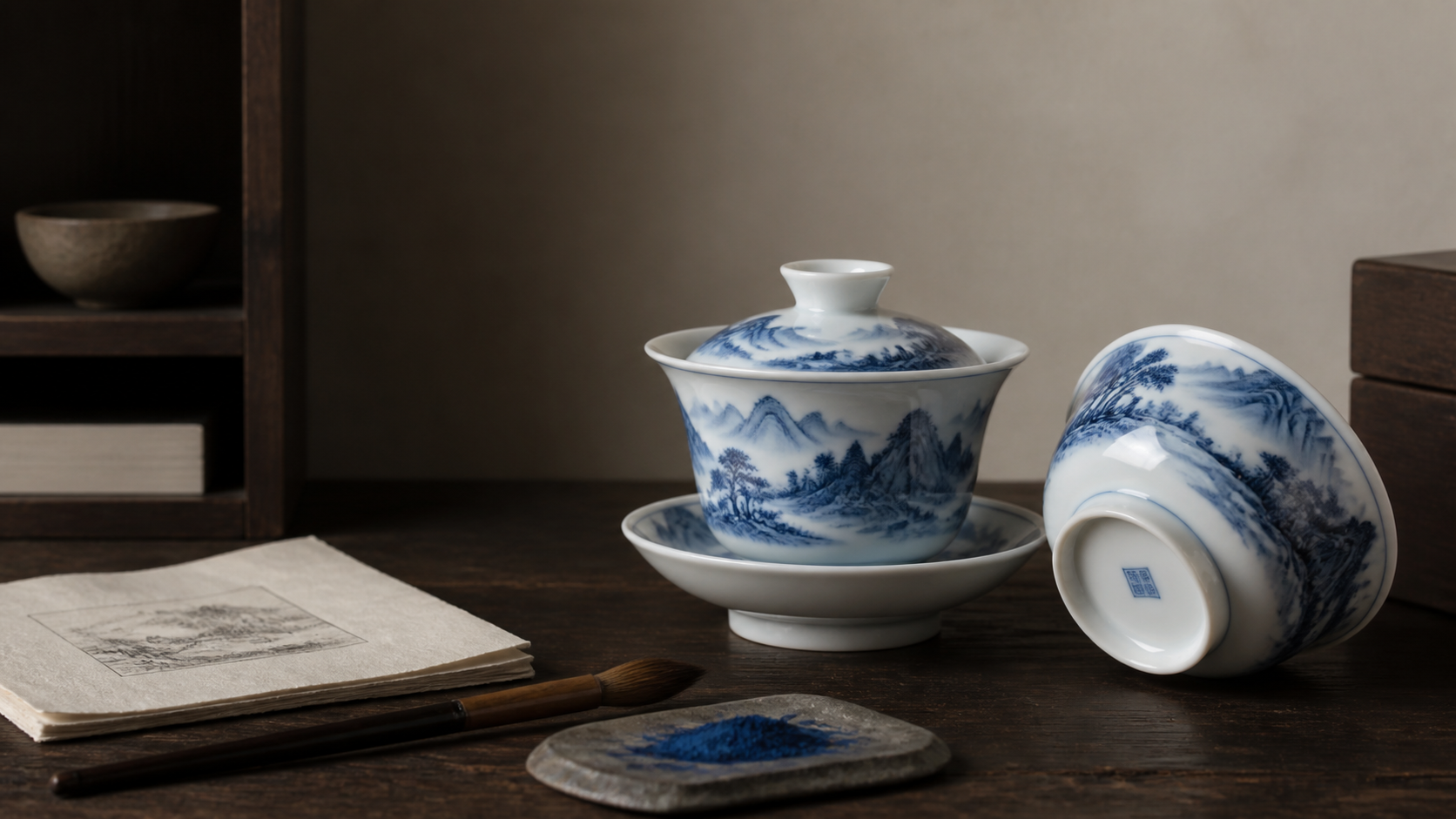
Both Arita and Kutani can be excellent for tea; neither tradition automatically improves flavor. The best choice depends on the vessel’s size, rim, weight, balance, heat behavior and how comfortably it supports the way you brew. Decoration shapes the mood of tea, while proportion and craftsmanship shape its use.
Fine Arita porcelain can make a tea setting feel lucid and composed. A pale interior also lets the drinker see the liquor’s color clearly. Kutani brings a more pictorial atmosphere: a single cup can become the visual focus of a quiet tray, especially when the rest of the setting is simple.
For cups, inspect rim thickness and how the vessel meets the lip. For teapots and lidded vessels, check the fit of the lid, the clarity of the pour and whether the handle remains comfortable when hot. A very thin body may feel delicate and responsive but can transfer heat quickly; a thicker body may be steadier and retain warmth differently. These are design choices, not universal rankings.
Explore Oriental Artisan’s tea set collection with the same attention: not only to the painted surface, but to the ritual the vessel is meant to serve.
Arita and Kutani at the Dining Table
Japanese porcelain becomes most convincing when it leaves the display cabinet. A plate changes when it holds grilled fish; a small Kutani dish gains new color beside dark soy sauce; cobalt ornament around an Arita bowl frames rice, noodles or fruit without competing with them.
Begin with function. Choose bowls deep enough for what you cook, plates with usable wells, and serving pieces that are easy to lift. Then think in layers. Let one vividly painted Kutani piece carry the visual emphasis and surround it with quieter forms. Or build a blue-and-white Arita foundation and add color through food, textiles and one contrasting vessel.
Japanese dining does not require every piece to match. Repetition can come from scale, rim shape or a shared touch of blue rather than an identical pattern. This makes collecting slowly practical: one bowl, then a pair of small plates, then a serving dish that earns its place.
That approach belongs naturally to Oriental Artisan’s Art of Quiet Living: luxury not as a room reserved for special occasions, but as the decision to use beautifully made things on an ordinary Tuesday. Discover pieces for daily meals in the tableware collection.
Arita and Kutani in Contemporary Interiors
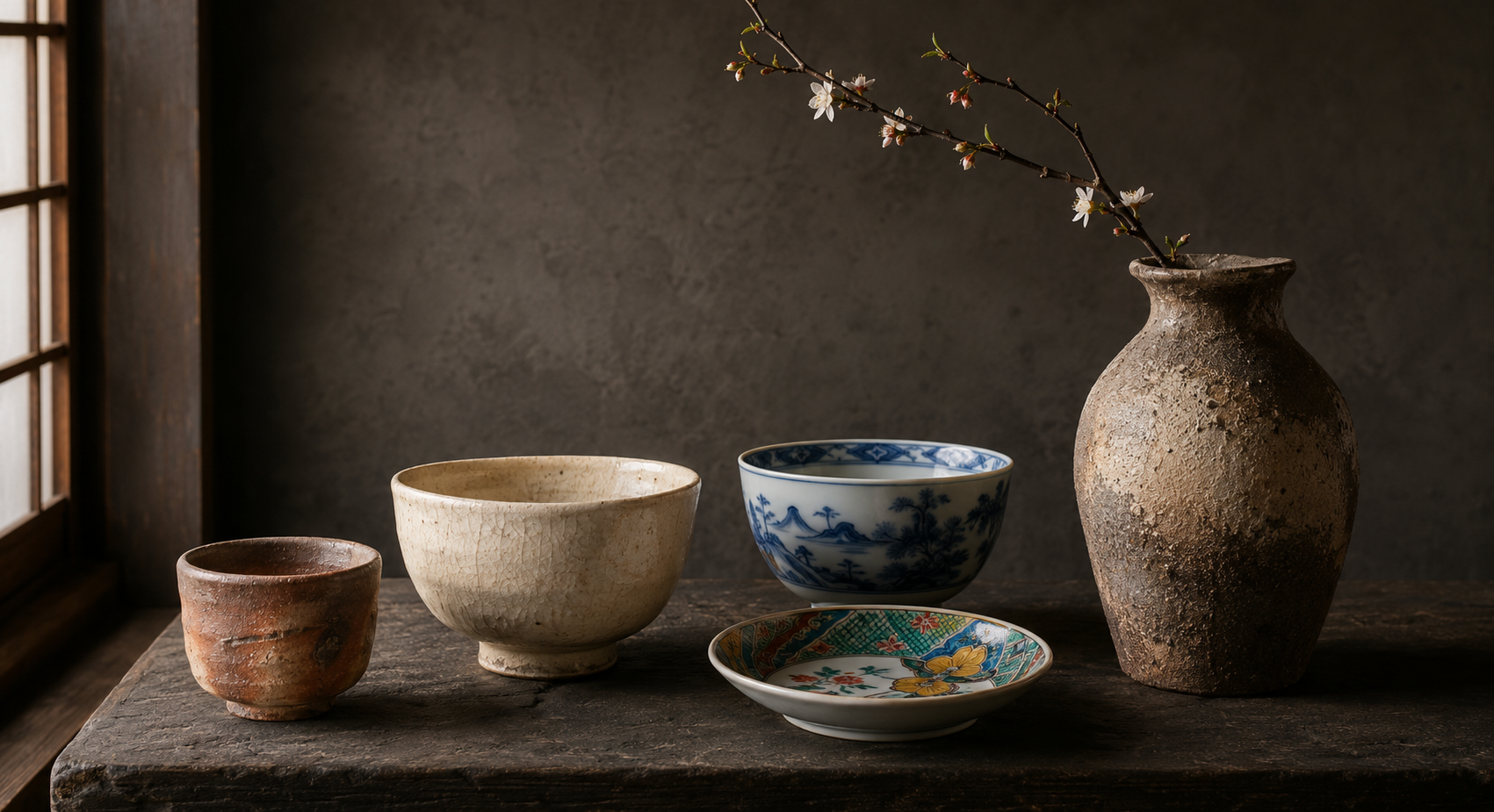
Arita usually brings visual clarity to a room; Kutani brings concentrated color and narrative. Both can live comfortably in contemporary minimal, Japandi, wabi-sabi-inspired, traditional Japanese and eclectic interiors when scale and placement are considered.
In a minimal room, resist filling every shelf. One Kutani vase against limewash or dark timber can behave like a painting in three dimensions. Give detailed decoration enough space to be seen from near and far, and repeat only one of its colors elsewhere—a green textile, a red lacquer accent, a small work on paper.
A beautifully proportioned Arita vessel can add a quieter, almost architectural presence. Blue-and-white porcelain works especially well near natural oak, walnut, linen and brushed metal. Several small pieces can be grouped if their heights form a deliberate rhythm, but avoid arranging them in a flat line.
In eclectic interiors, pair by conversation rather than origin. A Kutani charger can sit beside modern art if scale and color connect them. An Arita jar can soften a sharp contemporary console. In wabi-sabi-inspired spaces, remember that refinement and imperfection are not enemies: a precise porcelain form can make the grain of aged wood or the irregularity of hand-plastered walls more legible.
How to Recognize Quality Japanese Porcelain
Quality is found in the relationship between form, material, decoration and finishing—not in a single sign such as thinness, a signature or perfect uniformity. Turn the object in your hands, view it from several angles and ask whether every decision supports its intended use.
Form
Look at the silhouette before the decoration. Does the profile feel balanced? Is the rim controlled? Does a teapot pour cleanly? Intentional asymmetry can be beautiful; accidental distortion usually feels unresolved.
Porcelain Body
Translucency can signal a refined body, but it is not mandatory for every form. Weight should suit scale and function. Extremely light is not automatically better, especially for large serving pieces or vessels meant to retain heat.
Painting
Examine the confidence of line, the rhythm of repeated marks and the way a motif turns around curvature. Hand painting may reveal slight shifts in pressure and color. The test is not mechanical sameness, but whether variation contributes to a coherent composition.
Glaze
A good glaze should support the body and decoration. Observe its depth, clarity and surface. Tiny pinholes or firing marks may be acceptable in some artisan work, but widespread crawling, sharp glaze faults or surfaces unsafe for the intended use are different matters.
Foot and Finishing
Collectors often turn a piece over because the foot reveals care. Look for a stable base, considered trimming and an underside finished appropriately for the object. The foot may also hold a kiln mark, artist signature or useful evidence of technique.
Maker and Provenance
Marks help, but they require interpretation. A signature is not proof of age, and unmarked work is not necessarily inferior. Reliable seller information, artist biography, original box and documented ownership can add confidence. For antiques, provenance becomes increasingly important.
Handmade Variation
A brushstroke that differs slightly from its neighbor, a gentle shift in glaze or a minute variation in a pair may show human involvement. Cracks, unstable feet, severe warping and undisclosed restoration are not romantic “imperfections.” Learning the difference protects both appreciation and value.
Handmade vs. Mass-Produced Japanese Porcelain
“Japanese-style” does not necessarily mean made in Japan, and “handmade” can describe different levels of human involvement. Ask who formed the body, how the decoration was applied, where firing occurred and whether the piece came from an individual artist, a small workshop or industrial production.
Transfer decoration can reproduce a pattern efficiently and consistently. Hand finishing may add brushed lines, gold or glaze to a transferred base. Small workshops may combine molds with hand painting. A studio artist may design, form, decorate and fire a piece personally. None of these categories can be judged by label alone.
Industrial porcelain can be durable, well designed and appropriate for daily use. Artisan-made work offers a different value: visible judgment, scarcity, variation, technical risk and a closer relationship between maker and object. The important distinction is honesty. A buyer should be able to understand what was done by hand and why it matters.
Why Collectors Continue to Love Arita and Kutani
Arita and Kutani endure because they are not static inheritances. Their makers preserve knowledge while continually testing what regional tradition can mean in the present.
Arita offers the fascination of porcelain technology joined to an exceptionally wide design vocabulary. It can move from quiet domestic sometsuke to brilliant export-inspired color without losing its concern for form and finish. Kutani offers the continued reinvention of painted ceramic surface. Its schools, ateliers and artists demonstrate how line and enamel can turn a functional object into a concentrated field of expression.
Both also remain close to life. Cups are lifted, plates are washed, sake is poured, flowers alter a vase through the seasons. Use creates familiarity, and familiarity creates attachment. This is one reason ceramics often become the most personal part of a collection: they allow us to live with art rather than encounter it only at a distance.
For a wider view of the country’s regional traditions, read A Guide to Japanese Pottery Styles.
Discovering Japanese Porcelain Through Oriental Artisan
Oriental Artisan seeks handcrafted objects from Japan and China not simply for surface beauty, but for the relationship they preserve between maker, material, place and everyday use. The aim is to make traditional craft legible without removing it from contemporary life.
For a first purchase, begin with the ritual you already have: the cup used each morning, the bowl reached for at dinner, the small dish placed beside a teapot. For a collection, begin with a response rather than a category. Notice whether you return to an Arita piece for its composure or a Kutani work for the life of its painted surface.
Then choose slowly. The most satisfying collection is not always the largest. It is the one in which every object has a reason to be there.
Frequently Asked Questions
What is the difference between Arita and Kutani ware?
Arita ware is centered in Saga Prefecture and is strongly associated with Japan’s early porcelain industry, refined bodies and diverse decoration including blue-and-white and polychrome enamel. Kutani ware is associated with Ishikawa Prefecture and is especially known for expressive overglaze painting and color. These are broad tendencies; both traditions contain many styles.
Is Kutani the same as Arita?
No. They are distinct regional ceramic traditions. Some works historically labeled Ko-Kutani have since been attributed by scholars to Arita-area kilns, which complicates the classification of particular seventeenth-century objects, but modern Kutani is not another name for Arita.
Is Imari the same as Arita?
Historically, much porcelain made around Arita was shipped through the port of Imari and became known as Imari ware. The terms therefore overlap, especially for Edo-period porcelain. Today, “Imari” can also describe a decorative style, while “Arita” more directly identifies the production region.
Which is older, Arita or Kutani?
Arita porcelain production began in the early seventeenth century. The first phase associated with Kutani is generally dated to the mid-to-late seventeenth century, so Arita’s porcelain tradition is earlier. Exact attribution of some Old Kutani works remains a subject of ceramic scholarship.
Why is Arita porcelain famous?
Arita became Japan’s first major porcelain-production center and developed deep expertise in forming, glazing, firing and decoration. Its wares served Japanese households and elite patrons and were also exported through Imari and Nagasaki, shaping international awareness of Japanese decorative arts.
Why is Kutani ware famous?
Kutani is famous for overglaze enamel painting, strong color and the diversity of its decorative schools. From areas of green, yellow, purple and blue to minute red linework and gold, Kutani artists have made the ceramic surface a field for sophisticated pictorial expression.
What colors are traditional in Kutani ware?
Kutani gosai usually refers to green, yellow, purple, blue and red. Not every piece uses all five. Aode styles may emphasize green, yellow, purple and blue without red, while akae styles can focus on fine red painting. Contemporary Kutani uses an even broader range.
Is Arita porcelain handmade?
Some Arita porcelain is made and painted by individual artisans or small workshops; some combines industrial forming with hand decoration; and some is fully industrial. “Arita ware” identifies a regional tradition, not one production method. Ask the seller for specific information about forming, painting and firing.
Is Kutani porcelain handmade?
Many Kutani pieces involve hand painting or hand finishing, but production methods vary. Some objects are studio-made from start to finish, while others use standardized porcelain blanks with decoration applied by specialist painters. Authentic regional production can include both artisan and industrial processes.
Which is more valuable, Arita or Kutani?
Neither is automatically more valuable. Price and collector value depend on maker, age, kiln, condition, rarity, technique, provenance, artistic quality and demand. A contemporary bowl and a historically significant antique should never be evaluated by the same criteria.
How can you tell high-quality Japanese porcelain?
Study the balance of the form, suitability of weight, finish of the foot, glaze quality and relationship between painting and curvature. Look for confident brushwork and coherent composition. Maker information, original boxes and provenance can add confidence, but no single mark replaces close examination.
Which is better for everyday tableware?
Both can be excellent. Arita often appeals as versatile, refined tableware; Kutani can bring concentrated color to an otherwise quiet setting. Choose food-safe pieces with practical dimensions, stable feet and care instructions compatible with the way you cook, serve and wash.
Can Arita and Kutani porcelain be used for tea?
Yes, when the object is made for beverage use. Consider capacity, rim, balance, lid fit, pouring performance and heat transfer. Decoration affects the atmosphere of tea, but the regional name alone does not determine whether a vessel brews or tastes better.
Where can I buy authentic Japanese artisan porcelain?
Buy from makers, established galleries, specialist dealers or retailers that explain origin and production rather than relying on “Japanese-style” language. Oriental Artisan curates distinctive Japanese and Chinese craft and provides a considered starting point through its tableware and tea set collections.
One Beautiful Choice
Return to the two pieces placed side by side.
One speaks through precision, proportion and quiet refinement. The other speaks through color, brushwork and expressive decoration. Neither contains the whole story of its region, yet each reveals a different dimension of Japanese ceramic culture.
Choosing between Arita and Kutani is ultimately less about deciding which tradition is superior than discovering which kind of beauty you want to live with. Perhaps it is the clear interval between cobalt branches. Perhaps it is a painted bird emerging from deep green enamel. Perhaps, over time, it is the conversation between both.
Explore Japanese artisan tableware at Oriental Artisan, and choose the piece that makes an everyday ritual feel more fully your own.

Leave a comment
This site is protected by hCaptcha and the hCaptcha Privacy Policy and Terms of Service apply.