


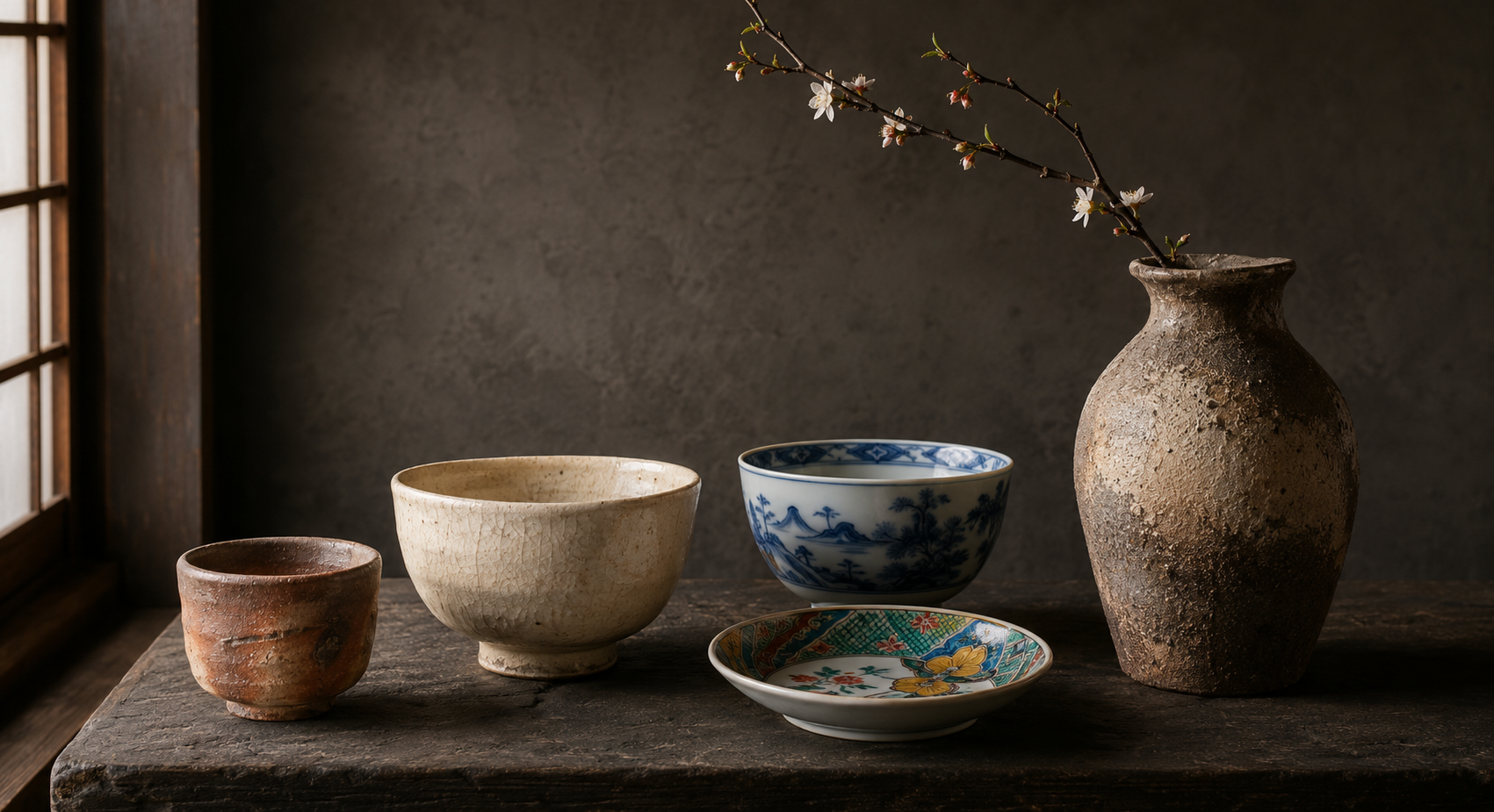
A Guide to Japanese Pottery Styles: Find the Ceramic That Feels Like You
Some ceramics announce themselves through color and precision. Others ask you to come closer: to feel coarse clay beneath the thumb, follow a brushstroke around a bowl, or notice where ash settled during a long firing. Japanese pottery contains all of these possibilities.
At first, the number of names can feel bewildering. Bizen, Hagi, Arita, Kutani, Mino, Karatsu and Mashiko are not simply competing “looks.” They are regional traditions shaped by different clays, kilns, patrons, foods, tea practices and ideas about what a vessel should do.
The major Japanese pottery styles include the unglazed, fire-marked stonewares of Bizen and Shigaraki; the softly glazed tea wares of Hagi and Raku; the refined porcelains of Arita, Imari and Kutani; the diverse glaze traditions of Mino; the functional folk pottery of Mashiko; the restrained tea ceramics of Karatsu; and the historically influential ceramics of Seto. No single style represents Japanese ceramics as a whole.
The most useful way to begin is not to ask which is “best.” Ask what you want to feel when you pick it up. Do you want raw earth or luminous porcelain? The evidence of flame or the control of a painter’s brush? A tea bowl that slowly changes through use, or a plate whose colors make dinner feel celebratory?
This guide will help you recognize the differences, understand the history behind them and find the tradition that feels most like you.
The short answer: If you love raw earth and visible fire, begin with Bizen or Shigaraki. For softness, tea and evolving surfaces, look at Hagi. For hand-formed tea bowls, explore Japanese Raku. For white porcelain and fine blue decoration, consider Arita. For brilliant color, look at Kutani. For varied glazes and expressive forms, explore Mino. For grounded everyday tableware, begin with Mashiko or Seto. For restrained brushwork and tea culture, consider Karatsu.
Japanese Pottery Styles at a Glance
| Style | Region | Material or technique | Visual character | Best known for | Ideal for |
|---|---|---|---|---|---|
| Bizen ware | Okayama | High-fired, usually unglazed stoneware; wood firing | Reddish brown, charcoal gray, ash and flame markings | Natural kiln effects and strong clay presence | Sake ware, vases, tea ware, collectors of earthy minimalism |
| Shigaraki ware | Shiga | Coarse clay, feldspar inclusions, natural ash effects | Warm orange-red clay, glassy ash, scorched surfaces | Rustic jars, tea ware, vases and sculptural forms | Textural interiors, flowers and dramatic wood-fired character |
| Hagi ware | Yamaguchi | Porous pottery body with soft ash or feldspathic glazes | Cream, warm white, blush, pale gray; visible crazing | Tea bowls whose surfaces can deepen through use | Matcha, intimate tea or sake rituals, lovers of subtle aging |
| Raku ware | Kyoto | Hand-formed, low-fired glazed earthenware | Black or red, tactile, compact and highly individual | Chawan made in close relationship with chanoyu | Japanese tea ceremony and focused appreciation of form |
| Arita ware | Saga | High-fired porcelain; underglaze blue and/or overglaze color | White, often crisp and refined; delicate to richly decorated | Japanese porcelain and fine tableware | Tea, sake, dining, gifts and blue-and-white interiors |
| Imari ware | Saga and historical export context | Usually Arita-region porcelain historically shipped through Imari | Often cobalt blue, iron red and gold; many variants | Export porcelain and richly patterned tableware | Decorative tables, collectors and statement gifts |
| Kutani ware | Ishikawa | Porcelain with richly colored overglaze painting | Saturated green, yellow, purple, blue and red; expressive brushwork | Painterly decoration and Kutani gosai palette | Color lovers, gifts, display pieces and distinctive table accents |
| Mino ware | Gifu | Broad ceramic family including Shino, Oribe, Ki-Seto and Setoguro | From milky white to copper green, yellow and deep black | Exceptional glaze variety and tea ceramics | Anyone who wants choice, expressive plates or tea ware |
| Mashiko ware | Tochigi | Functional pottery, often sturdy and generously glazed | Warm, substantial, direct and handmade | Everyday vessels and the modern Mingei legacy | Daily meals, mugs, bowls, serving ware and relaxed homes |
| Karatsu ware | Saga | Iron-bearing clay; ash, feldspar and iron glazes; brushwork | Earthy, restrained and often sparsely decorated | Tea ware and quiet brush-painted surfaces | Tea, sake and understated dining |
| Seto ware | Aichi | Long tradition of glazed pottery and later porcelain | Extremely varied, from medieval ash and iron glazes to blue-and-white porcelain | Historic glaze innovation and broad functional production | Versatile tableware, tea ware and ceramic history enthusiasts |
A useful caution: each regional name covers many kilns, makers and periods. A contemporary artist may work within a tradition while changing its form, palette or firing method. Use this table as a doorway, not a rigid identification key.
What Makes Japanese Pottery Different?
Japanese pottery is distinctive less because of one national appearance than because it preserves many strong local identities. The Japanese word yakimono (焼き物) is an everyday term for fired wares. Tōjiki (陶磁器) refers broadly to ceramics, combining tōki (陶器), commonly translated as pottery, and jiki (磁器), porcelain.
Across Japan, a vessel may be valued for the whiteness and precision of its porcelain body, the depth of its painted decoration, the tactile warmth of its clay, or the unrepeatable traces left by flame and ash. Tea culture encouraged close attention to how a bowl sits in two hands. Food culture encouraged a rich vocabulary of shapes sized for rice, noodles, pickles, sauces, sake and shared dishes. Seasonal presentation made the vessel part of the meal rather than a neutral background.
Three ideas help make sense of this diversity:
- Material is visible. Many Japanese potters allow clay, glaze and fire to remain legible rather than disguising them beneath a uniform surface.
- Use is part of beauty. Weight, lip, foot, capacity, heat and how a vessel frames food can matter as much as its appearance on a shelf.
- Regional knowledge accumulates. Local geology, kiln construction, fuel, trade and inherited workshop practice create recognizable families of ceramics over generations.
Japanese ceramics are therefore not universally rustic, irregular or “wabi-sabi.” Japan also has traditions of translucent porcelain, brilliant enamels, controlled symmetry, minute painting and highly polished courtly presentation. The tension between elemental pottery and refined porcelain is one of the field’s great pleasures.
Pottery vs. Porcelain: Understanding Japanese Ceramics
Pottery and porcelain differ primarily in their raw materials, degree of vitrification and resulting physical character. Porcelain is generally made from refined, pale-firing materials rich in kaolin or porcelain stone and fired until dense and often translucent at thin sections. Pottery uses clay bodies that may retain more visible mineral character, color and porosity. Stoneware is high-fired and substantially vitrified, but usually not as white or translucent as porcelain.
English labels do not map perfectly onto every Japanese historical category, so museum descriptions may classify similar-looking pieces differently. For buying, these practical distinctions are more useful:
| Quality | Pottery and stoneware | Porcelain |
|---|---|---|
| Look | Earth tones, mineral specks, textured or softly glazed surfaces | White or pale body, crisp color, fine painted detail |
| Feel | Often warmer, heavier or more tactile | Often smoother, denser and sometimes thinner |
| Sound | Usually lower and softer when gently tapped | Often clearer and more ringing |
| Water absorption | Varies; some bodies are porous even under a crazed glaze | Usually very low when fully vitrified |
| Typical traditions | Bizen, Shigaraki, Hagi, Raku, Mashiko, Karatsu | Arita, Imari, Kutani, Hasami |
These are tendencies, not a home authentication test. Body composition, glaze, firing and wall thickness vary substantially.
Glazed, unglazed and naturally glazed
A glaze is a glass-forming coating fused to the ceramic body during firing. It can seal the surface, add color, change texture and make a vessel easier to clean. Bizen is celebrated for surfaces created without an applied glaze. Shigaraki can display natural ash glaze, formed when wood ash lands on a piece and melts at high temperature. The Japanese term yakishime often refers to high-fired, unglazed wares whose dense surfaces are created through firing rather than an applied glaze.
Underglaze and overglaze decoration
Underglaze decoration is painted before the final transparent glaze firing, so the image sits beneath a glassy surface. Cobalt blue on white porcelain is the classic example. Overglaze decoration is applied after the main glaze firing and fixed in a later, lower-temperature firing. It allows a wider range of enamel colors and metallic details. Arita and Kutani may employ both, but Kutani is particularly associated with expressive overglaze painting.
Hand-building, wheel throwing and molding
Wheel-thrown vessels may retain throwing rings, variations in profile and a trimmed foot. Hand-built works are shaped by pinching, coiling or joining slabs. Traditional Japanese Raku tea bowls are hand-formed rather than thrown. Molds and casting also have long and legitimate roles in Japanese ceramic production, particularly where specialized artisans divide shaping, painting, glazing and firing. “Handmade” does not always mean that one person completes every stage without tools.
Why Japanese Pottery Is So Regional
Place is not marketing decoration in Japanese ceramics. It can be present in the body of the object.
Clay from one area may be rich in iron and fire red or brown. Another may contain visible feldspar grains that soften and melt in a wood kiln. Porcelain stone can produce a white, dense body suited to precise cobalt painting. Forests once provided particular woods for long firings; hillsides made tunnel and climbing kilns possible. Ports connected workshops with domestic and international patrons. Feudal domains sponsored kilns. Tea masters changed which accidental-looking surfaces were admired. Local cuisines created demand for particular serving forms.
A regional tradition is therefore an ecosystem: geology + fuel + kiln + technique + patronage + use + inherited judgment. Modern potters may use electric or gas kilns, imported materials or personal glazes, yet their work still converses with this regional history.
The Six Ancient Kilns of Japan
The Six Ancient Kilns of Japan (Nihon Rokkoyō, 日本六古窯) are Echizen, Seto, Tokoname, Shigaraki, Tamba and Bizen. They are recognized as representative production centers where ceramics continued from the medieval period into the present. Japan’s Agency for Cultural Affairs describes Seto as the glazed-ware exception within a group otherwise strongly associated with high-fired, unglazed traditions. The Six Ancient Kilns are also recognized together as a Japan Heritage story.
- Echizen, in Fukui, is known historically for robust storage jars and other high-fired utilitarian vessels.
- Seto, in Aichi, became an exceptional center for glazed wares and later porcelain.
- Tokoname, also in Aichi, produced large utilitarian wares and is now especially familiar for red-clay teapots.
- Shigaraki, in Shiga, is recognized for coarse clay, natural ash and warm firing color.
- Tamba, in Hyogo, developed durable household ceramics and a distinctive climbing-kiln culture.
- Bizen, in Okayama, is renowned for unglazed stoneware transformed by fire, ash and kiln placement.
Their importance is not that they contain the six “best” styles. Hagi, Raku, Arita, Kutani, Mino, Mashiko and Karatsu are essential to the larger story. The Six Ancient Kilns matter because they preserve long continuities in Japan’s native stoneware culture and show how medieval centers grew around local resources, circulation networks and everyday needs.
Major Japanese Pottery Styles
Bizen Ware: Earth Written by Fire
Bizen ware (備前焼, Bizen-yaki) is high-fired, generally unglazed stoneware from Okayama, known for reddish-brown clay and natural markings produced by flame, ash, straw, charcoal and kiln placement. It is one of the Six Ancient Kilns.
Bizen does not depend on painted ornament. Its visual language comes from the clay body and the firing. Iron-bearing clay can mature into russet, brown, gray or near-black tones. Ash may create sesame-like deposits known as goma. Straw tied or placed around a piece can leave red linear markings called hidasuki. Reduced or charcoal-rich areas may produce darker sangiri effects. These names describe families of kiln results, not printed patterns.
Traditional firings can be long and demanding. Makers load the kiln with an understanding of flame paths, but results retain an element beyond complete control. This is why two vessels of the same shape can feel like individuals.
Choose Bizen if: you prefer raw material to applied decoration; you enjoy rust, ember, charcoal and earthen colors; or you want sake ware, a flower vessel or tea object with a strong physical presence.
Look closely at: how the surface changes as you turn the piece. Good Bizen should reward movement and touch, not merely appear uniformly brown.
Shigaraki Ware: Ancient Texture and Glassy Ash
Shigaraki ware (信楽焼, Shigaraki-yaki) is a pottery tradition from Shiga known for resilient, often coarse clay, visible feldspar particles, warm fire color, scorched areas and natural ash effects. It is also one of the Six Ancient Kilns.
The clay can appear granular and stone-like. During wood firing, feldspathic particles may bloom pale against orange or reddish clay, while ash can melt into greenish or glassy runs. Large jars, vases and tea wares often make the most of this dramatic relationship between rugged body and fluid surface. Contemporary Shigaraki is broad and also includes tableware, architectural ceramics and familiar tanuki figures, but its most compelling studio pottery retains a powerful sense of geological material.
Shigaraki and Bizen can both be earthy and wood-fired. A practical distinction is that Shigaraki often appears coarser and more visibly granular, with pale feldspar inclusions and glassier ash passages; Bizen often reads as denser, smoother and more dependent on reddish clay and named fire markings. Individual works can cross these expectations.
Choose Shigaraki if: you love rough texture, ancient jars, bold vases, natural ash and ceramics that feel almost excavated from a landscape.
Hagi Ware: Softness That Records Use
Hagi ware (萩焼, Hagi-yaki) is a tea-centered pottery tradition from Yamaguchi, admired for soft clay bodies, restrained forms, pale ash or feldspathic glazes and surfaces that may gradually change as tea enters fine glaze crazing. Its historical development is closely connected with Korean potters and Joseon ceramic influence.
A Hagi bowl may be warm white, cream, pale gray, blush or softly purple where atmosphere and glaze meet. The body is often comparatively porous. With repeated use, tea can enter the fine network of crazing and deepen the surface. This celebrated aging is known as the “seven transformations of Hagi” (Hagi no nanabake), though the phrase describes an evolving relationship rather than seven literal, scheduled stages.
That porosity brings responsibilities. Follow the maker’s instructions. Some pieces benefit from being saturated briefly with clean water before use; all should be washed promptly and dried completely to discourage odor or mold.
Choose Hagi if: you want a tea or sake vessel that feels gentle in the hands and becomes more personal through careful use.
Look closely at: the foot, the balance of glaze and exposed clay, and whether the rim feels comfortable. Subtlety leaves little room for careless form.
Raku Ware: A Tea Bowl Shaped Around the Hands
Japanese Raku ware (楽焼, Raku-yaki) is a low-fired, glazed earthenware tradition closely associated with chanoyu, Kyoto and the Raku family. Its characteristic tea bowls are hand-formed rather than thrown on a wheel. The Smithsonian’s National Museum of Asian Art notes that Raku developed in close exchange between sixteenth-century potters and tea practitioners, while The Metropolitan Museum of Art describes traditional Raku as lightweight, hand-molded earthenware.
Raku chawan are often black or red, compact in silhouette and intimate in scale. Hand-forming lets the maker respond directly to the imagined grip, lip and interior pool of the tea bowl. The low-fired body and glaze create a tactile experience very different from vitrified porcelain.
Japanese Raku should not be casually conflated with modern Western raku firing, which commonly removes red-hot work from the kiln and places it in combustible material to create smoke, crackle and metallic effects. Western raku developed from Japanese inspiration but became a different studio process. Not every smoke-blackened or crackled raku object belongs to the historic Japanese tea tradition or Raku family lineage.
Choose Raku if: matcha and the focused experience of a single hand-formed bowl matter more to you than durability or general-purpose dining use.
Arita Ware: The Clarity of Japanese Porcelain
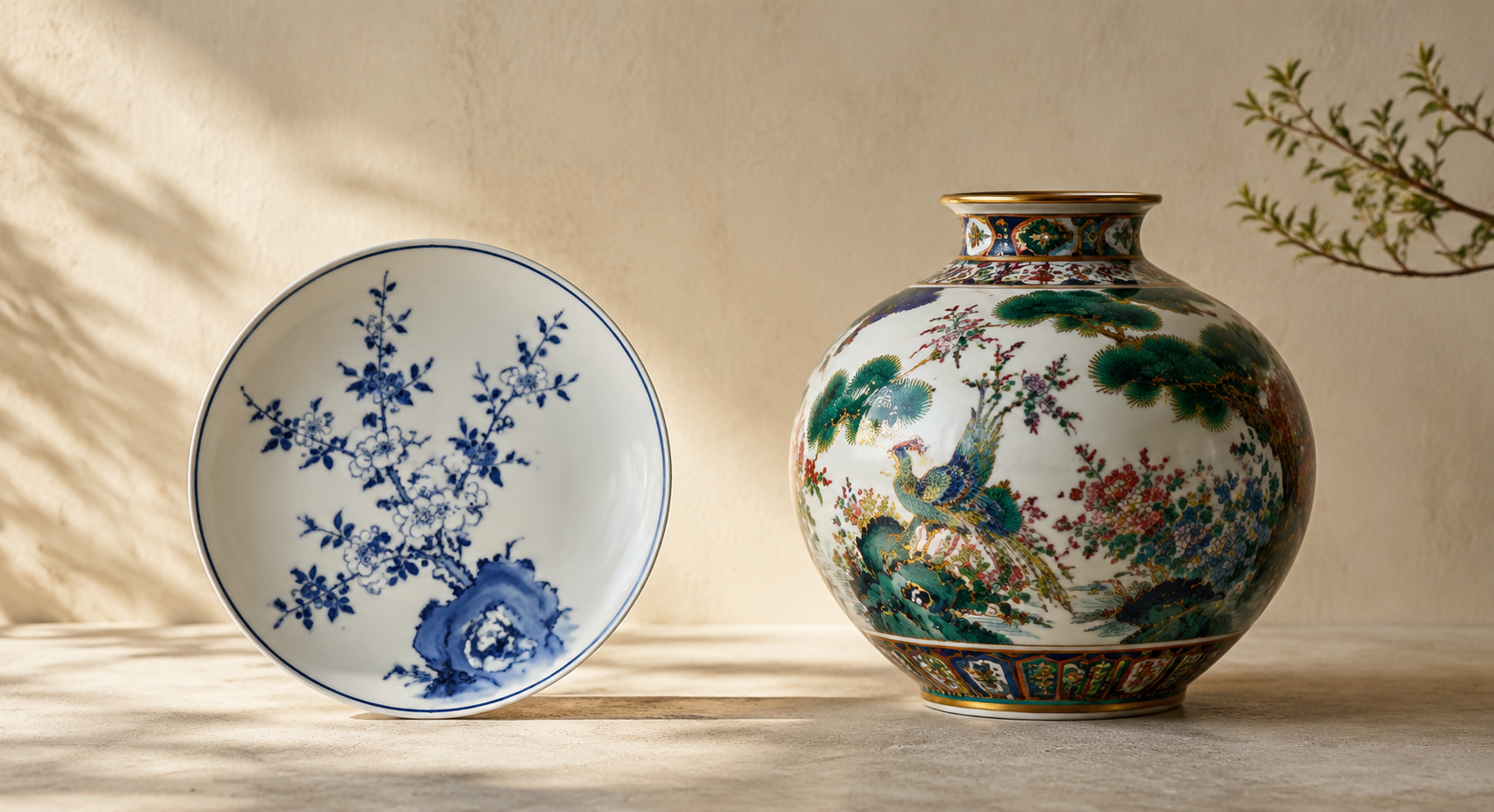
Arita ware (有田焼, Arita-yaki) is porcelain from the Arita region of Saga, where Japanese porcelain production emerged in the early seventeenth century with crucial knowledge brought by potters from the Korean Peninsula. Arita became known for a white, dense porcelain body suited to underglaze cobalt, overglaze enamels and refined tableware.
Arita is not one visual style. It includes restrained blue-and-white ware, colorful iro-e decoration, Kakiemon-associated compositions with generous white space, and richly ornamented works. Production was historically collaborative: clay preparation, forming, painting, glazing and firing could be performed by specialized craftspeople.
Compared with earthy pottery, porcelain gives color and line a different authority. Cobalt can remain crisp beneath a transparent glaze; thin walls can transmit light; a smooth rim can feel precise rather than soft.
Choose Arita if: you love white porcelain, fine brushwork, blue-and-white schemes, lighter visual weight and ceramics that can move easily between Japanese and international tables.
Imari Ware: A Name Shaped by a Port
Historically, “Imari ware” often refers to porcelain made in and around Arita and shipped through the nearby port of Imari. It is therefore not always a separate production body or technique from Arita ware. The official Traditional Craft Industries Promotion Association likewise explains that Arita porcelain was called Imari because of its shipping port. Arita remains widely recognized as the birthplace of Japanese porcelain.
In Western collecting language, Imari often evokes densely patterned export porcelain in cobalt blue, iron red and gold. Yet “Imari” has been used broadly, and historical categories such as Early Imari, Ko-Imari, Kakiemon and Nabeshima require more precision than color alone can provide. Modern ceramics are also made in Imari City.
Choose Imari if: you enjoy historical export design, patterned surfaces and tableware with more visual ceremony. When buying an older or expensive piece, ask whether “Imari” describes origin, period, decorative style or a modern product label.
Kutani Ware: Porcelain as Painting
Kutani ware (九谷焼, Kutani-yaki) is an Ishikawa porcelain tradition celebrated for richly colored overglaze painting. Its famous Kutani gosai, or five-color vocabulary, is commonly identified as green, yellow, purple, blue and red, though specific styles may omit or emphasize particular colors.
Kutani is not merely “colorful porcelain.” Its power comes from the relationship between dark contour drawing, saturated enamel fields and a porcelain ground that can appear slightly blue-white. Several lineages create very different effects: Yoshidaya-style work is associated with dense color and traditionally omits red; aka-e saibyō uses intricate red linework; Eiraku-style decoration pairs red grounds with gold; and other schools combine multiple approaches.
The origins of Ko-Kutani, or Old Kutani, remain debated. Archaeological and stylistic research has led some scholars to connect part of the group with Arita production, while regional tradition connects it to Kutani. A responsible guide should preserve that uncertainty rather than turn it into a neat origin story. The Traditional Craft Industries Promotion Association explicitly notes that the debate remains unresolved.
Choose Kutani if: color gives you energy; you enjoy painterly narrative, birds, flowers or graphic pattern; or you want a small dish, cup or vase that can carry a room by itself.
Mino Ware: Not One Style, but a World of Glazes
Mino ware (美濃焼, Mino-yaki) is a broad ceramic tradition from Gifu rather than one uniform look. Its celebrated tea ceramics include Shino, Oribe, Ki-Seto and Setoguro. Official craft standards recognize numerous Mino categories, which is why a single visual definition is misleading.
- Shino is known for thick, milky feldspathic glaze, often with pinholes, soft blushes or iron-painted designs beneath the glaze.
- Oribe often uses vivid copper green, bold geometry and asymmetrical or molded forms; black, white and other Oribe variants also exist.
- Ki-Seto is associated with warm yellow glaze and restrained incised or stamped decoration.
- Setoguro uses a deep black glaze historically developed through particular firing and cooling control.
These traditions flourished in conversation with late sixteenth- and early seventeenth-century tea culture, when deliberately fresh forms and glaze effects could challenge imported ideals.
Choose Mino if: you do not want to choose between rustic and graphic, quiet and expressive. Mino is especially rewarding for plates and bowls because glaze, asymmetry and food presentation can work together.
Mashiko Ware: The Beauty of Useful Things
Mashiko ware (益子焼, Mashiko-yaki) is a Tochigi pottery tradition rooted in practical household production and later transformed by the Mingei movement. It began as a production center in the late Edo period, making everyday vessels from local clay. Traditional Mashiko forms are often sturdy, generous and direct, with glazes in persimmon, black, white or ash-based tones.
Potter Hamada Shōji settled in Mashiko in the 1920s and became a central figure in the Mingei, or folk craft, movement. His presence drew new attention to the beauty of useful, locally grounded ceramics and helped make Mashiko an international center for studio pottery. That does not mean all Mashiko is “Hamada style.” Today the town supports many individual makers and contemporary directions. The Mashiko Museum’s own history records both Hamada’s enormous influence and the broader group of potters who shaped modern Mashiko.
Choose Mashiko if: you want a bowl or mug to use constantly, appreciate a substantial hand-feel and believe beauty should live in ordinary meals rather than wait in a cabinet.
Karatsu Ware: Restraint, Brushwork and Tea
Karatsu ware (唐津焼, Karatsu-yaki) is a Saga pottery tradition known for iron-bearing clay, restrained glazes, lively brushwork and a deep relationship with tea. Its development around the late sixteenth century reflects technologies and aesthetic influence from the Korean Peninsula, while its many kiln sites and substyles make it more varied than a single “rustic” label suggests.
Some Karatsu is sparsely painted in iron under a translucent glaze (e-Karatsu). Other works use slip, ash, feldspar, iron or copper-bearing glazes. The best pieces often feel unforced: a few brush lines, an open field of warm clay and a form that serves tea before it performs for the viewer.
The familiar tea-world saying “First Raku, second Hagi, third Karatsu” expresses the esteem given to these tea-bowl traditions, but it should be understood as a traditional preference formula, not an objective or universal ranking.
Choose Karatsu if: you admire calligraphic economy, Korean-influenced tea forms, iron-rich clay and ceramics whose decoration knows when to stop.
Seto Ware: The Name That Came to Mean Ceramics
Seto ware (瀬戸焼, Seto-yaki) is an Aichi tradition of extraordinary breadth, historically distinguished by sophisticated glazed ceramics and later by porcelain as well. In medieval Japan, Seto was exceptional for its production of glazed wares influenced by, but not merely imitating, Chinese ceramics.
Seto’s reach was so great that setomono, literally “things from Seto,” became a generic Japanese word for ceramics. The Kyoto National Museum explains how the regional term expanded into a general one.
Because Seto has produced ash-glazed stoneware, iron-glazed vessels, porcelain, blue-and-white decoration and industrial ceramics, identification requires more than spotting one palette. Its identity lies partly in technical adaptability.
Choose Seto if: you value ceramic history, glaze knowledge and useful objects that connect long tradition with an unusually broad range of forms.
Other Traditions Worth Knowing
No guide can contain the full map of Japanese ceramics. These traditions add useful points of reference:
- Tokoname ware is one of the Six Ancient Kilns and is especially loved today for unglazed or subtly finished red-clay teapots used for sencha.
- Tamba ware combines durable everyday forms with slipped, glazed and wood-fired surfaces; its climbing kilns are central to the regional story.
- Echizen ware is known historically for strong high-fired vessels and robust clay character.
- Iga ware can be dramatically wood-fired, with scorched areas and glassy bidoro ash effects; its sturdy pots and flower vessels often feel sculptural.
- Kyō or Kiyomizu ware from Kyoto is not defined by one local clay body. It is associated instead with diverse workshop traditions, refined forming and often sophisticated decoration shaped by Kyoto patronage.
- Hasami ware is porcelain from Nagasaki known for practical, repeatable tableware, especially blue-and-white designs. It is an excellent reminder that good craft can involve coordinated production, not only one-off studio work.
Which Japanese Pottery Style Is Right for You?
Choosing by region alone is difficult. Start with the feeling you want, then confirm that the object suits its intended use.
If you love earthy minimalism
Begin with Bizen, then compare Karatsu and quieter Mashiko work. Bizen gives you the clearest expression of clay and fire without applied glaze. Karatsu introduces restrained brushwork or a thin glaze. Mashiko offers an approachable version of earthy character for daily dining.
Best first object: a Bizen sake cup, a Karatsu small plate or a Mashiko rice bowl.
If you love wabi-sabi
Look at Hagi, Raku, Karatsu, Shigaraki and selected Mino tea wares. Each approaches imperfection differently: Hagi through softness and aging, Raku through hand-formed intimacy, Karatsu through restraint, Shigaraki through elemental kiln effects and Shino through a thick glaze that welcomes variation.
Do not shop for damage in the name of wabi-sabi. Look for a coherent form, a purposeful rim and foot, and variation that grows from material or process.
If you love raw texture and dramatic fire
Choose Shigaraki, Bizen or Iga. Shigaraki tends toward granular clay and glassy ash; Bizen toward refined fire markings on an unglazed body; Iga can be especially bold and sculptural.
Best first object: a flower vase. An open vessel lets dramatic texture become part of the room without introducing food-care concerns.
If you love refined blue-and-white porcelain
Begin with Arita or Hasami, then explore blue-and-white Seto and Mikawachi work. Arita can be highly refined and painterly. Hasami often prioritizes functional everyday clarity. Mikawachi is known for exceptionally delicate blue painting on white porcelain.
Best first object: a small plate set, teacup or sake cup that allows you to compare brushwork at close range.
If you love expressive color
Choose Kutani for painterly, saturated overglaze decoration or Oribe within Mino for copper green, black line and assertive form. Imari-style porcelain is ideal if you prefer red, cobalt and gold in a more patterned, ceremonial composition.
Best first object: one Kutani side plate or cup. A single colored piece can enliven neutral tableware without requiring a complete matching service.
If you love the Japanese tea ceremony
For matcha, explore Raku, Hagi, Karatsu, Shino, Oribe and selected Bizen tea bowls. Choose with your hands as much as your eyes: consider diameter, depth, the sweep of the interior for whisking, lip comfort, thermal feel and stability of the foot.
For sencha or other leaf teas, Tokoname teapots and porcelain wares from Arita or Hasami may be more practical. A glazed or porcelain interior is easier to use across different teas; an unglazed clay pot is often best reserved for a narrower tea range because it may retain aromatic traces.
If you want ceramics for everyday meals
Start with Mashiko, Mino, Seto, Hasami or practical Arita ware. They offer broad ranges of bowls and plates. Prioritize stackability, weight, foot smoothness and confirmed dishwasher or microwave guidance over romantic origin stories.
Best first object: a rice bowl, noodle bowl or medium plate you will use at least twice a week.
If you are choosing sake ware
Choose by temperature, volume and atmosphere rather than claims that one clay universally “improves” sake.
- For a grounded, tactile pour, consider Bizen, Karatsu, Hagi or Mashiko.
- For chilled sake and a cleaner visual presentation, consider thin Arita porcelain.
- For a celebratory cup, choose painted Kutani or Imari-style porcelain.
- For warmed sake, confirm that the tokkuri is intended for heating and follow its maker’s instructions; never assume direct-flame or microwave safety.
If you want something that becomes more beautiful with age
Hagi is the clearest choice because controlled staining through fine crazing is traditionally appreciated. Unglazed Bizen may also develop a softer hand-feel and subtle surface depth through use. Aging should come with attentive cleaning and complete drying, not neglect.
If you want a meaningful Japanese gift
Match the ceramic to the recipient’s ritual. A tea drinker may appreciate Tokoname or Hagi; a color lover, Kutani; a minimalist, Bizen; an enthusiastic home cook, Mashiko or Mino. Include the maker, region, technique and care instructions. Provenance turns a beautiful object into a story the recipient can keep.
Japanese Pottery for Tea
Tea ware is where touch, temperature and visual attention meet most clearly. A matcha bowl should be wide enough to whisk comfortably, stable when set down and pleasant at the lip. Its interior color affects how the green of matcha appears: black Raku makes green vivid; pale Hagi creates a soft contrast; Oribe green produces a more layered conversation between tea and glaze.
No style is automatically “best.” Tea practitioners may select bowls by season, gathering and aesthetic intention. A deep cylindrical bowl can feel sheltering in cold weather, while a more open form releases heat in warmer months.
For loose-leaf tea, consider the relationship between clay and repeat use. Unglazed Tokoname teapots are often chosen for Japanese green tea, while glazed stoneware and porcelain are versatile because their interiors absorb little aroma. Check the fit of the lid, the flow of the spout, the filter and whether the handle remains comfortable when the pot is full.
Continue exploring: Explore Japanese Tea Ware
Japanese Pottery for Sake
Sake vessels shape pace and attention. A small cup encourages repeated pouring, often reinforcing hospitality between companions. A wider guinomi opens aroma more readily than a tiny sakazuki, while an ochoko supports small, measured sips. A tokkuri should pour cleanly and feel balanced when held by the neck or body.
Pottery can feel warm and grounded; porcelain can feel crisp and visually precise. Thick walls generally buffer temperature changes and feel substantial. Thin porcelain communicates temperature quickly. These are experiential differences, not guarantees that a particular regional clay improves every sake.
For a first set, choose a practical capacity, confirm heating instructions and decide whether you prefer matched cups or the Japanese pleasure of related but non-identical pieces.
Continue exploring: Discover Japanese Sake Ware
Japanese Ceramics for the Dining Table
Japanese table settings rarely require every vessel to match. Harmony may come from proportion, shared color or seasonal contrast rather than identical decoration. This makes collecting gradually both practical and aesthetically rewarding.
- A dark Bizen or black-glazed Mino plate can intensify pale sashimi, tofu or fruit.
- Blue-and-white Arita or Hasami works easily with rice, noodles and many Western dishes.
- Oribe green can frame grilled vegetables or neutral foods boldly.
- Mashiko bowls bring warmth to soups, rice and casual shared meals.
- A single Kutani dish can act as a point of color among quieter ceramics.
Size matters. A rice bowl is designed to sit in the hand. A ramen bowl needs enough capacity for broth, noodles and toppings without filling to the rim. Small side dishes create rhythm and separation. Before buying, compare dimensions with a vessel you already use rather than relying on photographs.
Continue exploring: Discover Japanese Bowls · Explore Artisan Ramen Bowls
Understanding Wabi-Sabi in Japanese Pottery
Wabi-sabi in pottery is an appreciation of transience, restraint, natural material, asymmetry and the depth that can emerge through time and use. It is not a blanket term for anything rough, cracked or imperfect.
A Hagi bowl that slowly changes, a Karatsu cup with spare iron brushwork or a Shigaraki jar marked by ash may invite wabi-sabi appreciation. The viewer notices what is incomplete, quiet or seasonal. But the object still needs sound judgment. A balanced asymmetry is different from careless collapse. A fine glaze craze is different from a structural crack. A kiln mark is different from a sharp defect that makes a cup unsafe.
Japanese ceramics also contain aesthetics that are almost the opposite: the saturated color of Kutani, the technical precision of Arita, the gold and red density of Imari-style decoration, or the playful geometry of Oribe. Understanding Japanese pottery means making room for austerity and abundance.
How to Recognize Handmade Japanese Pottery
No single mark proves that a piece is handmade. Look for a constellation of evidence:
- Form variation: a rim may move subtly, but it should remain usable and visually resolved.
- Throwing or forming evidence: faint concentric rings, trimming lines, joined handles or hand-compressed planes can reveal process.
- Glaze variation: pooling, thinning, pinholes or color shifts may be expected within a particular glaze tradition.
- Brushwork: hand-painted lines usually show changes in speed, pressure, pigment load and direction.
- Kiln effects: ash deposits, flame shadows and protected areas should relate convincingly to firing and kiln placement.
- The foot: a well-finished foot is stable, considerate to the table and appropriate to the style. Rough clay should not mean a carelessly sharp base.
- Variation across a set: handmade siblings are related, not cloned. Their dimensions and decoration may differ slightly without impairing function.
- Maker and workshop information: a seal, box inscription, certificate, biography or documented studio origin can support attribution, though marks also require interpretation.
Variation is not automatically quality. Poorly fitted lids, unstable feet, uncomfortable sharp rims, undisclosed cracks, severe warping that compromises use or glaze defects in food-contact areas may be faults. Good craftsmanship often appears as controlled variation within functional discipline.
How to Choose Japanese Pottery
1. Begin with the intended use
Decide whether the piece is for matcha, loose-leaf tea, sake, whisky, ramen, rice, serving, flowers, incense, display or collecting. A sculptural vase can celebrate rough ash in ways that would be inconvenient on a soup bowl. A tea bowl needs a comfortable rim and whiskable interior. A ramen bowl needs capacity and a stable foot.
2. Choose the material deliberately
Select pottery when you want tactile warmth, mineral character and glaze depth. Choose porcelain when you prefer a smoother, denser body, crisp painted detail or lower absorption. For daily use, neither is universally superior: construction and intended function matter more than category alone.
3. Read the surface
A rough exterior can improve grip but may require hand washing. Matte glazes may show metal marks from cutlery. Pale crackle glazes may stain. Overglaze enamel and gold require gentler care than decoration protected beneath a glaze. Ask whether variations, pinholes or crazing are expected and whether the interior is approved for food contact.
4. Check size, weight and proportion
Read actual measurements and capacity. Imagine the vessel full, not empty. Check whether a mug handle fits your hand, a sake bottle can be poured without strain, a bowl nests in the cupboard and a plate fits your dishwasher. Japanese serving pieces may be smaller than buyers expect from lifestyle photographs.
5. Understand handmade variation
Product photography may show a representative piece rather than the exact one you will receive. Ask whether color, pattern, shape and kiln effects vary, and how much. For one-of-a-kind wood-fired work, request images of the actual piece when possible.
6. Confirm food safety
For functional tableware, look for an explicit statement that the item is intended for food use and complies with the relevant market’s requirements. Do not use decorative or unknown vintage ceramics for food simply because they resemble tableware. The U.S. Food and Drug Administration advises against using pottery that contains leachable lead for cooking, serving or storing food and drink. See the FDA’s guidance on lead-glazed traditional pottery.
7. Read care instructions piece by piece
Dishwasher, microwave, oven and direct-flame suitability depend on the body, glaze, decoration and construction. Never infer microwave safety from “stoneware” alone, and never microwave metallic overglaze or gold decoration. Avoid sudden temperature changes unless the maker expressly confirms thermal-shock resistance.
8. Ask about authenticity and provenance
Useful information includes the maker or kiln, region, material, forming method, decoration, firing method and whether the piece carries a seal, signed box or certificate. A trustworthy seller should distinguish “made in Arita,” “Arita-style” and “inspired by Japanese ceramics.” Provenance matters more as price and collectability rise.
9. Understand the price
Japanese ceramics range from accessible coordinated tableware to unique works by acclaimed artists. Price may reflect material preparation, hand forming, carving, painting time, multiple firings, wood-firing losses, scale, rarity, signed packaging, provenance and the maker’s reputation. High price does not guarantee emotional connection, but unusually low prices should invite questions about origin, labor and claims of hand production.
How to Care for Japanese Ceramics
Always prioritize instructions from the maker or seller. When those are unavailable, use conservative care:
- Wash before first use. For porous or crazed pottery, ask whether brief pre-soaking is recommended.
- Hand wash delicate pieces. Use a soft sponge and mild detergent. Avoid abrasive powders and metal scrubbers.
- Dry completely. Porous bodies and unglazed feet should air-dry fully before storage.
- Avoid prolonged soaking. This is especially important for porous pottery, repaired work, wooden attachments or pieces with unknown adhesives.
- Prevent thermal shock. Do not move a cold vessel directly into boiling water, a hot oven or a cold stone surface.
- Treat gold and overglaze decoration gently. Do not microwave metallic decoration. Dishwasher abrasion may dull enamels or gold even when the porcelain body itself is durable.
- Inspect cracks. Fine crazing within a glaze can be part of the intended surface. A crack through the body, a loose handle or sharp glaze loss is different and may make the piece unsuitable for food or hot liquid.
- Use restored pieces appropriately. Traditional or decorative repair materials are not automatically food-safe, microwave-safe or dishwasher-safe. Confirm the repair system and intended use.
If a piece develops odor, persistent staining, seepage or a structural crack, stop using it for food until a knowledgeable maker or conservator can advise.
Japanese Pottery as Part of Everyday Ritual
A handmade vessel does not need a ceremony to justify its presence. Its value can emerge through repetition.
A rice bowl teaches the hand its weight. A sake cup slows a pour just enough to notice the person across the table. A wide ramen bowl leaves room for broth, noodles and toppings rather than treating dinner as fuel. A vase changes with one winter branch or a handful of summer flowers. A tea bowl asks you to feel heat through clay before you taste anything.
This is where Japanese pottery is most persuasive: not as a generalized symbol of “Japan,” but as an object made for a particular action. The choice between rough Bizen and luminous Arita is ultimately a choice about how you want that action to feel.
At Oriental Artisan, the natural role of curation is to preserve those distinctions. Japanese ceramic tableware, tea ware, sake ware, ramen bowls, cups, vases and incense objects should not be grouped only by color or trend. Maker, region, material, technique and use allow a person to find an object with which a real ritual can grow.
Is Japanese Pottery a Good Gift?
Yes. Handmade Japanese pottery can be an especially meaningful gift when the form matches the recipient’s habits and the maker’s story is included. A useful piece avoids becoming a beautiful obligation.
Consider:
- Their ritual: tea, sake, coffee, flowers, cooking or collecting.
- Their aesthetic: earthy, quiet, colorful, graphic or refined.
- Their household: dishwasher habits, storage space, children and preferred serving sizes.
- The level of care: porous Hagi and gold-painted porcelain ask for more attention than robust daily tableware.
- Presentation: a signed wooden box or clear information card can add cultural and collectible value.
- Pairs versus singles: a pair of sake cups suggests sharing; one exceptional chawan honors an individual practice.
For a recipient you do not know intimately, a medium serving bowl, small plate set or vase is often safer than highly specialized tea ware.
Frequently Asked Questions About Japanese Pottery
What are the main types of Japanese pottery?
The best-known Japanese ceramic traditions include Bizen, Shigaraki, Hagi, Raku, Arita, Imari, Kutani, Mino, Mashiko, Karatsu and Seto. They range from unglazed, wood-fired stoneware to soft tea pottery and highly decorated porcelain. Japan also has many other important regional traditions, including Tokoname, Tamba, Echizen, Iga, Hasami and Kyō ware.
What is traditional Japanese pottery called?
Yakimono is a common Japanese term for fired ware or ceramics. Tōjiki is a broad term for ceramics, encompassing tōki, usually translated as pottery, and jiki, porcelain. Regional names commonly end in -yaki, meaning fired or baked ware, as in Bizen-yaki.
What is the difference between Japanese pottery and porcelain?
Japanese pottery generally uses clay bodies that retain more color, texture or porosity, while porcelain uses pale-firing porcelain stone or kaolin-rich materials and becomes dense, hard and sometimes translucent. Bizen and Hagi are pottery traditions; Arita and Kutani are porcelain traditions. Exact technical classification can vary by body and firing.
What are the Six Ancient Kilns of Japan?
The Six Ancient Kilns are Echizen, Seto, Tokoname, Shigaraki, Tamba and Bizen. They are historically important production centers where ceramic making continued from the medieval period into modern times. Seto is especially associated with early glazed wares, while the other five are strongly linked with high-fired, unglazed ceramic traditions.
What is the most famous Japanese pottery style?
There is no single most famous style for every audience. Arita and Imari are internationally renowned for porcelain; Raku and Hagi are central to tea culture; Bizen is famous for unglazed wood-fired stoneware; and Kutani is recognized for colored overglaze painting. The answer depends on whether the context is tea, export porcelain, folk craft or contemporary collecting.
Why is Japanese pottery often irregular?
Some Japanese pottery displays asymmetry, throwing marks, glaze variation and kiln effects because the maker allows material and process to remain visible. These qualities may support tea aesthetics or regional identity. Irregularity is not universal, and it is not automatically desirable: Japan also has highly precise porcelain traditions, and functional defects remain defects.
What Japanese pottery is best for tea?
For matcha, Raku, Hagi, Karatsu, Shino and Oribe are historically important choices. For sencha and other leaf teas, Tokoname teapots are widely admired, while glazed stoneware and Arita or Hasami porcelain offer versatile, low-absorption interiors. The best piece fits the tea, preparation method and user’s hands.
What Japanese pottery is best for sake?
Bizen, Hagi, Karatsu and Mashiko offer tactile, earthy sake ware. Arita porcelain provides a smooth, refined experience, while Kutani brings color and ceremony. Choose the vessel’s shape and wall thickness for the intended serving temperature, and confirm whether a tokkuri may be warmed.
What is wabi-sabi pottery?
Wabi-sabi pottery values qualities such as restraint, asymmetry, natural material, transience and beauty deepened by use. Hagi, Raku, Karatsu and Shigaraki may invite this appreciation, but wabi-sabi is not a synonym for damaged, rough or poorly made ceramics.
How can you tell if Japanese pottery is handmade?
Look for coherent variation in form, wheel or forming marks, changing brush pressure, glaze pooling, a carefully finished foot and credible maker or kiln information. No single irregularity proves hand production. Molds and collaborative workshop methods can also be part of authentic Japanese craft.
Is Japanese pottery dishwasher safe?
Some Japanese pottery is dishwasher safe and some is not. Safety depends on clay, glaze, decoration, porosity and construction. Hand washing is the conservative choice for wood-fired, porous, crazed, overglaze-painted, gold-decorated, antique or one-of-a-kind pieces. Follow the maker’s instructions.
How do I choose Japanese ceramics as a gift?
Match the object to the recipient’s routine and taste. Choose Bizen for an earthy minimalist, Hagi for a careful tea lover, Kutani for someone who enjoys color, Arita for refined blue-and-white taste, or Mashiko and Mino for daily cooking and dining. Include provenance and care information.
Finding the Piece That Feels Like You
The first Japanese ceramic you choose does not need to represent an entire tradition. It only needs to make one part of daily life feel more attentive.
Perhaps that is a Bizen cup whose surface holds the memory of flame. A Hagi bowl that changes slowly with tea. An Arita plate on which a cobalt line remains suspended beneath clear glaze. A Kutani dish whose color refuses to disappear into the background. A Mashiko bowl sturdy enough for an ordinary Tuesday dinner.
Learn the names, but do not stop at names. Turn the piece in your hands. Look at the foot. Imagine it full. Ask who made it, where, from what and for which use. The ceramic that feels like you is the one whose beauty becomes clearer when it enters your life.
Explore Japanese ceramics at Oriental Artisan and find a piece for your own quiet ritual.

Leave a comment
This site is protected by hCaptcha and the hCaptcha Privacy Policy and Terms of Service apply.