

Beyond the Bag: The Connoisseur’s Guide to Chinese Loose Leaf Tea and the Art of the Gaiwan
The Renaissance of the Leaf: A Philosophical Shift in Brewing
In an era increasingly defined by the frantic cadence of digital noise, the act of brewing a cup of tea has transitioned from a mundane utility into a revolutionary act of stillness. The connoisseur understands that tea is not merely a commodity; it is a conversation between the earth, the fire, and the human spirit. This definitive Chinese loose leaf tea guide serves as an invitation to abandon the transactional convenience of the industrial tea bag in favor of a deeper, more resonant engagement with the Camellia sinensis plant. To embrace loose leaf tea is to prioritize quality over speed, and soul over efficiency.
The transition toward authentic loose leaf tea is often sparked by a realization that the standard supermarket tea bag is a compromise—a physical and chemical degradation of a once-noble leaf. By contrast, the Chinese tradition of Gongfu Cha, or "brewing with skill," offers a pathway to mindfulness. This ritual requires the practitioner to be fully present, observing the slow unfurling of the leaves as a metaphor for personal growth and tranquility. This report delves into the intricate terroir, the scientific composition, and the spiritual dimensions of Chinese tea, ultimately centering on the Sancai Gaiwan as the indispensable tool for the modern tea master.
The Myth of the Tea Bag: Deconstructing Convenience
The ubiquity of the tea bag in Western culture has created a fundamental misunderstanding of what tea is meant to be. While the tea bag offers a rapid infusion, it does so at the cost of the leaf’s physical and chemical integrity. To understand the superiority of Chinese loose leaf tea, one must first deconstruct the industrial myths surrounding the tea bag.
The Reality of Dust and Fannings
Most commercial tea bags contain what is known in the industry as "dust and fannings." These are the smallest particles of tea leaves, essentially the debris left over after higher-quality whole leaves have been sorted for luxury markets. Because these particles have a massive surface area relative to their volume, they oxidize almost instantly upon exposure to air, leading to the evaporation of the essential oils that contain a tea's most delicate aromas and flavors.
Furthermore, the rapid extraction caused by these small particles results in a lopsided chemical profile. In a tea bag, the tannins—the compounds responsible for bitterness—are released almost immediately into the water, often overpowering the sweeter, more complex molecules that require a slower release. This creates a "flat" or "sharp" taste that lacks the evolving layers of a whole leaf tea.
The Hidden Impact: Microplastics and Environmental Costs
Beyond flavor, the materials used in modern tea bags present significant health and environmental concerns. Many seemingly "silken" or "paper" bags are actually composed of or sealed with polypropylene, a type of plastic. Research indicates that a single plastic tea bag can release approximately 11.6 billion microplastics and 3.1 billion nanoplastics into a single cup of tea. These particles are associated with inflammation and endocrine disruption in the human body.
Comparison Table: Industrial Tea Bags vs. Chinese Loose Leaf Tea
| Characteristic | Industrial Tea Bags | Chinese Loose Leaf Tea |
| Leaf Integrity | Broken fragments, dust, and fannings. | Whole leaves, intact buds, or meticulously rolled shapes. |
| Flavor Profile | One-dimensional, bitter, and quickly flat. | Complex, multi-layered, and evolving through multiple steeps. |
| Essential Oils | Largely lost through high surface-area oxidation. | Preserved within the whole leaf structure. |
| Material Safety | Potential microplastic and nanoplastic leaching. | Naturally pure; no synthetic bags or bleached papers. |
| Brewing Potential | Single-use; rapid extraction. | Re-steepable 5 to 15 times, revealing new notes each time. |
| Sustainability | High waste from packaging, tags, and non-biodegradables. | Minimal packaging; leaves are 100% compostable and organic. |
The Six Families of Tea: A Sensory Journey Through Terroir
All true tea comes from the Camellia sinensis plant, yet through the centuries, Chinese tea masters have developed six distinct processing methods that yield wildly different sensory experiences. These six families—Green, White, Yellow, Oolong, Black (Red), and Dark—are defined by how the leaf is treated after harvest, specifically the degree to which it is allowed to oxidize.
Green Tea (Lǜ Chá): The Brightness of Spring
Green tea is the most ancient form of tea, prized for its freshness and vibrant, vegetal notes. Its processing is designed to halt oxidation as quickly as possible. This is achieved through the "Kill-Green" (Sha Qing) step, where heat is applied to the fresh leaves—either through pan-firing, steaming, or baking—to denature the enzymes responsible for oxidation.
-
West Lake Longjing (Dragon Well): Perhaps the most famous Chinese green tea, Longjing is grown in the mist-covered hills around Hangzhou. It is known for its flat, sword-like leaves and a profile reminiscent of roasted chestnuts and fresh spring peas.
-
Bi Luo Chun (Green Snail Spring): Originating from the Dongting mountains, these tiny, spiraled leaves are often harvested among fruit trees, which imparts a delicate floral and fruity aroma.
-
Brewing Note: Green tea is sensitive to heat. Using water that is too hot (above 80°C or 176°F) will "scorch" the leaves, releasing excess catechins and creating an unpleasant bitterness.
White Tea (Bái Chá): The Elegance of Minimalist Craft
White tea represents the pinnacle of simplicity. The leaves are not rolled, fired, or shaped; instead, they are simply withered and dried in the sun or a temperature-controlled room. This minimal intervention allows for a very slow, natural oxidation.
-
Silver Needle (Bai Hao Yin Zhen): Made only from the unopened, downy buds of the tea plant, it offers a silky mouthfeel and notes of wild honeysuckle and hay.
-
White Peony (Bai Mu Dan): Including both buds and young leaves, this variety has a fuller body and deeper floral character.
-
Aging Potential: Uniquely, white tea improves with age. After three to seven years, its fresh floral notes transform into deep, medicinal aromas of honey and dried dates.
Yellow Tea (Huáng Chá): The Vanishing Art
Yellow tea is exceptionally rare, requiring a labor-intensive step called "Sealed Yellowing" (Men Huáng). After the kill-green step, the moist leaves are wrapped in cloth or paper, allowing them to undergo a slow micro-fermentation. This removes the grassy astringency often found in green tea, resulting in a mellow, silky-smooth infusion with a subtle sweetness of sweet corn and grains.
Oolong Tea (Wū Lóng): The Master of Complexity
Oolong is arguably the most technically demanding tea to produce. It is semi-oxidized (ranging from 10% to 80%) and involves repeated bruising and rolling of the leaves to release their juices before oxidation is halted.
-
Wuyi Rock Tea (Yan Cha): Grown in the mineral-rich soil of the Wuyi Mountains, these teas—like Da Hong Pao (Big Red Robe)—are known for their "Rock Rhyme" (Yan Yun), a distinctive mineral finish that tastes of warm stone and fire-roasted cocoa.
-
Anxi Tieguanyin (Iron Goddess of Mercy): A lighter-oxidized oolong from Fujian, famous for its intense orchid fragrance and refreshing, buttery finish.
-
Phoenix Dan Cong: Known as the "perfume of teas," these leaves are harvested from single trees and processed to naturally mimic the aromas of various fruits and flowers, such as Honey Orchid (Mi Lan Xiang).
Black Tea (Hóng Chá): The Crimson Warmth
What the West calls "Black Tea" is known in China as "Red Tea" (Hóng Chá), referring to the deep amber or crimson color of the brewed liquor. These leaves are 100% oxidized.
-
Keemun (Qi Men): Celebrated for its "rose-like" aroma and winey, fruity undertones, it was historically the base of many prestigious Western blends.
-
Yunnan Dian Hong: Made from large-leaf varieties, these teas are rich in golden buds and offer a malty, chocolaty, and honey-sweet profile.
Dark Tea (Hēi Chá): The Wisdom of Time
Dark tea is post-fermented, meaning it undergoes a biological aging process involving microbial activity. The most famous sub-category is Pu-erh from Yunnan province.
-
Sheng (Raw) Pu-erh: Naturally aged over decades, it begins with a bright, astringent profile and matures into a complex, forest-like depth with profound "Hui Gan".
-
Shou (Ripe) Pu-erh: Developed in the 1970s, this tea undergoes an accelerated "piling" process to mimic decades of aging, resulting in an earthy, smooth, and deeply grounding liquor.
The Science of the Sip: Bioavailability and the "Hui Gan"
The superiority of Chinese loose leaf tea is not merely an aesthetic preference; it is supported by the complex biochemistry of the leaf. When leaves are kept whole, they preserve a precise balance of chemical compounds that work synergistically to benefit the human body and mind.
Antioxidants and EGCG
Loose leaf tea is a powerhouse of catechins, specifically Epigallocatechin gallate (EGCG), a potent antioxidant. The chemical formula for EGCG is C22H18O11. Because whole leaves are processed gently, these molecules remain stable and bioavailable. Research indicates that whole-leaf green tea can provide up to three times more antioxidants than lower-grade bagged varieties, helping to combat oxidative stress and support metabolic health.
L-theanine and the Alpha State
Tea is unique among beverages for its high concentration of the amino acid L-theanine (C7H14N2O3). L-theanine promotes relaxation by increasing alpha-wave activity in the brain without causing drowsiness. When consumed in the high-leaf-to-water ratios of Gongfu brewing, L-theanine works in tandem with caffeine to provide a state of "calm alertness," enhancing focus and reducing the "jittery" effects often associated with coffee.
The Mystery of Hui Gan (Returning Sweetness)
For the connoisseur, the hallmark of a high-quality tea is "Hui Gan" (回甘). This refers to a unique sensation where an initial bitterness or astringency transforms into a lingering, cooling sweetness in the back of the throat after the tea is swallowed.
This is not the simple sweetness of sugar, but a chemical "echo" created by the interaction of tea polyphenols and glycosides with our saliva. A strong Hui Gan is a direct indicator of superior terroir, mineral-rich soil, and the skill of the tea maker.
The Ritual (The Bridge): Why the Mug is Not Enough
While a standard Western mug is sufficient for a quick caffeine fix, it is an inadequate vessel for unlocking the true potential of Chinese loose leaf tea. The depth of a high-quality Oolong or Pu-erh cannot be fully appreciated in a single, long infusion.
Gongfu Cha (功夫茶), which translates to "making tea with skill," is a method that utilizes a high ratio of leaves to water and a series of very short infusions—often lasting only 10 to 30 seconds. This technique allows the tea to "unfold" gradually. The first infusion might highlight the aroma, the third the body, and the seventh the lingering sweetness of the finish.
By using a standard mug, the leaves are often over-steeped, leading to a bitter, one-dimensional liquor that hides the tea's subtle complexities. Gongfu brewing is the bridge between the beverage and the experience, transforming a simple drink into a meditative ritual that cultivates presence and mindfulness.
Mastering the Sancai Gaiwan: Symbolism and Skill
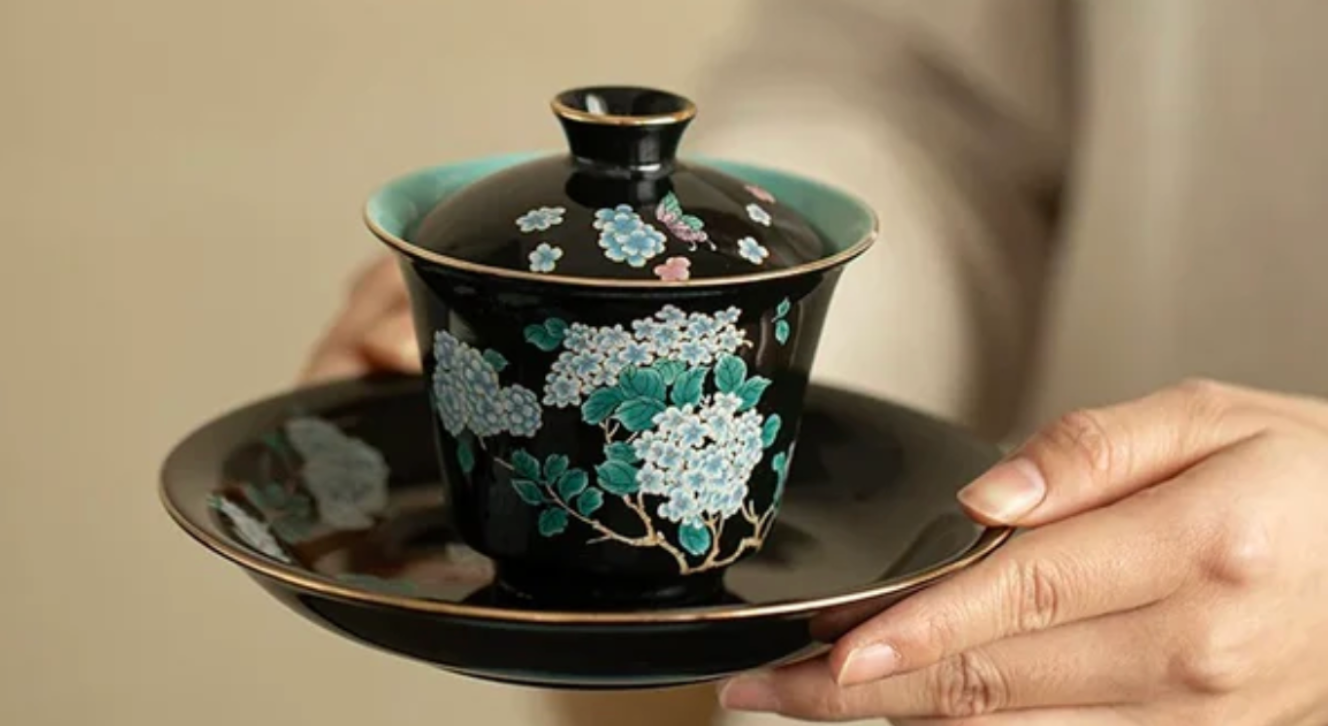
The Gaiwan is the ultimate tool for the tea connoisseur. Simple in appearance yet profound in function, it has been the preferred brewing vessel for Chinese tea masters since the Ming Dynasty. Its three-part design is known as "Sancai" (三才), representing the three powers of the universe.
The Cosmic Trinity of Design
-
The Lid (Gài - Heaven): Representing the sky and the cosmos, the lid provides protection and traps the volatile aromatic compounds.
-
The Bowl (Wǎn - Man): Positioned in the middle, the bowl is the vessel of transformation. It represents humanity’s role as the active participant who brings balance to the brew.
-
The Saucer (Tuō - Earth): The stable foundation that supports the bowl, symbolizing the grounding and nurturing nature of the earth.
Technical Advantages of the Gaiwan
| Feature | Technical Benefit |
| Flared Rim | Dissipates heat rapidly, allowing the fingers to hold the bowl without burning. |
| Aroma Trap | The lid captures the "soul" of the tea. Smelling the lid after a pour is a vital part of quality assessment. |
| Open Mouth | Allows the brewer to observe the leaves' unfurling and adjust water temperature or steeping time in real-time. |
| Instant Decanting | Unlike a teapot with a narrow spout, a Gaiwan pours instantly from the rim, providing total control over infusion time—critical for "flash-brewing". |
How to Use a Gaiwan: A Step-by-Step Guide
Using a Gaiwan requires a gentle hand and a focused mind. The following steps outline the traditional process for a successful Gongfu brew.
-
The Warmup: Pour hot water into the Gaiwan and the fairness pitcher to pre-heat the porcelain. This ensures the tea's temperature doesn't drop too quickly during the infusion.
-
Measuring the Leaf: Add approximately 5 to 7 grams of loose leaf tea for a 100-150ml Gaiwan.
-
The Rinse (The Awakening): For Oolong and Pu-erh, pour hot water over the leaves and discard it after 5 seconds. This "awakens" the leaves and removes any residual dust.
-
The Steep: Pour water in a circular motion. Place the lid on top, slightly askew to create a small gap.
-
The Grip: Place your thumb and middle finger on the flared rim of the bowl. Place your index finger firmly on the knob of the lid.
-
The Pour: Tilt the Gaiwan toward you, decanting the liquid through the lid-gap into the fairness pitcher. The lid acts as a natural strainer, keeping the leaves inside.
Why Oriental Artisan: The Soul of the Kiln
The vessel is the final ingredient in a perfect cup. Oriental Artisan does not produce mass-market ceramics; they curate heirlooms that are forged from the philosophies of Zen and the imperial grandeur of ancient Chinese craftsmanship.
The Craftsmanship of Jingdezhen
Each Oriental Artisan Gaiwan is a testament to the "Jiang Ren" (Craftsman Spirit). In the sacred workshops of Jingdezhen—the porcelain capital of the world—masters like Master Lin and Master Chen have spent decades learning to "converse with the fire".
-
Kiln Transformation (Yao Bian): Many pieces feature a naturally flowing glaze that is shaped by the flame. Because every kiln firing is unique, no two pieces emerge with the exact same pattern of "cicada-wing" crackle or "sky-after-rain" hue.
-
Ru Ware Perfection: The Ru Ware collection features glazes that are smooth and warm to the touch, like jade. These pieces are designed to "breathe" and develop a unique character as they are nourished by tea over the years.
The Innovation of the Floating Lid
The Oriental Artisan Sancai Gaiwan is not just a relic of the past; it is a masterpiece of modern ergonomics. The "Floating Lid" technology is precision-engineered to sit with a specific gap, allowing for a smoother pour and providing superior anti-scald benefits for the fingers. Its "Yuanbao" (gold ingot) shape is both an auspicious symbol of prosperity and a functional design that provides an exceptionally secure grip.
Conclusion: Investing in a Moment of Peace
The journey into Chinese loose leaf tea is a journey of sensory refinement and spiritual grounding. By moving "beyond the bag," the connoisseur reclaims their time and their health. The ritual of the Gaiwan is more than a way to prepare a drink; it is a way to prepare oneself for the world. To hold an Oriental Artisan Gaiwan is to hold a microcosm of the universe—a harmonious balance of Heaven, Earth, and Man.
Start Your Ritual
True luxury is defined by the soul etched into every stroke and grain of the tools we use. The right vessel is the final, essential ingredient in your tea journey—a silent partner that transforms a simple leaf into a sacrament.
We invite you to explore the Oriental Artisan Gaiwan Collection. Claim your stewardship of a narrative that began millennia ago and will endure for generations.
Assume your role in the chronicle. Begin your ritual today.


Leave a comment
This site is protected by hCaptcha and the hCaptcha Privacy Policy and Terms of Service apply.