


Why Lead-Free Glass Matters: The Science Behind Safer Luxury Glassware
In fine glassware, brilliance has long been mistaken for quality. Historically, that brilliance was often achieved by introducing lead oxide into glass formulations—enhancing weight, refractive index, and workability. Yet modern materials science tells a more nuanced story.
For today’s informed connoisseur, lead-free glass represents not a departure from tradition, but an advancement rooted in chemistry, health science, and long-term material stability.
What Lead Does in Glass—and Why It Matters
Lead oxide increases a glass’s refractive index, creating heightened sparkle and density. However, lead is also a toxic heavy metal with no biological benefit to the human body.
Scientific studies have shown that leaded glassware can release measurable amounts of lead when in contact with liquids—particularly:
-
High-alcohol spirits
-
Acidic beverages (wine, citrus-based cocktails)
-
Liquids stored for extended periods
The leaching process is gradual and invisible, but cumulative exposure—even at low levels—is associated with neurological, renal, and cardiovascular risks. This is why international health bodies, including the World Health Organization (WHO) and U.S. FDA, recognize no safe threshold for lead ingestion.
For vessels designed to hold premium spirits, often aged longer than a human lifetime, material integrity is not a decorative concern—it is a functional one.
Lead-Free Glass: Material Composition
Lead-free glass replaces lead oxide with alternative metal oxides such as:
-
Barium oxide
-
Zinc oxide
-
Titanium oxide
These compounds enhance clarity and strength without introducing toxicity. Modern formulations achieve optical precision while remaining chemically stable in prolonged contact with alcohol.
From a scientific standpoint, lead-free glass is non-leaching, meaning it does not release harmful substances into the liquid it contains—even over decades of use.
Optical Performance Without Chemical Risk
Advances in glass chemistry and cutting techniques have eliminated the need for lead to achieve brilliance.
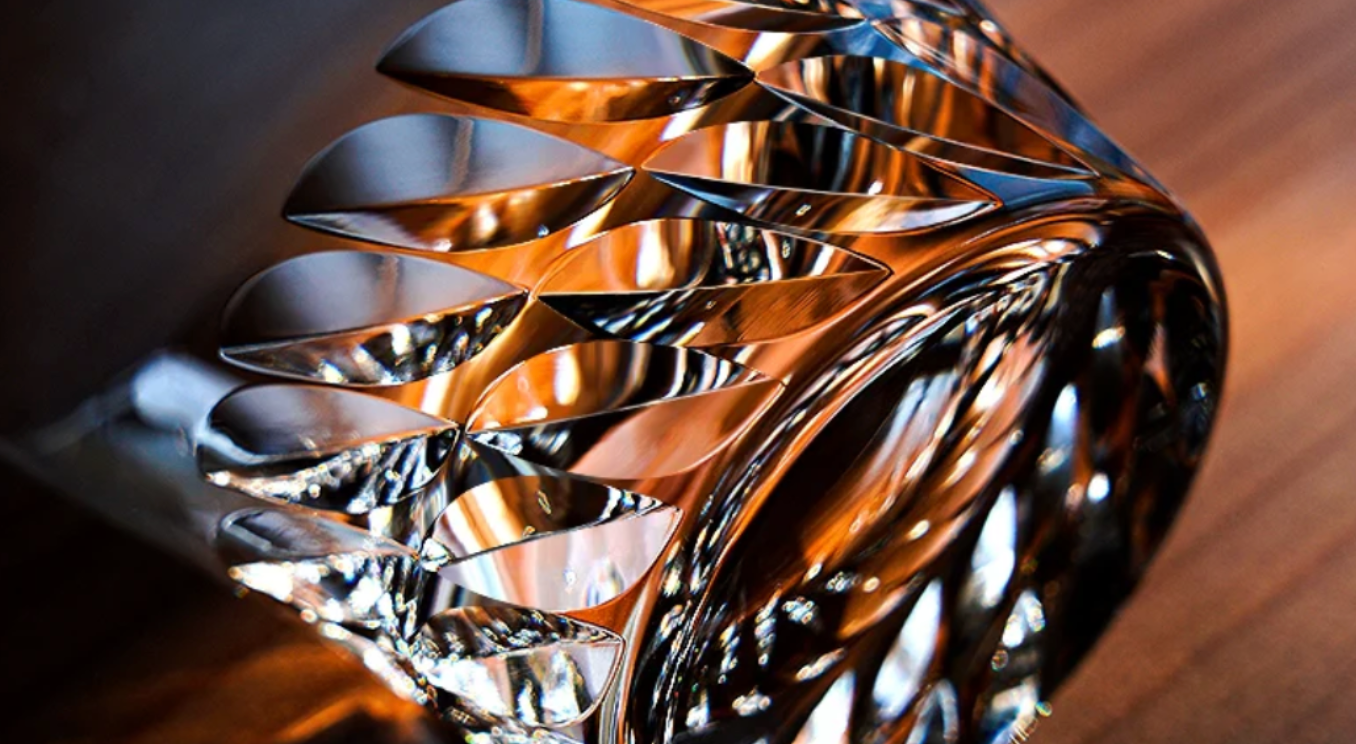
In traditions such as Edo Kiriko, light refraction is controlled not by material density alone, but by:
-
Facet angle precision
-
Depth of cut
-
Symmetry and geometry
These physical variables manipulate light through architecture rather than additives. The result is clarity that is crisp, controlled, and enduring—without relying on lead to artificially boost refractivity.
Structural Stability and Aging
Lead-free glass demonstrates superior long-term performance in several measurable areas:
-
Greater resistance to clouding and surface corrosion
-
Improved tolerance to temperature variation
-
Enhanced durability under repeated washing
Unlike leaded crystal, which may develop microscopic surface degradation over time, lead-free glass maintains its structural and optical integrity. For heirloom objects intended for regular use, this stability is critical.
A Health-Conscious Evolution of Luxury
Modern luxury is defined as much by what it avoids as by what it includes.
Choosing lead-free glass aligns with contemporary scientific consensus, responsible manufacturing standards, and long-term wellness considerations—without sacrificing visual performance or artisanal depth.
It is not an emotional decision.
It is an informed one.
Precision Over Excess
At Oriental Artisan, we regard lead-free glass as the logical convergence of heritage craftsmanship and modern science. It reflects a philosophy where excellence is measured not by spectacle, but by accuracy, safety, and respect—for both the material and the individual.
Because the future of timeless objects belongs to those engineered to endure—
chemically pure, structurally sound, and uncompromisingly clear.

Leave a comment
This site is protected by hCaptcha and the hCaptcha Privacy Policy and Terms of Service apply.