


How a Bamboo Folding Fan Is Made: The Ancient Craftsmanship Behind Folding Fans
Introduction
In a quiet workshop, a master artisan sits before a workbench worn smooth by decades of use. Sunlight filters through the window, illuminating rows of bamboo strips, carving knives, brushes, silk fabrics, and unfinished fans waiting patiently to take shape.
The artisan selects a piece of bamboo and begins a process that has changed little for centuries. With measured movements and practiced precision, raw bamboo is split, shaped, polished, carved, painted, and assembled. What emerges is not merely a cooling accessory, but a work of art that embodies generations of craftsmanship, cultural heritage, and human creativity.
To the casual observer, a bamboo folding fan may seem simple. Yet behind every handcrafted folding fan lies dozens of individual steps, years of artisan training, and centuries of accumulated knowledge.
So what does it truly take to create a handcrafted bamboo folding fan?
The answer reveals one of the most fascinating traditions within Chinese handicrafts and traditional Chinese crafts—a process where artistry and engineering come together in perfect harmony.
What Is a Bamboo Folding Fan?
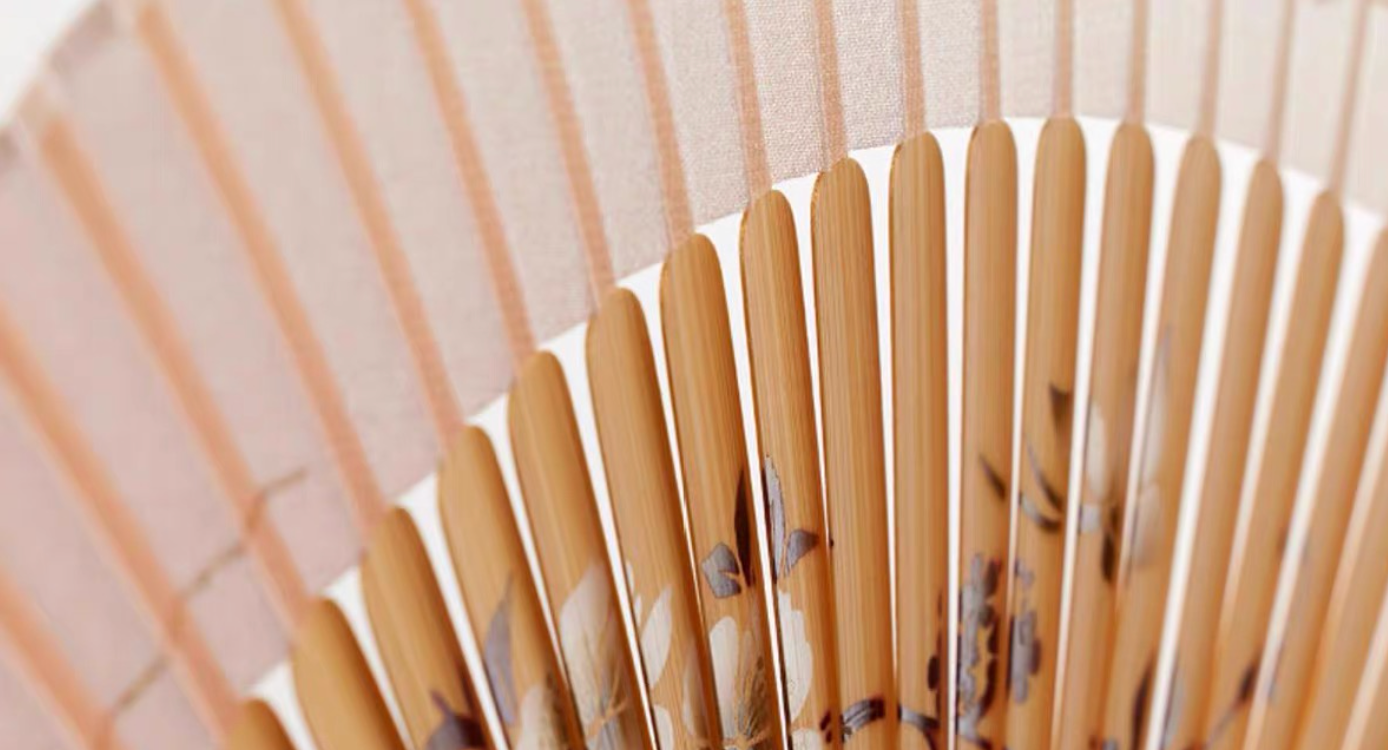
A bamboo folding fan is a traditional Chinese fan constructed from multiple bamboo ribs connected by a pivot rivet and covered with a decorative fan leaf made from paper, silk, cotton, or specialty textiles.
When opened, the fan forms an elegant semicircle. When closed, it becomes compact and portable.
The basic structure includes:
-
Outer guards (larger protective ribs)
-
Inner bamboo ribs
-
Central pivot rivet
-
Fan leaf (paper, silk, or fabric)
-
Decorative artwork
-
Carved or engraved details
Unlike mass-produced fans, an artisan bamboo fan reflects the hand of its maker through subtle variations in carving, shaping, painting, and assembly.
What is a bamboo folding fan?
A bamboo folding fan is a traditional Chinese fan made from carefully crafted bamboo ribs connected by a pivot mechanism and covered with decorative paper or silk. It combines functionality, artistry, and cultural heritage in a portable, foldable form.
For centuries, Chinese folding fans have served not only as practical tools for cooling but also as symbols of refinement, scholarship, and artistic expression.
The History of Folding Fans
To understand the significance of bamboo fan making, we must first explore the history of fans themselves.
Early Origins
China has a long history of fan usage dating back more than 2,000 years. Early fans were rigid structures made from feathers, silk, woven bamboo, and other materials.
These fans often served ceremonial purposes and were used by royalty, nobility, and court officials.
Development During the Song Dynasty
The folding fan is believed to have become widely adopted during the Song Dynasty (960–1279).
As trade and cultural exchange expanded across East Asia, folding fans gained popularity due to their portability and elegant design.
Scholars quickly embraced them as ideal surfaces for painting and calligraphy.
Flourishing in the Ming and Qing Dynasties
During the Ming Dynasty (1368–1644) and Qing Dynasty (1644–1912), folding fan craftsmanship reached extraordinary levels.
Artisans specialized in:
-
Bamboo carving
-
Fan painting
-
Silk mounting
-
Lacquer decoration
-
Ivory and sandalwood embellishments
Fans became treasured possessions among scholars, officials, poets, and collectors.
Symbol of the Literati
For China's educated elite, the traditional Chinese fan became much more than an accessory.
It represented:
-
Education
-
Artistic cultivation
-
Literary achievement
-
Social status
-
Personal taste
A folding fan often displayed poetry, landscape paintings, philosophical reflections, or symbolic imagery.
Many famous scholars and artists created fan paintings specifically for collectors.
As a result, some antique Chinese folding fans are now regarded as important works of art preserved in museums worldwide.
Materials: The Foundation of Every Great Folding Fan
Exceptional craftsmanship begins with exceptional materials.
Bamboo
Bamboo remains the preferred material for traditional folding fan construction because it offers a remarkable balance of strength, flexibility, and beauty.
Advantages of bamboo include:
-
Lightweight structure
-
Natural durability
-
Resistance to cracking
-
Elegant grain patterns
-
Sustainability
Bamboo also carries deep symbolic meaning in Chinese culture, representing integrity, resilience, humility, and scholarly virtue.
Fan Leaf Materials
Silk
Silk folding fans are among the most luxurious varieties.
Silk provides:
-
Smooth texture
-
Rich color depth
-
Elegant drape
-
Superior painting surface
Paper
Paper remains popular for traditional painting and calligraphy.
Benefits include:
-
Fine detail reproduction
-
Ink absorption
-
Historical authenticity
Cotton
Cotton fabrics offer durability and affordability while maintaining visual appeal.
Specialty Textiles
Contemporary artisans may use specialty fabrics that combine traditional aesthetics with modern performance characteristics.
Decorative Elements
Many luxury folding fans feature:
Hand Painting
Traditional subjects include:
-
Mountains
-
Rivers
-
Flowers
-
Birds
-
Bamboo groves
Calligraphy
Poetry and philosophical writings frequently adorn fan leaves.
Carving
Artisans carve intricate patterns directly into bamboo ribs.
Engraving
Detailed engraving adds texture and visual complexity.
What materials are used in traditional folding fans?
Traditional folding fans are typically made from bamboo ribs combined with silk, paper, cotton, or specialty fabric fan leaves. Decorative elements often include hand painting, calligraphy, carving, engraving, and other artisan techniques.
The Complete Bamboo Folding Fan Making Process
This is the heart of bamboo craftsmanship and the reason why handmade folding fans remain highly respected today.
Step 1: Selecting the Bamboo
Every great fan begins with careful material selection.
Not all bamboo is suitable for fan production.
Artisans evaluate:
-
Species
-
Age
-
Density
-
Fiber quality
-
Grain consistency
Bamboo that is too young may warp or crack.
Bamboo that is too old may become brittle.
Only properly matured bamboo possesses the ideal balance of flexibility and strength.
This selection process directly affects the longevity of the finished fan.
Step 2: Drying and Aging
Freshly harvested bamboo contains significant moisture.
Before it can be transformed into fan ribs, it must undergo controlled drying and aging.
Traditional methods often involve:
-
Air drying
-
Natural seasoning
-
Long-term storage
This stage helps:
-
Prevent warping
-
Reduce cracking
-
Stabilize fibers
-
Improve durability
Some artisans season bamboo for months before use.
Patience at this stage greatly improves final quality.
Step 3: Splitting and Shaping the Fan Ribs
Once properly aged, the bamboo is split into narrow sections.
This process requires exceptional precision.
Each rib must maintain:
-
Uniform thickness
-
Consistent flexibility
-
Structural integrity
Artisans use specialized knives and hand tools to gradually shape each rib.
Even small inconsistencies can negatively affect opening and closing performance.
The shaping stage often determines whether a fan feels smooth and balanced or awkward and fragile.
Step 4: Polishing and Refining
After shaping, the ribs undergo extensive refinement.
The goal is to achieve:
-
Smooth surfaces
-
Rounded edges
-
Comfortable handling
-
Elegant appearance
Artisans carefully sand and polish each piece.
The bamboo gradually reveals its natural beauty, including subtle grain patterns and warm coloration.
This stage may require multiple rounds of inspection and adjustment.
Step 5: Carving and Decorative Work
For premium folding fans, decoration extends beyond the fan leaf.
Many artisans embellish the bamboo itself.
Techniques include:
Hand Engraving
Fine lines and patterns are carved into the surface.
Openwork Carving
Sections of bamboo are cut away to create lace-like designs.
Relief Carving
Raised motifs add depth and sophistication.
Popular themes include:
-
Dragons
-
Phoenixes
-
Bamboo
-
Plum blossoms
-
Orchids
-
Mountains
-
Literary symbols
The more complex the carving, the greater the skill required.
Step 6: Preparing the Fan Leaf
The fan leaf is the visual centerpiece of the fan.
Preparation varies according to material.
Silk Preparation
Silk is stretched and mounted to ensure smoothness.
Paper Mounting
Paper is carefully cut and reinforced for durability.
Design Planning
Artists determine:
-
Composition
-
Color balance
-
Subject placement
-
Visual flow
A well-designed fan leaf must remain beautiful whether the fan is open or partially folded.
Step 7: Painting and Calligraphy
This stage transforms craftsmanship into art.
Traditional themes include:
Landscape Painting
Mountains, rivers, forests, and waterfalls.
Floral Subjects
Peonies, lotus flowers, chrysanthemums, and orchids.
Bird-and-Flower Painting
A beloved genre in Chinese art.
Poetry
Classical poems often accompany painted scenes.
Symbolic Imagery
Common symbols include:
| Symbol | Meaning |
|---|---|
| Bamboo | Integrity |
| Plum Blossom | Perseverance |
| Pine Tree | Longevity |
| Crane | Wisdom |
| Lotus | Purity |
Many collectors value the artwork as highly as the craftsmanship itself.
Step 8: Assembly
Assembly is where all components come together.
The artisan:
-
Aligns every rib precisely
-
Attaches the fan leaf
-
Inserts the pivot rivet
-
Tests folding movement
-
Adjusts spacing
A high-quality Chinese folding fan should open smoothly and close effortlessly.
Balance is critical.
The fan must feel stable in the hand while maintaining graceful movement.
Step 9: Quality Inspection
The final stage is meticulous inspection.
Artisans examine:
Movement
Does the fan open smoothly?
Alignment
Do the ribs form a symmetrical arc?
Durability
Can the structure withstand repeated use?
Artistic Quality
Is the artwork executed to a high standard?
Only after passing inspection is the fan considered complete.
How are bamboo folding fans made?
Bamboo folding fans are made through a multi-stage process involving bamboo selection, drying, shaping, polishing, carving, fan leaf preparation, painting, assembly, and quality inspection. Each stage requires specialized skills developed through years of training.
Why Handcrafted Folding Fans Are So Difficult to Produce
Labor-Intensive Process
A single artisan folding fan may require dozens of individual operations.
Each step builds upon the previous one.
Mistakes can ruin hours of work.
Years of Skill Development
Mastering bamboo craftsmanship often takes years or even decades.
Artisans must learn:
-
Material behavior
-
Carving techniques
-
Design principles
-
Assembly precision
Precision Requirements
Tiny deviations can affect:
-
Fan balance
-
Folding action
-
Structural durability
Artistic Components
Many fans incorporate original artwork and calligraphy.
This combines multiple artistic disciplines into a single object.
High Rejection Rates
Not every fan reaches completion.
Materials may fail inspection or reveal flaws during production.
Why are handcrafted folding fans expensive?
Handcrafted folding fans are expensive because they require premium materials, extensive manual labor, years of artisan training, artistic expertise, and careful quality control. Each fan represents significant time and craftsmanship that cannot be replicated by mass production.
Why Every Handmade Folding Fan Is Unique
No two handmade Chinese fans are exactly alike.
Natural bamboo varies in:
-
Grain
-
Color
-
Texture
Hand carving introduces subtle differences.
Paintings are created individually.
Calligraphy reflects the artist's hand.
Some artisans even sign their work.
These characteristics transform a fan from a product into a collectible work of art.
What makes artisan folding fans special?
Artisan folding fans are special because they combine handcrafted bamboo construction, individual artistic expression, natural material variation, and traditional craftsmanship, making every piece unique.
Folding Fans as Art, Fashion, and Cultural Heritage
Today, folding fans continue to serve multiple roles.
They function as:
-
Cooling accessories
-
Decorative art pieces
-
Cultural symbols
-
Fashion statements
-
Collectible objects
Many interior designers incorporate luxury folding fans into:
-
Asian-inspired interiors
-
Modern minimalist spaces
-
Cultural displays
-
Gallery walls
Their versatility helps preserve their relevance in contemporary life.
Why Collectors Value Handmade Bamboo Folding Fans
Collectors appreciate handmade folding fans for several reasons.
Craftsmanship
Each fan demonstrates specialized artisan skills.
Artistic Value
Many fans feature original artwork.
Cultural Significance
Fans connect collectors to centuries of Chinese tradition.
Limited Production
Authentic artisan-made fans are produced in small quantities.
Heirloom Potential
Well-crafted fans can be treasured across generations.
For many collectors, a folding fan represents both artistic beauty and cultural preservation.
Bamboo Folding Fans in Modern Living
Traditional craftsmanship continues to thrive in contemporary environments.
Bamboo folding fans complement:
Contemporary Interiors
Displayed on shelves, walls, or stands.
Asian-Inspired Design
Enhancing cultural authenticity.
Luxury Gifting
Meaningful gifts with artistic value.
Wedding Gifts
Elegant symbols of harmony and refinement.
Corporate Gifts
Sophisticated alternatives to conventional promotional items.
Cultural Collections
Ideal additions to collections of traditional Chinese crafts.
Their combination of beauty, functionality, and heritage makes them remarkably versatile.
How to Identify a High-Quality Bamboo Folding Fan
Not all fans are created equally.
When evaluating a fan, consider the following factors.
Bamboo Quality
Look for:
-
Consistent grain
-
Smooth finish
-
Structural integrity
Smooth Operation
The fan should open and close effortlessly.
Artwork Quality
Authentic hand-painted designs typically show depth, detail, and individual character.
Craftsmanship Details
Examine:
-
Alignment
-
Carving quality
-
Edge finishing
-
Assembly precision
Artisan Provenance
Knowing who made the fan and how it was produced adds confidence and value.
Authentic artisan-made fans stand apart from mass-produced alternatives through visible craftsmanship and attention to detail.
The Oriental Artisan Difference
In an age of mass production, preserving traditional craftsmanship has become increasingly important.
Oriental Artisan serves as a bridge between historical artistry and contemporary appreciation.
By curating handcrafted folding fans and other artisan-made cultural products, Oriental Artisan helps connect modern collectors with authentic traditions that might otherwise fade from view.
The collection reflects a commitment to:
-
Traditional craftsmanship
-
Artisan communities
-
Cultural preservation
-
Exceptional quality
-
Timeless design
Rather than treating cultural objects as mere décor, Oriental Artisan highlights the stories, skills, and heritage behind every piece.
For collectors, gift buyers, and enthusiasts of Chinese handicrafts, this approach provides a deeper and more meaningful connection to the traditions they admire.
Frequently Asked Questions
How are bamboo folding fans made?
Bamboo folding fans are made through a detailed process that includes bamboo selection, drying, shaping, polishing, carving, artwork creation, assembly, and quality inspection. Each stage requires specialized craftsmanship and contributes to the fan's durability, beauty, and functionality.
What materials are used in folding fans?
Traditional folding fans typically use bamboo ribs combined with silk, paper, cotton, or specialty textile fan leaves. Decorative elements may include hand painting, calligraphy, carving, engraving, and other artisan techniques.
Why are handcrafted folding fans expensive?
Handcrafted folding fans require premium materials, extensive manual labor, artistic expertise, and years of training. Unlike factory-made products, each piece is individually crafted and inspected.
Are bamboo folding fans durable?
Yes. Properly made bamboo fans can remain functional for many years. High-quality bamboo offers excellent strength and flexibility when properly seasoned and maintained.
What makes artisan folding fans valuable?
Their value comes from craftsmanship, originality, cultural significance, artistic merit, and limited production. Many collectors view them as both functional objects and works of art.
How long does it take to make a folding fan?
Depending on complexity, a handcrafted folding fan may require many hours or even several days of work. Intricate carving and hand-painted artwork significantly increase production time.
Are folding fans still used today?
Absolutely. Folding fans remain popular for cultural events, fashion, interior decoration, collecting, gifting, and personal use. They continue to blend tradition with contemporary lifestyle needs.
Can folding fans be collected?
Yes. Many collectors specialize in handmade Chinese fans, particularly those featuring exceptional carving, historical significance, renowned artists, or rare materials.
What is the history of Chinese folding fans?
Chinese fans have existed for more than two millennia. Folding fans became especially popular during the Song Dynasty and flourished during the Ming and Qing periods as symbols of scholarship, artistic refinement, and social status.
Where can I buy authentic handmade folding fans?
Authentic handmade folding fans are best sourced from reputable specialists that prioritize traditional craftsmanship, artisan partnerships, and cultural authenticity. Curated collections such as those offered by Oriental Artisan provide access to carefully selected artisan-made pieces.
Conclusion
A bamboo folding fan is far more than a practical accessory.
Behind its graceful silhouette lies an extraordinary journey of craftsmanship—from the careful selection of bamboo to the final brushstroke of paint and the precise alignment of every rib.
Each handcrafted folding fan represents patience, skill, artistic vision, and centuries of cultural knowledge passed from one generation to the next.
In an increasingly mechanized world, these remarkable objects remind us that true craftsmanship cannot be rushed. It is shaped by human hands, refined through experience, and enriched by tradition.
Whether admired as art, collected as cultural heritage, displayed as décor, or gifted as a meaningful keepsake, the traditional Chinese fan continues to embody elegance, refinement, and enduring beauty.
For those who wish to experience this timeless craft firsthand, Oriental Artisan offers an opportunity to explore carefully curated handcrafted folding fans that celebrate the artistry, heritage, and spirit of one of China's most beloved traditional crafts.

Leave a comment
This site is protected by hCaptcha and the hCaptcha Privacy Policy and Terms of Service apply.