
Which Japanese Whisky Glass Should You Choose? Mount Fuji, Glacier and Cut-Glass Styles Compared
Pour the same whisky into three glasses. In one, a mountain landscape catches the amber light. In another, an uneven surface recalls melting ice. In the third, a lattice of cuts breaks the evening into small, bright reflections.
Choose a Mount Fuji whisky glass for Japanese landscape imagery, a glacier-style tumbler for sculptural texture, or Edo Kiriko for an interest in traditional cut-glass craftsmanship. For focused nosing, look first at the bowl and opening: a decorative style alone does not determine aroma performance.
The best Japanese whisky glass is the one that suits the way you drink and the objects you like to live with. This guide compares the three approaches, then looks at specific Oriental Artisan pieces, practical dimensions and thoughtful gifting.
The Three Japanese Whisky Glass Styles at a Glance
These categories overlap. Mount Fuji and glacier describe a design; Edo Kiriko describes a specific craft tradition. A mountain motif can appear on a cut-glass tumbler, while an ice-like surface can be achieved through different production methods.
| Feature | Mount Fuji | Glacier Style | Edo Kiriko Cut Glass |
|---|---|---|---|
| Signature design | Mountain imagery on the body or within the base | Ice-like relief, irregular texture or facets | Deliberately cut patterns associated with the Tokyo craft tradition |
| Visual appeal | A recognisable landscape and a story | Abstract reflections and sculptural surfaces | Pattern, precision and contrasts of colour and clarity |
| Craftsmanship | Method varies by maker; the motif proves no particular technique | May involve forming, moulding, cutting or finishing; verify the piece | Handwork with rotating cutting tools; provenance matters |
| Drinking experience | Depends on rim, bowl, weight and usable space | Texture can change the feel in the hand | Cutwork adds visual detail; bowl shape governs aroma presentation |
| Best for | Japan enthusiasts and landscape lovers | Contemporary interiors and tactile design | Buyers interested in decorative craft and its origins |
| Gift appeal | Personal associations with Japan | A design-led addition to a home bar | A craft-focused keepsake with documented provenance |
| Personalisation | Confirm a suitable engraving area | Texture may limit placement | Preserve the cut pattern; ask about the base or box |
| Care | Follow instructions for the individual glass | Clean relief and any rim decoration gently | Protect edges, polished cuts and coloured surfaces |
Start with the look that appeals to you, then compare the actual products in the Oriental Artisan whisky glassware collection. Capacity and construction deserve as much attention as the photograph.
Mount Fuji Whisky Glasses: A Landscape Within Your Glass
A Mount Fuji whisky glass brings a recognisable mountain into the drinking ritual. Some designs place a three-dimensional peak in the base; others interpret the landscape through engraving or cut decoration on the walls. Check which interpretation you are buying.
Its appeal is personal. A mountain scene may recall a journey, a favourite view or a long-planned visit to Japan. As the glass turns, the liquid and decoration create changing layers of colour. That visual pleasure is a sound reason to choose it, without needing to claim that the mountain improves the whisky.
Two different Mount Fuji interpretations
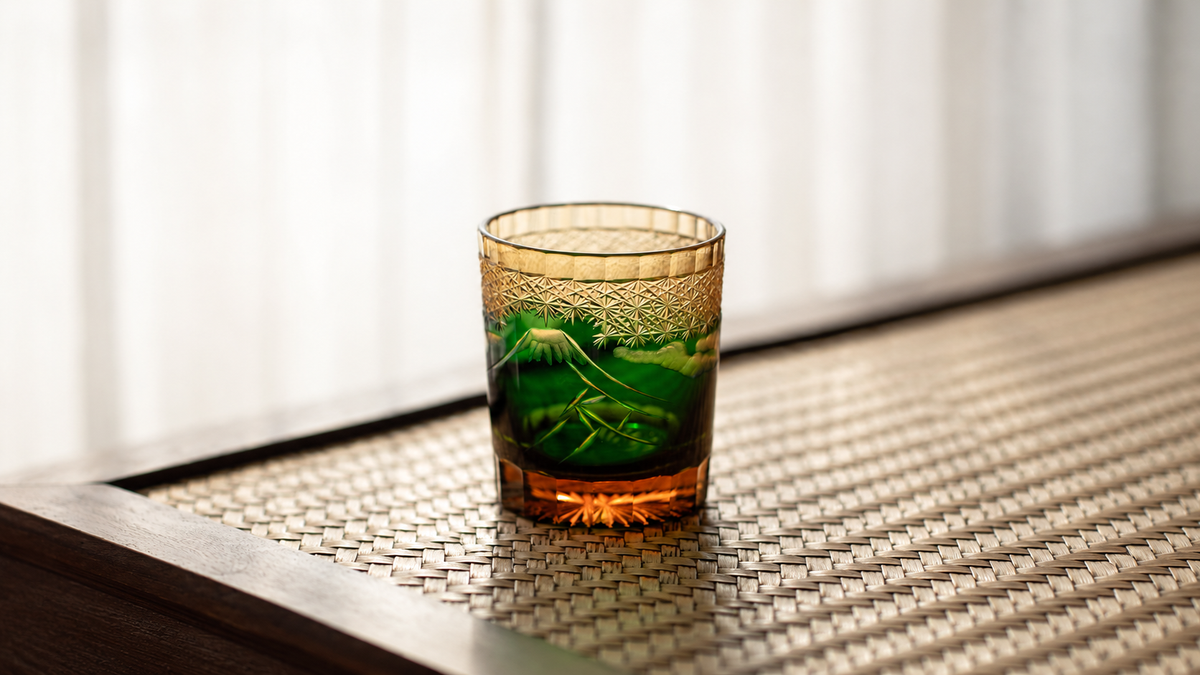
The Exquisite Handmade Edo Kiriko Mount Fuji Crystal Tumbler pairs mountain scenery with decorative cutwork. Its current listing specifies lead-free crystal, 260 ml capacity, 90 mm height and 80 mm diameter, with green, blue, red and black variants. The green product image shows the landscape on the body of the glass.
For a different treatment, the Handcrafted Japanese “Mount Fuji” Cut-Glass Tumbler is listed at 250 ml, 85 mm high and 92 mm in diameter, also in lead-free crystal. Compare its clear decorative treatment with the coloured mountain-scene model rather than assuming the two names describe identical glasses.
Both listings describe Japanese handcrafting; these are retailer specifications, rather than an independent assessment of a named workshop. If a particular maker or craft designation is central to your purchase, request the supporting provenance.
For everyday use, consider cleaning access and the space available for ice. A raised internal mountain can reduce usable room, but that concern does not apply equally to a design decorating the outer wall. Overall diameter also does not establish the size of the opening.
Glacier Whisky Glasses: Sculptural Beauty Inspired by Ice
A glacier whisky glass uses irregular texture or facets to suggest ice. “Glacier” is a contemporary design description, rather than a formally defined historical Japanese glassmaking tradition.
The attraction lies in interrupted reflections. Smooth walls present the drink as a relatively continuous field; an uneven surface breaks it into smaller shapes. Against pale stone or a dark wooden table, a clear glacier-style tumbler can provide detail without introducing a strong colour.

Oriental Artisan’s Edo Handcrafted “Glacier” Whisky Glass is listed in lead-free crystal at 290 ml, 95 mm high and 73 mm in diameter. Options include Glacier, golden-rim and matte versions, alongside Frost variations. These are distinct finishes; select the version deliberately.
Choose it over a mountain design if you prefer abstraction to an identifiable scene. Choose it over densely patterned coloured glass if you want texture to carry the composition. This is a styling judgement, rather than a hierarchy of quality.
Texture also has practical consequences. Inspect where your fingers rest, whether relief extends inside the bowl and how easily a soft cloth can reach it. Raised surfaces do not make glass unbreakable. A golden rim introduces another finish to protect, and matte areas deserve gentle cleaning. Follow the selected variant’s instructions.
Edo Kiriko Whisky Glasses: The Art of Japanese Cut Glass
What is Edo Kiriko?
Edo Kiriko is a Japanese cut-glass tradition associated with Edo, present-day Tokyo. The Edo Kiriko Cooperative traces its beginnings to Kagaya Kyubei in 1834. Its official explanation connects the name with handwork, rotating tools and production within a designated region centred on Koto Ward and the wider Kanto area.
This makes provenance relevant. A geometric tumbler, a Japanese-sounding name or the word “crystal” alone does not establish Edo Kiriko status. The cooperative also identifies Edo Kiriko as its registered trademark. Buyers seeking the recognised craft should look for the maker and supporting documentation.
How are the patterns made?
The cooperative describes marking guidelines, rough cutting with a wet diamond wheel, finer cutting, smoothing and polishing. These stages turn a planned pattern into crisp, reflective surfaces. In coloured overlay glass, cutting can expose the clear layer beneath, producing contrasts between colour and transparency.
Japan House London describes familiar patterns including nanako, asanoha and chrysanthemum designs. Their interest lies in the arrangement and execution of the cuts. A decorative resemblance is not enough to identify a pattern conclusively or attach a particular symbolic meaning to an individual product.
Three pieces to compare
The Edo Kiriko Handcrafted Pine and Crane Whisky Glass is listed in lead-free crystal, with 260 ml capacity and dimensions of 90 × 80 mm, height by diameter. Blue, dark blue and red options offer a different visual character from clear glass. Its bird and tree imagery suits someone drawn to figurative decoration; the listing specifies gift-box presentation.
The Edo Kiriko Handcrafted “Amber Celestial” Whisky Glass is listed at 320 ml, 100 mm high and 95 mm in diameter, in amber-gold lead-free coloured crystal. Its larger stated capacity makes it worth comparing for drinks with ice, while the warm colour appeals to someone who enjoys a stronger presence on the table.
The coloured Mount Fuji tumbler discussed above provides a third option: mountain scenery combined with patterned decoration. It illustrates why these three styles cannot be separated into rigid boxes.
Is Edo Kiriko good for whisky?
A cut-glass tumbler can be a satisfying vessel for a relaxed dram, with or without ice where space permits. Its craft value and its tasting geometry are separate considerations. Decorative cutting does not automatically concentrate aromas, and a higher price does not guarantee better nosing.
Does the Shape of a Whisky Glass Affect the Taste?
Glass shape can influence the drinking experience by changing aroma presentation, the approach to the rim and the space above the liquid. It does not, simply through decoration, transform the whisky’s underlying composition.
Glencairn explains that its tapering mouth focuses aroma towards the nose. A wider tumbler presents the drink differently and can be more convenient for ice. Neither observation makes one vessel the right choice for every occasion.
When comparing glasses, consider the opening, the bowl and the headspace left above your pour. Temperature also matters to the experience; ice chills and dilutes the drink as it melts. A mountain scene, glacier relief or cut pattern tells you little about those variables on its own.
For attentive comparison of whiskies, a dedicated nosing glass is a sensible companion to decorative tumblers. For a slow evening drink, the comfort of a rocks glass and the pleasure of its design may matter more. If you already own a tasting glass, you need not replace it to enjoy a different kind of ritual.
Mount Fuji vs Glacier vs Edo Kiriko: Which Is Best for You?
For Japanese design enthusiasts
Choose Mount Fuji when the landscape has meaning for you. Decide whether you prefer a clear interpretation or a coloured mountain scene. Look at the glass empty as well as filled: it will spend much of its life on a shelf.
For traditional craftsmanship lovers
Prioritise documented Edo Kiriko provenance, the quality of the cutwork and a pattern you want to study closely. Ask who made the piece and where. A precise answer is more useful than a long list of luxury adjectives.
For modern minimalist interiors
Start with clear glacier-style glass. Its texture can work alongside plain ceramics, brushed metal and linen. If you prefer a visually quiet table, compare the plain version before choosing a coloured or metallic finish.
For whisky collectors
Choose according to what is missing from your collection. A clear nosing glass, a coloured patterned tumbler and a sculptural rocks glass serve different interests. For glass collectors, provenance and condition matter; do not buy on an assumption of future investment returns.
For everyday drinking
Give priority to a comfortable rim, a stable base and easy washing. Check that your preferred ice fits through the opening without force. A design you are happy to wash and use is a better everyday choice than one you keep avoiding.
For luxury gifting
Match the design to the person: Fuji for a traveller, glacier for a design enthusiast, patterned cut glass for someone interested in craft. Presentation and a short explanation of your choice can be as memorable as a larger, more expensive set.
For someone who already owns whisky glasses
Add a different experience. If they own clear tumblers, consider colour or a mountain scene. If their cabinet is already decorative, a restrained glacier design may provide variety. Their existing taste is a better guide than a generic “gift for him” label.
How to Choose the Right Japanese Whisky Glass
- Capacity and serving size. Capacity is the vessel’s stated volume, not a recommended pour. The featured listings span 250–320 ml. Leave room for your drink and any ice rather than filling to the brim.
- Rim shape and comfort. Inspect close-up photographs. A narrow opening and a broad tumbler offer different approaches to drinking; overall diameter may not equal internal rim diameter.
- Glass material. Read the specification. Lead-free crystal is stated for the featured pieces, but neither “Japanese” nor “Kiriko” establishes the composition of every glass.
- Weight and balance. Check weight if provided. A large glass is not necessarily heavy, and a heavy base is not proof of superior quality. Consider the recipient’s grip.
- Decorative craftsmanship. Examine clear views of the cuts, edges and transitions. Look for a design you enjoy at ordinary table distance, as well as in a macro photograph.
- Production method. Forming, cutting and polishing are separate stages. “Handmade” can describe different combinations of work; request specifics if the method matters to you.
- Cleaning. Consider textured areas, narrow openings and decorative rims. Check that your usual washing routine suits the piece.
- Gift packaging. Confirm what is included with the selected item. A box shown in a photograph should not replace a clear packaging specification.
- Engraving. Confirm eligibility, placement, lettering limits, cost and lead time for the exact glass or box before ordering.
- Budget and use. Compare individual pieces with individual pieces, and sets with sets. Pay for the design, materials and documented work you value; price alone proves none of them.
Daily drinkers should put comfort first. Collectors should ask more about the maker. Gift buyers should settle packaging, personalisation and the delivery date before choosing between similar designs.
Are Japanese Whisky Glasses Good Gifts?
A carefully chosen whisky glass makes a good gift when it reflects the recipient’s interests and drinking habits. A useful question is whether they will want to reach for it on an ordinary evening.
For a birthday or Father’s Day, one distinctive tumbler can feel personal. For a wedding or anniversary, two complementary glasses may suit a shared ritual; verify whether you are buying singles or an actual set. Retirement and milestone gifts lend themselves to a design with a personal association. For Christmas, a housewarming or corporate appreciation, consider how comfortably the piece fits the recipient’s home and routine.
Oriental Artisan’s current product-page guidance says selected pieces may be personalised, but does not establish engraving eligibility for every featured glass. Contact the team with the exact product and wording. Confirm the location and finish, especially on textured or intricately decorated surfaces.
For an identifiable starting point, consider the gift-boxed Pine and Crane model above, then compare the Edo Kiriko collection for other patterns and presentation options. A brief handwritten note explaining the choice gives the recipient a story to keep.
How to Care for Japanese Whisky Glasses
The featured product listings advise gentle handwashing, mild detergent, soft drying and avoiding sudden temperature changes; they also advise against dishwasher use. Follow the instructions supplied with your exact glass and finish.
As a general handling routine, wash one piece at a time in lukewarm water, using a soft sponge rather than abrasive pads. Rinse detergent thoroughly and dry without twisting the rim against the base. Work gently around cut edges and raised texture.
Store glasses with space between them to avoid contact scratches. Do not stack them unless the maker expressly designed them for stacking. Protect gold-coloured rims and other decorative finishes from scrubbing, and avoid assuming that coloured glass is either dishwasher-safe or uniformly delicate.
Keep boiling water away from a chilled tumbler, and do not force oversized ice through the opening. A clear, unchipped rim and careful storage help preserve the pleasure of using a glass often.
Frequently Asked Questions
What is a Japanese whisky glass called?
There is no single name for every Japanese whisky glass. A short, broad glass may be called a rocks glass, tumbler or old fashioned glass. Edo Kiriko refers to a particular cut-glass tradition, while Mount Fuji and glacier usually describe designs. Those terms tell you different things about an individual piece.
What is the best type of glass for Japanese whisky?
Choose a tapering nosing glass for focused aroma appreciation, or a comfortable tumbler for relaxed drinking and ice where space permits. Japanese whisky does not require one exclusive glass style. Let your serving preference guide the shape, then choose decoration and craftsmanship according to your taste.
What is special about a Mount Fuji whisky glass?
Its distinguishing feature is a design inspired by Mount Fuji. This may be a sculptural peak inside the base or a landscape on the glass wall. The motif can make a thoughtful gift for someone with a connection to Japan, but it does not establish origin, production method or tasting performance.
What is a glacier whisky glass?
A glacier whisky glass is a tumbler with ice-inspired texture, irregular relief or facets. The term describes an appearance rather than a single recognised craft tradition. Materials, manufacturing methods and finishes vary, so compare the exact product’s dimensions and care instructions instead of relying on the name alone.
What is Edo Kiriko glass?
Edo Kiriko is a traditional Japanese cut-glass craft associated with Tokyo. Its official cooperative describes requirements concerning handwork, rotating tools and a designated production region. It is a craft and provenance term, rather than a synonym for all decorative crystal or every glass with a Japanese-inspired geometric pattern.
Are Edo Kiriko whisky glasses handmade?
Handwork is part of the cooperative’s definition of Edo Kiriko. That does not mean artisans work without tools: rotating cutting and polishing equipment is integral to the process. For an individual listing, ask about the maker and production stages rather than assuming that a hand-cut glass was also mouth-blown.
How does Edo Kiriko differ from ordinary cut glass?
Cut glass is a broad category of glass decorated through cutting. Edo Kiriko belongs to a specific Japanese regional craft tradition with requirements attached to the name. An intricate pattern alone cannot establish that provenance. Compare maker information and documentation as well as the visual quality of the decoration.
Are Japanese whisky glasses made of crystal?
Some are, and others use different glass compositions. The Oriental Artisan pieces featured here are listed as lead-free crystal, but that specification should not be extended to all Japanese glassware. “Crystal” also does not automatically mean lead crystal. Read the material description for the exact item.
Does a whisky glass change the taste of whisky?
It can change the perceived experience through aroma presentation, rim geometry and serving conditions. Ice also affects temperature and dilution. Decorative cutting or a mountain motif does not itself change the whisky into a better spirit. Choose a shape suited to how you want to smell and drink it.
What size whisky glass should I buy?
Choose capacity around your usual pour and ice, leaving comfortable headspace. The featured 250–320 ml glasses provide useful points of comparison, rather than a universal ideal. If you use a large cube or sphere, confirm internal opening and bowl dimensions; advertised capacity and external diameter cannot guarantee a fit.
Can Japanese whisky glasses be engraved?
Some can, depending on their construction, decoration and the maker’s service. A suitable base or presentation box may provide space, but this must be confirmed individually. Oriental Artisan states that selected pieces can be personalised. Request confirmation for your chosen item, including wording, placement, price and preparation time.
Where can I buy authentic Japanese whisky glasses?
Look for makers and specialist retailers that explain materials, origin and production methods clearly. Oriental Artisan offers the pieces linked in this guide. If a named Japanese workshop or recognised Edo Kiriko provenance is essential to your purchase, request supporting information for the exact piece before ordering.
Discover Japanese Whisky Glasses at Oriental Artisan
The mountain scene, the ice-like surface and the cut pattern offer three different pleasures. One carries a landscape; one invites the hand; one rewards a closer look at the maker’s work.
Choose the design you will enjoy seeing beside your chair, then check the dimensions and details that make it useful. This is the spirit of Art of Quiet Living: an object selected with care, and given a place in the day.
Explore Japanese Whisky Glasses at Oriental Artisan.

Leave a comment
This site is protected by hCaptcha and the hCaptcha Privacy Policy and Terms of Service apply.