


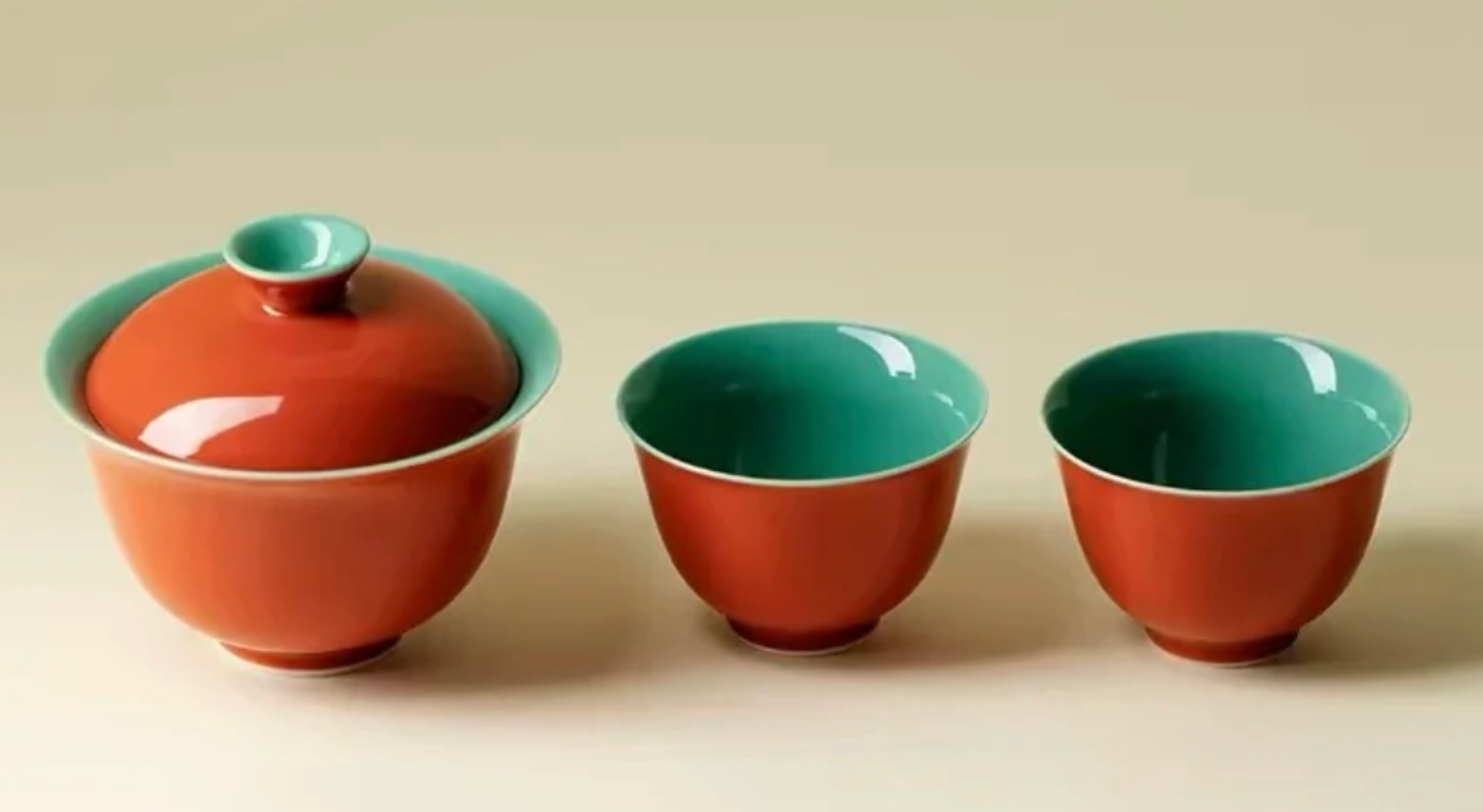
The Alchemy of Clay: The Journey of an Oriental Artisan Gaiwan from Earth to Vessel
There is a moment in every tea ritual when attention narrows.
The kettle has fallen silent. The leaves have awakened. Hands instinctively reach for the gaiwan—the humble three-piece vessel that has served tea drinkers for centuries. Its bowl sits lightly in the palm. Its lid settles with a gentle ceramic note. Steam gathers along its rim before disappearing into the air.
To the casual observer, a gaiwan appears remarkably simple.
A bowl.
A lid.
A saucer.
Yet few objects embody such a profound convergence of geology, chemistry, artistry, engineering, and cultural memory.
Before it becomes a companion to tea, a porcelain gaiwan begins deep within the earth. Its journey spans the extraction of minerals, the refinement of clay, the precision of skilled hands, the uncertainty of fire, and the accumulated wisdom of generations of ceramic artisans.
What ultimately emerges is not merely a vessel.
It is a transformation.
Understanding this transformation changes the experience of tea itself. Every pour becomes more deliberate. Every touch reveals details previously overlooked. Every subtle variation speaks of the artisan who shaped it.
This is the story of how earth becomes porcelain, and how porcelain becomes ritual.
What Is a Porcelain Gaiwan?
A porcelain gaiwan is a traditional Chinese tea brewing vessel consisting of three parts: a bowl, a lid, and a saucer.
Unlike teapots designed for specific tea styles, porcelain gaiwans are celebrated for their versatility. Because porcelain is largely non-porous and flavor-neutral, it allows tea drinkers to experience the true character of a tea without interference from the vessel itself.
The finest handcrafted gaiwans combine technical precision with artistic sensitivity, balancing weight, proportion, thermal performance, and visual elegance within a deceptively simple form.
The Earth: Where Every Gaiwan Begins
Long before an artisan touches clay, nature begins the process.
The foundation of fine porcelain lies in a combination of minerals that have formed over millions of years through geological processes. Among these materials, none is more important than kaolin clay.
Named after Gaoling, a region historically associated with porcelain production, kaolin possesses qualities that make true porcelain possible. Its purity contributes whiteness. Its structure provides strength. Its behavior under extreme heat enables the creation of dense, translucent ceramic bodies.
Kaolin alone, however, is not enough.
Traditional porcelain bodies often combine kaolin with porcelain stone and other mineral components. Together, these materials create a clay body capable of surviving temperatures that would destroy ordinary ceramics.
To an untrained eye, these raw materials appear unremarkable. They resemble common earth.
Yet hidden within them is the potential for extraordinary refinement.
The relationship between tea and clay begins here. The translucency of a finished gaiwan, the smoothness of its glaze, the delicacy of its walls, and the clarity of its color all originate in decisions made long before shaping begins.
Great porcelain is not created solely by artisans.
It is created through a partnership between nature and craftsmanship.
Refinement: Transforming Earth into Potential
Raw clay is rarely suitable for immediate use.
Even premium deposits contain impurities that threaten the integrity of the finished vessel. Tiny stones, organic particles, inconsistent mineral concentrations, and microscopic contaminants can all create weaknesses during firing.
The refinement process exists to eliminate these risks.
The clay is washed.
Filtered.
Settled.
Separated.
Repeatedly refined until a consistent body emerges.
This stage is often invisible to collectors and tea enthusiasts, yet it profoundly influences the final result. Many of the qualities associated with luxury porcelain—its smoothness, consistency, translucency, and durability—depend upon the discipline exercised during preparation.
Some ceramic workshops also age their clay.
Time allows moisture to distribute evenly throughout the material. The clay becomes more stable, more responsive, and more predictable beneath the artisan's hands.
Master potters often describe aged clay as having a different character. It stretches differently. It compresses differently. It responds with greater sensitivity to pressure.
These observations may sound poetic, but they are rooted in centuries of practical experience.
Before artistry can begin, the material itself must be worthy of artistry.
Forming: The Birth of Shape
The creation of a gaiwan presents a unique challenge.
Unlike a simple bowl, a gaiwan consists of three independent components that must function together with precision.
The bowl must feel balanced.
The lid must fit comfortably.
The saucer must support without distracting.
Each component shrinks during drying and firing. Predicting that shrinkage requires both technical knowledge and intuition developed through years of practice.
This is one reason why high-quality handmade gaiwans remain difficult to produce consistently.
The forming process varies between workshops.
Some artisans use the potter's wheel, shaping clay through controlled rotation. Others rely on carefully developed molds refined over decades. Many combine both methods, using molds for consistency while introducing extensive hand-finishing to achieve individuality.
Regardless of technique, the objective remains the same:
To create a vessel that feels effortless.
The finest gaiwans rarely draw attention to their construction. Their proportions appear inevitable. Their balance feels natural. Their functionality disappears into the ritual itself.
Achieving such simplicity is remarkably difficult.
Precision: The Art Hidden in Details
After initial shaping, the vessel enters one of the most revealing stages of its creation.
Trimming.
This is where excess material disappears and refinement begins.
Wall thickness is adjusted.
Contours are sharpened.
Weight distribution is corrected.
Foot rings are defined.
Subtle asymmetries are addressed.
Experienced ceramicists often evaluate a vessel by examining its underside. The foot ring reveals discipline, confidence, and craftsmanship in ways that decorative surfaces cannot.
The lid receives particular attention.
A well-made lid should rest securely while rotating smoothly. Too loose, and it feels careless. Too tight, and it becomes frustrating during brewing.
Tea enthusiasts who have handled hundreds of gaiwans often develop an instinctive sensitivity to these details. They notice the way a lid settles into place. They observe how the rim feels against the fingers. They recognize the difference between visual symmetry and functional harmony.
These nuances rarely appear in product descriptions.
Yet they define the experience of ownership.
Glaze: The Language of Light
Before firing, glaze often appears dull and unremarkable.
Its true character emerges only through fire.
Glaze is far more than decoration. It is a carefully engineered surface created through the interaction of minerals, temperature, and atmosphere.
When successful, glaze transforms porcelain.
It introduces luminosity.
Depth.
Texture.
Visual movement.
The finest glazes possess an almost liquid quality. Light penetrates the surface, interacts with the body beneath, and returns with remarkable subtlety.
For tea drinkers, glaze serves both aesthetic and practical purposes.
A well-executed porcelain glaze creates a smooth, non-reactive surface that preserves the purity of tea aromas and flavors. Unlike more porous materials, porcelain allows tea to express itself clearly, making it one of the most versatile choices for brewing.
Yet glaze remains partially beyond human control.
Temperature fluctuations.
Kiln position.
Atmospheric conditions.
Mineral variations.
Each contributes to the final result.
The artisan may guide the process, but fire always retains the final word.
Fire: The Transformation of Porcelain
If clay provides potential, fire unlocks it.
This stage represents one of the most dramatic transformations in the world of craftsmanship.
The vessel enters the kiln as clay.
It emerges as porcelain.
During firing, temperatures frequently exceed 1,300°C. At these extremes, profound physical changes occur within the ceramic body.
Water disappears.
Minerals reorganize.
Particles fuse.
Porosity decreases.
Strength increases.
The material begins to vitrify.
Vitreous porcelain occupies a remarkable middle ground between ceramic and glass. It combines durability with delicacy, density with elegance, and strength with translucency.
Kiln atmosphere also plays a critical role.
In oxidation firing, oxygen remains abundant, encouraging certain color responses.
In reduction firing, oxygen becomes restricted, producing entirely different aesthetic outcomes.
Historically, mastery of kiln atmospheres represented one of the greatest achievements of ceramic culture. Entire traditions emerged from subtle differences in firing conditions.
Even today, experienced ceramic artists speak of firing with a mixture of confidence and humility.
The kiln remains both tool and mystery.
No matter how advanced the process becomes, there is always an element of uncertainty.
And perhaps that uncertainty is part of the beauty.
The Human Element: Why Handmade Matters
In an age of industrial perfection, handmade objects offer something increasingly rare.
Evidence of human presence.
A handcrafted gaiwan may exhibit minute variations.
The curve of a rim.
The contour of a foot ring.
The character of a glaze.
The movement of a brushstroke.
These variations are not flaws.
They are signatures.
Factory production prioritizes consistency.
Artisan production prioritizes character.
Neither approach is inherently superior for every purpose. Yet those who seek handcrafted teaware are often searching for something beyond functionality.
They are searching for connection.
A handmade gaiwan reminds us that excellence is not always synonymous with uniformity. Sometimes excellence emerges from the subtle dialogue between skill, material, and chance.
Why Porcelain Remains the Ideal Material for Tea
Tea reveals its character through interaction.
Water, leaves, temperature, time, and vessel all contribute to the final experience.
Porcelain remains one of the most respected brewing materials because it introduces minimal interference.
It does not readily absorb aromas.
It does not significantly alter flavor.
It provides excellent versatility across tea categories.
From delicate green teas to aromatic oolongs and structured black teas, porcelain offers clarity and consistency.
Its thermal properties further enhance its appeal.
Thin-wall porcelain responds quickly to temperature changes. Well-crafted examples provide both elegance and practicality, allowing experienced tea drinkers to manage heat with remarkable precision.
For these reasons, many tea practitioners regard the porcelain gaiwan not as a specialty tool but as a universal one.
Jingdezhen: The City That Shaped Porcelain History
Few places occupy such an important position in ceramic history as Jingdezhen.
For centuries, this city served as one of the world's most celebrated centers of porcelain production. Imperial commissions, technical innovation, and generations of specialized artisans transformed it into a symbol of ceramic excellence.
Its influence extended far beyond China.
Porcelain produced in Jingdezhen traveled along trade routes that connected continents, shaping global perceptions of luxury, craftsmanship, and artistry.
Even today, many of the world's most respected ceramic artists continue to work within traditions that trace their roots to this extraordinary city.
To understand porcelain is, in many ways, to understand Jingdezhen.
The Experience of Mastery
A gaiwan is ultimately a simple object.
Yet simplicity can conceal extraordinary complexity.
Within its walls reside geology, chemistry, history, craftsmanship, and culture. Every stage of its creation demands patience. Every stage requires knowledge accumulated across generations.
Once this journey becomes visible, the experience of tea changes.
The vessel no longer appears as a mere tool.
It becomes a record of transformation.
Earth becomes clay.
Clay becomes porcelain.
Porcelain becomes ritual.
And ritual becomes one of the quiet pleasures that enrich everyday life.
Explore Oriental Artisan's collection of handcrafted gaiwans, each one shaped by the enduring dialogue between earth, fire, and the artisan's hand.
Key Takeaways
-
Handmade porcelain gaiwans begin with carefully selected kaolin clay and porcelain stone.
-
Refinement and preparation of clay are critical to quality.
-
Forming a gaiwan requires balancing three separate components.
-
Trimming determines weight, balance, and functionality.
-
Glaze contributes both beauty and brewing performance.
-
High-temperature firing transforms clay into vitreous porcelain.
-
Slight variations are often indicators of authentic craftsmanship.
-
Porcelain remains one of the most versatile materials for tea brewing.
-
Jingdezhen continues to influence ceramic excellence worldwide.
-
Understanding craftsmanship deepens appreciation for tea rituals.


Leave a comment
This site is protected by hCaptcha and the hCaptcha Privacy Policy and Terms of Service apply.