


The Alchemy of the Deep: Why the Fish Motif Defines the Soul of Edo Kiriko
In the world of luxury Japanese craftsmanship, few art forms capture the interplay of light and liquid as masterfully as Edo Kiriko. While the geometric precision of the Kagome (basket weave) or Kiku (chrysanthemum) patterns is world-renowned, there is one motif that transcends mere geometry to touch the spiritual: the fish.
To hold an Edo Kiriko glass adorned with a fish motif is to hold a fragment of the Edo period’s soul. At Oriental Artisan, we view these pieces not as simple glassware, but as "living water"—functional art that brings the resilience and prosperity of the deep to your daily table.
Executive Summary: The Significance of the Fish Motif
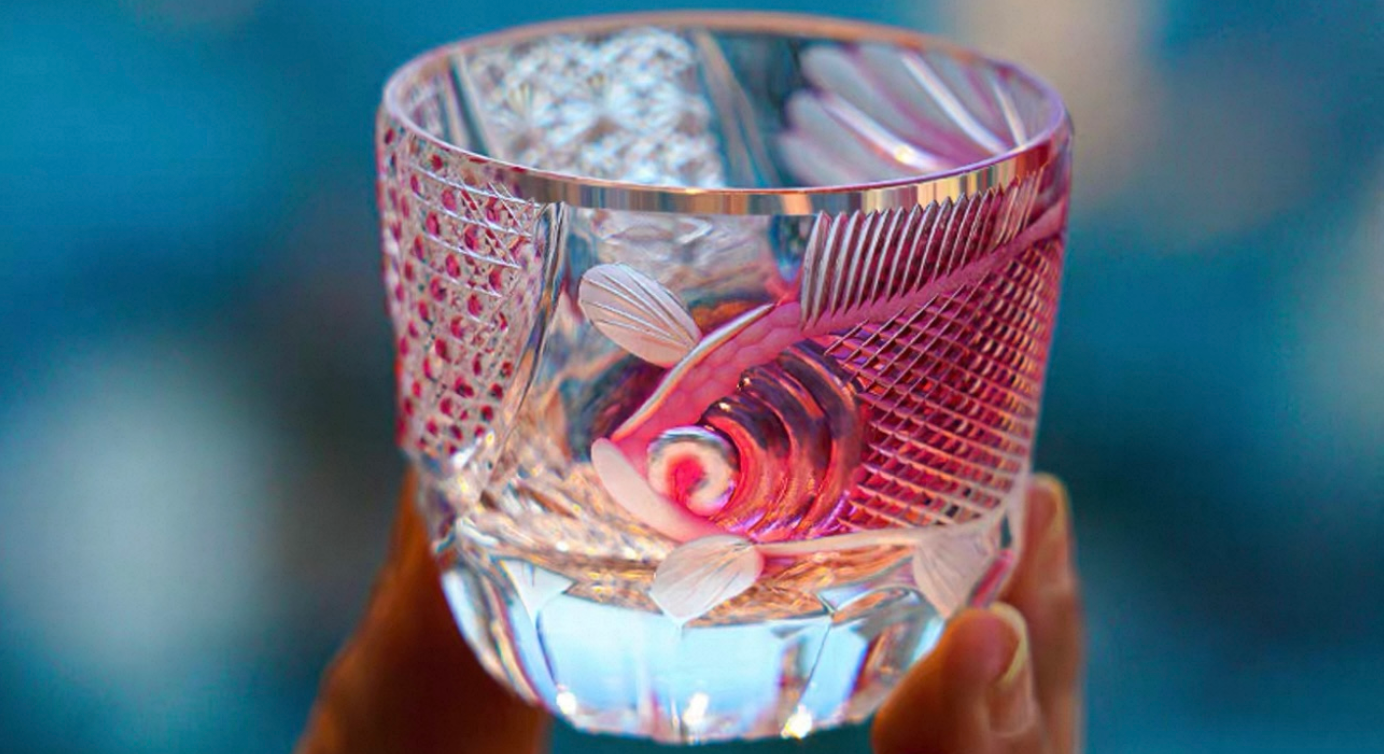
What does the fish motif represent in Edo Kiriko? In Japanese culture and Edo Kiriko glasswork, the fish—specifically the Carp (Koi) and Goldfish (Kingyo)—symbolizes resilience, perseverance, and prosperity. Historically, these motifs were used to evoke a sense of "cooling" (suzushisa) during hot Tokyo summers, utilizing the glass's refraction to simulate the movement of fish in water.
Why is the fish motif technically difficult to create? Unlike standard geometric cuts, fish motifs require curvilinear cutting on a curved surface. Artisans must vary the depth and angle of the wheel to create the "scale" effect (Uroko-mon), which demands immense hand-eye coordination to ensure the light refracts realistically through the colored glass layers.
How does Edo Kiriko use light to bring the fish motif to life? Edo Kiriko utilizes "cased glass" (a clear base layered with colored glass). By cutting away the colored layer, the artisan reveals clear "windows." When liquid is poured into the glass, the refraction causes the fish patterns to appear as if they are swimming, a phenomenon known as Yure (shimmering).
I. The Narrative of the Deep: Resilience and Prosperity
In Japanese symbolism, the fish is never just a biological subject; it is a carrier of virtue. When an artisan chooses to carve a fish into a vessel, they are embedding a specific intention into the glass.
The Carp (Koi): The Symbol of Triumph
The Carp is the ultimate emblem of perseverance. Based on the legend of the "Dragon Gate," a carp that swims upstream and leaps over a waterfall transforms into a dragon.
-
The Meaning: Gifting a Carp-motif Edo Kiriko glass is a gesture of support for someone’s career or personal growth. It represents the strength to overcome obstacles.
The Goldfish (Kingyo): The Messenger of Wealth
Introduced to Japan as luxury pets for the aristocracy, goldfish became a symbol of wealth and abundance. In the height of the Edo period, they were also prized for their "cooling" effect.
-
The Meaning: The goldfish motif is often chosen for home celebrations or as a "luck-bringing" gift for a new household, representing a flow of prosperity that never runs dry.
II. The Artisan’s Challenge: The Geometry of the Scale
Technically, the fish motif is one of the most demanding styles in the Oriental Artisan collection. It requires a mastery of the Uroko-mon (scale pattern), a traditional triangular design that predates glasswork in Japan.
-
Variable Depth: To give the fish "life," the artisan cannot use a uniform cut. They must press the glass against the spinning diamond wheel with varying pressure—deep for the body’s silhouette and feather-light for the delicate fins.
-
The Illusion of Motion: Artisans often combine the fish with the Yarai (arrow rain) or Saza-nami (ripples) patterns. This creates a background of movement. When the glass is rotated, the interplay between the clear and colored glass creates a cinematic effect of a fish darting through water.
III. The Sensory Experience: Why It Belongs on Your Table
The true magic of an Edo Kiriko fish-motif glass is only revealed when it is put to use. This is where the "Alchemy of the Deep" takes place.
-
Refractive Shimmer: When you pour sake or water into the glass, the liquid acts as a lens. The carved fish on the bottom or sides of the glass are magnified and distorted by the ripples, creating the startlingly realistic illusion of a living creature beneath the surface.
-
Tactile Mindfulness: Feeling the raised edges of the hand-cut scales provides a tactile anchor. It is a reminder of the Monozukuri (craftsmanship) spirit—a call to slow down and appreciate the moment.
IV. Choosing Your Heirloom: The Oriental Artisan Selection
When selecting a fish-motif piece, look for the clarity of the cut and the richness of the color. Our collection focuses on the two most iconic hues of Edo:
-
Ruri (Lapis Blue): Evoking the deep, cool waters of the Sumida River. Best for those who seek tranquility and focus.
-
Kiku-hi (Chrysanthemum Crimson): Representing the vibrant energy of the goldfish. Ideal for celebrations and bringing warmth to a hosting set.
Conclusion: A Legacy in Every Pour
The fish motif in Edo Kiriko is a bridge between the natural world and the human hand. It turns a functional object into a vessel of cultural history, resilience, and beauty. Whether you are a collector of fine glass or looking for a meaningful gift that carries the "soul of Japan," a fish-motif piece is a choice of profound intentionality.
Experience the shimmer of the deep.
Explore the Edo Kiriko Collection at Oriental Artisan.
%20or%20Ki...)
Leave a comment
This site is protected by hCaptcha and the hCaptcha Privacy Policy and Terms of Service apply.