

The Alchemy of Time: A Definitive Guide to Authentic Lacquerware and the Art of Urushi
The intersection of biology, artistry, and infinite patience finds its most profound expression in the medium of Urushi. To the uninitiated, it is merely a varnish; to the connoisseur, it is a living substance that breathes, ages, and endures. Often referred to as the impossible material, Japanese lacquerware represents a ten-thousand-year dialogue between the human hand and the volatile sap of the Toxicodendron vernicifluum tree. This guide serves as an authoritative exploration of this ancient craft, detailing the chemical miracles, historical evolutions, and meticulous techniques that define authentic lacquerware. In an era dominated by the ephemeral and the mass-produced, Urushi stands as a testament to the value of objects that are not merely manufactured, but nurtured through the slow passage of time.
Definitions of Excellence
To understand the prestige of authentic lacquerware, one must first master the vocabulary of its excellence. These definitions provide the foundational knowledge required by collectors and specialists to distinguish the sublime from the mundane.
What is Urushi? Urushi is a natural, organic resin derived from the sap of the Toxicodendron vernicifluum tree. Unlike industrial coatings that dry via solvent evaporation, Urushi hardens through a complex enzymatic oxidation process called polymerization. This reaction creates a molecular bond that is acid-proof, heat-resistant, and inherently antibacterial, resulting in a surface that is as resilient as it is luminous.
Why is authentic lacquerware so expensive? The valuation reflects extreme material scarcity and labor intensity. A single lacquer tree must grow for 10 to 15 years to produce approximately 200 grams of sap—less than a single cup—before it is harvested and cut down. A master-crafted bowl requires between 30 and 124 distinct steps, demanding months of curing and hand-polishing in humidity-controlled environments.
How to identify authentic handmade lacquer? Authenticity is revealed through sensory nuance. True Urushi possesses a "wet shine" and a tactile warmth compared to human skin. It is remarkably light due to its wooden core and lacks the cold, brittle sensation of plastic. Authentic pieces age gracefully; their colors become more transparent and luminous over decades as the polymerization process continues.
The Impossible Material: The Biological Miracle of Sap
At the heart of every Oriental Artisan piece lies a substance that defies conventional chemistry. The sap of the lacquer tree is a volatile, milky-white emulsion containing urushiol, water, plant gums, and the enzyme laccase. It is this specific biological cocktail that allows the material to transform from a toxic liquid into a food-safe, nearly eternal solid.
The Mechanism of Oxidative Polymerization
The hardening of Urushi is not a process of drying, but a chemical reaction catalyzed by the enzyme laccase. For this reaction to occur, the material requires precisely calibrated environmental conditions: a temperature between and and a relative humidity of 70% to 80%. In these conditions, the laccase enzyme facilitates the oxidation of urushiol molecules, causing them to cross-link and form a dense, three-dimensional network. This paradox—that a material must be "wet" with humidity to become "dry" to the touch—is what necessitates the use of a muro, a specialized wooden cabinet sprayed with water to provide the moisture necessary for the lacquer to breathe into its final state.
| Chemical Component | Percentage | Function in Polymerization |
|---|---|---|
| Urushiol | 60% – 80% | The primary resin that undergoes cross-linking |
| Water | 10% – 30% | Essential medium for enzyme activity |
| Plant Gums | 5% – 7% | Provides viscosity and helps emulsification |
| Laccase Enzyme | 1% – 2% | Biological catalyst for oxidative hardening |
| Nitrogenous Substances | 1% – 2% | Supports the stability of the emulsion |
The quality of the sap is highly seasonal, influencing the chemical composition and the eventual durability of the piece. Artisans distinguish between Hatsu-urushi (early-season sap), which has high water content and is ideal for priming, and Sakari-urushi (peak-season sap), which contains the highest concentration of urushiol and is reserved for topcoats. This sensitivity to the seasons means that a single object may contain sap harvested across multiple years, blended to achieve the perfect balance of flexibility and hardness.
The Paradox of the Poison and the Cure
The primary component, urushiol, is the same allergen found in poison ivy. In its raw, liquid state, it causes severe contact dermatitis, known in Japan as urushi-kabure. This inherent danger necessitates a profound level of dedication from the artisan, who must handle the material with extreme care, often developing a partial immunity over decades of exposure. However, once the polymerization is complete, the urushiol is entirely transformed. The cured surface is inert, non-toxic, and safe for contact with food and skin, representing a poetic transition from the "poison" of the forest to the "cure" of the ritual table.
The Architecture of Luster: A Chronology of Heritage
The history of lacquerware is an epic of cultural exchange and regional refinement, spanning over nine millennia. While the roots of the craft are found across East Asia, the Japanese and Chinese traditions represent two distinct peaks of aesthetic and technical philosophy.
Ancient Origins and the Jomon Independent Invention
Evidence suggests that lacquer technology was an independent invention of the Jomon people in Japan. Archaeological excavations at the Kakinoshima site in Hokkaido have unearthed lacquered ornaments and vessels dating back 7,000 to 9,000 years. These early artifacts demonstrate that even in the Neolithic period, humans had mastered the extraction of sap and the use of natural pigments like iron oxide and cinnabar to produce the iconic red and black palettes that still define the medium today.
The Continental Influence: Ming Dynasty Mastery
During the Ming Dynasty (1368–1644), Chinese lacquerware reached a pinnacle of decorative complexity. This "golden age" was characterized by techniques such as tihong (carved red lacquer), where hundreds of layers are built up over years and then meticulously carved into high-relief scenes of nature or mythology. This style emphasized "decorative excess" and a high-gloss finish that fascinated European collectors, who eventually began to use the term "japan" to refer to the material, much as "china" referred to porcelain.
The Zen Zenith: Edo Period Refinement
In contrast to the carved traditions of China, Japan's Edo period (1603–1868) saw the perfection of maki-e (sprinkled gold) and a focus on durability and subtle elegance. The stability of the Tokugawa shogunate allowed for the rise of specialized regional guilds, such as the Wajima-nuri masters, and the popularization of lacquer among the wealthy merchant class. Edo craftsmanship favored the integration of natural materials—including mother-of-pearl, ivory, and eggshell—into the lacquer layers, reflecting a Neo-Confucian appreciation for restraint and the "beauty of the transient."
| Period | Region | Primary Technique | Aesthetic Philosophy |
|---|---|---|---|
| Jomon | Japan | Red/Black thread coating | Functional protection of ceramics/wood |
| Nara | Japan | Buddhist ritual implements | Religious sanctity and continental influence |
| Ming | China | Tihong (Carved Lacquer) | Imperial grandeur and decorative excess |
| Edo | Japan | Maki-e (Sprinkled Gold) | Precision, restraint, and regional identity |
| Meiji | Japan | Export lacquerware | International trade and creative art status |
The 100-Step Process: The Labor of a Lifetime
The creation of a single piece of authentic Oriental Artisan lacquerware is a grueling odyssey of labor. In specialized centers like Wajima, a single bowl may pass through 124 distinct processes, divided among specialists who have dedicated their lives to a single stage of production.
Step 1: The Foundation (Kiji)
The process begins with the kiji, or wooden substrate. Artisans typically select slow-growing, stable timbers such as Japanese Zelkova (keyaki), horse chestnut, or cherry. The wood is turned on a lathe (rokuro) or hand-carved to a precise thickness. Crucially, the wood must be seasoned and smoked for up to a year to ensure all moisture is removed, preventing future warping or cracking. This is the silent preparation upon which all subsequent layers depend.
Step 2: The Undercoats (Shitaji)
The durability of authentic lacquer is owed to its invisible ground layers. The artisan applies kiji-katame (raw lacquer to harden the wood) and reinforces the stress points with nuno-gise (pasting hemp cloth with lacquer). A mixture called jinoko—a powder made from fired and ground volcanic clay—is blended with raw lacquer and rice glue to create the foundation. These layers are applied with a spatula, dried in the muro, and then sanded flat with whetstones before the next is applied. This "armored" core is what allows the piece to withstand heat and daily use for centuries.
Step 3: Intermediate and Top Coating (Nakanuri and Uwanuri)
Once the foundation is perfectly smooth, intermediate (nakanuri) and top (uwanuri) coats are applied. These final layers use the highest quality refined lacquer, often filtered through hemp cloth or special paper multiple times to remove microscopic impurities. The uwanuri must be applied in a strictly dust-free environment; even a single speck of dust can ruin months of work. The lacquer is applied with a brush made of long, fine human hair, which provides the necessary tension and flow to avoid brush strokes.
Step 4: The Finishing (Roiro)
For pieces requiring a mirror finish, the roiro process begins. The surface is polished with increasingly fine abrasives, starting with charcoal and ending with the artisan's bare hands and a fine polishing powder. This physical contact between the hand and the material generates the heat necessary to bring out the deep, "wet" luster that defines high-end Urushi.
| Production Stage | Technique/Material Used | Duration/Frequency |
|---|---|---|
| Kiji-zukuri | Zelkova/Zanzhou wood carving | 1 year (including drying) |
| Kiji-katame | Raw Ki-urushi saturation | 24–48 hours curing |
| Nuno-gise | Hemp cloth + Rice glue + Urushi | Applied to rims and joints |
| Jizuke | Jinoko clay + Raw Urushi | 3 separate layers, sanded between |
| Nakanuri | Refined black/transparent Urushi | 1–4 layers |
| Uwanuri | Highest grade refined Urushi | Final dust-free application |
| Roiro-togi | Charcoal and hand-polishing | Multiple iterations for depth |
Decorative Virtuosity: Narrative in Gold and Shell
Beyond its functional perfection, Urushi serves as a canvas for decorative techniques that transform simple vessels into narrative masterpieces. These methods are not merely surface applications but are integrated into the very structure of the lacquer.
Maki-e: The Art of Sprinkled Light
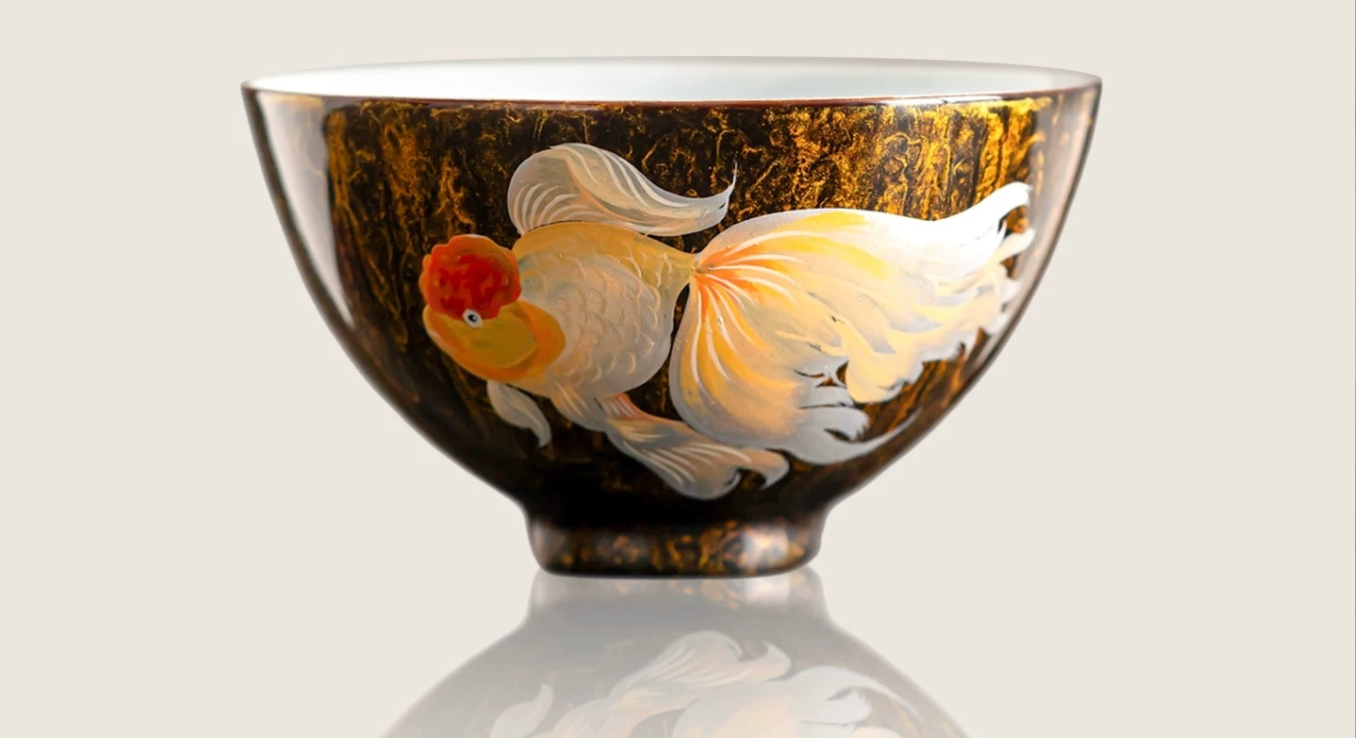
Maki-e is the quintessence of Japanese lacquer art. The artist draws a design with wet lacquer and then sprinkles fine powders of gold, silver, or copper through a specialized bamboo tube. Once cured, additional layers of transparent lacquer are applied and then sanded back to reveal the metallic design embedded within, creating an illusion of depth known as shishiai maki-e. This technique reflects the Japanese aesthetic of ukiyo, focusing on the transient beauty of nature—cherry blossoms, cricket calls, and the shifting seasons.
Raden and Chinkin: Subtractive and Additive Elegance
Raden involves the inlay of iridescent mother-of-pearl, planed to paper-thinness and set into the wet lacquer. Chinkin (sunken gold) is a subtractive process where the artisan carves delicate lines into the hardened surface with a chisel, rubs raw lacquer into the grooves, and then presses gold leaf into the incisions. Because the carving is permanent, the artisan has no room for error, requiring a level of focus that is indistinguishable from meditation.
Negoro-nuri: The Beauty of Wear
Named after the Negoro-ji temple, this style features a red lacquer layer applied over a black base. Through years of use, the red begins to wear away in high-contact areas, revealing the black beneath. This intentional degradation celebrates the passage of time and the history of the object's use, a perfect embodiment of the wabi-sabi philosophy where imperfection and age are valued over pristine novelty.
The Collector’s Eye: Distinguishing the Eternal from the Ephemeral
In a market saturated with "lacquer-style" products, the modern collector must possess the technical knowledge to distinguish authentic Urushi from mass-produced resin imitations. Authentic Oriental Artisan pieces are an investment in heritage, whereas synthetic alternatives are merely disposable commodities.
Sensory Indicators of Authenticity
Authentic lacquerware possesses a unique tactile signature. It is surprisingly light due to the wooden core and feels warm and "soft" against the lips and hands. In contrast, plastic or resin imitations feel cold and brittle. Visually, look for "inner illumination." Light should seem to penetrate the surface and reflect from within the multiple layers, creating a "wet shine" that cannot be replicated by chemical varnishes. Furthermore, authentic Urushi will have a subtle, sweet, and slightly medicinal scent from the tree sap, while synthetics often smell of petroleum or are entirely odorless.
Labeling and Provenance
When evaluating a potential acquisition, specific Japanese terminology on the label provides a roadmap to its quality:
-
Tennen-boku (天然木): Natural wood core (the hallmark of quality).
-
Urushi-nuri (漆塗): Authentic lacquer coating.
-
Kashu-nuri (カシュー): Cashew oil-based varnish. While durable, it lacks the depth and biological properties of real Urushi.
-
Uretan-jushi (ウレタン): Polyurethane resin. Often dishwasher-safe but will not age or develop a patina.
The Test of Time
The ultimate indicator of authenticity is how the piece responds to age. Synthetic lacquer is at its best the day it is purchased and degrades thereafter. Authentic Urushi, however, is a "living" material that continues to polymerize for decades. This causes the colors to become more vibrant and the surface to become glossier as it interacts with the moisture in the air and the oils from human skin.
Functional Art: The Original "Forever" Material
The enduring appeal of lacquerware lies in its remarkable functional properties. Historically used for samurai armor, temple structures, and imperial tableware, Urushi was valued for its protective qualities long before it was admired as fine art.
Resilience and Hygiene
Once fully cured, Urushi is a natural bio-plastic. It is resistant to nearly all household chemicals, including alcohol, acids (like vinegar), and alkalis. Its insulating properties make it the perfect vessel for hot food, as it keeps the liquid warm while remaining comfortable to hold. Furthermore, Urushi is naturally antibacterial and antiseptic, inhibiting the growth of mold and bacteria—a critical feature for tableware in humid climates.
Sustainability and the Circular Economy
In an era focused on environmental impact, Urushi is a sustainable alternative to plastics. Derived from tree sap and wood, it is entirely biodegradable. Because it can be sanded down, recoated, or repaired through kintsugi, an Urushi object can literally last for a thousand years. It is not a disposable item, but a heritage piece that embodies the circular economy of traditional craftsmanship.
| Feature | Authentic Urushi | Synthetic Resin |
|---|---|---|
| Material Origin | Natural tree sap | Petroleum-based chemicals |
| Hardening Method | Oxidative polymerization (enzymatic) | Solvent evaporation |
| Heat Resistance | Up to | Low (often warps/melts) |
| Aging Property | Becomes more transparent/luminous | Dulls, yellows, and cracks |
| Repairability | High (Kintsugi/Recoating) | Low (usually discarded) |
| Hygiene | Naturally antibacterial/deodorizing | Porous/subject to bacterial growth |
Modern Minimalism: The Daily Ritual Tool
Lacquerware is not merely a relic of the past; it is a vital tool for mindfulness in the contemporary home. Its presence encourages a slowing down of gestures and an appreciation for the tactile experience of living.
The Zen of the Minimalist Table
In a minimalist interior, the deep black or vibrant vermilion of a lacquer bowl provides a focal point of "quiet luxury." The use of lacquerware in the daily ritual of a meal transforms a mundane act into a ceremony. The lack of clatter when a lacquer bowl is placed on a table contributes to a more serene atmosphere, emphasizing the Zen principles of harmony (wa), respect, and silence. As Junichiro Tanizaki famously noted in In Praise of Shadows, the beauty of lacquer is best appreciated in low light, where the "wet" surface catches the flicker of a candle or the dim glow of a sliding door.
Integrating Heritage into Contemporary Rituals
Oriental Artisan pieces are designed to fit into the modern collector's life not as museum pieces, but as active participants in daily mindfulness:
-
Tea Ceremony: The natsume (tea caddy) is a partner in the gestures of the tea room, its weight and texture grounding the participant.
-
Interior Design: A jubako (tiered box) can serve as an elegant organizer for precious items, bringing order and beauty to a workspace.
-
Personal Accessories: Hand-polished chopsticks or a lacquer-coated fountain pen offer a tactile connection to heritage during the workday.
The Ritual of Care: Preserving the Legacy
While Urushi is incredibly durable, it possesses specific sensitivities that the collector must respect. Proper care is not a chore, but a gesture of continuity that honors the artisan's labor.
The Adversary: Ultraviolet Light
The most significant threat to Urushi is direct sunlight. UV rays break down the molecular structure of the polymer, causing the surface to dull, crack, and eventually lose its luster. Collectors should store their pieces in dark cabinets or use the traditional wooden boxes provided. When displaying pieces, they should be kept away from windows or high-intensity artificial light.
The Ally: Humidity and Consistent Use
Ironically, the best way to care for lacquerware is to use it. Urushi thrives on the moisture it absorbs from the air and the contact with human skin. If a piece is kept in an excessively dry environment, the wood core may shrink and crack the lacquer. In dry climates, storing lacquerware with a small glass of water nearby helps maintain the necessary ambient humidity.
Cleaning and Maintenance Protocol
-
Hand Wash Only: Never use a dishwasher. The high heat and rapid temperature changes can warp the wood and destroy the bond of the lacquer.
-
Gentle Cleaning: Use lukewarm water and a drop of mild, neutral soap. Avoid abrasive sponges or metallic pads which can scratch the surface.
-
Immediate Drying: Wipe the piece immediately after rinsing with a soft, lint-free cloth (like gauze or fine cotton). This prevents mineral deposits from forming water spots.
-
Thermal Care: Avoid extreme heat shocks. Before pouring hot soup into a bowl, warm it under a stream of lukewarm water to prevent micro-cracks.
| Care Requirement | Action to Take | Reasoning |
|---|---|---|
| Sunlight | Keep in dark/shaded areas | UV light causes photodegradation and crazing |
| Humidity | Maintain 60%–80% RH | Prevents wood shrinkage and surface cracking |
| Washing | Hand wash with soft sponge | Protects against mechanical scratches |
| Storage | Use wooden boxes/paper wrap | Shields from light and dust |
| Temperature | Avoid microwaves/fridges | Prevents warping of the organic substrate |
The Oriental Artisan Bridge: From Heritage to Collector
Oriental Artisan serves as a sanctuary for the world's most exquisite Asian craftsmanship, acting as the bridge between disappearing heritage workshops and the modern collector. Every piece curated by the brand is a testament to human hands guided by centuries of tradition.
The Artisan's Codex and the Pledge
The brand operates under a strict "Artisan's Codex," a philosophy that values mastery, lineage, and the embrace of imperfection (wabi-sabi). This is reinforced by "The Oriental Artisan Pledge," a commitment to social responsibility where 1% of all revenue is donated to uplift artisan communities across mainland China and Japan. These funds support:
-
Education: Scholarships for young artists in Jingdezhen and other cultural hubs.
-
Preservation: Grants for elder masters to teach endangered techniques to a new generation.
-
Sustainability: Reforestation projects for the camphor and lacquer trees essential to the craft.
Begin Your Collection: A Curation Guide
Acquiring a piece of authentic lacquerware is a commitment to a lifestyle of refined elegance. Depending on your personal ritual, we suggest the following starting points:
For the Daily Mindful Ritual: The Polished Bowl If you are new to the world of Urushi, begin with a pair of soup bowls (shiru-wan). Their insulating properties transform the simple act of eating soup into a tactile, sensory experience. Choose a classic black or vermilion finish to ground your morning or evening routine.
For the Meditative Workspace: The Jubako A tiered jubako or an intricate natsume can serve as a focal point in a home office or study. These objects organize the small essentials of a life while providing a visual depth that invites reflection during moments of pause.
For the Connoisseur’s Display: The Maki-e Masterpiece For those seeking the pinnacle of the art form, our limited edition Maki-e boxes and Chinkin decorated trays represent the highest level of technical virtuosity. These are heirloom pieces intended to be displayed in a low-light environment, where they can reveal their hidden depths to the patient eye.
The Eternal Luster
The art of Urushi is a reminder that time is not an obstacle to be overcome, but an ingredient to be embraced. From the fifteen years a tree grows to the months an artisan spends polishing, every moment is embedded in the final luster of the object. Oriental Artisan invites you to view our current limited edition collection—each piece a living history, finished in the slow, luminous shine of the Orient. By choosing authentic lacquerware, you are not merely purchasing an object; you are becoming a steward of a ten-thousand-year legacy, ensuring that the alchemy of time continues for generations to come.

Leave a comment
This site is protected by hCaptcha and the hCaptcha Privacy Policy and Terms of Service apply.