

The Ultimate Guide to Edo Kiriko: The Japanese Art of Cut Glass
Introduction
There are moments in life when a simple object transcends its function and becomes something more—a vessel not just for liquid, but for light, memory, and meaning. Imagine holding a glass that catches the afternoon sun and scatters it into a constellation of tiny rainbows across your table. Imagine pouring amber whisky into a crystal cup and watching the spirit ignite with a thousand facets of fire. This is the world of Edo Kiriko.
Edo Kiriko is not merely glassware. It is the product of nearly two centuries of uninterrupted craftsmanship, a dialogue between human hands and crystal that transforms the ordinary act of drinking into an extraordinary experience. Each piece carries within it the spirit of Edo-period Tokyo, the precision of master artisans, and a philosophy that sees beauty not in mass production but in the patient, deliberate work of a single craftsman.
For the collector, the whisky enthusiast, or anyone who believes that the objects we surround ourselves with should tell a story, Edo Kiriko offers something rare: a tangible connection to Japanese heritage, a piece of art that lives in your hands.
What Is Edo Kiriko? The Definition of Japanese Cut Glass
Edo Kiriko (江戸切子) is a traditional Japanese glass-cutting craft that originated in Edo (modern-day Tokyo) in 1834. The term Kiriko (切子) literally means "cut thing"—a reference to the technique of carving intricate patterns into the surface of glass using abrasive powders and rotating wheels.
At its essence, Edo Kiriko is a cold-working glass technique: instead of shaping glass while molten, artisans cut and polish already-formed glass objects to create delicate, geometric patterns. What sets Edo Kiriko apart from ordinary cut glass is not just the technique but the philosophy behind it. Every Edo Kiriko piece is entirely handmade, without the use of stencils or pre-drawn patterns. The artisan works from memory and instinct, carving designs directly onto the glass surface—a feat of extraordinary skill that demands years, even decades, of training.
In 1985, Edo Kiriko was designated a traditional craft industry of Tokyo, and in 2002, it was officially recognized as a National Traditional Craft of Japan. This designation is not given lightly. It means that Edo Kiriko is regarded as a cultural treasure, an art form worthy of preservation and传承 for future generations.
But Edo Kiriko is more than a craft—it is a philosophy. It embodies the Japanese aesthetic of finding beauty in the everyday, of elevating functional objects to the level of art. A Edo Kiriko glass is not simply a container for your whisky or water; it is an invitation to pause, to appreciate, and to experience the world with greater attention.
The History of Edo Kiriko: From Edo Period Innovation to Modern Luxury
The Birth of a Craft (1834)
The story of Edo Kiriko begins in the final decades of the Edo period (1603–1868), a time when Japan was slowly opening to foreign influences after centuries of isolation. In 1834—the fifth year of the Tenpō era—a glass merchant named Kagaya Kyūbei (加賀屋久兵衛) was running a shop in the Ōtenma-chō district of Edo (near present-day Nihonbashi).
Kyūbei had learned glass-cutting techniques in Osaka and began experimenting with them on imported glassware from the United Kingdom. Using emery powder—a hard abrasive made from crushed garnet—he carved patterns into the surface of glass bottles and cups. These early experiments are considered the first Edo Kiriko.
The craft remained relatively obscure until the Meiji Restoration of 1868, when Japan embarked on a rapid program of modernization and industrialization.
The Meiji Transformation (1873–1881)
A pivotal moment came in 1873, when the Shinagawa Glass Factory (later known as Kogyosha) was established in Tokyo as part of the Meiji government's industrial development policy. Then, in 1881, the British glass-cutting expert Emmanuel Hauptmann was invited to Japan to train local artisans in the latest European cutting techniques.
Hauptmann's arrival was transformative. Over ten Japanese craftsmen studied under him, learning advanced cutting and polishing methods that were then fused with traditional Japanese aesthetics. This synthesis of Western technology and Japanese sensibility gave birth to the refined Edo Kiriko technique that continues to this day.
The Golden Age and Beyond
From the late Meiji period through the Taishō (1912–1926) and early Shōwa eras, Edo Kiriko experienced its first golden age. Research into glass materials improved, polishing techniques for crystal glass were developed, and "cut glass" became synonymous with the highest level of glass craftsmanship in Japan.
Edo Kiriko pieces were showcased at international expositions, earning global recognition for their beauty and precision. The craft became a source of national pride, representing the best of Japanese glass artistry.
The post-war period brought challenges as traditional crafts declined in the face of mass production. However, Edo Kiriko experienced a revival as contemporary artisans embraced traditional techniques while introducing new designs and innovations. Today, workshops in Tokyo's Kōtō and Sumida districts continue to produce Edo Kiriko using methods passed down through generations.
How Edo Kiriko Is Made: The Art Behind Every Cut
The creation of a single Edo Kiriko piece is a journey—one that transforms raw crystal into a luminous work of art. The process involves six main stages, each requiring extraordinary skill and patience.
1. Blowing the Glass
The process begins not with cutting, but with glassblowing. A thin layer of colored glass is blown over a clear inner layer—a technique called pokan, named after the sound made when removing the glass from the kiln. This creates the distinctive two-layer structure that characterizes much of Edo Kiriko: a colored exterior that, when cut away, reveals the transparent crystal beneath.
2. Marking the Design (Waridashi / 割り出し)
With the glass object formed, the artisan marks the design guidelines on its surface. Using red iron oxide pigment, vertical and horizontal lines are drawn to serve as the blueprint for the cuts to come.
Remarkably, no detailed sketches or stencils are used. The artisan works from memory and intuition, drawing only the basic grid that will guide the cutting. For vertical lines, a bamboo stick cut to the width of the chosen pattern serves as a guide; for horizontal lines, a paper cylinder divided into equal parts is inserted into the glass.
3. Rough Cutting (Arazuri / 粗摺り)
The artisan begins the actual cutting using a diamond wheel with water as a lubricant. The rough outline of the pattern is carved into the glass, establishing the basic contours of the design.
This stage requires immense physical control. The glass is rotated against the wheel, and the artisan must maintain perfect steadiness—any slip of the hand can ruin the piece.
4. Detailed Cutting (Sanbangake / 三番掛け)
With the rough outline established, the artisan moves to finer diamond wheels to create the intricate details of the pattern. This is where the true artistry of Edo Kiriko emerges. The depth and angle of each cut determine how light will interact with the finished piece, creating the brilliant sparkle that Edo Kiriko is famous for.
5. Polishing with a Whetstone (Ishikake / 石掛け)
The cut surfaces are then smoothed using natural whetstones, traditionally sourced from Gotō and Sasaguchi in Kyūshū. Water is applied during this process to achieve a smooth, refined finish.
6. Final Polishing (Migaki / 研磨)
The final stage uses a wooden wheel with water-soluble polishing powders and iron oxide to bring the glass to its full brilliance. For finer patterns, a bristle brush may be used. This stage transforms the matte cut surfaces into transparent, luminous facets that catch and scatter light.
The result is a piece of extraordinary clarity and brilliance—a testament to the artisan's skill and the beauty of traditional craftsmanship.
The Unique Beauty of Edo Kiriko Patterns
The patterns of Edo Kiriko are not mere decoration. Each carries symbolic meaning, drawing from Japan's rich cultural heritage and the natural world. The Edo Kiriko Cooperative Association recognizes dozens of traditional patterns, but because each piece is handmade, the variations are infinite.
Fish Egg Pattern (Nanako / 魚子文)
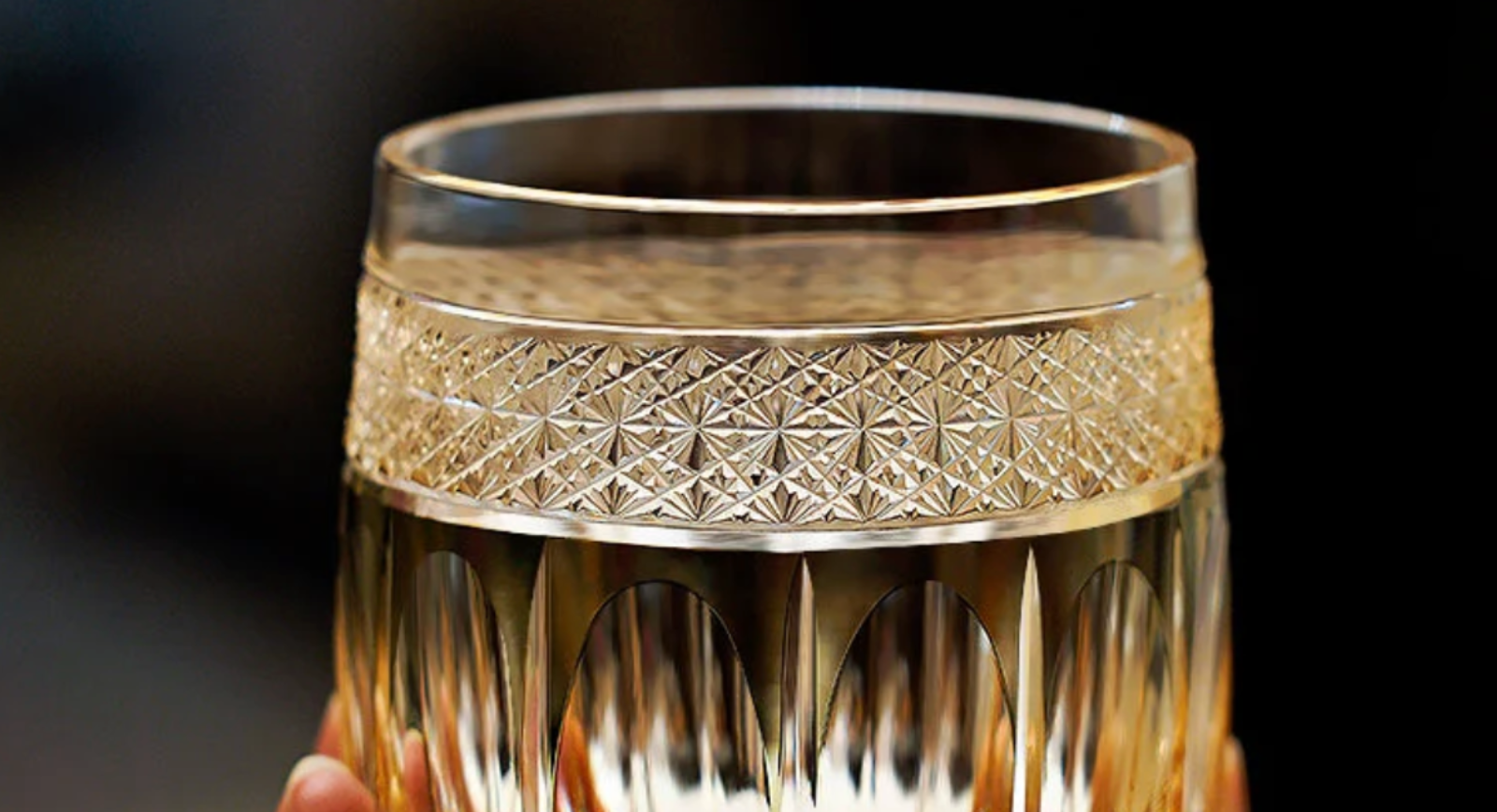
Perhaps the most iconic Edo Kiriko pattern, Nanako features thousands of tiny, pyramid-like cuts that resemble fish roe. This pattern embodies a wish for prosperity and abundance for future generations. When light passes through a Nanako-cut glass, it creates a shimmering, almost liquid effect that seems to dance across the surface.
Chrysanthemum Patterns (Kiku / 菊)
The chrysanthemum, a symbol of the Japanese imperial family, appears in several variations: Kiku-tsunagi (chrysanthemum chain), Kiku-kagome (chrysanthemum basket weave), and Kikka (chrysanthemum flower). These patterns evoke elegance, longevity, and nobility.
Hemp Leaf Pattern (Asa-no-ha / 麻の葉文)
Inspired by the shape of hemp leaves, this geometric pattern has been used in Japanese textiles for centuries. It carries wishes for health and growth, making it a popular motif for celebratory gifts.
Bamboo Pattern (Sasa-no-ha / 笹の葉文)
Bamboo, a symbol of resilience and flexibility in Japanese culture, appears as a delicate leaf pattern that speaks to the Japanese appreciation for nature's quiet strength.
Basket Weave Patterns (Kagome / 籠目)
Patterns like Rokkaku-kagome (hexagonal basket weave) and Hakkaku-kagome (octagonal basket weave) draw inspiration from traditional Japanese bamboo basketry, connecting the craft to everyday life in Edo-period Japan.
Yarai (矢来文)
This pattern mimics the粗编 bamboo fences used in traditional Japanese gardens. It is considered a protective motif, believed to ward off evil.
How Patterns Interact with Light
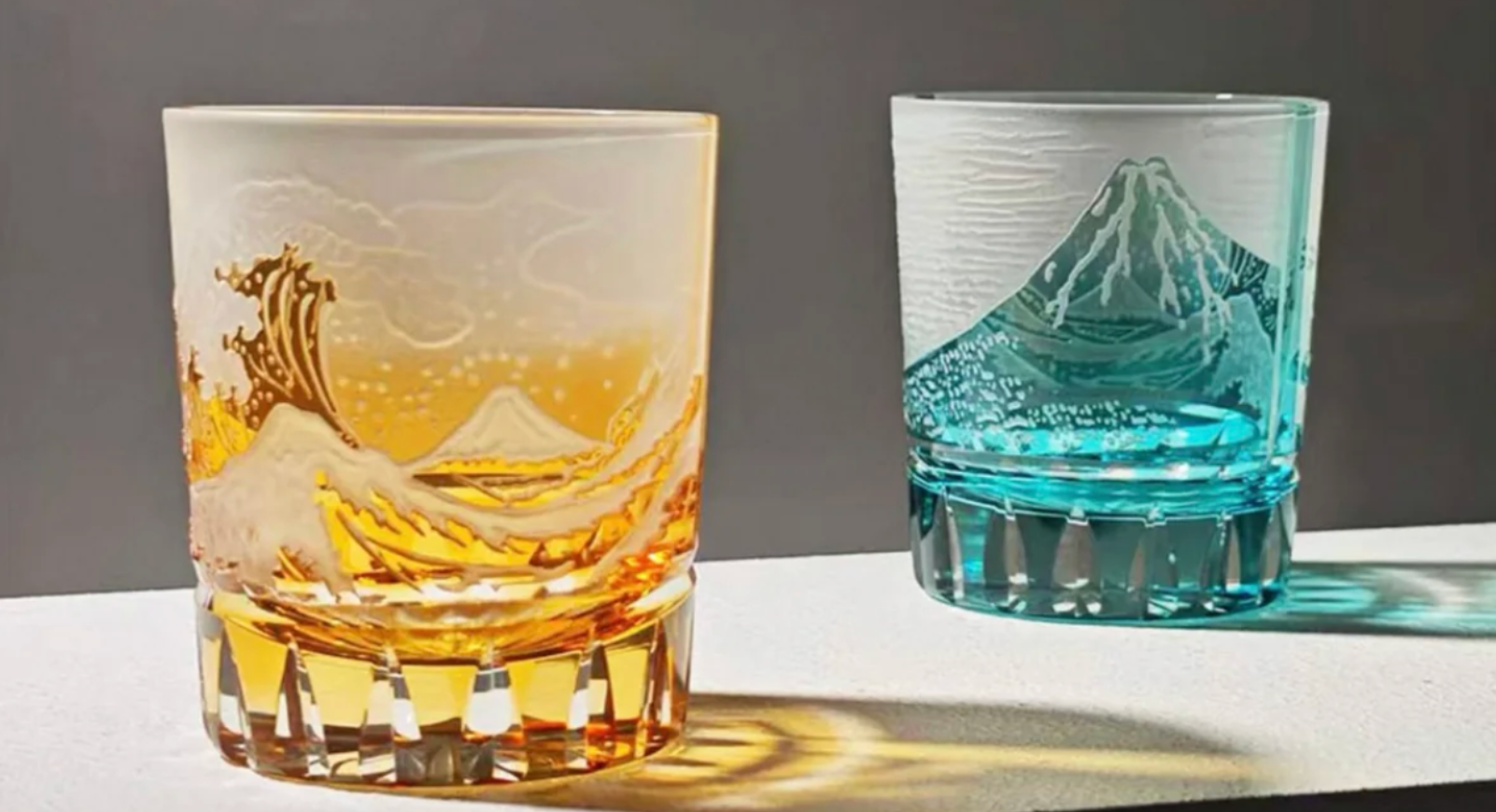
The true magic of Edo Kiriko reveals itself when light passes through the cut crystal. Each facet catches and refracts light differently, creating a play of brilliance that changes with every angle. When filled with amber whisky, the patterns seem to ignite, transforming the spirit into a glowing jewel. This interaction between pattern, light, and liquid is why Edo Kiriko is so beloved by whisky connoisseurs.
Edo Kiriko vs Other Japanese Glass Traditions
Edo Kiriko vs Satsuma Kiriko
While both Edo Kiriko and Satsuma Kiriko are forms of Japanese cut glass, they differ significantly in origin, technique, and aesthetic.
Origins: Edo Kiriko was born in the merchant culture of Edo (Tokyo) in 1834. Satsuma Kiriko emerged later, in 1849, in the Satsuma Domain (present-day Kagoshima Prefecture) under the patronage of the Shimazu clan.
Social Context: Edo Kiriko was a craft of the people, created for and used by ordinary townspeople. Satsuma Kiriko, by contrast, was a luxury item for the nobility, used for presentation to feudal lords and for export.
Technique: Edo Kiriko typically features a thin layer of colored glass (about 1 millimeter thick) over a clear core, creating a light, delicate feel. Satsuma Kiriko uses thicker colored glass overlays (up to 5 millimeters), resulting in a heavier, more substantial piece.
Patterns: Edo Kiriko patterns are predominantly geometric and inspired by everyday life—fish eggs, bamboo fences, hemp leaves. Satsuma Kiriko features more elaborate, luxurious designs, often incorporating European influences.
Aesthetic: Edo Kiriko is characterized by bold, sharp cuts and bright, clear colors. Satsuma Kiriko has a more subdued, semi-transparent quality.
Edo Kiriko vs Ordinary Cut Crystal
What distinguishes Edo Kiriko from mass-produced cut crystal is not merely the quality of the glass, but the human element.
Handmade vs Machine-Made: Every piece of authentic Edo Kiriko is entirely handmade, without stencils or automation. Mass-produced cut glass is made using molds and machines, resulting in identical, soulless pieces.
The Artisan's Touch: Edo Kiriko reflects the individual skill and artistic vision of the craftsman. No two pieces are exactly alike. Each carries the subtle imperfections that testify to its human origin.
Cultural Significance: Edo Kiriko is recognized as a National Traditional Craft of Japan. It embodies centuries of cultural heritage, not merely a manufacturing technique.
Collectibility: Because of its handmade nature and limited production, Edo Kiriko is collectible in a way that mass-produced glass never can be. Each piece is a potential heirloom.
Why Edo Kiriko Whisky Glasses Are Loved by Collectors
In recent years, Edo Kiriko has found a passionate new audience among whisky enthusiasts and collectors. The reasons are as layered as the cuts in the glass itself.
The Enhancement of the Whisky Experience
When amber whisky meets Edo Kiriko crystal, something magical happens. The cut facets catch and refract light, making the whisky glow from within. As you rotate the glass, the patterns seem to shift and dance, creating a visual experience that deepens the appreciation of the spirit.
A Dialogue Between Craft and Spirit
Edo Kiriko embodies the Japanese philosophy of mindful drinking—the idea that how you drink is as important as what you drink. A Edo Kiriko whisky glass transforms a simple pour into a ceremony, inviting you to slow down, observe, and savor.
The Intersection of Two Japanese Traditions
Edo Kiriko and Japanese whisky are both expressions of Japanese craftsmanship—one in glass, one in spirit. To enjoy a Japanese single malt from a Edo Kiriko glass is to experience two of Japan's finest cultural exports in perfect harmony.
A Statement of Discernment
For collectors, a Edo Kiriko whisky glass is a mark of taste and discernment. It signals an appreciation not just for fine whisky, but for the craftsmanship, history, and culture behind the objects we use.
The Perfect Gift
Edo Kiriko whisky glasses make exceptional luxury gifts—for weddings, anniversaries, corporate milestones, or simply for someone who deserves something extraordinary. Presented in a wooden box, each piece becomes a gift that communicates thoughtfulness, taste, and respect.
How to Choose an Authentic Edo Kiriko Glass
With the growing popularity of Edo Kiriko, it's increasingly important to know how to identify authentic pieces. Here's what to look for:
1. Handmade Craftsmanship
Authentic Edo Kiriko is entirely handmade. Look for subtle variations in the pattern—these are the hallmarks of human craftsmanship, not machine production.
2. Two-Layer Glass Construction
Traditional Edo Kiriko features a colored glass overlay on a clear crystal base. Inspect the base of the piece to see the transition between the two layers.
3. Precision of the Cuts
The cuts should be sharp and precise, with clean edges that catch the light brilliantly. The pattern should exhibit the geometric precision that Edo Kiriko is famous for.
4. The Light Test
Hold the glass up to the light. Authentic Edo Kiriko will scatter light into a spectrum of colors, creating a brilliant, diamond-like sparkle.
5. Crystal Quality
Authentic Edo Kiriko is made from high-quality crystal glass, which is softer and heavier than ordinary glass, making it suitable for精细 cutting and producing an exceptional shine.
6. Design Complexity
While simpler patterns can be beautiful, more complex designs require greater skill and are generally more highly valued.
7. Packaging and Presentation
Authentic Edo Kiriko is typically presented in a wooden box with appropriate documentation.
8. Geographic Origin
True Edo Kiriko is produced in the Kantō region, primarily in Tokyo's Kōtō and Sumida districts. The name "Edo Kiriko" is strictly controlled and reserved for pieces made using traditional techniques in these areas.
How to Care for Edo Kiriko Glassware
Edo Kiriko is a treasure that deserves proper care. Follow these guidelines to preserve its brilliance for generations.
Washing
-
Wash by hand using a soft cloth or sponge.
-
Use a mild dishwashing detergent diluted in lukewarm water.
-
Never use abrasive scrubbers—they can scratch the delicate cut surfaces.
-
If grime accumulates in the facets, use a soft toothbrush to gently clean it out.
Dishwashers and Microwaves
-
Not dishwasher safe—the harsh detergents and high heat can damage the glass.
-
Do not use in microwave ovens or conventional ovens.
Temperature Precautions
-
Avoid sudden temperature changes, which can cause the glass to crack.
-
Do not pour boiling water into cold Edo Kiriko glass.
Storage
-
Store pieces separately to prevent them from knocking against each other.
-
If stacking is necessary, place a soft cloth between pieces.
Preserving Brilliance
-
Over time, cut surfaces may develop a slight haze. Some artisans recommend cleaning with a mixture of coarse salt and alcohol to restore clarity.
-
Handle with care—Edo Kiriko is crystal, not ordinary glass, and while it is durable, it should be treated with respect.
Edo Kiriko as a Luxury Gift
There is something profoundly meaningful about giving Edo Kiriko as a gift. It is not merely an object; it is a piece of Japanese heritage, a collaboration between human hands and crystal, and a timeless object worthy of collecting.
For Weddings and Anniversaries
Edo Kiriko represents the enduring beauty that a marriage should embody. The cut crystal, with its intricate patterns and brilliant light, symbolizes the complexity and radiance of a shared life.
For Whisky Lovers
For the enthusiast who appreciates fine spirits, a Edo Kiriko whisky glass is the ultimate vessel—one that honors the whisky as much as the drinker.
For Corporate Gifts
A Edo Kiriko piece communicates respect, discernment, and generosity. It is a gift that will be treasured, not forgotten.
For Collectors
For those who appreciate the world's finest craftsmanship, Edo Kiriko represents an investment in beauty—a piece that will appreciate in value and significance over time.
The Meaning Behind the Gift
When you give Edo Kiriko, you are giving more than a glass. You are giving time—the hours of training, the decades of experience, the patient work of skilled hands. You are giving heritage—nearly two centuries of tradition passed from master to apprentice. And you are giving beauty—a piece that will bring joy every time it catches the light.
Discover Authentic Edo Kiriko at Oriental Artisan
At Oriental Artisan, we believe that the objects we bring into our homes should tell stories—stories of skill, of heritage, of the human spirit. Our mission is to connect discerning collectors around the world with the finest handcrafted treasures from Japan and China, preserving traditional craftsmanship and bringing rare heritage arts to modern homes.
Our curated collection of authentic Edo Kiriko represents the pinnacle of Japanese glass artistry. Each piece is:
-
Handcrafted by master artisans in Tokyo
-
Made using traditional techniques passed down through generations
-
Crafted from premium crystal for exceptional brilliance
-
Presented in elegant packaging worthy of a collector's treasure
Whether you are a whisky connoisseur seeking the perfect glass, a collector searching for a new treasure, or someone looking for a gift that will be remembered forever, Oriental Artisan offers a selection of Edo Kiriko that embodies the very best of Japanese craftsmanship.
We invite you to explore our collection and discover the beauty of Edo Kiriko—a piece of Japanese heritage that will illuminate your home and enrich your life.
Frequently Asked Questions About Edo Kiriko
What is Edo Kiriko?
Edo Kiriko (江戸切子) is a traditional Japanese glass-cutting craft that originated in Edo (modern-day Tokyo) in 1834. It involves hand-carving intricate geometric patterns into crystal glass using diamond wheels and abrasives. In 2002, it was designated a National Traditional Craft of Japan.
How is Edo Kiriko different from ordinary cut glass?
Edo Kiriko is entirely handmade without stencils or automation, with each piece reflecting the individual skill of the artisan. It is made from high-quality crystal and features distinctive two-layer construction (colored glass over clear). Edo Kiriko is also recognized as a National Traditional Craft, giving it cultural significance that mass-produced glass lacks.
Why is Edo Kiriko expensive?
The cost of Edo Kiriko reflects the extraordinary skill required to produce it. Each piece is handmade by artisans who have trained for years, sometimes decades. The process involves multiple stages of cutting and polishing, and any mistake can ruin the piece. Additionally, authentic Edo Kiriko is made from premium crystal and produced in limited quantities in Tokyo.
Is Edo Kiriko handmade?
Yes, authentic Edo Kiriko is entirely handmade. Artisans carve patterns directly onto the glass surface without using stencils or pre-drawn patterns, working from memory and intuition. The manufacturing process involves six main stages, all performed by hand.
Can Edo Kiriko glasses be used for whisky?
Absolutely. Edo Kiriko whisky glasses are highly prized by collectors and whisky enthusiasts. The cut facets enhance the visual experience of drinking whisky, catching and refracting light to make the spirit glow. Many collectors consider Edo Kiriko the ultimate vessel for enjoying fine whisky.
How do you care for Edo Kiriko glass?
Wash Edo Kiriko by hand using a soft cloth or sponge with mild detergent diluted in lukewarm water. Never use abrasive scrubbers or place in a dishwasher. Avoid sudden temperature changes. If grime accumulates in the facets, use a soft toothbrush to gently clean it out.
How can I tell if Edo Kiriko is authentic?
Authentic Edo Kiriko is handmade in Tokyo's Kōtō or Sumida districts. Look for sharp, precise cuts that scatter light brilliantly. The piece should feature two-layer construction (colored glass over clear). Authentic pieces are typically presented in wooden boxes with appropriate documentation.
What is the difference between Edo Kiriko and Satsuma Kiriko?
Edo Kiriko originated in Tokyo in 1834 among merchant-class craftsmen, featuring thin colored glass overlays and bold geometric patterns. Satsuma Kiriko originated in Kagoshima in 1849 under noble patronage, using thicker colored glass and more elaborate, luxurious designs.
What patterns are common in Edo Kiriko?
Common patterns include Nanako (fish egg, symbolizing prosperity), Asa-no-ha (hemp leaf, for health and growth), Kiku (chrysanthemum, for nobility), Yarai (bamboo fence, for protection), and various basket weave patterns.
Why is Edo Kiriko considered a Japanese national craft?
Edo Kiriko was designated a National Traditional Craft in 2002 because it represents a significant aspect of Japanese cultural heritage. The craft embodies traditional techniques passed down through generations, uses locally sourced materials, and reflects the aesthetic values of Japanese culture. It is also economically important to the regions where it is produced.

Leave a comment
This site is protected by hCaptcha and the hCaptcha Privacy Policy and Terms of Service apply.