
The Ultimate Guide to Ramen Bowl Sets: Craftsmanship, Aesthetics, and the Art of the Functional Vessel
The elevation of a humble street-side noodle soup into a global culinary icon has necessitated a parallel evolution in the vessels used to serve it. A ramen bowl set is far more than a collection of kitchenware; it is a meticulously engineered ensemble designed to harmonize the five essential elements of ramen—stock, tare, noodles, aromatic oil, and toppings—into a singular, immersive sensory experience. For the true enthusiast, the choice of a bowl is as critical as the choice of ingredients, influencing everything from heat retention and aroma concentration to the physical ergonomics of the "slurp". Oriental Artisan stands at the vanguard of this tradition, positioning the ramen bowl not merely as a container, but as a bridge between the artisan’s kiln and the diner’s soul.
The Anatomy of a Ramen Bowl: Engineering the Perfect Dining Experience
To understand the ramen bowl, or ramen bachi, one must recognize it as a specialized tool rather than a generic soup container. Unlike Western soup bowls, which are often shallow to encourage cooling, an authentic ramen bowl is defined by its depth, volume, and thermal mass, specifically designed to keep the complex broth at a consistent temperature while providing a stage for intricate topping arrangements. The engineering of these vessels is a balance of physics and aesthetics, where the curvature of the walls and the thickness of the ceramic play vital roles in the final tasting.
Dimensions and Capacity: The Scale of Professional Presentation
The capacity of a ramen bowl is its most fundamental functional attribute. A standard serving of ramen typically requires a vessel that can accommodate between 800 ml and 1,000 ml (approximately 27 to 34 ounces) to ensure the broth can fully submerge the noodles without splashing over the rim. However, professional settings and connoisseurs often prefer "generous" bowls ranging from 1,200 ml to 1,500 ml (40 to 50 ounces). This additional volume is not intended for larger portions of food, but rather to provide "breathing room" for the presentation, allowing the vibrant colors of the scallions, nori, and nitamago (seasoned egg) to stand out against the rich, dark broth.
| Bowl Classification | Capacity (ml) | Capacity (oz) | Recommended Usage Context |
| Compact/Appetizer | 600 – 750 ml | 20 – 25 oz | Ideal for children’s portions, side dishes, or light appetizers. |
| Standard Personal | 800 – 1,000 ml | 27 – 34 oz | Perfect for everyday home use; fits a standard pack of instant ramen with basic toppings. |
| Artisanal/Professional | 1,200 – 1,350 ml | 40 – 45 oz | The benchmark for authentic presentation; provides a balanced ratio of soup to toppings. |
| Generous/Jiro-Style | 1,500 – 1,750 ml | 50 – 60 oz | For extra-large portions or complex "loaded" ramen with multiple protein layers. |
The physical dimensions usually correspond to a diameter of 18 to 23 cm (7 to 9 inches) and a height of 8 to 10 cm (3.5 to 4 inches). These ratios are carefully calculated; a bowl that is too shallow will allow the broth to cool too quickly, while walls that are too steep can make it difficult to maneuver chopsticks and reach the bottom of the bowl.
Material Science: Heat, Weight, and Tactile Richness
The material of a ramen bowl dictates its thermal performance and durability. While modern materials like melamine and stainless steel have found a place in high-traffic, casual restaurants, the premium experience remains rooted in high-fired ceramics.
Porcelain (Jiki)
Porcelain is a pure white ceramic fired at extreme temperatures between $1,200^{\circ}C$ and $1,400^{\circ}C$. This high-temperature vitrification creates a material that is dense, non-porous, and remarkably strong, even when stretched into thin, elegant forms. Porcelain is prized for its refined look and its ability to act as a clean canvas for intricate hand-painted designs, particularly the cobalt-blue patterns associated with Arita ware. Because it is non-absorbent, it does not retain odors or stains, making it exceptionally hygienic.
Stoneware (Tōki)
Stoneware offers a more robust, earthy aesthetic characterized by a grounding weight and substantial feel in the hands. It possesses excellent heat retention properties, acting as a thermal insulator that keeps the broth piping hot from the first slurp to the last. Stoneware is the material of choice for the "wabi-sabi" aesthetic, where subtle imperfections and natural variations in the clay celebrate the artisan’s hand.
Melamine and Alternative Materials
In commercial environments where breakage is a concern, melamine is often used due to its lightweight and shatter-resistant properties. However, it lacks the heat retention of ceramic and cannot be used in microwaves. Stainless steel, specifically double-walled varieties, offers modern utility by keeping the soup hot while the outer surface remains cool to the touch. Despite these alternatives, Oriental Artisan focuses on traditional ceramics, as they provide a tactile richness that synthetic materials cannot replicate.
The Geometry of the Bowl: Shapes and Their Culinary Logic
The silhouette of a ramen bowl is not a mere stylistic choice; it is a culinary strategy that influences heat distribution and aroma concentration.
-
Kodai Don (High-Footed Bowl): This shape features an elevated base, which serves to minimize heat transfer to the table and the diner’s hands. It is widely considered the most popular and "authentic" ramen bowl shape, often associated with classic Japanese aesthetics.
-
Kittate Gata (Straight-Sided Bowl): With its vertical or near-vertical walls, the Kittate Gata prevents noodles and toppings from sinking or spreading out. This shape is ideal for styles of ramen that require a structured, tall presentation, such as Hakata-style tonkotsu.
-
Sori Gata (Flared-Rim Bowl): The rim of this bowl curves outward, allowing the steam and fragrance of the broth to expand toward the diner. It is particularly favored for home use because the rounded rim offers a pleasant mouthfeel and is comfortable to sip from directly.
-
Tamabuchi Don (Rounded-Rim Bowl): Recognized by its thick, robust rim, this bowl is designed for durability in busy kitchens. The wide mouth and stable base make it suitable for extra-large portions or dishes with heavy toppings like champon.
The Essentials of a Complete Set: Creating a Harmonious Table
A complete ramen bowl set from Oriental Artisan is a curated ensemble that ensures every tool matches in quality and aesthetic. This harmony transforms a casual meal into a sensory event.
The Renge: The "Fallen Lotus" Spoon
The renge, or chirirenge, is a flat-bottomed Japanese spoon originally hailing from China. Its name, which translates to "fallen lotus flower petal," reflects its graceful teardrop shape. Unlike Western spoons, the renge is designed with a deep, wide reservoir that allows the diner to capture a balanced mouthful of broth, toppings, and noodles simultaneously. Premium sets ensure the glaze of the renge matches the bowl, providing a cohesive visual experience. Many renge feature a notch or a hook at the end of the handle to prevent the spoon from sliding into the deep broth of the donburi.
Hashi and Hashioki: Precision and Etiquette
Chopsticks (hashi) are the "skillful noodle navigators" of the set. In a high-end set, they are balanced for comfort and typically measure about 23 cm (9 inches) in length. For ramen, non-slip tips are essential; many Oriental Artisan chopsticks feature a fine, ridged pattern or grooved tips engineered to secure slick, alkaline noodles with ease.
The hashioki, or chopstick rest, is a small but impactful accessory. It serves the practical purpose of keeping the chopstick tips and the table surface clean of food stains, but it also adds a layer of personality to the setting. Rests often feature seasonal motifs, such as autumn leaves or cherry blossoms, or artistic designs from famous pottery regions like Kutani.
Trays and Condiment Sets: The Ritual of "Ajihen"
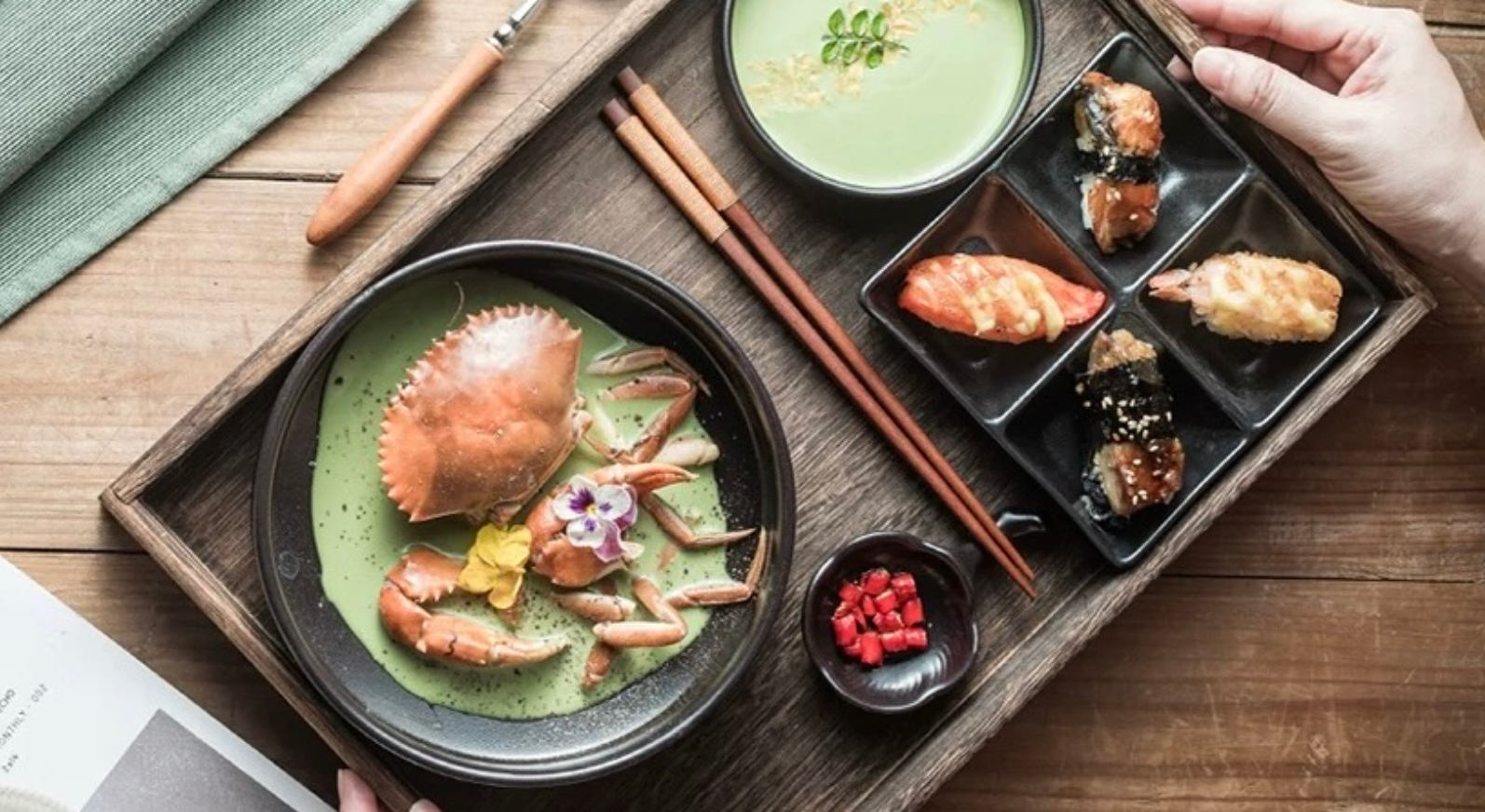
A lacquer tray acts as a "stage" that frames the entire meal, elevating the presentation and creating an intentional dining space. Furthermore, the inclusion of dedicated condiment holders—for chili oil, sesame seeds, or garlic—facilitates the Japanese tradition of ajihen, which means "changing the flavor midway through". This allows the diner to explore the shifting depths of the broth as they eat, making the meal a dynamic experience.
Aesthetics and Symbolism: The Soul of Japanese Tableware
The visual language of Japanese ceramics is rich with meaning, often rooted in centuries of cultural history and Buddhist philosophy. When one selects an Oriental Artisan ramen bowl set, they are choosing more than a pattern; they are choosing an auspicious message.
Traditional Auspicious Patterns
| Pattern Name | Visual Motif | Symbolic Meaning |
| Seigaiha | Concentric arches representing ocean waves. | Unbroken peace, tranquility, and a wish for a peaceful life to continue forever. |
| Karakusa | Gracefully winding vines and arabesque scrolls. | Vitality, longevity, prosperity, and family continuity. |
| Shippo | Interlocking circles representing "Seven Treasures". | Harmony, abundance, wealth, and blessings across generations. |
| Asanoha | Hexagonal pattern inspired by hemp leaves. | Health and strong, straight growth (traditionally used for children). |
| Ichimatsu | Alternating checkered squares. | Continuous success, prosperity, and business milestones. |
| Raimon | Square-swirl jagged motifs symbolizing lightning. | Power, protection, and an appreciation for the forces of nature. |
Artistic Icons and Motifs
Beyond geometric patterns, ramen bowls frequently feature powerful cultural icons. The Dragon is a symbol of strength and success, historically associated with emperors and the ability to bring rain for crops. The Phoenix represents peace, good fortune, and is a staple in celebratory designs. The Brush Stroke design, often found on the rim, symbolizes nirvana, truth, and the spontaneity of Zen philosophy. For those seeking a deeper connection to Japan, bowls featuring Mount Fuji are highly prized, representing the heart of the Japanese landscape.
Regional Mastery: The Pillars of Japanese Ceramic Excellence
The diversity of Japanese pottery is defined by regional traditions, where specific clays and firing methods have been passed down for generations. Oriental Artisan sources its collections from these historic kilns to ensure authenticity.
Mino Ware (Mino-yaki): The Center of Versatility
Produced in Gifu Prefecture, Mino ware is the most prolific style of Japanese ceramics, accounting for over 60% of the market. It is celebrated for its artistic diversity, encompassing fifteen different styles designated as traditional Japanese crafts.
-
Oribe Ware: Easily recognizable by its bold green glazes and asymmetrical forms, Oribe ware challenges traditional aesthetics with its avant-garde designs.
-
Shino Ware: Known for its thick, milky-white glaze and tiny "pinholes" (yuzuhada), Shino was the first Japanese pottery to feature hand-painted iron-oxide designs.
-
Setoguro: This style features a deep black glaze achieved by removing the pots from the kiln while they are red-hot, a technique known as hikidashi guro.
Arita Ware (Arita-yaki): The Elegance of Porcelain
Arita ware, or Imari, is synonymous with fine Japanese porcelain. Originating in the 17th century and inspired by Chinese techniques, Arita ware is characterized by its bright white clay body and detailed enamel patterns in deep reds and blues. These bowls are favored for "high-end" presentations, lending an air of sophistication to lighter broths.
Kutani Ware (Kutani-yaki): The Boldness of Color
Kutani ware is renowned for its vibrant "five colors" and intricate designs that often tell a visual story. Authentic Kutani pieces are marked by hand-painted signatures near the footring, using the characters '九谷'. The evolution of Kutani from its 17th-century roots has kept it at the forefront of ceramic innovation, blending traditional motifs with modern artistic expression.
Care and Longevity: Preserving the Soul of the Table
A handmade ceramic ramen bowl set is a "forever" piece for the kitchen, but its longevity depends on proper maintenance and an understanding of the material’s needs.
Seasoning and Initial Care
Before using a new clay or stoneware bowl for the first time, it is often beneficial to "season" it. This process involves soaking the pottery in water (or rice water) for several hours to allow the clay to absorb moisture, which makes it less likely to crack during use and helps prevent the absorption of soup odors.
Daily Maintenance Practices
-
Handwashing: While many modern Japanese ceramics are dishwasher-safe, handwashing with a soft sponge and mild soap is always the safest method to preserve delicate glazes and prevent chipping. Harsh detergents and abrasive scrubbers can erode the natural patina over time.
-
Avoiding Thermal Shock: Rapid temperature changes are the primary cause of ceramic breakage. One should never rinse a hot bowl with cold water or move a chilled bowl directly into a hot microwave. Pre-heating the bowl with warm tap water before adding hot ramen is a professional practice that protects the vessel and keeps the soup hot.
-
Stain Management: For tough food or tea stains, a gentle paste of baking soda and water applied with a soft cloth can remove residue without damaging the glaze.
Thoughtful Storage
When stacking ramen bowls, it is recommended to place soft cloths or felt separators between each piece to prevent scratches. Large serving pieces should be handled with both hands, and care should be taken to avoid hitting the vulnerable edges of the rim.
Buying Guide: Choosing the Perfect Set for Every Occasion
Selecting a ramen bowl set is a balance of functional necessity and personal aesthetic. Whether purchasing for your own table or as a gift, several key factors should be considered.
For Personal Use: Matching the Vessel to the Cuisine
The color and style of the bowl can dramatically enhance the visual appeal of specific ramen types.
-
Shio and Shoyu Ramen: For transparent, lighter broths, white or off-white bowls emphasize the clarity and freshness of the soup. Flared-rim (sori gata) shapes are ideal here, as they accentuate the delicate aromas.
-
Tonkotsu and Miso Ramen: Rich, cloudy, and creamy soups look best against dark, deep-colored bowls (black, red, or dark brown). Deeper, thicker-walled bowls are recommended to retain the heat required for these heavier broths.
-
Tantanmen and Tsukemen: These dishes often require deeper bowls to accommodate rich, aromatic sesame broths or separate vessels for dipping.
For Gifting: The Benchmark of Quality
A curated ramen gift set from Oriental Artisan is a thoughtful gesture for culinary enthusiasts, new homeowners, or lovers of Asian aesthetics. When selecting a gift, look for:
-
Completeness: A high-quality set should include the bowl, matching renge, non-slip chopsticks, and a rest.
-
Artisanal Signatures: Check for kiln marks or artist signatures near the footring, which verify the piece’s handmade origin and add to its prestige.
-
Packaging: Modern luxury trends favor sustainable yet elegant packaging, such as maple wood gift boxes with dovetail joinery or eco-friendly recycled materials.
-
Personalization: Custom-engraved chopsticks or personalized names on the bowl can turn a functional set into a cherished keepsake.
The Future of Tableware: Trends for 2026 and Beyond
As we look toward 2026, the world of "Home & Kitchen" is moving toward a philosophy of "Conscious Glamour" and "Dopamine Dining". Consumers are increasingly seeking pieces that tell a story and align with their environmental values.
Soft Minimalism and Organic Silhouettes
The classic, perfectly round bowl is being complemented by organic and freeform silhouettes inspired by movement in nature—ocean waves, river stones, and water ripples. "Soft Minimalism" is the dominant aesthetic, defined by rounded silhouettes, warm ivory tones, and matte finishes that feel inviting and cozy for daily use.
Advanced Materials and Sensory Depth
Visual depth is being achieved through innovative glazing techniques like ombré gradients and reactive finishes, ensuring that no two pieces are exactly alike. Furthermore, the interplay between a matte exterior and a high-gloss interior—creating a "liquid" look—provides a high-end, multi-dimensional experience that makes food colors "pop" without glare.
The Sustainability Mandate
Sustainability is no longer optional in 2026. Discerning buyers are looking for lead-free and cadmium-free glazes, efficient kiln firing processes, and reduced waste in production. Oriental Artisan meets this demand by prioritizing artisans who utilize sustainable clays and traditional methods that emphasize longevity over disposability.
Conclusion: Investing in Functional Art
A handcrafted ramen bowl set is more than a utility; it is a commitment to the ritual of dining. At Oriental Artisan, we believe that the "soul of the slurp" resides in the harmony between the chef’s creation and the potter’s vessel. By choosing an authentic, high-quality set, you are not just purchasing tableware—you are bringing a piece of Japanese heritage into your home.
Whether you are a home cook perfecting your tonkotsu or a minimalist who appreciates the beauty of a single, well-made object, the right ramen bowl set changes everything. We invite you to explore the Oriental Artisan collection, where every piece is a testament to the artisan’s hand and a gateway to a more thoughtful, beautiful table experience. Transform your next ramen night into an authentic cultural moment with the perfect vessel—because every slurp deserves a soul.

Written by Castor Kwok


Leave a comment
This site is protected by hCaptcha and the hCaptcha Privacy Policy and Terms of Service apply.