
The Ultimate Guide to the Five Famous Kilns of the Song Dynasty: A Masterclass in Chinese Porcelain History
The cultural landscape of the Song Dynasty (960–1279) represents a transformative epoch in human history, characterized by a shift from the robust, multi-colored vibrancy of the Tang Dynasty toward a restrained, intellectual, and deeply philosophical aesthetic. This period, often termed the "Golden Age" of Chinese craftsmanship, saw the elevation of ceramics from functional household items to high-art forms that mirrored the virtues of the literati class. Within this sophisticated milieu, the Five Famous Kilns—Ru, Guan, Ge, Jun, and Ding—emerged as the pinnacle of achievement, establishing a legacy that remains the definitive standard for Authentic Oriental Porcelain. These kilns did not merely produce pottery; they refined the chemical and artistic possibilities of earth and fire, creating monochrome glazes and elegant forms that captured the ephemeral beauty of nature, from the clarity of a clearing sky to the depth of polished jade.
To study Song Dynasty Ceramics is to explore the intersection of Neo-Confucian discipline, Zen Buddhist tranquility, and an advanced understanding of high-temperature mineralogy. The five legendary lineages were so highly regarded by subsequent generations that Ming and Qing dynasty writers codified them as a singular group of "Great Kilns," ensuring their survival in the collective consciousness of collectors and historians. Today, these pieces are among the rarest and most sought-after treasures in the global art market, with single specimens often fetching tens of millions of dollars at auction. This guide provides an exhaustive analysis of each kiln’s historical context, technical mastery, and the diagnostic features that define their unique identity.
| Kiln Lineage | Geographic Origin | Ceramic Category | Key Innovation | Imperial Status |
| Ru Kiln | Ruzhou, Henan | Celadon | Agate-fluxed glaze | Exclusive Imperial |
| Guan Kiln | Kaifeng / Hangzhou | Celadon | Multi-layered glazing | State-Operated |
| Ge Kiln | Longquan (probable) | Celadon / Stoneware | Double-crackle patterns | Scholarly / Elite |
| Jun Kiln | Yuzhou, Henan | Opalescent Stoneware | Copper transmutation | Imperial & Civilian |
| Ding Kiln | Quyang, Hebei | White Porcelain | Upside-down firing | Imperial Tribute |
Ru Kiln: The Celestial Mirage of the Northern Song
The Ru kiln occupies the highest echelon of Chinese Porcelain History, a status derived from its extreme rarity and the sublime, "jade-like" quality of its glaze. Operating for a remarkably brief window of approximately twenty to forty years during the late Northern Song Dynasty—primarily under the aesthetic direction of Emperor Huizong—the Ru kilns produced wares exclusively for the imperial palace. Any pieces that failed to meet the emperor's exacting standards were reportedly ordered to be smashed, ensuring that only perfection was associated with the imperial house. The fall of the Northern Song to the Jin army in 1127 resulted in the destruction of the kiln sites and the loss of its proprietary glaze recipes, leaving behind a legacy of fewer than 100 known intact pieces worldwide.
Characteristics
The most celebrated feature of Ru ware is its "sky-blue after rain" (tianqing) glaze. This hue is described by medieval connoisseurs as the color of the sky appearing in a clearing among the clouds following a storm—a soft, duck-egg blue that can shift into subtle celadon green or moon-white depending on the lighting. This ethereal quality was achieved by the revolutionary inclusion of powdered agate in the glaze mixture, which acted as a flux and imparted a thick, unctuous texture that mimicked the tactile sensation of "mutton fat" jade.
Under magnification, the Ru glaze reveals a unique "sparse stars at dawn" bubble structure, where tiny air bubbles are scattered irregularly through the translucent layers, creating a depth of field that invites prolonged contemplation. The ceramic body is typically made from a light-grey clay, often compared to the color of incense ash, which remains visible only at the very edges where the glaze thins. Ru forms are characterized by their "modesty and simplicity," frequently taking the shape of brush washers, narcissus basins, and tripod censers that draw inspiration from ancient Han Dynasty bronzes.
Identification Tips
For the discerning collector, identifying authentic Ru ware requires a forensic attention to three specific technical markers: the support marks, the crackle pattern, and the foot-rim geometry.
-
Sesame-Seed Spur Marks (Zhimazhi): Because Ru pieces were fully glazed on both the base and the rim to enhance their resemblance to jade, they could not be fired resting on their foot-rings. Instead, they were balanced on three or five tiny ceramic or metal spurs, which left behind small, oval, unglazed dots on the base. These marks are famously described as "sesame seeds" due to their size and shape; larger or more circular marks are often indicative of later imitations.
-
Cicada-Wing Crackle: While the most perfect Ru pieces were originally prized for having no surface flaws, most surviving examples feature a network of incredibly fine, natural fissures known as "cicada-wing" or "crab-claw" crackle. These cracks occur because the glaze contracts at a different rate than the clay body during the cooling process, creating a shimmering, ice-like texture that is an integrated part of the object's beauty.
-
The Splayed Foot: Most Ru vessels feature a "clearly defined, slightly splayed foot-rim," a subtle design choice that provides a sense of architectural stability to otherwise delicate and thin-walled forms.
| Diagnostic Feature | Description in Authentic Ru Ware | Sign of Modern Reproduction |
| Glaze Texture | Thick, oily, "jade-like" semi-opacity | Thin, glassy, overly reflective |
| Bubble Pattern | "Sparse stars" (scattered, irregular) | Uniform, dense, machine-like |
| Spur Marks | Three or five tiny, oval "sesame seeds" | Large, round, or absent |
| Crackle | Fine "cicada-wing" (natural) | Broad, dyed, or mechanically induced |
| Clay Body | "Incense-ash" light grey | Pure white or dark brown |
Guan Kiln: The Official Standard of State and Spirit
The Guan kiln—literally translating to "Official"—was established specifically to serve the ritual and daily needs of the Song imperial court. Historically, the Guan lineage is divided into the Northern Song Guan (based in Kaifeng) and the Southern Song Guan (established in Hangzhou after 1127). The Southern Song Guan kiln, particularly those sites at Xiuneisi and Jiaotanxia, represents a masterclass in controlled high-fire chemistry, utilizing the iron-rich clays of Phoenix Mountain to produce a ceramic style that emphasized structural dignity over ornate decoration. Guan ware production was so prestigious that it continued well into the Ming and Qing dynasties as a standard for "Imperial Excellence."
Characteristics
The hallmark of Guan ware is its thick, multi-layered glaze, which was often applied in four or five successive coats, with each layer fired independently to achieve a deep, translucent quality. This technique created a glaze layer that was occasionally thicker than the ceramic body itself, resulting in a "moist and lustrous" finish that ranges in color from pale green and duck-egg blue to "moon-white" and lavender-grey.
The most iconic aesthetic feature of the Southern Song Guan kiln is the "purple mouth and iron foot" (zikou tiezu). Because the Hangzhou clay had an exceptionally high iron oxide content, the unglazed foot of the vessel would turn a dark, metallic black during the firing process (the "iron foot"). Simultaneously, as the thick glaze flowed downward from the rim of the piece, the thinner layer at the top allowed the dark body to show through, creating a subtle purple or brown tint at the rim (the "purple mouth").
Identification Tips
Identification of Guan ware focuses on the interplay between the "single crackle" and the vessel’s silhouette. Unlike the fine crackle of Ru ware, Guan crackle is typically bolder and more prominent, often appearing as "wide-spaced cracks" that reveal the dark body beneath.
-
Lobed and Foliated Forms: Guan vessels frequently feature lobed rims that resemble flower petals (mallows or lotus), a design inspired by contemporary gold and silver wares. These "wave-like" rims are a hallmark of Southern Song craftsmanship.
-
Translucence and Opacity: Hold a Guan piece to the light; the multi-layered glaze should exhibit a "semi-transparent" quality, where the light seems to be trapped within the glaze layers rather than passing straight through.
-
The "Ice-Crackle" Texture: On many pieces, particularly brush washers, the crackle pattern is so dense and overlapping that it resembles "fractured ice," a feature that collectors prize for its ability to reveal the texture of the glaze's stratigraphy.
Ge Kiln: The Paradox of the "Older Brother" and the Crackle of Ages
The Ge kiln is arguably the most mysterious of the Five Famous Kilns, as its exact location remains a subject of intense scholarly debate. Tradition holds that it was founded by Zhang Shengichi, the elder of two brothers who were master potters in Longquan during the Southern Song. While the younger brother produced traditional, smooth celadon, the elder brother (Ge) developed a unique style defined by its complex, deliberate crackle. Modern archaeological research has found Ge-type wares primarily in Yuan Dynasty tombs, leading some experts to categorize it as a Yuan refinement of the Song Guan aesthetic.
Characteristics
The defining characteristic of Ge ware is the "double crackle" effect, poetically known as "gold thread and iron wire" (jinsi tiexian). This involves two distinct, overlapping networks of cracks: the "iron wire" consists of larger, darker, and wider fissures, while the "gold thread" refers to a secondary network of finer, golden-brown lines that weave within the larger sections.
The glaze of Ge ware is notably different from the green-dominant celadons of Ru and Guan; it tends toward a "cream or ivory" tone, often with hints of grey, brown, or soft greenish-yellow. The texture is described as having a "slight perspiration" or a "layer of oil" on the surface, providing a tactile sensation that is both glossy and warm. Like its Guan counterpart, Ge ware also features the "purple mouth and iron foot" due to the dark, iron-rich stoneware body.
Identification Tips
Distinguishing Ge from Guan is one of the ultimate challenges for a collector of Authentic Oriental Porcelain.
-
Crackle Color and Intensity: In Ge ware, the crackle is the primary decorative element. The "iron wire" cracks are deliberately stained with dark pigments, and the "gold thread" cracks are stained with a yellowish or brown pigment during the cooling process to make the patterns stand out.
-
Opaque Glaze: The Ge glaze is typically more opaque than Guan glaze, possessing an "ivory-toned" quality that lacks the turquoise transparency seen in Ru or Guan pieces.
-
Unique Vessel Shapes: While sharing some forms with Guan, Ge ware is particularly noted for "fish-handled vases" and "tripod bowls," shapes that highlight the contrast between the dark crackle and the pale glaze.
| Feature | Guan Ware Diagnostic | Ge Ware Diagnostic |
| Crackle Structure | Single-layer, bold cracks | Double-layer "gold thread & iron wire" |
| Primary Glaze Color | Pale green to lavender-blue | Creamy ivory to pale grey-yellow |
| Opacity | Semi-transparent / Translucent | Opaque / Oily semi-matte |
| Rim Appearance | "Purple mouth" (subtle) | Darker, more pronounced rim tint |
Jun Kiln: The Alchemical Splendor of the "Chameleon" Ceramic
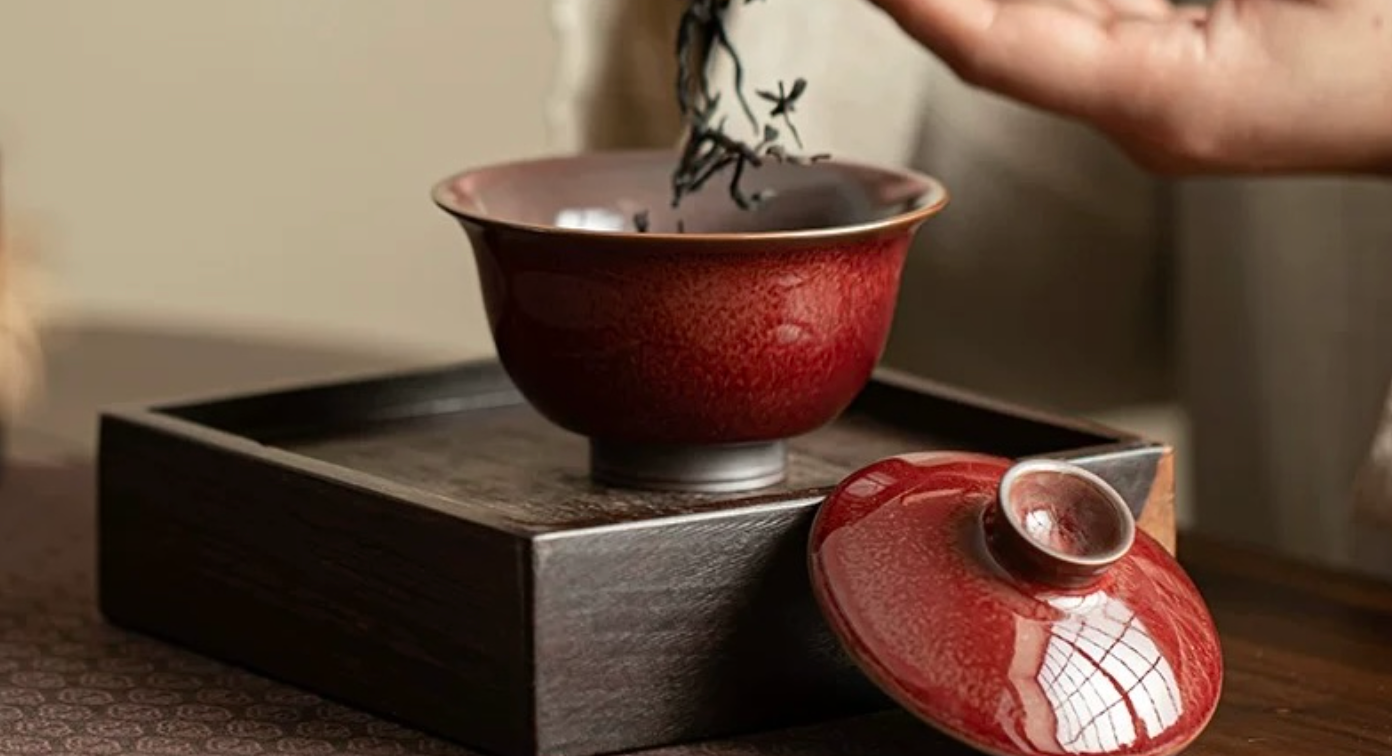
While the other four kilns pursued the subtle, monochromatic tones of jade and silver, the Jun kiln embraced a flamboyant and unpredictable palette. Located in the Bagua Cave of Yuzhou, Henan, Jun ware is technically a high-fired stoneware rather than true porcelain, distinguished by its thick, opalescent blue glazes and vibrant "transmutation" colors. The phrase "one color before firing, ten thousand colors out of the furnace" encapsulates the alchemical magic of the Jun kiln, where the kiln master ceded half of the artistic control to the fire itself.
Characteristics
The opalescent blue of Jun ware is not the result of a blue pigment but a phenomenon of physics known as "liquid-liquid phase separation." During the firing process, the silica-rich glaze separates into minute droplets that scatter blue light, creating an "optical blue" effect similar to the appearance of the sky. This creates a "milky blue" or "lavender" base that is often suffused with microscopic bubbles, giving the surface a glowing, three-dimensional depth.
In the mid-Northern Song, Jun potters mastered the addition of copper oxide to create "splashes" of rose-red, deep purple, and crimson. These splashes were often "planned yet random," appearing like "cosmic nebulae" or "mountains in the mist." Another key diagnostic is the "earthworm crawling pattern" (qiuyin zouwen)—irregular, wandering lines in the thick glaze caused by the glaze flowing to fill drying cracks during the high-temperature melting phase.
Identification Tips
Identifying Song-era Jun ware requires an examination of the glaze's fluidity and the finish of the base.
-
Glaze Pooling: Jun glaze is exceptionally thick and viscous. On bowls and vases, it tends to thin at the rim (often appearing as a "mushroom" or "olive-brown" color) and pool heavily at the bottom, frequently ending in a thick, rounded "line" or "bead" just above the foot.
-
Numerical Stamping: Many "Official Jun" pieces, particularly flowerpots and narcissus bowls, have a Chinese numeral (1 to 10) incised or stamped into the base under the glaze. These numbers correspond to the vessel's size and are a hallmark of imperial commissions.
-
The "Ru-Jun" Finish: Some early Jun pieces exhibit a thinner, more refined "sky-blue" glaze that is very similar to Ru ware; these are often categorized by experts as "Ru-Jun" and represent the highest level of Northern Song Jun craftsmanship.
Ding Kiln: The Ivory Radiance and the Innovation of Northern White
The Ding kiln, situated in Quyang County, Hebei, was the preeminent producer of white porcelain during the Northern Song. While the other "Great Kilns" were essentially celadon-based, Ding ware focused on a creamy, "ivory-white" aesthetic that sought to replicate the purity of white jade. Ding ware was the first of the five to be utilized by the imperial court as "tribute porcelain," and its influence was so vast that it was imitated by kilns across China, leading to the development of the "Ding style" in Southern kilns like Jingdezhen.
Characteristics
The most striking feature of Ding ware is its "mutton-fat" glaze—a warm, creamy white that feels exceptionally smooth and glossy to the touch. This color was a result of the kiln being fired with coal rather than wood, which created an oxidizing atmosphere that gave the glaze its signature yellowish-ivory tint. Ding porcelain is also noted for its exquisite "carved" (kehua) or "impressed" (yinhua) decorations, featuring fluid floral motifs (peonies, lotuses, lilies), phoenixes, and dragons that appear to float beneath the transparent glaze.
Ding artisans were pioneers in firing technology, developing the "upside-down firing" method (mangkou) to maximize kiln efficiency and prevent the thin-walled porcelain from warping under high heat. This technique resulted in an unglazed rim, which was then elegantly bound with a band of gold, silver, or copper to hide the rough clay and add a touch of luxury.
Identification Tips
Authentication of Ding ware relies on three "fingerprints" left by the Song Dynasty artisans: tear marks, brush patterns, and the "feel" of the foot-rim.
-
Tear Marks (Leihan): These are streaks of thickened glaze that look like "teardrops" flowing down the exterior wall of the piece. In Northern Song Ding ware, these tears typically flow from bottom to top due to the upside-down firing method—a detail that modern fakers often fail to replicate correctly.
-
Bamboo Filament Brush Pattern: On the exterior walls of bowls and plates, one can often see fine, closely woven scratches created by a brush or tool during the shaping of the body on the potter's wheel. These marks are exceptionally dense and fine in authentic Ding pieces.
-
Fingernail Impressions: Look closely at the foot-rim. Artisans who hand-dipped the vessels into the glaze often left subtle traces of fingernail impressions around the base, a human touch that is a strong indicator of hand-crafted authenticity.
| Firing Era | Glaze Color & Tone | Decorative Technique | Firing Position |
| Tang Dynasty | Thin, pure white | Simple, unadorned | Right-side-up |
| Early N. Song | Thick, yellowish tint | Incised/Carved | Right-side-up |
| Middle N. Song | Ivory-white, "mutton fat" | Impressed (Yinhua) | Upside-down (Mangkou) |
| Jin / Yuan | Coarser ivory | Heavy molded designs | Variable |
How to Distinguish Modern Reproductions from Antiques
As the value of Song Dynasty Ceramics has soared, the market has been flooded with high-quality reproductions, some of which are created using traditional techniques in the original kiln regions. To build trust and protect an investment in Authentic Oriental Porcelain, a collector must combine traditional "connoisseurship" with modern scientific verification.
Surface Patina vs. Artificial Aging
The most fundamental sign of a genuine antique is its "patina"—the organic surface wear that develops over 1,000 years of handling and exposure.
-
Organic Wear: Authentic patina is uneven and logical; it appears in areas of high use, such as the rim or the base, and features infinitely small scratches going in all directions.
-
Artificial Aging: Be wary of pieces with uniform surface dullness or "perfectly aged" appearances. Fakers often use "sanding paper" to create scratches, but these are typically parallel and unnatural. Some use "acid baths" to strip the glaze's shine, which leaves the surface feeling "dry" or "sticky" rather than the soft, jade-like luster of genuine de-vitrified glaze.
Microscopic Bubble Analysis
The "de-vitrification" of ancient glaze is a process that modern technology cannot perfectly replicate. Under a 20x or 40x jeweler’s loupe:
-
Ancient Bubbles: Bubbles in Song porcelain are "irregular in size and erratic in spacing." Over centuries, some bubbles will have "burst" or collapsed, leaving tiny cavities or micro-cracks that are serially connected—a phenomenon caused by the slow re-crystallization of the mineral glaze.
-
Modern Bubbles: Modern gas and electric kilns have much more precise temperature controls, resulting in bubbles that are uniform, dense, and "too perfect."
Scientific Authentication Methods
For high-value pieces, visual inspection should be supplemented by laboratory testing:
-
Thermoluminescence (TL) Testing: This measures the radiation energy absorbed by the clay since its last firing. It is the most reliable method for determining "absolute age." A genuine Song piece will have accumulated a specific level of natural radiation that a modern reproduction, even one made from ancient clay, cannot possess unless it has been artificially irradiated.
-
X-Ray Fluorescence (XRF) Spectroscopy: This non-invasive method analyzes the chemical composition of the glaze and body. It can identify the presence of modern chemical additives or confirm the authentic mineral profiles of specific kilns, such as the agate powder in Ru glaze or the high-iron content in Guan clay.
-
Fluorescent Imaging: New technologies using blue and green LED excitation light can reveal "microstructural crackle networks" that distinguish between Northern and Southern Song periods by analyzing how light is emitted from different mineral distributions in the glaze.
| Identification Method | What to Look For | Significance |
| Hand-Feel | Balance, weight, "warmth" | Authentic pieces feel "alive" and ergonomic |
| Base Analysis | Kiln marks, firing faults, irregular foot | Modern fakes are often "too clean" or overly smooth |
| UV Light | Fluorescence of repairs or modern binders | Detects hidden restorations and structural fillers |
| Magnification | De-vitrification, "sparse stars" bubbles | The definitive check for ancient mineral aging |
The Enduring Legacy of the Song Aesthetic
The Five Famous Kilns of the Song Dynasty represent more than just a historical achievement in ceramics; they are the material manifestation of a philosophy that sought the infinite within the finite. The "natural, naive" beauty of these wares continues to resonate in the 21st century, influencing modern minimalist design and eco-conscious aesthetics. To own a piece of this history is to possess a fragment of a civilization that valued tranquility, restraint, and the quiet perfection of the natural world.
For the discerning collector, the journey into Song Dynasty Ceramics is one of both the mind and the senses. It requires an eye for the "ice-crackle" of Guan, a heart for the "sky-blue" of Ru, and a soul that appreciates the "earthworm tracks" of Jun. These are not merely objects; they are vessels of time, fire, and human ingenuity.
Bring a piece of history home. Explore Oriental Artisan’s curated collection of masterfully crafted Song-style ceramics and authentic-period treasures.
%20represents%20a%20transformative%20epoch%20in%20human%20history,%20characterized%20by%20a%20shift%20from%20the%20robust,%20multi-colored%20vibrancy%20of%20the%20Tang%20Dynasty%20toward...)
1 comment
Excellant, informative article. The subject is very complex and full of man traps. Identification is now a ‘possible’ rather than a ’maybe’’ Thank You
’
Anthony Reddin
Leave a comment
This site is protected by hCaptcha and the hCaptcha Privacy Policy and Terms of Service apply.