


The Best Gaiwan for Beginners: Size, Material and Shape Made Simple
A gaiwan may be one of the simplest tea vessels ever created: a bowl, a lid, and—traditionally—a saucer. Yet choosing your first one can feel surprisingly complicated.
Should it hold 80 ml or 150 ml? Is thin porcelain better than thick porcelain? Does Yixing clay improve the taste of tea? Why do some gaiwans pour beautifully while others seem determined to burn your fingers?
For most beginners, the answer is refreshingly straightforward:
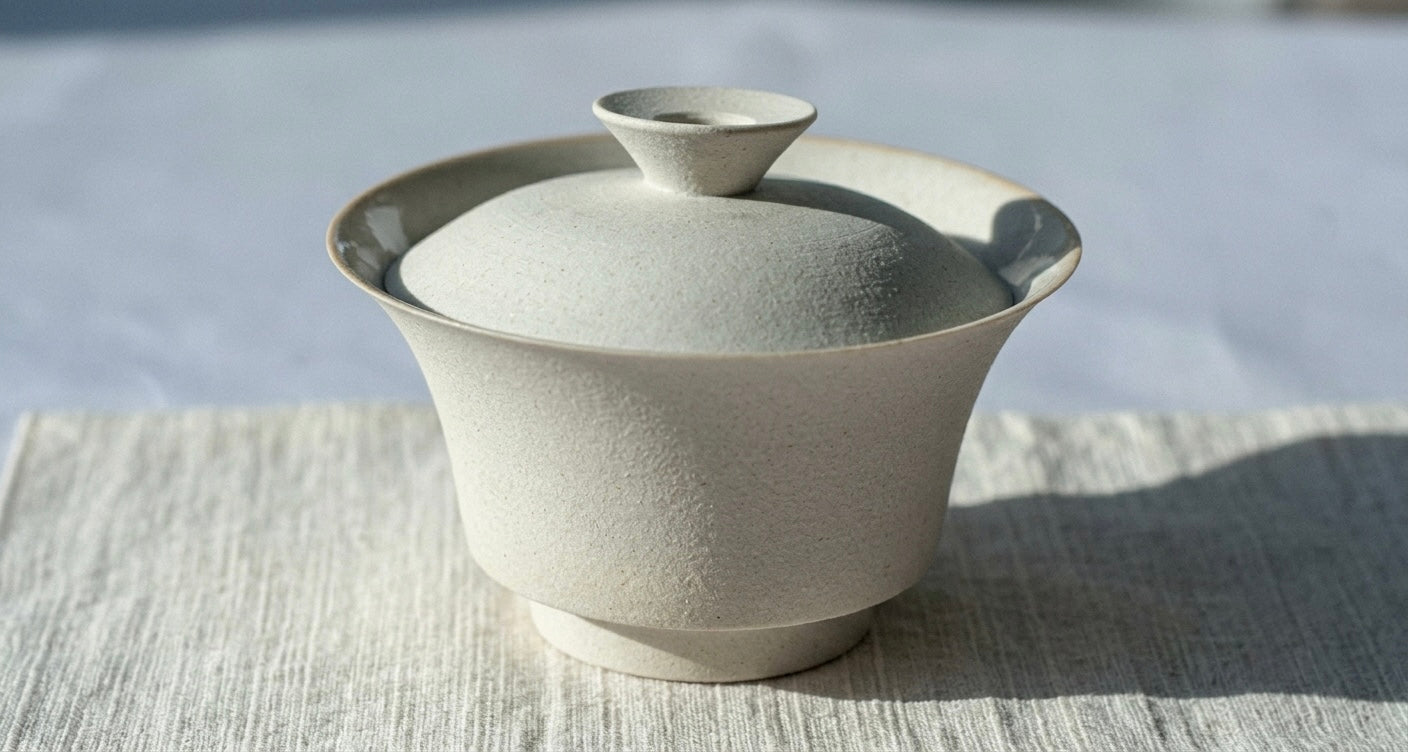
The best gaiwan for beginners is a glazed porcelain gaiwan with a nominal capacity of approximately 100–120 ml, gently curved walls, a moderately flared rim, and a lid that sits level and moves smoothly.
This combination offers the best balance of brewing control, comfort, neutrality, versatility, and ease of cleaning. It is small enough for traditional Gongfu tea brewing, yet large enough to feel manageable while you learn.
This gaiwan buying guide explains exactly how size, material, shape, thickness, lid fit, and craftsmanship affect the brewing experience—so that your first gaiwan becomes a vessel you continue using long after you are no longer a beginner.
What Is a Gaiwan?
A gaiwan, written 盖碗 in simplified Chinese and 蓋碗 in traditional Chinese, literally means “lidded bowl.”
It is a traditional Chinese tea brewing vessel composed of:
- A bowl that holds the tea leaves and water
- A lid that controls heat, aroma, and the flow of leaves
- A saucer that traditionally supports the hot bowl
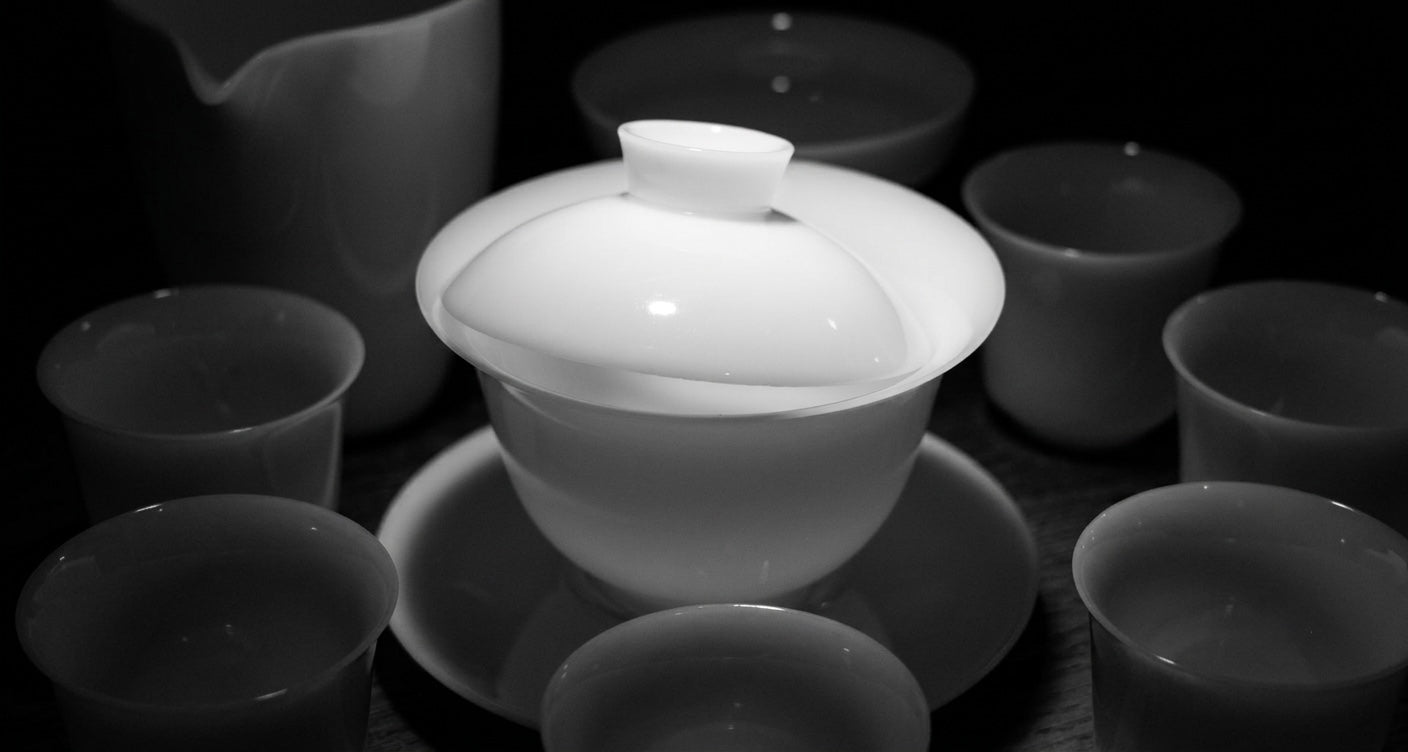
Modern Gongfu tea drinkers often brew and pour using only the bowl and lid, although the saucer remains useful for presentation, stability, and traditional drinking styles.
A Brief History of the Gaiwan
The gaiwan did not appear fully formed at a single documented moment. Its development was connected to a broader transformation in Chinese tea culture.
Earlier tea traditions frequently involved compressed or powdered tea. During the Ming dynasty, steeping loose leaves in hot water became increasingly important, creating demand for vessels suited to direct infusion. The Victoria and Albert Museum notes that the steeping method familiar today became established in China during the 14th century, encouraging the development of purpose-made brewing vessels.
The gaiwan also inherited features from earlier Chinese objects. Lidded bowls were used from at least the Tang period, while elevated tea-bowl stands appeared during the Song dynasty. The familiar combination of lid, bowl, and raised saucer later became especially prominent during the Qing dynasty, when loose-leaf tea drinking was widespread at court, in scholarly circles, in teahouses, and eventually throughout society.
Historical examples preserved in museum collections demonstrate that covered porcelain bowls were made in Jingdezhen during the Qing dynasty, often decorated in underglaze cobalt blue.
The gaiwan is therefore both practical and culturally significant: it reflects centuries of evolution in tea preparation, ceramic craftsmanship, hospitality, and Chinese aesthetics.
The Best Beginner Gaiwan at a Glance
For a first purchase, look for the following features:
| Feature | Best beginner choice | Why it helps |
|---|---|---|
| Capacity | 100–120 ml | Easy to control without feeling miniature |
| Material | Fully glazed porcelain | Neutral, versatile, and easy to clean |
| Bowl shape | Gently curved and moderately wide | Supports leaf expansion and a smooth pour |
| Rim | Noticeably flared | Keeps fingers farther from hot walls |
| Wall thickness | Medium to moderately thin | Balances heat response with durability |
| Lid | Level, smooth-moving, comfortable knob | Makes pouring easier and more controlled |
| Foot ring | Stable and evenly finished | Prevents rocking and improves balance |
| Decoration | Underglaze or verified food-safe glaze | Suitable for regular use |
| Overall weight | Light but not fragile-feeling | Easier to handle while learning |
Oriental Artisan’s Practical Recommendation
Choose a 110 ml glazed Jingdezhen porcelain gaiwan with a curved bowl and flared rim.
It is large enough for comfortable handling, small enough for Gongfu tea, neutral enough for nearly every tea category, and refined enough to remain rewarding as your experience grows.
What Is the Best Gaiwan Size for Beginners?
Why 100–120 ml Is Usually Ideal
A gaiwan between approximately 100 and 120 ml gives beginners the most forgiving balance of control and usability.
It allows you to:
- Use a reasonable quantity of tea leaves
- Produce several small tasting cups
- Control short infusion times
- Pour before the tea overextracts
- Hold the vessel without stretching your fingers excessively
- Experiment without using large amounts of premium tea
- Brew alone or share with one or two guests
A smaller vessel also makes it easier to understand how a tea changes over successive infusions. Rather than preparing one large pot, Gongfu brewing uses a relatively high leaf-to-water ratio and a series of shorter steeps.
Nominal Capacity vs. Working Capacity
One detail frequently overlooked in a gaiwan size guide is the difference between stated capacity and practical brewing capacity.
A gaiwan described as 120 ml may hold 120 ml only when filled nearly to the rim. In actual use, tea leaves take up space, and the water should remain below the rim.
Its practical brewing capacity may therefore be closer to 100–110 ml.
When comparing products, check whether the stated measurement refers to:
- Brimful capacity
- Capacity with the lid fitted
- Recommended working capacity
- Bowl capacity without tea leaves
This distinction is especially important when buying online.
Gaiwan Size Comparison
| Nominal size | Best use | Advantages | Drawbacks | Beginner verdict |
| 80 ml | Solo tasting and expensive tea | Uses fewer leaves; fast and precise | Small opening; little margin for error; can feel delicate | Better after some practice |
| 100 ml | Solo Gongfu brewing | Excellent control; economical; responsive | May feel small to people with large hands | One of the best choices |
| 110–120 ml | Solo brewing or sharing | Comfortable, versatile, forgiving | Requires slightly more tea than an 80 ml vessel | Best all-round beginner range |
| 150 ml | Two or three drinkers | More tea per infusion; useful for larger groups | Harder to grip; slower to empty; uses more leaves | Acceptable, but often larger than necessary |
| 180 ml or more | Group serving or relaxed brewing | Higher serving volume | Difficult one-handed control; expensive in tea; slower pouring | Not recommended as a first Gongfu gaiwan |
Is an 80 ml Gaiwan Too Small?
An 80 ml gaiwan is not inherently difficult, but it can feel cramped.
Its advantages include:
- Lower tea consumption
- Fast heat response
- Quick pouring
- Excellent control for rare or expensive leaves
- Convenient solo sessions
However, the smaller lid knob, narrower rim, and reduced finger space can make an 80 ml gaiwan less comfortable for someone still learning the grip.
It is often a wonderful second gaiwan rather than the ideal first one.
Is a 150 ml Gaiwan Too Large?
For traditional solo Gongfu brewing, 150 ml is usually larger than necessary.
A larger gaiwan creates several challenges:
- It requires more tea.
Maintaining a Gongfu-style leaf-to-water ratio in a 150 ml vessel can use substantially more leaves per session. - It is harder to grip.
The wider span may force beginners to stretch their fingers closer to the hot bowl. - It takes longer to empty.
Slower decanting can cause the final portion of the infusion to become stronger than the first. - It becomes heavier when full.
The additional water places more strain on the wrist and fingers.
A 150 ml gaiwan can still be useful when serving several people, brewing large-leaf white tea, or using a lower leaf-to-water ratio. It is simply not the most forgiving beginner size.
Solo Brewing vs. Serving Guests
For one person, choose:
- 90–110 ml for focused tasting
- 110–120 ml for a more relaxed session
For two people, choose:
- 110–130 ml with small tasting cups
For three or more people, consider:
- 130–160 ml
- Multiple gaiwans
- A gaiwan paired with a larger fairness pitcher
Remember that Gongfu cups are intentionally small. A 110 ml gaiwan can often serve two or three tasting cups after allowing for the tea leaves and a small amount of water retained inside the vessel.
How Size Affects Brewing Control
A smaller gaiwan is generally more responsive. Water temperature, infusion time, and pouring speed become immediately noticeable.
A larger gaiwan is more forgiving when using fewer leaves and longer infusions, but less precise when performing very short steeps.
Beginner Starting Ratio
A practical starting point is approximately:
- 5 grams of tea per 100 ml of water for a gentle introduction
- 6–8 grams per 100 ml for more concentrated Gongfu brewing
This is not a universal rule. Rolled oolong, compressed pu’er, delicate green tea, and expansive white tea occupy very different amounts of space.
Begin with moderate quantities and adjust according to the tea, your palate, and the producer’s brewing guidance.
Which Gaiwan Material Is Best?
The material of a tea brewing vessel can influence its heat response, tactile experience, appearance, cleaning requirements, and—particularly with unglazed clay—its interaction with the infusion.
The Smithsonian’s National Museum of Asian Art notes that the size, shape, material, and color of teaware have traditionally been selected to enhance the tea.
For beginners, however, versatility should come before specialization.
Fully glazed porcelain is usually the best beginner material because it is neutral, easy to clean, visually clear, and suitable for almost every tea category.
The following comparisons are practical guides rather than fixed laboratory measurements. Heat behavior depends not only on material but also on wall thickness, firing, glaze, shape, and the amount of water inside the vessel.
Gaiwan Material Comparison
| Material | Heat behavior | Flavor influence | Cleaning | Durability | Best for | Beginner level |
| Jingdezhen porcelain | Responsive and balanced | Highly neutral when glazed | Very easy | Good with careful handling | Almost every tea | Excellent |
| Dehua porcelain | Often slightly softer and steadier when more substantial | Neutral when glazed | Very easy | Good | White, green, floral and lightly oxidized teas | Excellent |
| Eggshell porcelain | Responds and cools quickly | Neutral | Easy but delicate | Lower impact resistance | Aromatic teas and refined tasting | Intermediate |
| Glazed stoneware | Usually retains heat longer | Mostly neutral | Easy | Often robust | Oolong, black tea, pu’er | Good |
| Yixing clay | Varies by clay and construction | Can alter or soften the infusion | Requires dedicated care | Good, but lids can chip | Selected oolong, black tea and pu’er | Advanced |
| Glass | Strongly dependent on thickness | Neutral | Very easy | Vulnerable to impact and thermal shock | Green tea, flowering tea, visual learning | Good |
| Wood-fired ceramic | Varies considerably | May be neutral or subtly interactive | Depends on surface | Varies | Experienced, exploratory brewing | Intermediate to advanced |
Jingdezhen Porcelain Gaiwans
For many beginners, a Jingdezhen porcelain gaiwan is the most versatile long-term choice.
Jingdezhen has been associated with porcelain production for more than 1,700 years and is widely known as China’s “Porcelain Capital.” UNESCO describes it as an internationally important ceramic center whose porcelain travelled overland and by sea, facilitating artistic and commercial exchange between East and West.
The UNESCO World Heritage description of the Jingdezhen Handicraft Porcelain Industry Sites highlights the region’s influence from the 10th to the 19th centuries, including innovations in kiln design, production organization, and the combination of kaolin with porcelain stone. UNESCO also notes the global importance of Jingdezhen blue-and-white porcelain.
Why Jingdezhen Porcelain Works Well for Beginners
A well-made glazed Jingdezhen gaiwan generally offers:
- A clean, neutral brewing surface
- Good visual contrast for observing tea liquor
- Precise, refined forms
- A broad range of wall thicknesses
- Smooth pouring when properly shaped
- Easy cleaning between different teas
- Decorative traditions ranging from restrained monochrome glaze to hand-painted blue-and-white porcelain
Jingdezhen is not a single style or quality level. The city produces everything from inexpensive mass-market ware to exceptional studio ceramics.
The name alone is therefore not a guarantee. Look for clear provenance, functional design, responsible glaze practices, balanced construction, and evidence of genuine craftsmanship.
Best For
- Oolong tea
- White tea
- Green tea
- Chinese black tea
- Sheng and shou pu’er
- Scented tea
- Side-by-side tea comparisons
Beginner Verdict
Excellent. A moderately thin, fully glazed Jingdezhen porcelain gaiwan is one of the safest and most rewarding first purchases.
Dehua Blanc de Chine Porcelain
Dehua porcelain is produced in Fujian Province and is renowned for its luminous white or ivory-white appearance.
The term Blanc de Chine, meaning “white from China,” became widely used in Western writing for Dehua porcelain. Historic Dehua wares were admired for their refined white bodies, lustrous glazes, and sculptural qualities.
The V&A traces Dehua ceramic production to at least the 10th century and notes that its white porcelains became especially refined during the Ming period.
Brewing Character
A Dehua gaiwan often feels:
- Pure and visually quiet
- Slightly softer in appearance than blue-white Jingdezhen porcelain
- Well suited to observing tea color
- Elegant in minimalist or contemplative settings
Some Dehua vessels have more substantial walls and lustrous glazes, although individual pieces vary.
Best For
- White tea
- Green tea
- Jasmine tea
- Light oolong
- Floral black tea
- Minimalist tea settings
Beginner Verdict
Excellent, provided the rim, lid, and overall proportions are designed for pouring rather than purely decorative use.
Thin Eggshell Porcelain
Eggshell porcelain is admired for its extraordinary thinness, translucency, and delicacy.
It can make a tea session feel exceptionally refined. The walls respond quickly to temperature, and the lightness allows an experienced brewer to pour with precision.
However, extremely thin porcelain is not always the easiest beginner choice.
Advantages
- Elegant and lightweight
- Fast thermal response
- Refined tactile experience
- Excellent for appreciating aromatic teas
- Often visually translucent under light
Disadvantages
- The walls can become hot quickly
- The rim and lid are easier to chip
- Nervous gripping may cause slips
- Small temperature and timing changes become more noticeable
- Replacement lids may be difficult to obtain
Beginner Verdict
Choose moderately thin porcelain, not the thinnest piece available.
True eggshell porcelain is better approached once you can lift, tilt, and pour a gaiwan without squeezing the bowl or allowing the lid to slide unpredictably.
Glazed Stoneware
Stoneware gaiwans are often thicker, more tactile, and visually rustic.
Because construction varies, some feel warm and substantial, while others are nearly as refined as porcelain. Glazed interiors make them more versatile than fully unglazed vessels.
Advantages
- Often durable
- Comfortable for people who prefer more weight
- Frequently retains heat well
- Complements wabi-sabi and natural tea settings
- Suitable for teas that benefit from sustained warmth
Disadvantages
- Heavier when full
- Thick walls may conceal temperature changes
- Some forms pour more slowly
- Dark interiors make liquor color harder to judge
- Rough exterior textures can be uncomfortable near the rim
Best For
- Roasted oolong
- Chinese black tea
- Aged white tea
- Shou pu’er
- Heavily compressed teas
Beginner Verdict
Good, especially when the inside is fully glazed and the rim is comfortable. For maximum neutrality and versatility, porcelain remains preferable.
Yixing Clay Gaiwans
Yixing is famous for unglazed zisha stoneware, particularly teapots associated with Chinese tea culture and literati traditions. Historic Yixing teapots were already being made for loose-leaf tea by the early 17th century.
Scientific study has found that some zisha bodies possess a distinctive pore structure and greater porosity than porcelain, although properties vary across clay types and firing methods. Research has also found measurable differences between infusions prepared in Yixing clay and other materials, while acknowledging that many traditional claims require careful scientific interpretation.
Why It Is Not Usually the Best First Gaiwan
An unglazed Yixing gaiwan can interact with tea rather than presenting it with complete neutrality.
This creates several complications:
- Different clays behave differently
- Clay authenticity can be difficult to assess
- The vessel may be better dedicated to a limited family of teas
- Soap and strongly scented cleaning products should generally be avoided
- It becomes harder to compare unrelated teas objectively
- The open form of a gaiwan may not showcase Yixing’s heat characteristics as predictably as a well-designed teapot
Best For
- Experienced brewers exploring clay-and-tea pairings
- Roasted oolong
- Aged tea
- Certain black teas
- Pu’er
Beginner Verdict
Not ideal as your only gaiwan. Begin with glazed porcelain, develop your palate, and explore Yixing clay later as a specialized choice.
Glass Gaiwans
A glass gaiwan allows beginners to watch tea leaves open, float, descend, and change color.
This visibility can be educational and beautiful.
Advantages
- Does not retain previous tea aromas
- Easy to clean
- Excellent visual access
- Useful for flowering tea and whole-leaf green tea
- Makes the brewing process easy to understand
Disadvantages
- Transparent walls offer little visual warning of hot surfaces
- The lid knob may become uncomfortable
- Smooth glass can feel slippery
- The rim is not always sufficiently flared
- Glass may crack from impact or severe temperature shock
Beginner Verdict
Good as a second gaiwan or for visual learning. For everyday Gongfu brewing, a well-shaped porcelain gaiwan is usually more comfortable.
Wood-Fired Ceramic Gaiwans
Wood-fired ceramics develop their surfaces through prolonged interaction with flame, ash, atmosphere, and kiln position.
Some are fully glazed. Others have natural ash deposits, exposed clay, flashing, or partially vitrified surfaces.
Advantages
- Each piece is visually individual
- Rich tactile and artistic character
- Strong connection to kiln process
- Beautiful for contemplative and rustic tea settings
Disadvantages
- Heat behavior can vary
- Rough rims or lid galleries may reduce comfort
- Unglazed surfaces may interact with tea
- Irregular shapes can pour unpredictably
- Functional quality must be evaluated piece by piece
Beginner Verdict
Choose one only when it has been designed and tested as functional teaware. It is better as an artistic second or third gaiwan than as a universal first vessel.
Which Gaiwan Shape Is Easiest to Use?
Shape affects far more than appearance. It influences:
- How quickly the tea pours
- How much steam reaches your fingers
- How easily leaves can expand
- Whether the lid remains stable
- How concentrated the aroma feels
- How comfortably the bowl can be held
For most beginners, the best form is:
A moderately wide, gently curved bowl with a clearly flared rim and a medium-sized lid knob.
Wide Bowl vs. Tall Bowl
Wide Bowl
A wider bowl generally provides:
- More room for large leaves to open
- Faster decanting
- Easier access for cleaning
- Greater distance between fingers and the central hot liquid
- More rapid heat release when uncovered
It is particularly useful for twisted oolong, white tea, and large whole leaves.
However, an excessively shallow bowl can lose heat quickly and may allow leaves to approach the pouring gap more easily.
Tall Bowl
A taller gaiwan generally provides:
- A more concentrated aromatic chamber
- Greater depth for rolled or compact leaves
- Slower heat loss in some constructions
- An elegant vertical profile
Its disadvantages can include:
- A slower pour
- More difficult removal of leaves
- Greater chance of tea remaining at the bottom
- A deeper finger reach
- Reduced stability if the foot is narrow
Beginner Recommendation
Choose a shape that is wider than it is tall, but not dramatically shallow.
Straight Walls vs. Curved Walls
Straight Walls
Straight-sided gaiwans often look architectural and modern. They can create a clean stream when the lid and rim align precisely.
However, they may:
- Transfer heat more directly toward the fingers
- Feel less natural in the hand
- Give leaves less room to circulate near the base
- Demand greater pouring precision
Curved Walls
Gently curved walls create a more forgiving hand position and guide leaves toward the center of the bowl.
They often provide:
- Better balance
- More comfortable gripping
- Smooth leaf movement
- A natural pouring angle
- Easier cleaning
Beginner Recommendation
Choose gently curved walls rather than a sharply cylindrical form.
Why a Flared Rim Matters
The rim is one of the most important features in a beginner gaiwan.
A flared rim increases the distance between your fingertips and the hot central wall of the bowl. It also helps guide the tea into a cleaner stream.
A good beginner rim should:
- Extend visibly beyond the body
- Feel smooth under the fingers
- Be wide enough to grip without touching the hot wall
- Align evenly with the lid
- Avoid abrupt, sharp, or rough edges
A decorative gaiwan with almost no flare may be beautiful on a shelf but uncomfortable during repeated brewing.
Expert Tip
Do not judge the flare only from a front-facing photograph. Ask for a side view or top-down image, especially when purchasing online.
Thick Rim vs. Thin Rim
Thick Rim
A thicker rim can feel:
- Stable
- Durable
- Cooler at the fingertips
- Reassuring for beginners
However, an excessively thick rim may create a broad or untidy pouring stream.
Thin Rim
A thin rim can provide:
- A crisp pour
- Refined mouthfeel when drinking directly
- Elegant proportions
- Precise lid positioning
But it can become hot more quickly and may be easier to chip.
Beginner Recommendation
Choose a moderately thin rim with a clear flare. Avoid both a heavy, blunt rim and an extremely delicate knife-like edge.
The Lid Knob Matters Too
The knob or button on top of the lid should be large enough to support the pad of your index finger without forcing it against the hot lid.
Look for:
- A broad, slightly concave or flat top
- Enough height to separate the finger from the lid
- Smooth edges
- Balanced placement
- A size proportionate to the bowl
A tiny pointed knob can make an otherwise beautiful gaiwan frustrating to use.
Why Different Gaiwans Change the Tea Experience
A gaiwan does not need to be unglazed to influence brewing.
Even neutral glazed vessels differ through:
- Wall thickness
- Internal volume
- Lid opening
- Surface area
- Pouring speed
- Heat loss
- Leaf movement
- Aroma concentration
Pouring Speed
A fast pour stops the infusion quickly. This is especially useful for:
- Dancong oolong
- Wuyi rock tea
- Young sheng pu’er
- Strong black tea
- Any tea brewed with a high leaf ratio
A slow-pouring gaiwan may produce a noticeably stronger final cup because the leaves continue steeping during the decant.
The most important measurement is therefore not simply how long you wait before pouring, but the total contact time from the first drop of water entering the gaiwan until the final drop leaves it.
Heat Retention
A thicker, smaller-opening vessel generally preserves heat more effectively than a thin, broad, uncovered one, although material and firing also matter.
Higher heat can help open:
- Rolled oolong
- Roasted tea
- Compressed pu’er
- Mature leaves
Faster cooling can help protect:
- Tender green tea
- Delicate white tea
- Lightly oxidized oolong
- Highly aromatic spring tea
A versatile beginner gaiwan should not exaggerate either extreme.
Aroma Concentration
Tall walls and a close-fitting lid may concentrate aromatic vapor around the lid and upper bowl.
Broad forms allow aromas to disperse more quickly but make the leaves easier to inspect.
Neither is universally superior. The right choice depends on whether you value concentrated lid aroma, fast pouring, leaf visibility, or heat management.
How to Judge Lid Fit and Craftsmanship
Does a Gaiwan Lid Need to Be Airtight?
No.
A gaiwan is not meant to form an airtight seal. Tea must pass through the gap between the lid and bowl.
A good lid should:
- Sit level
- Rotate without catching
- Move smoothly enough to create a controlled opening
- Remain stable when tilted
- Avoid large, irregular gaps
- Match the bowl without appearing visibly warped
A slight sound when porcelain touches porcelain is normal. A lid that rattles does not automatically indicate poor quality.
The real question is whether the lid can be adjusted predictably during pouring.
Test the Pouring Gap
The brewer controls the flow by sliding the lid slightly away from the bowl.
For small-leaf tea, the opening should be narrow enough to hold back most leaves.
For large-leaf tea, a wider opening allows a faster pour.
A good gaiwan permits both positions without the lid slipping uncontrollably.
Check the Weight and Balance
A gaiwan should feel balanced both empty and full.
Avoid pieces that are:
- Excessively top-heavy
- Unusually thick at the base
- Much heavier than their capacity suggests
- Unstable on the saucer
- Difficult to tilt without twisting the wrist
Lightness can reflect refinement, but lightest does not always mean best. A beginner needs enough substance to feel secure.
Examine Wall Thickness
Wall thickness should be reasonably consistent.
Common warning signs include:
- One side visibly thicker than the other
- A heavy base paired with paper-thin walls
- A rim that varies dramatically in thickness
- A lid heavier than the bowl can comfortably support
- Localized bulging or distortion that interferes with pouring
Small variations are normal in handcrafted work and can contribute to the character of the piece. Functional imbalance is different from artistic individuality.
Inspect the Foot Ring
The foot ring is the raised base beneath the bowl.
It should:
- Sit flat without rocking
- Have no sharp, unfinished points
- Be wide enough to support the bowl
- Allow the vessel to stand securely without the saucer
- Avoid trapping excessive water after washing
A neatly finished foot is often a sign that the maker considered the vessel from every angle.
Evaluate the Glaze
A good everyday glaze should appear continuous and appropriately fired.
Look for:
- Even coverage inside the bowl
- No sharp glaze fragments
- No large bare areas where glaze is expected
- No severe crawling or peeling
- A smooth drinking and pouring rim
- Clear information about food-contact suitability from the maker or retailer
Tiny pinholes, iron spots, and glaze variations may be accepted features of certain handmade or wood-fired ceramics. They should be distinguished from active flaking, sharp defects, or poorly bonded glaze.
Appearance alone cannot confirm whether a glaze is food-safe. Buy functional teaware from a maker or curator able to provide reliable information about materials, firing, and intended use.
Hand-Painted vs. Transfer-Printed Decoration
Decoration does not necessarily improve or reduce brewing performance, but it affects artistic value, individuality, and provenance.
Hand-Painted Gaiwans
Hand-painted decoration may show:
- Variation in brush pressure
- Subtle differences in line width
- Tonal changes within cobalt or enamel
- Slight asymmetry
- Evidence of the artist’s rhythm and hand
A hand-painted gaiwan is not simply an image applied to a vessel. At its best, the painting is designed around the three-dimensional form, responding to the lid, bowl, rim, and negative space.
Transfer-Printed Gaiwans
Transfer or decal decoration may show:
- Repeated identical motifs
- Highly uniform lines
- Mechanical dot patterns
- Abrupt pattern seams
- Decoration that does not adapt naturally to the form
Transfer printing is not automatically poor quality. It can produce attractive, affordable, and durable everyday teaware.
The problem arises when transfer decoration is presented as hand-painted craftsmanship.
Beginner Recommendation
Choose hand-painted work for artistic individuality and collecting value. Choose a simpler undecorated or transfer-decorated porcelain gaiwan when budget, consistency, and everyday practicality matter more.
Handmade vs. Factory-Made Gaiwans
A handmade gaiwan is not automatically functional, and a mould-made gaiwan is not automatically inferior.
Handmade Gaiwans May Offer
- More individual proportions
- Hand-finished rims and feet
- Small-batch glazes
- Hand-painted decoration
- Evidence of the maker’s decisions
- Greater artistic and collectible value
- A stronger connection to regional craft traditions
Factory-Made Gaiwans May Offer
- Consistent dimensions
- Interchangeable forms
- Lower prices
- Greater availability
- Predictable replacement
- Reliable everyday performance
The best choice depends on your priorities.
A factory-made white porcelain gaiwan can be an excellent learning vessel. A handcrafted Jingdezhen gaiwan can unite that same functionality with regional heritage, skilled painting, refined form, and long-term emotional value.
What “Handmade” Should Not Excuse
Handmade should never be used to justify:
- An unstable base
- A dangerously sharp rim
- A lid that cannot be controlled
- Flaking glaze
- Poor pouring
- Misrepresented decoration
- An unsuitable food-contact surface
True craftsmanship brings individuality and function together.
Why Jingdezhen Craftsmanship Is Globally Respected
Jingdezhen’s reputation is not based on a single glaze or decorative style.
Its importance grew from an entire ceramic ecosystem:
- Access to porcelain stone and kaolin
- Specialized clay preparation
- Skilled throwing, moulding, trimming, glazing, and painting
- Innovations in kiln construction and firing
- Imperial and civilian production networks
- Merchant associations and international trade
- Generations of highly specialized artisans
UNESCO describes Jingdezhen as a center of technological innovation whose porcelain had far-reaching industrial, artistic, and commercial influence in China and globally.
Historically, one vessel might pass through many hands: clay processors, form makers, trimmers, painters, glaze workers, kiln specialists, and finishers.
This division of expertise helped Jingdezhen achieve extraordinary refinement. It also explains why an authentic handmade gaiwan is more than a container. It is the result of coordinated knowledge accumulated across generations.
For beginners, the value of a well-made Jingdezhen gaiwan lies in this union of:
- Functional precision
- Material refinement
- Cultural continuity
- Artistic expression
- Everyday usability
The best examples are not too precious to use. Their artistry becomes meaningful through repeated contact with water, tea, hands, and time.
Common Beginner Mistakes
1. Buying a Gaiwan That Is Too Large
A 150–200 ml gaiwan may look practical online, especially to someone accustomed to large Western mugs.
In Gongfu brewing, however, that volume can demand more tea, create a heavy vessel, and make short infusions harder to control.
Better choice: Begin around 100–120 ml.
2. Choosing Unglazed Clay Too Early
Beginners are often told that Yixing clay makes tea taste better.
The truth is more nuanced. Clay type, firing, vessel shape, authenticity, and tea pairing all matter. Without a neutral reference vessel, it can be difficult to understand what the clay is changing.
Better choice: Learn your teas with glazed porcelain before investing in specialized clay.
3. Confusing Beauty With Practicality
A dramatic sculptural gaiwan may have:
- A narrow rim
- A tiny lid knob
- An unstable foot
- Thick walls
- A slow pour
- Decorative relief exactly where the fingers need to rest
Better choice: Examine the pouring geometry before the artwork.
4. Ignoring the Lid Fit
A beautiful bowl with an unstable lid becomes frustrating after a few infusions.
Better choice: Look for a level lid, an even gallery, and a controllable pouring gap.
5. Buying Extremely Thin Porcelain First
Eggshell porcelain can feel exquisite, but it leaves little room for hesitant handling.
Better choice: Choose moderately thin porcelain with a well-flared rim, then move to ultra-thin work after your grip becomes natural.
6. Choosing a Rim With Too Little Flare
A nearly vertical rim places your fingers closer to the hottest part of the bowl.
Better choice: Select a clearly visible flare that creates a cooler gripping area.
7. Focusing Only on Capacity
Two 110 ml gaiwans can feel entirely different because of their width, height, lid size, wall thickness, and weight.
Better choice: Treat capacity as the beginning of the comparison, not the conclusion.
8. Assuming Expensive Means Functional
Price may reflect artistic reputation, rarity, hand painting, difficult firing, precious materials, or collector demand. It does not guarantee an effortless pour.
Better choice: Evaluate function and artistry separately, then decide how much each matters to you.
9. Overfilling the Bowl
Filling close to the rim makes the gaiwan hotter and leaves less safe gripping space.
Better choice: Keep the water below the flare and adjust the tea quantity to the actual working capacity.
10. Gripping Too Tightly
Beginners often squeeze the lid and bowl because they fear dropping them. This can bring the fingers into contact with hot porcelain and make the pouring motion less fluid.
Better choice: Use light, controlled pressure and practice first with cool water.
For a step-by-step technique guide, continue with Oriental Artisan’s How to Use a Gaiwan Without Burning Your Fingers.
Beginner Buying Recommendations
Best Overall Beginner Gaiwan
Choose:
- 100–120 ml
- Fully glazed porcelain
- Curved walls
- Moderate width
- Flared rim
- Medium wall thickness
- Broad lid knob
- Stable foot
- Smooth, fast pour
This is the most versatile option for exploring traditional Chinese tea.
Best Beginner Gaiwan for Large Hands
Choose:
- 115–130 ml
- Broad bowl
- Pronounced rim flare
- Wide lid knob
- Moderately thick rim
Avoid moving automatically to 150 ml. A well-proportioned 120 ml gaiwan may provide more finger space than a poorly shaped 150 ml one.
Best Gaiwan for Delicate Green and White Tea
Choose:
- Glazed porcelain or glass
- Moderately wide bowl
- Medium-to-thin walls
- Good lid control
- 100–120 ml capacity
The open form allows heat to be managed by adjusting water temperature, leaving the lid slightly open, or shortening the infusion.
Best Gaiwan for Oolong Tea
Choose:
- 100–120 ml porcelain
- Rounded interior
- Fast pouring gap
- Sufficient room for leaf expansion
- Lid that captures aroma well
For tightly rolled oolong, avoid a vessel so small that the fully expanded leaves become tightly compressed.
Best Gaiwan for Pu’er Tea
Choose:
- 100–120 ml for solo brewing
- Porcelain for neutrality and comparison
- Glazed stoneware for stronger heat retention
- Wide opening for handling compressed leaves
- Fast, complete drainage
Porcelain is particularly valuable when comparing different mountains, vintages, storage conditions, or producers.
Best Luxury Beginner Gaiwan
A luxury beginner gaiwan should not sacrifice usability for ornament.
Look for:
- Authentic regional provenance
- Hand-finished construction
- Hand-painted or carefully executed decoration
- Balanced wall thickness
- Refined foot and lid fit
- A functional flared rim
- Clear care and material information
- A form tested for actual tea brewing
A handcrafted Jingdezhen gaiwan can be both a practical first vessel and a lasting object of art—provided its proportions remain grounded in the needs of the brewer.
A Simple In-Person Inspection Checklist
Before buying, test the following where possible:
- Place the bowl on a flat surface. Does it rock?
- Rotate the lid gently. Does it catch or scrape?
- Tilt the empty gaiwan. Does the lid remain controllable?
- Place your fingers on the rim. Is there enough distance from the wall?
- Rest your index finger on the lid knob. Is the contact area comfortable?
- Check the rim under light. Is it even and smooth?
- Inspect the inner glaze. Is it continuous and free from sharp defects?
- Compare the weight of the lid and bowl. Do they feel balanced?
- Simulate pouring with cool water. Does it produce a clean stream?
- Empty it completely. Does water remain trapped behind the lid or at the bottom?
Online Buying Checklist
When purchasing online, look for:
- Capacity stated clearly
- Bowl dimensions, not only total height
- Side-view and top-view photographs
- Images with the lid removed
- A close-up of the rim and foot
- Information about glazing and firing
- Whether decoration is hand-painted, printed, or applied overglaze
- Confirmation that it is intended as functional teaware
- Maker, studio, or regional provenance
- Care instructions
- Return or damage policy
- A photograph showing the gaiwan held in a hand for scale
Avoid listings that rely entirely on atmospheric photographs without showing the lid fit, interior, rim, and base.
Frequently Asked Questions
What is the best gaiwan for beginners?
The best gaiwan for beginners is generally a 100–120 ml fully glazed porcelain gaiwan with curved walls, a flared rim, a comfortable lid knob, and a smooth, controlled pour.
This configuration is neutral, easy to clean, comfortable to handle, and suitable for nearly every major category of Chinese tea.
Is a 150 ml gaiwan too large?
A 150 ml gaiwan is not too large in absolute terms, but it is often larger than necessary for solo Gongfu brewing.
It requires more tea, becomes heavier when full, and may be harder to hold and empty quickly. It is more suitable for serving several people or using a lower leaf-to-water ratio.
Is porcelain better than Yixing clay?
Neither material is universally better.
Porcelain is more versatile and neutral, making it better for beginners, tea comparisons, and switching between tea types.
Yixing clay is a specialized material whose body, firing, shape, and relationship with a particular tea can affect the infusion. It is most rewarding after the brewer has developed a clearer palate and understanding of tea.
Can beginners use thin porcelain?
Yes, but moderately thin porcelain is easier than true eggshell ware.
A moderately thin porcelain gaiwan provides good temperature feedback without becoming excessively fragile or hot at the rim. Beginners should prioritize a flared rim and comfortable lid knob over extreme thinness.
Should I buy one gaiwan or several?
Begin with one versatile porcelain gaiwan.
Use it across different teas until you understand your preferences. Later, you might add:
- A smaller tasting gaiwan
- A glass gaiwan
- A thicker vessel for heat-loving teas
- A handcrafted collector’s gaiwan
- A specialized unglazed clay vessel
Owning several gaiwans becomes useful only when each serves a clear purpose.
What teas work best in a porcelain gaiwan?
A porcelain gaiwan can brew almost every loose-leaf tea, including:
- Green tea
- White tea
- Yellow tea
- Oolong tea
- Chinese black tea
- Sheng pu’er
- Shou pu’er
- Scented tea
- Aged tea
Water temperature, leaf quantity, and infusion time should be adjusted to the tea.
Does an expensive gaiwan make better tea?
Not necessarily.
A higher price may reflect craftsmanship, artistic reputation, rare glaze effects, hand painting, small-batch production, difficult firing, or collector value.
Brewing performance depends primarily on functional design: size, shape, lid control, pouring speed, balance, and heat behavior.
An expensive artistic gaiwan can also be an excellent brewing vessel, but price alone does not guarantee this.
Can I brew Western-style tea in a gaiwan?
Yes.
Use fewer leaves, add water, and allow a longer infusion. When the tea is ready, decant the entire infusion into a cup or fairness pitcher.
A 120–150 ml gaiwan may feel more convenient for this style than a very small Gongfu vessel.
Is a handmade gaiwan worth it?
A handmade gaiwan can be worth the investment when it combines:
- Skilled construction
- Functional proportions
- Authentic provenance
- Thoughtful decoration
- Reliable glaze and firing
- A meaningful connection to an artisan or regional tradition
Handmade work offers individuality and cultural value, but it should still pour safely and comfortably.
How long should a quality gaiwan last?
A well-made porcelain gaiwan can last for decades or even generations when handled carefully.
Its most vulnerable areas are the lid edge, rim, and knob. Avoid sudden temperature extremes, crowded sinks, hard impacts, and stacking heavy objects on top of it.
Historic covered porcelain bowls preserved in museum collections demonstrate how enduring well-fired ceramic vessels can be.
Does a gaiwan need a saucer?
No. Many Gongfu brewers pour using only the bowl and lid.
The saucer remains useful for:
- Traditional presentation
- Drinking directly from the gaiwan
- Carrying the hot vessel
- Protecting the table
- Supporting larger or heavier bowls
Beginners can learn with or without one.
Should the gaiwan lid fit tightly?
The lid should fit evenly, not tightly.
It needs enough freedom to slide and create a pouring gap. An airtight seal would prevent the gaiwan from functioning properly.
Look for smooth movement, level seating, and predictable control rather than complete silence or immobility.
Can a gaiwan go in the dishwasher?
Simple undecorated porcelain may tolerate dishwasher cleaning, but hand washing is safer for:
- Hand-painted decoration
- Overglaze enamel
- Gilding
- Delicate eggshell porcelain
- Wood-fired surfaces
- Collector-grade pieces
Use warm water, a soft cloth or sponge, and fragrance-free cleaning products when appropriate. Follow the maker’s specific care instructions.
Can I drink directly from a gaiwan?
Yes.
Traditionally, the lid can be used to move floating leaves aside while the tea is sipped from the bowl.
In modern Gongfu brewing, the tea is more commonly decanted into a fairness pitcher or small cups. Both methods are valid.
How can I avoid burning my fingers?
Choose a gaiwan with:
- A clearly flared rim
- A sufficiently tall lid knob
- A capacity that suits your hand
- A controllable lid
- Moderately thin walls rather than extreme eggshell construction
Keep the water below the flare, avoid overfilling, and practice the grip using cool water before brewing.
Final Recommendation
For most first-time buyers, the best gaiwan is not the largest, thinnest, most ornate, or most expensive one.
It is the vessel that quietly removes obstacles between you and the tea.
Choose a gaiwan with:
- A capacity of approximately 100–120 ml
- Fully glazed porcelain
- Gently curved walls
- A clearly flared rim
- Moderate wall thickness
- A stable, smooth-moving lid
- A broad, comfortable lid knob
- A clean and complete pour
This design is forgiving enough for a beginner, yet precise enough for serious tea study. It allows green tea to remain expressive, oolong to unfold through successive infusions, white tea to open gracefully, and pu’er to reveal its changing structure.
A thoughtfully made Jingdezhen gaiwan adds another dimension: the knowledge that an everyday act is being carried by one of the world’s great ceramic traditions.
Oriental Artisan curates handcrafted Jingdezhen gaiwans selected not only for their visual beauty, but for the qualities that matter in use—balance, proportion, lid control, functional elegance, authentic craftsmanship, and the ability to become part of a lasting tea ritual.
Explore Oriental Artisan’s handcrafted gaiwan collection and find a vessel designed to guide your first infusion—and remain beside you for many years to come.

Leave a comment
This site is protected by hCaptcha and the hCaptcha Privacy Policy and Terms of Service apply.