


The Right Whisky Glass for Every Pour: Bourbon, Scotch and Japanese Whisky
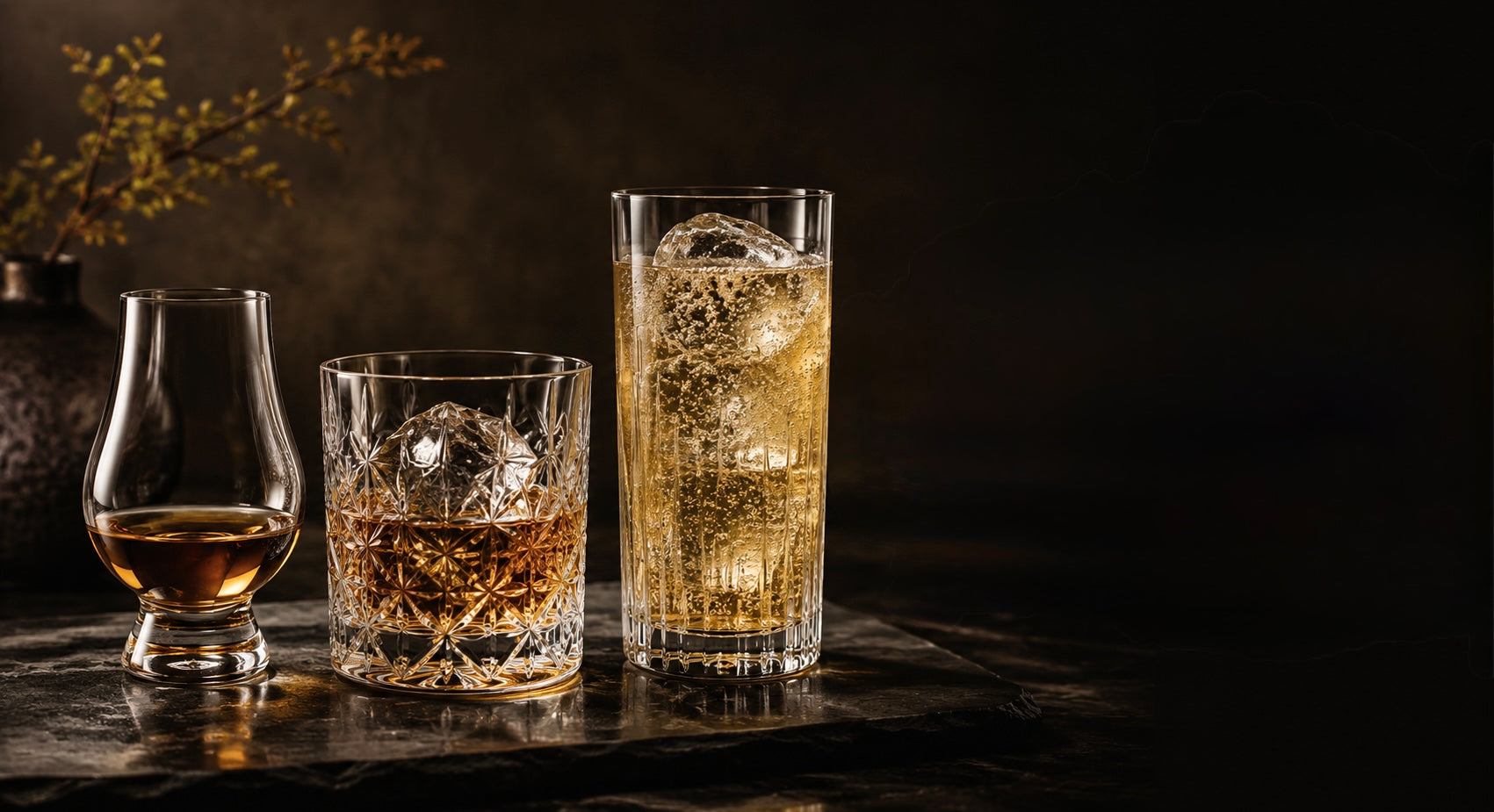
Amber whisky catches the light differently in every glass.
In a narrow tasting glass, the spirit gathers beneath a tapered rim, bringing malt, fruit, smoke and oak closer to the nose. In a broad tumbler, the same whisky feels more relaxed. Add a single clear cube and the experience changes again: colder, slower, heavier in the hand, with light moving through whisky and ice together.
So does choosing the right whisky glass actually matter?
Yes—but not because one glass magically makes every whisky taste better.
Glass shape can influence how aromas collect and reach the nose, how quickly a spirit warms, how comfortably ice fits, how the liquid reaches the mouth and how the drink feels in the hand. At the same time, weight, craftsmanship, texture and visual beauty affect a different part of the experience: pleasure, ritual and attention.
That distinction matters.
The best whisky glass depends on the whisky, how you serve it and what you want from the pour. A tulip-shaped glass is usually the stronger choice for serious nosing. A substantial rocks glass makes far more sense for a large cube. A tall highball glass serves an entirely different purpose. And a hand-cut Japanese tumbler may be chosen not because it wins a laboratory tasting, but because the glass itself becomes part of the evening.
This guide explains how to choose among them.
A note on whisky vs. whiskey: both spellings appear in English. “Whisky” is conventional for Scotch and Japanese whisky, while “whiskey” is common in the United States and Ireland. The glassware principles are the same.
Quick Answer: Which Whisky Glass Should You Choose?
If you want the shortest possible answer:
| How You Drink Whisky | Best Glass | Why |
|---|---|---|
| Serious tasting | Glencairn-style or tulip glass | Concentrates aromas near the nose |
| Bourbon neat | Tulip glass or comfortable tumbler | Choose aroma analysis or relaxed sipping |
| Bourbon on the rocks | Rocks / Old Fashioned glass | Wide enough for large-format ice |
| Scotch tasting | Glencairn-style or copita | Helps explore layered aromas |
| Scotch neat for pleasure | Glencairn or tumbler | Depends on whether analysis or comfort matters more |
| Japanese whisky neat | Tulip glass or refined tumbler | Aroma-focused tasting or contemplative sipping |
| Japanese whisky over ice | Japanese tumbler / rocks glass | Space for ice, substantial hand feel and presentation |
| Japanese highball | Tall highball glass | Accommodates ice, whisky and carbonated water |
| Old Fashioned | Rocks glass | Designed for short, spirit-forward cocktails |
| Luxury whisky gift | Handcrafted tumbler or tasting set | Combines utility, craftsmanship and presentation |
What is the best glass for whisky?
There is no single best whisky glass for every pour. Tulip-shaped glasses are usually better for nosing and comparative tasting because their bowls narrow toward the rim. Rocks glasses are more practical for whisky over ice and spirit-forward cocktails. Tall highball glasses are best for whisky served long with ice and soda.
For relaxed neat drinking, the decision becomes more personal: a tasting glass emphasizes aroma, while a well-balanced tumbler emphasizes comfort, touch and ritual.
Does the Whisky Glass Really Matter?
It matters—but in several different ways, and those effects should not be confused.
The measurable side: aroma, temperature and dilution
Whisky contains many volatile compounds that contribute to aroma. Once the spirit is poured, some of those compounds move into the headspace above the liquid. The geometry of the vessel influences that headspace: bowl size, liquid surface area and the diameter of the opening all affect how vapors disperse before they reach the nose.
Research on alcoholic beverages has demonstrated that vessel shape can influence aroma perception, and controlled studies of wine have found differences associated with bowl and opening geometry. Research has also visualized different patterns of ethanol evaporation according to glass shape. The exact findings from wine should not be treated as a whisky-specific law, but the underlying principle—that vessel geometry can affect what reaches the nose—is well supported.
Whisky dilution matters as well. A 2023 sensory and volatile-composition study found that adding water altered whisky aroma profiles; at increasingly high dilution levels, different whiskies became less sensorially distinct. That gives scientific support to something drinkers have long observed: a little water can change what you perceive, but more water is not automatically better.
Temperature changes the experience too. A whisky held in a warm hand will generally warm faster than one held by the stem of a tasting glass. Ice does the opposite, while gradually introducing water as it melts.
The glass is therefore not merely a container. It is part of the physical environment in which aroma, temperature and dilution develop.
The subjective side: weight, beauty and ritual
Then there is everything a laboratory cannot reduce to aroma concentration.
A heavy base feels different from a feather-light tasting stem.
A thin rim feels different against the lips from a thick one.
A hand-cut surface catches the fingertips.
Colored glass changes the way amber whisky appears.
A glass associated with an artisan, place or tradition can make someone pay closer attention to a drink they might otherwise pour without thinking.
These effects are subjective, but subjective does not mean unimportant.
A whisky glass can influence sensory analysis objectively while influencing enjoyment aesthetically and psychologically. Both are legitimate; they are simply different.
How Glass Shape Changes the Whisky Experience
Understanding a few design variables makes shopping for whisky glasses much easier.
Bowl width
A broader bowl exposes more liquid surface and gives the whisky a larger headspace.
For tasting, some bowl width is helpful because aromas need room to volatilize. But an extremely wide, completely open vessel allows those aromas to disperse quickly.
For ice, width becomes practical rather than analytical. A rocks glass needs enough interior diameter for a substantial cube or sphere without wedging it against the sides.
Practical rule
Choose moderate bowl width for tasting and generous bowl width for whisky over large-format ice.
Rim diameter
The relationship between the widest part of the bowl and the opening at the top is one of the most important differences between a tasting glass and a tumbler.
A tulip-shaped vessel widens around the whisky and then narrows toward the nose. A straight-sided or outward-opening tumbler does far less to contain the headspace.
That is why a Glencairn-style glass can seem noticeably more aromatic than an open rocks glass when the same small pour is compared side by side.
Tapered vs. open rim
A tapered rim generally favors aroma concentration.
An open rim favors ease of sipping, ice access and a relaxed drinking style.
Neither is universally superior.
If you are trying to distinguish orchard fruit from dried fruit, maritime smoke from medicinal peat, or vanilla oak from baking spice, tapering is useful.
If you are sitting outside with a bourbon and one large cube, an open tumbler may be exactly right.
Glass height
Height matters most when the drink itself requires volume.
A neat whisky needs little.
A whisky highball needs considerable room for ice and sparkling water. A taller, relatively narrow vessel also provides the visual and practical proportions associated with a long carbonated drink.
Suntory's own highball preparation emphasizes thoroughly chilled whisky, soda, glass and ice, followed by restrained stirring to preserve carbonation.
Base thickness
A thick base does not inherently improve the whisky's aroma or chemistry.
What it changes is physical character.
A substantial base can make a tumbler feel planted and reassuring, especially with ice. It also adds visible mass beneath the drink—one reason substantial Japanese cut-glass tumblers can feel so satisfying in the hand.
For analytical tasting, that mass is mostly unnecessary.
For an evening pour, it may be part of the point.
Wall and rim thickness
Thin glass can create a more delicate transition between liquid and mouth. Thick glass feels more substantial and may be desirable in a robust tumbler.
Neither automatically indicates quality.
A thin tasting glass must still be durable enough for repeated handling. A thicker artisan tumbler may intentionally use its physical presence as part of the design.
Weight
Weight is almost entirely a question of intended experience.
Light glass: precision, delicacy, tasting.
Heavy glass: solidity, tactile pleasure, ice and visual drama.
Do not mistake heaviness for technical superiority. A heavy rocks glass can be wonderful to drink from while being inferior to a lightweight tulip glass for blind comparative nosing.
Stemmed vs. stemless
A stem allows the drinker to hold the vessel without warming the bowl as quickly and keeps fingers away from the viewing area.
That is useful for formal sensory evaluation.
Stemless glasses are easier and often more natural for casual drinking. The Glencairn-style solution sits somewhere between the two: a tasting-oriented bowl with a solid foot rather than a long wine-glass stem.
Capacity
For most people, practical ranges are more useful than a single ideal measurement:
- Tasting glass: roughly 150–220 ml / 5–7.5 oz
- Neat whisky tumbler: roughly 200–300 ml / 7–10 oz
- Rocks glass: roughly 250–350 ml / 8.5–12 oz
- Highball glass: roughly 300–450 ml / 10–15 oz
These are buying ranges, not rigid standards.
The important question is how much unused space the drink needs. A 30 ml neat tasting pour does not require a giant tumbler. A 50 mm / 2 in clear cube certainly does require sufficient width.
The Main Types of Whisky Glasses Explained
Glencairn-Style Glass
Best for: whisky tasting, nosing, comparative flights, neat pours.
The Glencairn-style shape combines a rounded lower bowl with a narrower upper opening. The broadest area gives aromas room to develop, while the taper helps retain them near the nose.
Strengths
- Excellent for aroma-focused drinking
- Easy to swirl a small pour
- Compact enough for flights
- Stable compared with long-stemmed tasting glasses
- Versatile across bourbon, Scotch and Japanese whisky
Limitations
- Poor choice for a large cube
- Less visually dramatic for cocktails
- Can feel overly analytical when you simply want to relax
Best use
Keep one whenever you buy bottles specifically to study and compare.
Copita / Tulip Glass
Best for: analytical tasting, delicate spirits, careful nosing.
A traditional copita resembles a small tulip-shaped stemmed glass. The bowl allows aromatic development before narrowing toward the rim.
For serious sensory work, its stem is useful: you can examine and nose the spirit without wrapping your palm around the bowl.
Choose a copita when:
- comparing multiple whiskies
- evaluating cask influence
- studying a complex single malt
- tasting cask-strength whisky with incremental water
- you want your glassware to disappear into the background
The disadvantage is equally obvious: a copita feels like a tasting instrument because, in many contexts, that is exactly what it is.
Rocks Glass / Old Fashioned Glass
Best for: whisky over ice, relaxed neat pours and whisky-forward cocktails.
The rocks glass is wide, short and stable.
It sacrifices some aroma concentration for versatility.
That is not a flaw. It is a different assignment.
A rocks glass gives ice space. It accommodates citrus peel. It handles an Old Fashioned comfortably. And its broad opening makes casual sipping effortless.
Is a rocks glass good for whisky neat?
Yes.
A rocks glass is perfectly suitable for drinking whisky neat if your priority is pleasure rather than maximum aroma concentration.
It simply will not focus aromas as strongly as a tapered tasting glass.
Japanese Whisky Tumbler
There is no single legally defined shape called a “Japanese whisky tumbler.” The term is better understood as a family of low drinking glasses associated with Japanese glassmaking, bar culture and whisky service.
Some are minimalist and thin.
Others are substantial.
Some are molded.
Others are blown or hand-cut.
The important point is not that Japanese tumblers obey a special sensory law. It is that many Japanese drinking traditions place considerable attention on the entire serve: ice, temperature, proportion, vessel and presentation.
For whisky over ice, a beautifully made tumbler offers something a narrow tasting glass cannot: space and visual composition.
A large clear cube becomes part of the architecture of the drink.
Whisky moves around it.
Condensation appears against the glass.
Every rotation changes the way light passes through spirit, ice and surface pattern.
That is less about laboratory tasting performance and more about ritual.
Highball Glass
Best for: Japanese whisky highballs and other long whisky drinks.
The highball is tall because the drink requires volume: whisky, substantial ice and carbonated water.
Suntory recommends chilling the glass, whisky and soda, filling the glass with ice and minimizing unnecessary stirring after the carbonated water is added.
Why a tall glass works
- provides sufficient ice capacity
- leaves room for soda
- gives a long chilled column of liquid
- suits a refreshing drinking style
- reduces the temptation to overload the drink with whisky
A beautiful tumbler may suit Japanese whisky beautifully, but it does not replace a highball glass when you are actually making a highball.
Crystal and Cut-Glass Tumbler
Best for: relaxed whisky, whisky over ice, gifting and the pleasure of the vessel itself.
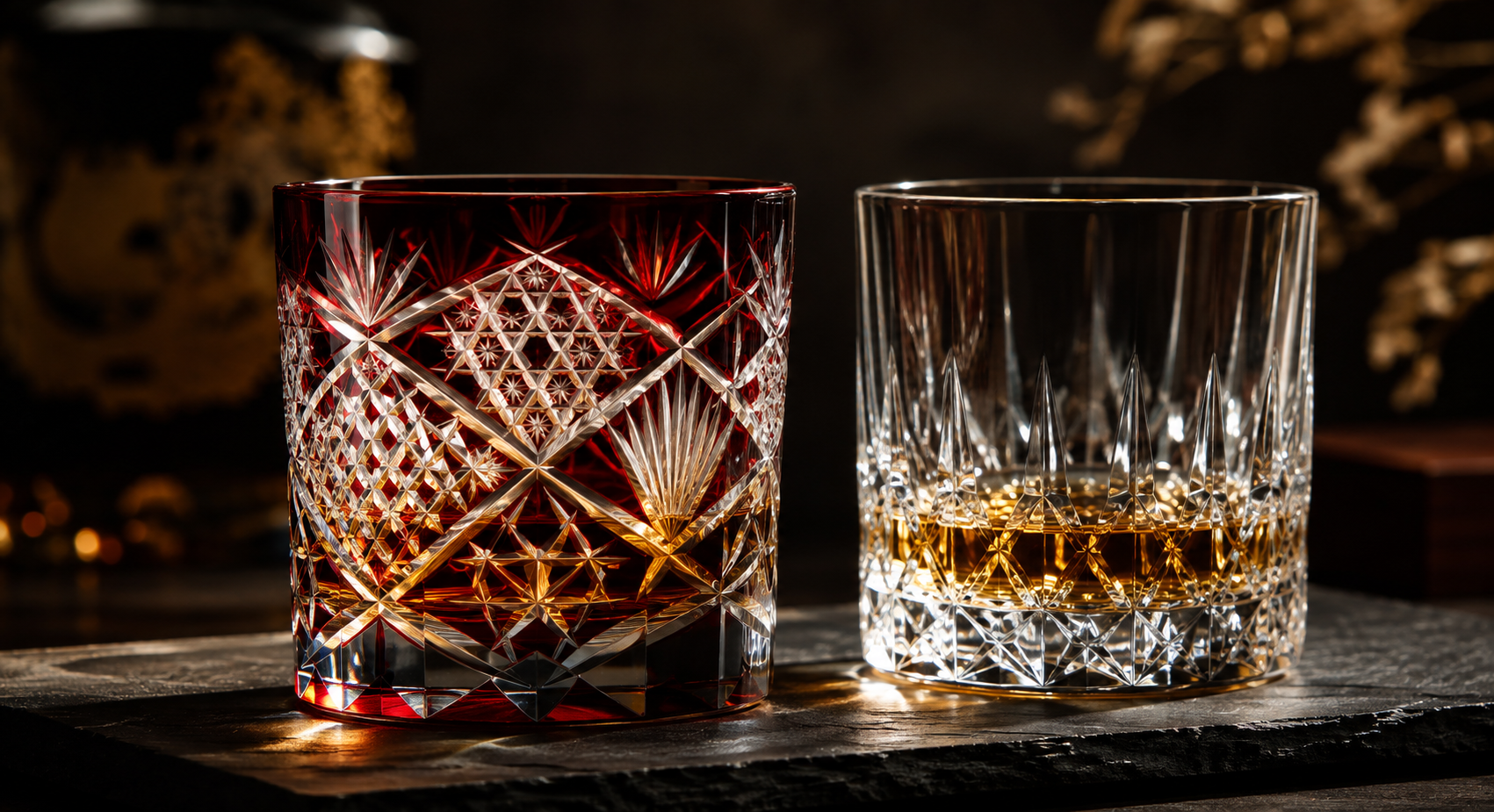
Cut crystal and cut glass introduce optical and tactile qualities that plain glass does not.
Facets bend and reflect light.
Deep cuts give the fingers something to register.
Colored overlays can produce striking contrast where cuts expose clear glass beneath.
But an important distinction should be made:
Decorative cutting does not automatically improve aroma concentration.
If the underlying vessel has a wide open rim, it remains a wide open rim.
The value of fine cut glass lies elsewhere—in brilliance, craft, texture, visual depth and the sense that the vessel itself deserves attention.
The Best Glass for Bourbon
What is the best glass for bourbon?
For bourbon tasting, choose a Glencairn-style or tulip-shaped glass. For bourbon over ice or an Old Fashioned, choose a wide rocks glass. For relaxed neat drinking, either can be right.
Bourbon must be produced from a mash containing at least 51% corn and aged in charred new oak containers under the U.S. standard of identity. Those production requirements help explain why oak-derived characteristics play such a prominent role across the category.
Bourbons commonly present combinations of vanilla, caramelized sweetness, oak, baking spices, toasted sugars and grain, although the profile varies enormously by mash bill, fermentation, barrel, maturation conditions and proof.
Best glass for bourbon tasting
Use a Glencairn or copita.
This is particularly worthwhile when comparing:
- wheated vs. rye-recipe bourbon
- different barrel proofs
- younger vs. older whiskey
- single-barrel expressions
- different warehouse locations or producers
The narrowed rim makes subtle comparisons easier.
Best glass for bourbon neat
You have two equally defensible choices.
Choose a tulip glass if:
you want to nose deeply and identify detail.
Choose a tumbler if:
you already know the bourbon and want to enjoy it without turning the evening into an examination.
For many bourbon drinkers, the best setup is simply to own both.
Best glass for high-proof bourbon
Start with a tulip-shaped glass, but nose carefully.
High ethanol concentration can dominate perception, and dilution can alter whisky's aroma profile substantially. Incremental water therefore makes more sense than flooding the glass at once.
A pipette or teaspoon of water is more controlled than relying entirely on melting ice when the purpose is analysis.
Best glass for bourbon on the rocks
Choose a wide rocks glass, ideally large enough that your preferred cube fits comfortably.
If you enjoy slow dilution, one large-format cube generally gives a more controlled experience than filling the glass with many small cubes because the ice configuration changes the available surface area and rate of melting.
The objective is not “zero dilution.” Dilution is part of drinking whisky on ice.
The objective is to let it happen at a pace you enjoy.
Best glass for an Old Fashioned
The answer is straightforward: a rocks glass or Old Fashioned glass.
You need room for:
- whisky
- sugar or syrup
- bitters
- dilution
- a large cube
- optional citrus expression
A Glencairn solves the wrong problem.
The Best Glass for Scotch Whisky
What is the best glass for Scotch?
For serious Scotch tasting, a Glencairn-style glass or copita is usually the most useful choice. For relaxed neat drinking, a tumbler remains entirely legitimate.
Scotch Whisky is legally defined around production in Scotland, maturation for at least three years in oak casks no larger than 700 litres and a minimum bottling strength of 40% ABV, among other requirements. UK law recognizes distinct Scotch categories including Single Malt and blends.
But “Scotch” does not describe one flavor profile.
A delicate unpeated malt, heavily peated Islay whisky, sherry-cask-influenced single malt and cask-strength expression may ask very different things of the drinker.
Single malt Scotch
A tulip-shaped glass is especially valuable when the whisky rewards slow nosing.
Fruit, malt, cereal, wax, herbs, esters, oak, smoke and cask-derived aromas may appear at different moments.
A concentrated headspace makes that exploration easier.
Peated Scotch
Peated whisky can seem enormously expressive even from a tumbler.
That does not make glass choice irrelevant.
A tasting glass can help separate smoke from what sits beneath it: citrus, medicinal notes, maritime impressions, sweetness, malt, fruit or oak.
If the alcohol feels aggressive, move your nose farther from the opening before deciding that the whisky itself is unbalanced.
Sherried Scotch
A nosing glass is useful when exploring dried fruit, spice, nutty notes, chocolate-like aromas and oak influence in whiskies matured or finished in sherry-seasoned casks.
Once again, the glass does not manufacture those characteristics. It simply creates a more useful environment for perceiving them.
Cask-strength Scotch
Use a tasting glass with enough volume to accommodate small additions of water.
The ideal approach is iterative:
- Nose the whisky as poured.
- Taste a small amount.
- Add a few drops of water.
- Revisit it.
- Continue only if the change is useful.
The dilution research on whisky reinforces why this should be controlled rather than indiscriminate: progressive dilution changes volatile and sensory profiles, and at sufficiently high dilution distinctive characteristics become less clear.
When is a tumbler better for Scotch?
When you are done analyzing it.
There is nothing unsophisticated about pouring a favorite single malt into a beautiful tumbler after dinner.
Professional tasting conventions and personal pleasure do not need to be identical.
The Best Glass for Japanese Whisky
What glass is best for Japanese whisky?
The best Japanese whisky glass depends more on how the whisky is served than on the nationality of the whisky.
Use:
- Tulip glass: neat tasting
- Refined tumbler: relaxed neat drinking
- Wide rocks glass: whisky over large-format ice
- Highball glass: whisky with soda
- Larger tumbler: mizuwari or whisky-and-water serves
This is the most important rule in this entire section.
Japanese whisky is not one flavor profile and should not be forced into one glass shape.
The Japan Spirits & Liqueurs Makers Association introduced standards defining what its members may label “Japanese whisky,” with production requirements relating to ingredients, Japanese water, fermentation, distillation, maturation and bottling in Japan. Japan's National Tax Agency has also published the industry definition in its liquor-administration materials.
What makes the glassware question especially interesting is the variety of established Japanese whisky serves.
Japanese whisky neat
For evaluating a Japanese single malt or complex blend, use a tulip glass exactly as you would for serious Scotch or bourbon tasting.
Nationality does not override physics.
If aroma analysis is the objective, a tapered glass remains useful.
For slow drinking rather than comparison, a refined tumbler can be more satisfying.
Japanese whisky over ice
This is where the tumbler becomes central.
Suntory's own serving material presents Japanese whisky on the rocks in a tumbler with a large block of ice, illustrating how important ice and vessel become to this style of drinking.
A good rocks glass should provide enough width that the ice is not trapped awkwardly.
From there, aesthetics matter.
Clear ice against amber whisky creates a simple composition. In a hand-cut glass, that composition becomes more intricate as facets divide the light.
Japanese whisky highball
The highball requires a tall glass.
Not because tall glassware is “more Japanese,” but because the drink requires a vessel designed around coldness, ice, carbonation and length.
Suntory describes the whisky highball as a major Japanese whisky serve and recommends chilled components with restrained stirring after soda is added.
Best glass:
Tall, relatively narrow highball glass.
A rocks tumbler simply does not provide the same ratio or volume.
Mizuwari
Mizuwari literally refers to whisky diluted with water.
A larger tumbler makes sense because the serve needs more capacity than a neat pour.
The objective is not concentrated nosing in the manner of a tiny copita. It is a longer, gentler drink in which whisky and water are deliberately integrated.
A simple straight-sided tumbler can therefore be more appropriate than an aggressively tapered tasting glass.
Why Japanese glassware can make sense for Japanese whisky
Not because both happen to be Japanese.
The more compelling relationship is one of attention.
When a drink is built carefully—with controlled ice, proportion, temperature and presentation—a vessel with visible human workmanship feels coherent with that approach.
That is where Japanese cut glass becomes relevant.
Whisky Neat, On the Rocks or Highball: Which Glass Works Best?
Best glass for whisky neat
There are really two versions of “neat.”
Neat for tasting
Use a Glencairn, copita or tulip glass.
Neat for leisure
Use whichever glass is comfortable enough that you want to reach for it repeatedly.
A well-proportioned tumbler is often ideal.
The distinction is intention.
Best Glass for Whisky on the Rocks
Choose a rocks glass with a generous interior diameter.
Look for:
- room for your preferred ice format
- enough volume for whisky plus meltwater
- a stable base
- comfortable rim geometry
- sufficient clearance that the cube can move slightly as you drink
A beautiful cut-glass tumbler is particularly well suited to this format because ice, liquid and refracted light are all visible simultaneously.
Best Glass for Whisky With Water
For a few drops of water during tasting, use your normal tasting glass.
For a deliberately lengthened whisky-and-water drink, choose a larger tumbler.
Capacity is the main practical consideration.
Remember that dilution should be purposeful rather than automatic. Whisky research has shown that substantial dilution can reduce sensory differentiation between expressions.
Best Glass for a Japanese Highball
Choose a tall highball glass with enough capacity for plenty of ice, whisky and chilled carbonated water.
Suntory recommends chilling all the principal components and minimizing agitation of the soda to preserve fizz.
If highballs are your principal way of drinking whisky, buying beautiful highball glasses may improve your daily ritual far more than buying an expensive tasting set you rarely use.
Best Glass for Whisky Cocktails
Match the glass to the architecture of the cocktail.
Old Fashioned: rocks glass
Whisky Highball: highball glass
Whisky Sour: coupe, sour glass or rocks glass depending on presentation
Whisky-forward short drinks over ice: rocks glass
The principle is the same throughout this guide:
Choose for the serve, not for the label on the bottle.
Bourbon vs. Scotch vs. Japanese Whisky Glass: Comparison Table
| Whisky / Serving Style | Recommended Glass | Why It Works | Best For |
| Bourbon tasting | Glencairn / tulip | Concentrates headspace aromas | Comparing bottles |
| Bourbon neat | Tulip or tumbler | Aroma focus or relaxed comfort | Everyday sipping |
| High-proof bourbon | Tulip | Supports careful nosing and measured water | Barrel-proof whiskey |
| Bourbon on rocks | Wide rocks glass | Space for large-format ice | Slow casual drinking |
| Old Fashioned | Rocks glass | Space for ice, bitters and garnish | Cocktails |
| Single malt Scotch tasting | Glencairn / copita | Useful for layered aromatic analysis | Serious tasting |
| Peated Scotch | Glencairn / tulip | Helps examine aromas beneath smoke | Nosing |
| Cask-strength Scotch | Tulip / copita | Easy to revisit with controlled water | Analytical tasting |
| Scotch neat for leisure | Tumbler | Comfortable, unhurried drinking | Evening pours |
| Japanese whisky tasting | Tulip / Glencairn | Focuses aromas | Comparing expressions |
| Japanese whisky neat | Tulip or refined tumbler | Analysis or ritual | Slow sipping |
| Japanese whisky on ice | Japanese tumbler / rocks glass | Ice capacity, weight and presentation | Evening pour |
| Mizuwari | Larger tumbler | Capacity for whisky and water | Long, gentle drinking |
| Japanese highball | Tall highball glass | Room for ice and carbonation | Refreshing long drink |
| Luxury whisky gift | Artisan tumbler or set | Combines practical use and craftsmanship | Milestones and collectors |
Edo Kiriko: When the Whisky Glass Becomes Part of the Ritual
There is a point at which choosing whisky glassware stops being purely functional.
You already own something that holds liquid.
You may already own a tasting glass that concentrates aroma perfectly well.
The next question is different:
Can the vessel itself become an object worth appreciating?
Edo Kiriko provides one answer.
What is an Edo Kiriko whisky glass?
Edo Kiriko is a Japanese cut-glass craft associated with Tokyo in which artisans cut patterns into the glass surface using grinding tools and finish the cuts through additional grinding and polishing processes.
The craft developed in Edo—present-day Tokyo—and remains officially recognized as a Japanese traditional craft. Traditional production involves hand grinding and polishing, and Edo Kiriko may use clear glass or color-overlay glass in which cutting reveals contrast between the colored surface and clear glass beneath.
The Edo Kiriko Cooperative Association also notes that Edo Kiriko is a registered trademark and cautions against products represented as authentic Edo Kiriko that are not handmade in Japan.
Why Edo Kiriko works so beautifully with whisky
Not because the cutting changes bourbon into better bourbon.
It does not.
The appeal is visual and tactile.
Amber whisky settles behind the pattern.
Where deeply cut facets meet colored glass, the liquid changes the apparent depth and contrast of the design.
Add clear ice and the composition becomes more complex: refraction through ice meets refraction through cut glass, while the whisky supplies color between them.
The glass moves slightly.
The pattern changes.
A reflection appears and disappears.
You notice the drink.
That is the value of the craft.
The tactile dimension
Traditional Edo Kiriko production demands deep, sharp and accurate cutting followed by careful polishing. Official craft guidance specifically emphasizes the importance of hand grinding, sharp cuts and polishing to restore transparent brilliance.
Those cuts are visible, but they are also felt.
A patterned tumbler communicates its construction every time it is lifted.
Smooth areas and cut facets alternate beneath the fingertips.
For someone who drinks whisky slowly, touch becomes part of the rhythm of the glass.
Does Edo Kiriko make whisky taste better?
Not objectively simply because it is Edo Kiriko.
If a particular Edo Kiriko tumbler has a broad open rim, a narrow tulip glass may still outperform it for concentrated nosing.
Its value lies in craftsmanship, light, tactility and emotional attachment.
That may make the whisky experience more pleasurable.
It should not be confused with a claim that decorative cutting changes the chemical quality of the spirit.
For those drawn to the ritual as much as the whisky itself, Oriental Artisan's handcrafted Japanese whisky glasses offer another perspective on what a drinking vessel can be: not simply equipment, but an object designed to accompany quiet pours for years.
Crystal vs. Standard Glass for Whisky
Is crystal better for whisky?
Crystal can offer exceptional clarity, brilliance, cutting potential and tactile character, but it does not automatically make whisky taste better. Shape is generally more relevant to aroma performance than whether the material is marketed as crystal or standard glass.
The word crystal requires some care.
Traditional lead crystal uses lead oxide to achieve particular optical and working properties. European legislation specifically recognizes lead-containing crystal-glass categories, and the European Commission has described lead crystal's distinctive optical characteristics.
But crystal does not automatically mean leaded crystal in modern retail use. Major contemporary glassmakers sell lead-free materials as crystal glass; for example, Riedel states that its current crystal glass does not use lead oxide as a principal ingredient, while Zwiesel markets lead-free Tritan crystal glass.
Therefore, when buying whisky glasses, read the maker's material specification rather than assuming that the word “crystal” tells you the exact composition.
Standard glass
Advantages
- accessible
- practical
- often durable
- available in almost every form
- perfectly capable of excellent whisky service
A well-designed standard-glass tulip is more useful for tasting than an expensive crystal tumbler with an unsuitable shape.
Lead-free crystal / crystalline glass
Advantages
- high clarity
- strong visual brilliance
- capable of refined shaping and cutting
- avoids the assumption that crystal must rely on traditional lead composition
Composition varies by maker, so material transparency matters.
Traditional lead crystal
Lead crystal has historically been valued for optical and working characteristics useful in decorative glassmaking.
For modern drinkware buyers, however, the important principle is simpler:
Do not use “crystal” as a synonym for “better whisky glass.”
Judge:
- shape
- material specification
- craftsmanship
- intended use
- care requirements
Hand-cut glass
Hand cutting adds labor, individuality and tactile complexity.
It may also allow the artisan to create deeper and more nuanced patterns than many mass-production methods.
Its primary advantage is craftsmanship—not automatic sensory superiority.
Machine-cut glass
Modern machine production can be extremely precise and consistent.
If your priority is uniformity, replacement availability, durability or matching a large set, machine-made glassware can be the rational choice.
Hand-blown glass
Hand blowing affects how the vessel is formed rather than how decorative cuts are subsequently applied.
Fine hand-blown glass can achieve elegant proportions and thin walls, but again, “handmade” describes a production method, not a guarantee that every aspect of the result is functionally superior.
Handmade vs. Machine-Made Whisky Glasses
Are handmade whisky glasses worth it?
They can be—if you value the aspects that handwork actually changes.
Do not buy handmade glassware because someone tells you a machine-made glass cannot hold whisky correctly.
Buy it because you care about:
- individual workmanship
- hand-finishing
- cutting technique
- pattern complexity
- minor variations
- artistic authorship
- local craft knowledge
- visual depth
- tactile character
- scarcity or collectibility
- emotional attachment
Handmade glassware often preserves evidence of process rather than erasing it.
Two pieces may not be microscopically identical.
For some buyers, that is a disadvantage.
For others, it is the reason to own them.
Machine-made glassware wins easily when you need twelve identical glasses at a predictable price.
An artisan glass answers a different desire.
How to Choose the Right Whisky Glass for You
Forget the whisky region for a moment.
Start with behavior.
Step 1: How do you actually drink whisky?
Mostly neat and analytical?
Buy a tulip-shaped tasting glass first.
Mostly neat and relaxed?
Buy a well-balanced tumbler.
Mostly over one large cube?
Buy a wide rocks glass.
Mostly Japanese highballs?
Buy highball glasses.
Mostly Old Fashioneds?
Buy rocks glasses.
This single question eliminates most bad purchases.
Step 2: Do you care more about aroma or ice?
This is the central trade-off.
A narrow upper bowl helps concentrate aromas.
A wide mouth makes room for large ice.
Trying to maximize both usually produces compromise.
That is why serious whisky drinkers often eventually own more than one glass shape.
Step 3: How much whisky do you pour?
Do not buy a 400 ml tumbler for tiny tasting pours unless you specifically enjoy the scale of it.
Likewise, do not buy a tiny nosing glass if you regularly drink whisky with a 50 mm cube.
Match capacity to reality.
Step 4: How important is weight?
If you enjoy delicate stemware, heavy cut crystal may feel cumbersome.
If you love the sensation of a substantial rocks glass, an ultralight tasting glass may feel clinical.
Weight is not a quality score.
It is part of the design language.
Step 5: Does craftsmanship matter to you?
If all you need is functional whisky analysis, excellent machine-made tasting glasses can do the job.
If you also want:
- an artisan's hand
- cultural story
- pattern
- light
- collectibility
- a glass that feels personal
then handcrafted glassware becomes relevant.
This is the point at which something like Edo Kiriko begins to make sense.
Step 6: Are you buying one glass or building a system?
The most useful whisky cabinet is often surprisingly small.
For most enthusiasts:
1. Tulip tasting glass
For analysis.
2. Beautiful rocks tumbler
For relaxed neat drinking and ice.
3. Highball glass
If you regularly drink long whisky serves.
Those three forms cover almost everything.
Should Whisky Glasses Be Heavy or Thin?
Neither is universally better.
A thin rim often feels more precise and unobtrusive during tasting.
A heavier body can provide more tactile presence for a relaxed whisky or rocks serve.
If someone tells you a whisky glass must be heavy to be luxurious, they are confusing one design preference with quality.
If someone tells you all serious whisky must be drunk from feather-light glass, they are confusing analysis with pleasure.
Choose according to purpose.
Can You Drink Whisky From a Tumbler?
Absolutely.
The tumbler is not an inferior whisky glass.
It is simply less specialized for aroma concentration than a tulip-shaped tasting glass.
For neat evening pours, large ice cubes, whisky cocktails and contemplative drinking, a tumbler can be the better choice.
This is particularly true when the pleasure of holding and looking at the glass matters as much as analyzing every aroma.
Glencairn vs. Rocks Glass: Which Is Better?
Choose a Glencairn when:
- nosing is the priority
- comparing whiskies
- adding controlled drops of water
- drinking small neat pours
- studying cask or distillery character
Choose a rocks glass when:
- adding ice
- making an Old Fashioned
- drinking casually
- tactile weight matters
- the visual presentation of the drink matters
The verdict
The Glencairn is better for tasting. The rocks glass is better for ice and often better for leisure.
There is no contradiction.
What Size Whisky Glass Is Best?
For general use, about 200–300 ml / 7–10 oz is an exceptionally versatile range for a tumbler.
It gives a neat pour visual breathing room without becoming enormous and can accommodate modest ice.
If large cubes are important, look closer to 250–350 ml / 8.5–12 oz and check the interior width rather than capacity alone.
For tasting, smaller tulip glasses around 150–220 ml / 5–7.5 oz are usually easier to work with.
For highballs, look around 300–450 ml / 10–15 oz.
Capacity alone, however, is not enough.
A 300 ml glass can still be too narrow for your favorite cube.
Choosing Whisky Glasses as a Gift
A bottle disappears.
A glass remains.
That is one reason whisky glassware makes such a useful gift: it can continue to be used long after the occasion itself.
Best whisky glasses for birthdays
Choose according to the recipient's drinking habits.
If they collect bottles and hold tastings, choose tasting glasses.
If they pour one whisky every Friday evening, an artisan tumbler may feel far more personal.
Father's Day whisky gifts
Avoid relying on the idea that all men want giant, heavy glasses.
Instead ask how he actually drinks.
A father who loves Scotch flights may prefer two elegant nosing glasses to a huge rocks set.
A bourbon drinker who always adds one cube may want the opposite.
Anniversary and wedding gifts
This is where pairs work particularly well.
Matching handcrafted tumblers can become objects associated with a shared ritual rather than simply barware.
Presentation packaging adds value because the moment of opening becomes part of the gift.
Where personalization or engraving is offered, it can turn a useful object into a commemorative one without changing the underlying design.
Retirement gifts
Retirement gifts benefit from a sense of permanence.
A handcrafted whisky glass works because it is both ceremonial and usable.
It can sit on a shelf, but it does not have to.
The best luxury objects are allowed to enter ordinary life.
Christmas gifts
Sets are convenient when you do not know exactly how the recipient drinks.
A pair of versatile tumblers is safer than highly specialized glassware for most casual whisky drinkers.
Corporate whisky gifts
Consider:
- packaging
- personalization
- cultural story
- consistency
- replacement possibilities
- delivery practicality
- whether the glass is actually comfortable to use
Do not select a complicated object merely because it looks expensive in a box.
What Is the Best Whisky Glass for a Gift?
For most whisky drinkers, a high-quality tumbler is the safest premium gift because it can be used neat, over ice and for whisky-forward cocktails.
A tasting glass is more specialized.
A handcrafted Japanese or Edo Kiriko whisky tumbler becomes especially compelling when the recipient appreciates Japanese whisky, craft, design or objects with a visible making tradition.
Oriental Artisan curates handcrafted Japanese whisky glasses for exactly this intersection: practical drinkware shaped by craft, material and cultural context rather than decoration alone.
Frequently Asked Questions
1. What is the best all-purpose whisky glass?
For someone who drinks mostly neat whisky, a Glencairn-style glass is one of the most versatile choices. If you frequently add ice or make Old Fashioneds, a medium-sized rocks glass is more practical.
There is no universal winner because the two shapes solve different problems.
2. Is a Glencairn glass really necessary?
No.
You can enjoy excellent whisky without one.
However, if you frequently compare whiskies or want to study aroma in detail, the tapered shape is genuinely useful.
It is a tool, not an entry requirement.
3. Is a rocks glass good for drinking whisky neat?
Yes.
A rocks glass is excellent for relaxed neat drinking.
Its broader rim does not concentrate aroma as efficiently as a tulip glass, but that does not make the drinking experience inferior.
4. What glass should I use for bourbon?
Use a Glencairn or tulip glass for bourbon tasting, a tumbler for relaxed neat drinking and a wide rocks glass for bourbon over ice or an Old Fashioned.
5. What glass should I use for Scotch?
For serious Scotch tasting, use a Glencairn or copita.
For an evening pour where comfort matters more than detailed nosing, a tumbler is perfectly appropriate.
6. What glass should I use for Japanese whisky?
Match the glass to the serve.
Tulip for tasting.
Tumbler for neat whisky or whisky over ice.
Larger tumbler for mizuwari.
Tall highball glass for whisky and soda.
7. Why do Japanese whisky drinkers use highball glasses?
A Japanese whisky highball is a long drink built with whisky, ice and carbonated water, so a tall glass provides the necessary capacity and proportions.
Suntory's preparation guidance also emphasizes chilling the glass, ice, whisky and soda and limiting unnecessary stirring after carbonation is added.
8. Does crystal make whisky taste better?
Not automatically.
Material can change clarity, weight and tactile experience, while the shape of the vessel is generally more relevant to aroma concentration.
A well-shaped standard-glass tasting vessel can therefore outperform a beautiful open crystal tumbler for analytical nosing.
9. What size whisky glass is best?
For a general-purpose tumbler, around 200–300 ml / 7–10 oz is versatile.
For large ice, consider approximately 250–350 ml / 8.5–12 oz and check the internal diameter.
For tasting, smaller tulip glasses are usually preferable.
10. Can Edo Kiriko glasses be used for bourbon and Scotch?
Yes.
Edo Kiriko describes the Japanese cut-glass craft, not the whisky that must be served inside it.
A well-proportioned Edo Kiriko tumbler can be used for bourbon, Scotch, Japanese whisky and appropriate whisky cocktails.
Its particular appeal lies in craftsmanship, tactility and the way cut glass interacts visually with whisky and ice.
11. Are handmade whisky glasses worth it?
They are worth considering if craftsmanship, individuality, artistic authorship and tactile experience matter to you.
They are not necessary for technically competent whisky tasting.
You are paying partly for the object, not merely its ability to contain liquid.
12. Should I buy a whisky glass set or individual glasses?
Buy a set when you regularly drink with others or want visual consistency.
Buy individual glasses when you want specialized shapes for different serves or when collecting artisan work.
For many enthusiasts, two excellent tumblers and several simple tasting glasses make more sense than a large matching set.
The Final Pour
The best whisky glass is not determined by prestige, price or a rule handed down by someone standing behind a tasting bar.
It is determined by what you are asking the glass to do.
A narrow tulip helps you search for aroma.
A copita turns a pour into an examination.
A broad rocks glass welcomes ice.
A tall highball glass makes space for cold soda and carbonation.
A tumbler asks less of you. It sits comfortably in the hand and allows whisky to become part of the evening rather than its subject.
And then there are glasses in which the vessel itself deserves attention.
In an Edo Kiriko tumbler, amber whisky settles behind hand-cut geometry. Clear ice bends the pattern. A slight turn of the wrist changes the light.
The whisky has not become chemically better.
The moment has simply acquired another object worth noticing.
For those who care about that distinction, Oriental Artisan's collection of handcrafted Japanese whisky glasses offers a place to discover vessels chosen not only for what they hold, but for how they are made—and for the kind of quiet drinking ritual they may accompany for years.

Leave a comment
This site is protected by hCaptcha and the hCaptcha Privacy Policy and Terms of Service apply.