


Edo Kiriko vs. Crystal: Why Japanese Cut Glass Catches Light Differently
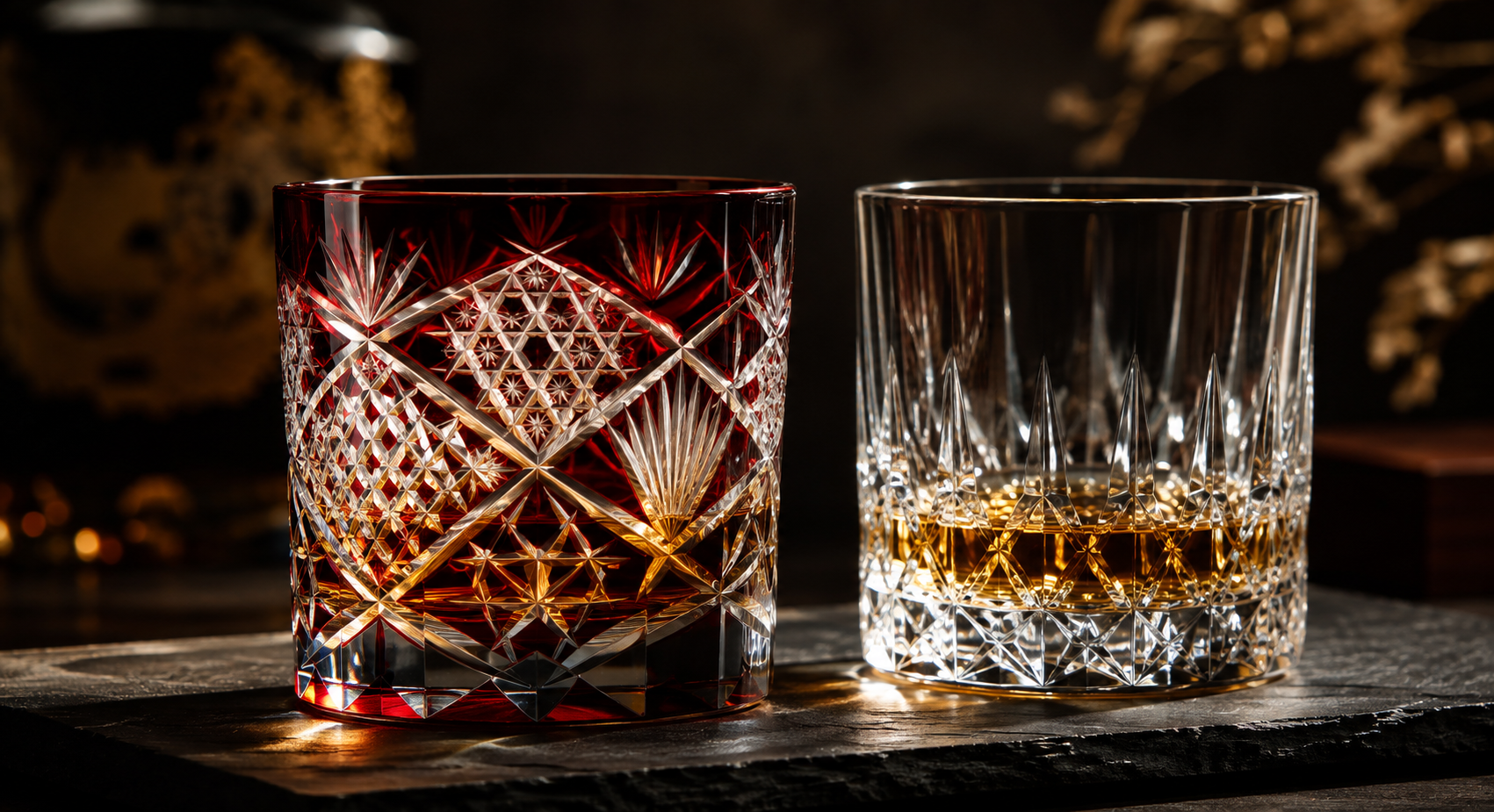
Place an Edo Kiriko whisky glass beside a window and turn it slowly.
A cut that appeared dark a moment ago flashes white. A field of fine lines sharpens, then almost disappears. Where an artisan has cut through a colored surface, clear glass opens beneath it like a line of light. Move the glass again and the pattern changes once more.
A conventional crystal tumbler can be brilliant too. It may throw bright reflections, prismatic flashes and extraordinary clarity. Yet its visual language can feel quite different.
Why?
The answer is not that Edo Kiriko possesses some mysterious optical property that other glass lacks. It is more interesting than that.
Edo Kiriko's character emerges from the relationship between glass composition, color, cut geometry, cut depth, surface finish, pattern density, illumination and the decisions of the person holding the glass against the cutting wheel.
And there is one important distinction to understand before comparing the two.
Quick Answer: Edo Kiriko vs. Crystal
Edo Kiriko is a Japanese cut-glass tradition, while crystal describes a category of glass material. They are not opposites, and some Edo Kiriko is itself made from crystal glass. Modern standards distinguish types of crystal glass according to factors including chemical composition, density and refractive index. Edo Kiriko, by contrast, is defined primarily by its craft tradition and cutting techniques. Its distinctive appearance often comes from precise hand-cut facets, colored glass layered over clear glass, geometric patterning and careful polishing. Crystal may provide exceptional clarity and optical brilliance, but Edo Kiriko uses those properties as part of a more complex composition of color, transparency, pattern and light.
What Is Edo Kiriko?
Edo Kiriko is a traditional form of cut glass associated with Tokyo.
The Edo Kiriko Cooperative Association traces the beginning of the craft to 1834, when Kyubei Kagaya, a glassware merchant in Edo's Odenmacho district, is said to have engraved the surface of glass using an abrasive. The tradition developed significantly during the Meiji period. In 1881, British glass-cutting specialist Emmanuel Hauptmann was brought to the Shinagawa glassworks, where Japanese craftsmen learned more advanced cutting techniques. Edo Kiriko was later designated a Traditional Craft of Tokyo in 1985 and a nationally designated Traditional Craft by Japan's Ministry of Economy, Trade and Industry in 2002.
That history matters because Edo Kiriko was never simply a recipe for making a particular type of glass.
It is better understood as a tradition of transforming glass through cutting.
Early examples were made from transparent glass. Today, one of the forms most strongly associated with Edo Kiriko uses irokise or colored overlay glass: a thin layer of colored glass over a transparent body. Artisans cut through that colored surface to expose clear glass beneath, producing the dramatic contrast many people now associate with the craft. Tokyo Teshigoto notes that colored overlay glass has become mainstream in contemporary Edo Kiriko, although transparent cut glass remains part of the tradition.
Traditional designs often rely on repeated geometric cuts rather than pictorial decoration. The object is therefore not merely covered with a pattern.
The pattern alters the way the glass receives, redirects and releases light.
What Is Crystal Glass?
The word crystal is more complicated than it first appears.
In tableware, crystal does not mean that the glass has a crystalline atomic structure. It is still glass. Instead, "crystal glass" describes particular high-quality glass compositions and classifications.
ISO's IWA 43:2023, for example, distinguishes crystal glass, crystal and lead crystal using criteria including chemical composition, density and refractive index. This is important because the old shorthand that "crystal simply means glass containing lead" is no longer adequate.
Traditional lead crystal historically achieved desirable optical and working characteristics partly through lead oxide. Modern crystal formulations can differ, and the exact designation standards vary across markets.
What matters visually is that the composition of a glass influences properties such as:
- refractive index;
- dispersion;
- density;
- transparency;
- how the material behaves during cutting and polishing.
The refractive index describes how strongly light changes direction when it moves from one medium into another. SCHOTT's technical documentation explains that reflection and refraction occur at a boundary when light enters glass, and that refractive index measures, in practical terms, the strength of this deflection.
Dispersion is different. It describes how refractive index varies with wavelength. Because different wavelengths of visible light are bent by different amounts, suitable glass and facet geometry can separate white light into small spectral flashes. SCHOTT notes that refractive index varies with wavelength and uses the Abbe number to characterize dispersion in optical glasses.
This is one reason high-quality crystal can appear unusually brilliant.
But it is only one part of the Edo Kiriko story.
Is Edo Kiriko Crystal?
Sometimes, but not necessarily.
The question mixes two different ways of describing an object.
Crystal tells you something about the glass material. Edo Kiriko tells you something about the craft tradition and how the glass is worked.
A useful analogy is woodworking: "walnut" describes a material; "marquetry" describes a decorative technique. Marquetry can be made using walnut, but marquetry is not itself a species of wood.
Similarly, an Edo Kiriko object can be made from crystal glass, but Edo Kiriko is not synonymous with crystal.
This overlap is not theoretical. KAGAMI, one of Japan's established crystal-glass manufacturers, produces Edo Kiriko in crystal and describes its own overlay crystal as transparent crystal coated with a thin layer of colored glass that is subsequently cut to reveal contrasting layers.
So when you see the phrase Japanese crystal whisky glass, it may accurately describe an Edo Kiriko piece.
But it does not define the entire tradition.
Edo Kiriko vs. Crystal: The Key Differences
| Feature | Edo Kiriko | Conventional Crystal Glassware |
|---|---|---|
| Classification | Craft tradition and cutting technique | Glass material category |
| Historical identity | Closely associated with Tokyo | Found in many glassmaking traditions worldwide |
| Material | Varies by maker; can include crystal | Crystal composition |
| Cutting | Traditionally artisan-cut | May be hand-cut, machine-cut, pressed or otherwise formed |
| Color | Colored overlay is common today; clear examples also exist | Frequently clear, though colored crystal also exists |
| Pattern language | Often Japanese geometric motifs | Depends on maker and tradition |
| Light effect | Often combines color contrast, transparent cuts, reflection, refraction and dense geometry | Often emphasizes clarity, brilliance, faceting and dispersion |
| Variation | Small variations can reveal handwork | Depends strongly on production method |
| Collectibility | Maker, workshop, technique, pattern and provenance matter | Brand, material, designer, maker, age and provenance may matter |
| Primary distinction | How glass is transformed | What the glass is |
The categories overlap. A hand-cut crystal tumbler from Europe and an Edo Kiriko crystal tumbler may share excellent material, deep cuts and skilled polishing.
Their difference may lie less in "quality" than in design logic.
The Science: Why Cut Glass Catches Light
The most compelling Edo Kiriko can look almost animated under changing illumination, but there is no need to invoke mystery to explain it.
Several optical effects are working together.
Refraction
When light passes from air into glass, its direction changes because light propagates differently through the two media.
That bending is refraction.
A perfectly smooth cylindrical glass already refracts light. Cutting the surface changes the angles at which light meets the glass, creating many more possible optical paths.
Instead of one comparatively simple curved wall, the eye encounters a landscape of small surfaces positioned at different angles.
SCHOTT's optics documentation expresses this relationship through Snell's law and describes refractive index as a measure of the deflection occurring at a material boundary.
Reflection
Not all light passes through a facet.
Some is reflected.
A polished cut can act like a tiny mirror at the right angle, briefly directing a concentrated highlight toward the viewer.
That is why rotating cut glass causes certain facets to flare while others become dark.
The glass is not producing more light. It is redirecting existing light differently as its orientation changes.
Dispersion
The refractive index of glass depends on wavelength.
Blue and red portions of visible light are therefore refracted by slightly different amounts. Under suitable conditions, especially around sharply angled facets and bright directional illumination, the difference may become visible as small colored flashes.
Glass composition influences the strength of this effect.
This is one area where some crystal formulations can have an advantage in creating strong prismatic brilliance.
But strong dispersion alone does not explain why Edo Kiriko looks like Edo Kiriko.
Facet Geometry
Geometry may be even more important to the visual identity of a finished piece.
A shallow diagonal groove and a deep intersecting V-cut create different surface orientations.
Change those angles and you change where reflected and refracted light travels.
Repeat them hundreds of times and the artisan creates an optical structure.
The cuts are therefore both decoration and geometry.
Cut Depth
Depth changes more than texture.
On colored overlay glass, the artisan may remove the colored surface until transparent glass underneath is revealed.
A shallow cut can retain more color. A deeper cut may expose a broader transparent region and create stronger contrast.
Depth also changes the size and orientation of the new surfaces created by the cut.
Polishing
Freshly ground glass is microscopically rough.
Rather than allowing light to pass through or reflect from a clean surface, that roughness scatters it, making the cut appear comparatively pale or matte.
Polishing reduces surface roughness and restores optical clarity to the cut.
Tokyo Teshigoto's profile of Edo Kiriko workshop Hanashyo makes this unusually clear: immediately after cutting, the glass has relatively little sparkle; the brilliance becomes evident through polishing.
That detail is fundamental.
The artisan does not merely cut the sparkle into the glass. The cutting creates the geometry; polishing allows that geometry to interact with light more cleanly.
Viewing Angle
Finally, there is you.
A facet only appears intensely bright when light reaches it at an orientation that redirects some of that light toward your eyes.
Move the glass, move the lamp or move your head and the relationship changes.
This is why Edo Kiriko can look remarkably different in photographs taken only a few degrees apart.
Its beauty is partly positional.
The Secret of Edo Kiriko: Color Over Clear Glass
One of the most distinctive visual techniques in contemporary Edo Kiriko is colored overlay glass.
A transparent glass body is covered with a thin layer of colored glass. The artisan then removes selected areas of that colored layer through cutting.
The cut exposes the transparent glass beneath.
KAGAMI describes its overlay crystal in essentially this way: a thin colored surface layer is applied over colorless transparent crystal, then cut or engraved so that contrasting layers become visible.
The optical result is striking because several things happen simultaneously.
The untouched surface retains saturated color.
The cut becomes transparent or substantially lighter.
The sloping walls of the cut produce additional reflecting and refracting surfaces.
Light can pass through the transparent opening while also interacting with the remaining colored layer around it.
Viewed from another side of the vessel, one group of cuts may overlap another.
The pattern therefore gains a kind of visual depth despite being carved into a relatively thin wall.
Tokyo's official craft program notes that the colored layer used in some Edo Kiriko may be less than a millimeter thick, illustrating the degree of control required when the artisan cuts through color without simply treating the glass as a thick decorative block.
This is why it is misleading to attribute Edo Kiriko's appearance purely to a high refractive index.
The color structure itself is part of the optical design.
Why the Cut Matters as Much as the Glass
Imagine two tumblers made from exactly the same batch of glass.
Leave the first smooth.
Cover the second with carefully arranged intersecting cuts.
Their chemistry is identical. Their appearance will not be.
Every new facet changes how part of the surface faces the light.
An artisan therefore works, whether consciously in optical terminology or through accumulated craft knowledge, with variables such as:
angle, depth, spacing, repetition, symmetry, intersection, facet width and surface finish.
A sparse pattern leaves large quiet areas of uninterrupted color.
A dense kiku-tsunagi field can fragment illumination into hundreds of fine highlights.
A large diagonal cut may produce one broad reflection.
A network of minute intersections creates many smaller ones.
This is one reason craftsmanship matters so much. The pattern is not merely drawn onto the surface. Its execution determines the three-dimensional form of every line.
At Kobayashi Glass, for example, Tokyo Teshigoto describes the extreme precision necessary for sougiriko, in which repeated straight cuts must intersect in the correct places across an entire object. Their workshop even adds an additional preliminary engraving process before the main cutting to improve accuracy.
The difference between an ordinary line and an exceptional line can therefore be fractions of position, angle and depth.
Yet multiplied over an entire glass, those differences become visible.
Traditional Edo Kiriko Patterns and Light
Edo Kiriko has developed many characteristic patterns. Workshops may interpret them differently, combine them or create original motifs alongside the traditional repertoire.
Five are particularly useful for understanding how geometry shapes light.
Nanako
Nanako consists of extremely fine repeated cuts. The Edo Kiriko Cooperative Association relates the name to 魚子, fish roe, and regards the deceptively simple pattern as one that reveals a cutter's skill.
Optically, a field of closely spaced small cuts creates many narrow reflecting surfaces. Instead of a few large flashes, the viewer sees a finer shimmer that changes rapidly as the vessel turns.
Kiku-tsunagi
Kiku-tsunagi, or chrysanthemum mesh, is built from intricate intersecting cuts that form repeated chrysanthemum-like structures. KAGAMI describes it as a pattern created from fine cross cuts depicting chrysanthemums joined across the surface.
Its optical intensity comes from density.
Numerous intersections create small facets at many orientations, so directional light can produce a dense field of changing highlights.
Yarai
Yarai refers visually to the crossed structure of a bamboo or log fence.
Compared with extremely fine patterns, its broader diagonals can create stronger, more legible directional reflections.
The eye reads both the geometry of the pattern and the luminous bands produced by the cuts.
Asa-no-ha
Asa-no-ha, the hemp-leaf pattern, is a traditional geometric motif also used in Japanese textiles. In Edo Kiriko, intersecting lines form angular leaf-like units.
Its repeated radiating geometry creates a rhythm of different facet directions. Under directional illumination, adjacent sections can alternate between brightness and shadow.
Shippo
Shippo is formed from repeated intersecting circular or pointed-oval geometry. KAGAMI describes the Edo Kiriko version as a repeated pointed-oval structure derived from a traditional circle-mesh pattern.
The curved visual rhythm distinguishes it from the strongly linear impression of yarai, although the actual cuts themselves are still generated through controlled glass cutting.
One caution is worthwhile: symbolic interpretations of traditional Japanese patterns are frequently embellished in modern marketing.
Where a historic symbolic meaning cannot be established reliably, it is better to appreciate the pattern's documented name, form and craft lineage than to assign it a convenient story.
Hand-Cut vs. Machine-Cut Glass
A machine can cut glass extremely accurately.
That does not make machine-cut glass inherently inferior.
For repeated commercial designs, computer-controlled production may create extraordinary consistency and technically complex surfaces.
What distinguishes skilled hand cutting is something different.
The craftsperson remains involved in a continuous sequence of judgments.
The vessel must be positioned.
The line must meet the wheel correctly.
Pressure must be controlled.
Depth must be judged.
Intersections must align.
The pattern must account for curvature.
A slightly irregular blank may require compensation.
Finishing must suit the particular design.
The object is therefore not merely sent through a predetermined cutting program. The maker repeatedly responds to it.
Tokyo Teshigoto documents workshops where artisans introduce additional cutting stages specifically to improve precision, and others where individual cuts are polished one by one.
That does not mean every tiny difference should be romanticized.
A poorly aligned cut is still poorly aligned.
But minor evidence of handwork is not the same thing as careless manufacture.
The important question is whether the variation feels controlled within an otherwise coherent pattern.
Edo Kiriko Under Different Lighting
A good Edo Kiriko glass does not have a single "correct" appearance.
It responds to its surroundings.
Daylight
Soft natural daylight is excellent for judging the actual color of the glass.
Near a window, fine cutting tends to remain legible without being overwhelmed by glitter. Transparent areas are easier to distinguish from colored overlay.
For photographing a piece accurately, this is often the most revealing light.
Warm Evening Light
Warm lamps shift the atmosphere.
Red, amber and violet glass can appear particularly rich, while the polished cuts pick up bright warm highlights.
The optical effect is less clinical and more intimate.
This is often the light in which a whisky tumbler begins to feel like part of an evening rather than an object on display.
Directional Light
A small directional light source makes individual facets easier to see.
Because each cut faces a slightly different direction, some sections suddenly flare while neighboring cuts remain almost black.
Rotate the glass and the bright regions travel across the pattern.
Dark Backgrounds
A dark background increases perceived contrast.
Transparent cuts and bright reflections stand clearly against it, particularly on deeply colored overlay glass.
This is why Edo Kiriko is frequently photographed against black or dark wood.
Candlelight
Candlelight introduces movement.
The light source itself flickers, so the relationship between flame, facet and viewer changes even when the glass barely moves.
The result is not necessarily greater brilliance than strong electric light.
It is greater instability, and that instability can make the glass feel unusually alive.
Why Edo Kiriko Works So Well for Whisky
Whisky adds another optical material to the composition.
Pour an amber whisky into transparent cut glass and the liquid introduces color where there was previously only air.
Now light may pass through:
air → glass → whisky → glass → air
with cut surfaces interrupting that journey at different angles.
The visual effect changes again when ice enters the glass.
An ice cube brings its own reflective faces, internal fractures, bubbles, melting surfaces and refractive boundaries.
As the drink is lifted, tilted and rotated, all these elements move relative to the pattern.
Some Edo Kiriko whisky glasses are deliberately designed to exploit this relationship. KAGAMI, for example, describes one deeply cut whisky glass as becoming particularly striking when viewed from above after whisky is poured, with the cuts taking on the drink's amber color.
There is also a tactile dimension.
Cuts create ridges, recesses and changes in surface texture that the fingers can feel. Depending on the design, that texture may make a heavy tumbler feel more secure or simply make holding it more interesting.
What should not be claimed is that Edo Kiriko inherently makes whisky taste better.
Cut geometry does not magically improve spirit chemistry.
Its contribution is more defensible and, arguably, more compelling:
it changes the visual, tactile and ritual experience of drinking.
Edo Kiriko vs. European Crystal
It is tempting to frame the comparison as Japan versus Europe.
That would flatten two extraordinarily diverse glassmaking histories.
European crystal traditions include everything from restrained modern stemware to deeply cut decorative crystal, engraving, colored glass and highly elaborate tableware.
Many European crystal makers have historically emphasized extraordinary clarity, precision cutting, brilliance and the optical properties of the glass itself.
Edo Kiriko can share all of those concerns.
What often distinguishes its visual language is the particular combination of:
Japanese geometric patterning + colored overlay + transparent cut lines + controlled negative space + craft-specific cutting traditions.
This can create a very different impression.
A clear European crystal tumbler covered with deep facets may read primarily as a volume of light.
A red Edo Kiriko tumbler with carefully reserved areas of color may read simultaneously as glass, pattern and color.
Neither approach is inherently superior.
They ask different questions of the material.
The finest pieces from either tradition can represent exceptional glassmaking.
How to Recognize Quality Edo Kiriko
When evaluating a piece, look beyond the amount of decoration.
More cuts do not automatically mean better work.
1. Examine the intersections
Where lines are intended to meet, do they actually meet?
Fine traditional patterns expose imprecision quickly.
2. Look at depth control
Cuts should feel intentional.
On overlay glass, the transition from colored layer to clear glass should support the design rather than appearing accidental.
3. Check pattern rhythm
Repeated units should maintain visual order around the curved vessel.
Perfect mechanical uniformity is not necessary, but the pattern should feel controlled.
4. Look at the polish
A properly polished cut should produce clarity and crisp highlights appropriate to the intended finish.
Tokyo Teshigoto specifically notes the transformation in sparkle that occurs during polishing.
5. Inspect the glass itself
Good material should support the design rather than distract from it.
Look for unwanted cloudiness, obvious defects or poorly finished edges.
6. Consider pattern placement
On excellent work, decoration feels composed for the vessel.
The base, rim, negative space and direction of the pattern should relate to one another.
7. Ask who made it
Workshop, cutter, region and provenance become increasingly important as price rises.
The Edo Kiriko Cooperative Association maintains the official craft identity and explicitly warns consumers about imitation goods marketed as Edo Kiriko without appropriate Japanese production or handwork.
8. Ask what the glass is made from
"Crystal," "lead-free crystal," "soda-lime glass" and other descriptions should not be treated as interchangeable.
A serious seller should be able to disclose the material where known.
9. Do not reject every irregularity
A fractionally different cut width or subtle variation in a handmade object does not automatically constitute a defect.
The question is whether the variation reflects human execution within a disciplined whole.
Is Edo Kiriko Worth It?
Edo Kiriko is worth its price when you value the work that the price represents.
You are not simply paying for a vessel that can hold liquid.
Depending on the piece, the cost may reflect:
- glass quality;
- preparation of the blank;
- pattern layout;
- hand cutting;
- repeated grinding stages;
- polishing;
- the difficulty and density of the design;
- artisan training;
- small-scale production;
- workshop reputation;
- provenance;
- presentation.
One Tokyo Teshigoto example illustrates the scale of labor particularly well. Hanashyo's Kome Tsunagi wine glass used at the 2008 G8 Hokkaido Toyako Summit contained 256 small rice-shaped cuts, each individually produced and polished; the workshop describes multiple polishing passes for each element.
That does not mean everyone needs Edo Kiriko.
If your priority is simply a durable, attractive whisky glass, excellent industrial glassware may satisfy you at a much lower price.
Edo Kiriko becomes more compelling when you care about the maker, Japanese design, tactile detail, ritual, small-scale craft and the pleasure of an object that rewards close looking.
In that context, value is not measured by functionality alone.
Choosing an Edo Kiriko Glass
For Whisky Drinkers
Begin with the hand rather than the pattern.
Look for a tumbler with a comfortable diameter, satisfying weight and enough capacity for the way you actually drink whisky, whether neat, with a large cube or as a whisky-and-water serve.
Then consider pattern density.
A deeply cut glass can feel highly tactile. A more restrained design may be preferable if you want a smoother grip.
For Collectors
Research the workshop and cutter.
Complexity matters, but authorship, unusual technique, provenance and the development of a maker's design language may matter more.
Original contemporary patterns can be as interesting as strict reproductions of older motifs.
For Gifts
Consider how easily the recipient can use the glass.
A whisky tumbler has broad appeal for a spirits drinker; paired glasses work naturally for weddings and anniversaries.
Presentation and reliable provenance matter.
Personalization can add meaning, provided engraving complements rather than competes with the cut pattern.
For Design Lovers
Look carefully at negative space.
Dense cutting is dramatic, but an intelligently restrained piece may integrate more easily into a contemporary interior.
Consider what the glass looks like both empty and filled, and against the surfaces where it will normally sit.
For Everyday Ritual
Do not automatically buy the most technically complex glass.
Choose the one you want to reach for.
The best everyday Edo Kiriko should feel precious enough to notice, but not so intimidating that it remains permanently inside its box.
Discover Edo Kiriko at Oriental Artisan
Understanding Edo Kiriko changes the way you look at it.
The colored surface is no longer simply color.
The transparent line is evidence of material carefully removed.
A burst of brilliance is not decoration painted onto the vessel, but the consequence of an angle chosen and polished by a craftsperson.
At Oriental Artisan, our approach to Edo Kiriko begins there: with objects whose craftsmanship becomes more apparent the longer they are used.
Our collection brings together handcrafted Japanese glassware designed for whisky, gifting, collecting and the quieter rituals of the table. Some are intricate and dramatic. Others leave more room for color, glass and negative space.
What connects them is not the idea of luxury for display alone.
It is the belief that craftsmanship deserves to become part of ordinary life.
Crafted for quiet moments.
The pleasure of Edo Kiriko is not only in owning something beautiful. It is in watching the same glass become slightly different each time the light changes.
For those ready to experience that relationship between glass, color, pattern and light, explore the Oriental Artisan Edo Kiriko collection.
Frequently Asked Questions
1. Is Edo Kiriko made from crystal?
Sometimes, but not always. Edo Kiriko is a Japanese cut-glass craft tradition rather than a single material. Some makers produce Edo Kiriko from crystal glass, while other glass compositions may also be used. Crystal describes the glass; Edo Kiriko describes the craft.
2. What is the difference between Edo Kiriko and crystal?
Edo Kiriko is primarily a method and tradition of cutting glass associated with Tokyo. Crystal is a category of glass defined by material properties and composition. Therefore, a glass can be both Edo Kiriko and crystal at the same time.
3. Why does Edo Kiriko sparkle?
Edo Kiriko sparkles because polished cuts create many surfaces at different angles. These facets reflect and refract light differently as the glass moves. Glass composition and dispersion also affect brilliance, while colored overlay, cut depth and pattern density contribute to Edo Kiriko's distinctive appearance.
4. What makes Edo Kiriko expensive?
High-quality Edo Kiriko can require extensive skilled labor for pattern layout, cutting, depth control and polishing. Price may also reflect material quality, pattern complexity, workshop reputation, artisan experience and small-scale production.
5. Is Edo Kiriko always handmade?
Traditional Edo Kiriko relies heavily on skilled manual cutting, even though artisans use powered grinding wheels and other modern tools. Buyers should still verify workshop and provenance because products marketed loosely as "Edo Kiriko style" may not follow the recognized craft tradition. The Edo Kiriko Cooperative Association warns against imitation products that misrepresent their origin or production.
6. What glass is used for Edo Kiriko?
There is no single universal glass composition. Both clear glass and colored overlay glass are used, and crystal glass is employed by some makers. Contemporary Edo Kiriko is especially associated with colored glass layered over transparent glass and cut to reveal the clear body underneath.
7. What makes Edo Kiriko different from ordinary cut glass?
Its distinction comes from its Tokyo craft lineage, characteristic cutting techniques and the design vocabulary developed within that tradition. Many pieces combine Japanese geometric motifs with colored overlay glass and precise hand cutting, although clear Edo Kiriko also exists.
8. How can you tell if Edo Kiriko is high quality?
Look for controlled cut depth, clean intersections, coherent pattern alignment, appropriate polishing, good finishing and credible information about the maker or workshop. On handmade work, tiny variations can occur without indicating poor quality.
9. Can you drink whisky from Edo Kiriko?
Yes. Edo Kiriko tumblers are widely used as functional drinkware. Whisky is visually particularly striking because its amber color appears through the transparent cuts and interacts with the facets, especially when the glass is rotated or used with ice.
10. Is Edo Kiriko a good gift?
Yes, particularly for whisky drinkers, collectors, design enthusiasts and people interested in Japanese craftsmanship. For gifting, consider usability, pattern meaning where genuinely documented, presentation, maker information and optional personalization.
11. How should Edo Kiriko glass be cared for?
Follow the maker's specific instructions. As a cautious default for finely cut handmade glass, wash gently by hand with a soft sponge, avoid abrasive cleaners and sudden temperature changes, and do not stack glasses where cut surfaces can strike one another. Use a dishwasher only when the maker explicitly states that it is appropriate.
12. Where can I buy Edo Kiriko?
Buy from established workshops, authorized retailers or specialist sellers that identify the maker, material and provenance of the glass. Oriental Artisan offers a curated collection of handcrafted Edo Kiriko and Japanese whisky glasses for drinking, gifting and collecting.
The Real Difference Is the Relationship
The question "Edo Kiriko or crystal?" begins with a false choice.
Edo Kiriko can be crystal.
Crystal can be hand-cut.
European glass can use color.
Japanese glass can be clear.
Neither tradition owns brilliance.
What makes exceptional Edo Kiriko recognizable is not one ingredient but a relationship:
material + transparency + color + cut angle + cut depth + polish + pattern + illumination + human judgment.
The glass provides optical possibilities.
The artisan decides how to organize them.
And light completes the work.
That is why an Edo Kiriko tumbler rarely looks exactly the same twice.
Turn it a few degrees, pour something amber into it, place it against dark wood or carry it from daylight into the softer light of evening.
The object remains unchanged.
What you see does not.


Leave a comment
This site is protected by hCaptcha and the hCaptcha Privacy Policy and Terms of Service apply.