


What Size Ramen Bowl Do You Need? The Home Cook’s No-Guesswork Guide
Buying a ramen bowl should be simple. Then you start shopping.
One bowl is 32 oz. Another is 40 oz. A third is 50 oz. Some sellers give only the diameter. Others describe a bowl as “large” without telling you whether that means wide and shallow or narrow and deep.
All of them are called ramen bowls.
The good news is that choosing the right ramen bowl size becomes much easier once you understand three measurements:
capacity, diameter, and depth.
And if you want the answer before the explanation, here it is.
Quick Answer: What Size Ramen Bowl Should You Buy?
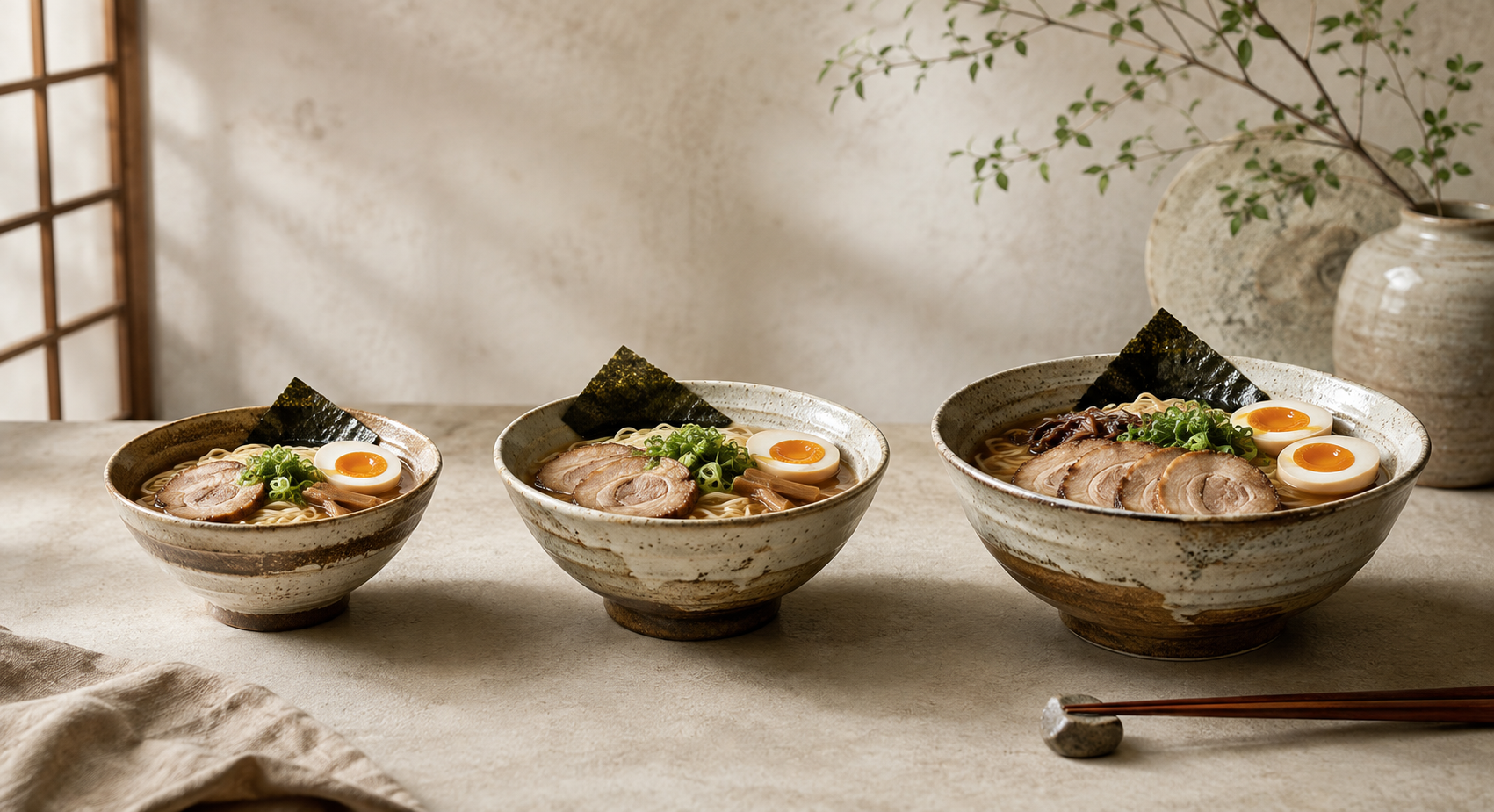
For most home cooks, the best all-around ramen bowl is approximately 40–45 US fl oz (1.2–1.35 L), about 7.75–8.5 inches (20–22 cm) in diameter, and roughly 3.5–4 inches (9–10 cm) deep.
That gives a normal serving of noodles and broth enough room for chashu, egg, vegetables, nori and other toppings without forcing you to fill the bowl close to its rim.
This range is also consistent with many Japan-made commercial noodle bowls. Current Japanese restaurant-supply examples include 40 fl oz bowls measuring 7.8 inches × 3.5 inches (19.8 × 8.9 cm), 44 fl oz bowls measuring 7.72 inches × 3.7 inches (19.6 × 9.4 cm), and other restaurant-oriented noodle bowls in the roughly 40–46 fl oz range.
As a practical rule:
- 30–34 fl oz / 890–1,000 ml: compact portions, instant ramen and lighter toppings.
- 40–45 fl oz / 1.2–1.35 L: the safest all-purpose size for most home ramen.
- 48–52 fl oz / 1.4–1.55 L: generous portions, abundant vegetables and restaurant-style presentation.
- 55 fl oz / 1.6 L and above: genuinely large bowls for oversized servings rather than an everyday necessity.
If you are buying only one ramen bowl size, start around 40–45 fl oz.
Ramen Bowl Size Chart
There is no single legally or culturally mandated “standard ramen bowl size.” Real bowls vary considerably by maker, shape and intended restaurant use. Japanese tableware retailers and restaurant suppliers currently sell ramen and noodle bowls spanning roughly 31 to more than 50 fl oz, with diameters from under 8 inches to well over 9 inches.
The table below is therefore a practical buying framework, not a claim that Japan follows one universal sizing system.
| Bowl Capacity | Approx. Diameter | Best For | Advantages | Watch Out For |
|---|---|---|---|---|
| 28–32 fl oz / 830–950 ml | 7–8 in / 18–20 cm | Small servings, instant ramen | Compact, lighter, easy to store | Tight once you add generous broth and toppings |
| 33–38 fl oz / 975–1,125 ml | 7.5–8.25 in / 19–21 cm | Moderate portions | Good compromise for smaller eaters | Less headroom for restaurant-style ramen |
| 40–45 fl oz / 1.18–1.33 L | 7.75–8.5 in / 20–22 cm | Most homemade ramen | Excellent balance of room, usability and storage | Can feel large for very small portions |
| 46–52 fl oz / 1.36–1.54 L | 8.25–9.25 in / 21–23.5 cm | Topping-heavy ramen, large servings | Generous presentation space | Heavier and harder to store |
| 55+ fl oz / 1.63+ L | Often 9+ in / 23+ cm | Oversized portions, specialty presentation | Maximum headroom | Often unnecessarily large for everyday use |
For context, MTC Kitchen currently lists Japan-made noodle bowls at 40 fl oz / 7.8 inches, 44 fl oz / 7.72 inches, 46 fl oz / 7.72 inches and 52 fl oz / 8.3 inches, while another large Japanese ceramic bowl holds 49 fl oz at a much wider 9.3-inch diameter. Those examples also illustrate why capacity and diameter must be considered together.
Why Ramen Bowl Capacity Matters More Than You Think
A ramen bowl does not hold broth alone.
It has to accommodate:
- cooked noodles
- broth
- chashu or another protein
- ajitama or another egg
- menma
- nori
- scallions
- mushrooms
- corn
- bean sprouts
- cabbage or bok choy
- aromatic oil
- minced meat
- chili paste
- sesame
- any other toppings you add
That distinction sounds obvious, yet it explains many disappointing ramen-bowl purchases.
A recipe may call for only 350–360 ml, or roughly 12 US fl oz, of broth. Just One Cookbook, for example, uses 360 ml of broth per serving in its shoyu ramen and 350 ml in its shio ramen. Sun Noodle similarly instructs cooks to mix one serving of its shoyu ramen soup base with approximately 1½ cups of hot water.
That does not mean a 16- or 20-ounce bowl is remotely suitable.
The noodles occupy substantial physical space. So do egg, pork and vegetables. More importantly, you need empty space above the food.
That empty space is headroom.
Why Headroom Matters
A bowl filled close to its maximum stated capacity is awkward to use.
There is less room to:
- lift and separate noodles with chopsticks
- slide a ramen spoon into the broth
- turn noodles without splashing
- arrange toppings attractively
- move the bowl safely from kitchen to table
- eat without pushing broth over the rim
One industry-oriented ramen bowl guide recommends keeping the finished dish around 70–80% of a bowl's full capacity rather than filling it to the brim. Treat that as a useful practical guideline rather than a formal Japanese rule.
A ramen bowl's stated capacity is therefore not the same thing as its ideal serving volume.
If a manufacturer says a bowl holds 40 fl oz, that usually describes approximately how much liquid the vessel can contain when filled very high. Your actual ramen should occupy less.
How Much Ramen Actually Goes Into a Bowl?
A realistic bowl of homemade ramen might begin with:
Broth: about 350–500 ml / 12–17 US fl oz
Fresh noodles: roughly 140–170 g / 5–6 oz before cooking
Protein: one or more slices of chashu, chicken or another topping
Egg: half or one whole ajitama
Vegetables: scallions, menma, sprouts, bok choy, corn, cabbage or mushrooms
Finishing ingredients: nori, aromatic oil, sesame, chili or other garnishes
Recipe examples support the noodle and broth quantities. Just One Cookbook's shoyu ramen uses 1,132–1,360 g of fresh noodles for eight servings—roughly 142–170 g per serving—along with 360 ml of broth per bowl. Its shio ramen uses 566–680 g of fresh noodles for four servings, a similar per-serving range.
A Worked Example
Imagine making one bowl with:
- 360 ml / 12.2 fl oz broth
- about 150 g / 5.3 oz fresh noodles
- 2 slices chashu
- 1 ramen egg
- menma
- scallions
- nori
- a spoonful of aromatic oil
It would be misleading to add those ingredients together as though every gram represented a milliliter of bowl capacity. Once noodles enter the soup, they displace broth and interlock rather than forming neat measured layers.
But this example explains why a bowl capable of holding only 900–950 ml to its brim can feel surprisingly crowded.
Move to roughly 1.2–1.35 L, and the same portion has room to breathe.
The larger bowl is not necessarily encouraging you to eat more. Much of the additional capacity is simply working space.
Is a 32 oz Ramen Bowl Big Enough?
Yes, a 32 fl oz ramen bowl—about 950 ml—can be large enough for ramen, but it is better suited to compact portions than to heavily topped restaurant-style bowls.
Thirty-two ounces works particularly well for:
- instant ramen
- smaller noodle portions
- lower-broth ramen
- children or lighter eaters
- minimalist toppings
- people with limited cupboard space
Japanese restaurant-supply catalogs do sell noodle bowls around this range. MTC Kitchen, for example, lists 31, 32 and 33 fl oz noodle bowls with diameters around 7.6–8 inches.
So there is nothing inherently “wrong” with 32 oz.
The limitation is headroom.
Once you introduce 360–500 ml of broth, a full portion of noodles, egg, multiple slices of pork and a mound of vegetables, 32 oz can become busy very quickly.
Choose 32 oz if you know you prefer modest ramen portions. Do not choose it as the default simply because 32 oz sounds large on paper.
Is a 40 oz Ramen Bowl the Ideal Size?
A 40 fl oz ramen bowl—about 1.18 L—is one of the best sizes for everyday home ramen.
It gives substantially more working room than a 32-ounce bowl without becoming cumbersome.
One Japan-made Mino ware noodle bowl sold for ramen measures 7.8 inches (19.8 cm) across, 3.5 inches (8.9 cm) high and 40 fl oz (1,180 ml) when filled. Another restaurant supplier lists several ramen-oriented bowls around 40–45 fl oz.
For most households, this is an excellent balance.
A 40-ounce bowl generally offers enough space for:
- a standard noodle portion
- normal broth volume
- egg
- several slices of protein
- vegetables
- nori
- comfortable chopstick movement
- a ramen spoon
If you usually cook relatively restrained ramen, 40 oz may be all you ever need.
If your favorite bowl involves a mountain of bean sprouts, thick chashu, corn, cabbage and an entire egg, consider moving closer to 44–50 oz.
Is 45 oz the Sweet Spot?
For someone who wants one bowl capable of handling almost every conventional home ramen serving, approximately 42–45 fl oz (1.24–1.33 L) is arguably the safest sweet spot.
This conclusion is a practical recommendation rather than a Japanese standard.
It is supported, however, by real commercial dimensions. Japan-made noodle bowls currently appear at 42, 44, 45 and 46 fl oz across restaurant-supply catalogs, while one ramen equipment specialist describes approximately 45 fl oz / 1.35 L as a commonly used restaurant capacity.
At this size, you receive generous headroom without crossing into obviously oversized territory.
What About 48–50 oz Ramen Bowls?
A 48–50 fl oz ramen bowl—approximately 1.42–1.48 L—is excellent for large, topping-heavy or restaurant-style ramen, but many home cooks do not need that much capacity every day.
Choose this size if you regularly make:
- miso ramen piled with vegetables
- spicy ramen with minced meat and greens
- bowls with several slices of chashu
- generous portions of bean sprouts or cabbage
- ramen with a whole egg and several toppings
- large servings for hearty appetites
- dramatic restaurant-style presentations
Large bowls can also create useful negative space around toppings, making the finished ramen look more composed.
Commercial examples demonstrate how different 50-ounce bowls can feel. A 52 fl oz ceramic noodle bowl can be 8.3 inches (21.1 cm) across and 4.13 inches (10.7 cm) high, while a 49 fl oz bowl can spread the similar volume across a much wider 9.3-inch (23.6 cm) mouth and only 3 inches (7.6 cm) of height.
Their capacities are close.
Their eating experiences are not.
The disadvantages of a 50 oz bowl
Larger bowls require more:
- cabinet space
- dishwasher space
- counter space
- table space
They may also weigh considerably more, particularly when made from substantial stoneware or thick restaurant ceramic.
And a very large empty-looking bowl can make an ordinary home portion seem visually undersized.
Choose 50 oz because your ramen needs the room—not because “larger” automatically means “better.”
Diameter vs. Capacity: Which Matters More?
Capacity tells you how much a bowl can hold. Diameter tells you how that volume is distributed. You need both measurements to understand how a ramen bowl will actually perform.
Consider two bowls with nearly identical capacities.
A narrow, deep bowl concentrates the noodles and broth vertically.
A wide, shallow bowl spreads everything horizontally.
That changes the experience.
Wide and Shallower Ramen Bowls
Advantages:
- more surface area for arranging toppings
- chashu and egg remain highly visible
- easier access with chopsticks
- visually generous presentation
- large pieces of nori or vegetables have more room
Potential disadvantages:
- more broth surface exposed to room air
- takes more horizontal table and cabinet space
- may feel less secure if extremely shallow
Japanese tableware guidance specifically notes that wide diameters are often preferred for ramen and other noodle dishes.
Narrower and Deeper Ramen Bowls
Advantages:
- compact footprint
- generous volume without excessive width
- potentially less exposed broth surface
- noodles remain gathered within a smaller area
Potential disadvantages:
- toppings can crowd each other
- lower noodles may be harder to manipulate
- very deep forms can feel more like multipurpose soup bowls than presentation-focused ramen bowls
Neither geometry is inherently superior.
For a home bowl intended specifically for ramen, a moderately wide opening with meaningful depth is usually the most forgiving compromise.
What Diameter Should a Ramen Bowl Be?
For most home ramen, look for a bowl about 7.75–8.5 inches (20–22 cm) in diameter.
That range is large enough to accommodate normal toppings while remaining manageable on a dining table.
A practical diameter guide is:
Around 7–7.5 in / 18–19 cm:
Best for compact servings and instant ramen.
Around 7.75–8.25 in / 20–21 cm:
An excellent everyday range.
Around 8.25–9 in / 21–23 cm:
Useful for large portions and toppings that benefit from more visible surface area.
Above 9 in / 23 cm:
Best when you deliberately want a broad, restaurant-like presentation.
A ramen equipment retailer describes approximately 7.5 inches / 19 cm as useful for home cooking, 8 inches / about 20.5 cm as common in restaurants, and 9 inches / about 23 cm as another restaurant size used for generous servings. Current Japanese restaurant-supply listings also show a concentration of ramen bowls around 7.7–8.5 inches.
Diameter alone, however, is not enough.
A wide bowl may still have surprisingly little capacity if it is shallow.
How Deep Should a Ramen Bowl Be?
Around 3.5–4 inches (9–10 cm) deep is a particularly versatile range for home ramen.
A Japan-made 40 fl oz bowl at MTC measures 3.5 inches / 8.9 cm high, while its 44 fl oz example measures 3.7 inches / 9.4 cm. A 52 fl oz example reaches just over 4 inches / 10.7 cm.
Depth matters because soup needs containment.
A bowl that is very shallow may look beautiful from overhead but becomes easier to splash when you lift noodles.
A bowl that is excessively deep presents the opposite problem: toppings disappear into the vessel and noodles at the bottom become less accessible.
As with diameter, the goal is balance.
Does Ramen Style Change the Bowl Size You Need?
Usually, portion size and topping volume matter more than the name of the ramen style itself.
You do not need to buy one bowl for shoyu and another for shio.
Still, certain styles tend to benefit from particular proportions.
Tonkotsu Ramen
Tonkotsu does not automatically require an enormous bowl.
Hakata-style ramen in particular can use relatively compact, straight-sided bowls because portions may be designed around additional noodle servings, or kaedama. Myojo describes the straight-sided kittachi-don as suitable for modest portions such as Hakata ramen and for accommodating this style of service.
For home use, roughly 36–44 fl oz / 1.06–1.30 L can work beautifully depending on toppings.
Shoyu Ramen
Shoyu ramen often looks particularly attractive in a moderately wide bowl where clear broth, noodles and toppings remain visible.
A recipe from Tokyo's Bizentei shared by Just One Cookbook uses 360 ml / 12.2 fl oz of soup broth per bowl, illustrating that an enormous vessel is not required simply because the dish contains soup.
A 40–45 fl oz bowl is an easy all-purpose choice.
Shio Ramen
Shio ramen follows much the same logic as shoyu ramen.
Just One Cookbook uses approximately 350 ml of broth per serving in its shio recipe.
A relatively open bowl can showcase the clarity of the soup, but portion size matters more than a rigid shape rule.
Miso Ramen
Miso ramen frequently carries substantial toppings—corn, ground meat, sprouts, cabbage or other vegetables—which can make extra surface area useful.
Japanese ramen-bowl guidance often pairs topping-heavy ramen with deeper or generously proportioned forms.
If your miso ramen is vegetable-heavy, 42–50 fl oz / 1.24–1.48 L is comfortable.
Spicy Ramen
Spiciness itself does not require a bigger bowl.
What matters is what accompanies the spice.
Tantanmen, for example, may include minced meat, greens, sesame-rich soup and aromatic toppings. A 40–48 oz bowl offers enough room without demanding an oversized vessel.
Topping-Heavy Ramen
This is where sizing up genuinely helps.
Choose 45–52 fl oz / 1.33–1.54 L if your ideal ramen includes multiple pieces of chashu, a whole egg, vegetables, mushrooms, corn and nori.
The additional room is not merely cosmetic. It makes it easier to reach the noodles beneath the toppings.
Instant Ramen
Instant ramen is one of the clearest cases where you can size down.
A typical single package plus basic toppings is comfortable in approximately 30–34 fl oz / 890–1,000 ml, though recipes with large amounts of water may demand more. Just One Cookbook's instant ramen example uses 500 ml of water before adding noodles, egg and optional protein, demonstrating why an ordinary cereal bowl may still be too small.
Tsukemen
Tsukemen changes the question completely.
Traditional tsukemen separates the noodles from the concentrated dipping broth, so you do not need one giant soup bowl. Just One Cookbook likewise presents tsukemen with the cold noodles and hot dipping soup served separately.
Use:
- a wider bowl or plate for the noodles
- a smaller, deeper bowl for the dipping broth
Buying a 50-ounce ramen bowl specifically for tsukemen would usually solve a problem that tsukemen does not have.
Ramen Bowl vs. Donburi Bowl: What’s the Difference?
The terms overlap in everyday retail, but the forms have different culinary centers of gravity.
A ramen bowl is generally optimized for noodles, broth and toppings, while a donburi bowl is traditionally associated with rice-and-topping dishes and tends to favor depth over an especially broad ramen-style opening.
MUSUBI KILN describes ramen bowls as larger and wider-rimmed than typical donburi bowls because ramen combines soup, noodles and toppings. Its donburi guidance suggests a versatile donburi around 18 cm / 7.1 inches in diameter, 9 cm / 3.5 inches deep and approximately 800–1,000 ml / 27–34 fl oz in capacity.
| Feature | Ramen Bowl | Donburi Bowl |
| Primary use | Soup noodles | Rice with toppings |
| Typical geometry | Wider opening | Often relatively deep |
| Topping visibility | High priority | Less dependent on broad surface |
| Broth handling | Central function | Secondary |
| Typical versatile capacity | Often 1 L+ | Around 800–1,000 ml is common for versatile medium forms |
| Can serve ramen? | Yes | Yes, if sufficiently large |
Can You Use a Donburi Bowl for Ramen?
Yes. A large donburi can make an excellent ramen bowl.
The question is not the label printed on the product page.
Check its:
- total capacity
- opening diameter
- depth
- rim
- weight
If your donburi holds around 1.0–1.2 L or more and has a comfortable opening, it may be perfectly suitable for moderate ramen portions.
A smaller 700–800 ml donburi, however, is likely to feel cramped.
Japanese Ramen Bowl Shapes Explained
Japanese ramen bowls are not one standardized object.
Specialist sources describe several forms used by restaurants, and the terminology refers primarily to shape and construction, not immutable rules linking a particular bowl to a particular recipe.
Kōdai-don / Sori Kōdai-don
The kōdai-don is a high-footed bowl.
Its raised foot helps provide a gripping point beneath the hot body of the bowl, while the sori variation incorporates a more outward-curving profile. Myojo identifies the high-footed form as one of the most familiar ramen-bowl shapes.
For the home cook, the practical benefit is straightforward: a defined foot can make a hot ceramic bowl easier to handle.
Kittachi-don
The kittachi-don has comparatively straight sides and tends to be compact and stackable.
Myojo specifically associates it with modest Hakata-style servings and kaedama service.
At home, this form makes sense when cabinet efficiency matters or when you prefer smaller bowls.
Tama-don / Tamabuchi-don
The tama-don or tamabuchi-don has a rounded, substantial rim.
The heavier rim can improve resistance to edge chipping in restaurant use, and these bowls are often associated with ramen carrying plentiful toppings.
Tayō-don
Tayō means multi-use.
The tayō-don is exactly that: a versatile bowl that can move between ramen, udon, soba and rice dishes rather than being optimized exclusively for one meal.
For a small kitchen, this can be one of the smartest choices.
Men-don / Men-bachi
Myojo describes men-don or men-bachi as a broad, open noodle bowl combining useful depth with a wide presentation area.
If your favorite part of ramen is arranging chashu, ajitama, nori and vegetables across the surface, this type of geometry is particularly appealing.
A useful terminology note
Japanese tableware vocabulary does not map perfectly onto English retail categories.
MUSUBI KILN distinguishes wan bowls, which are commonly lifted during eating, from larger hachi categories. Ramen bowls and donburi bowls fall into the latter group. A chawan, meanwhile, generally refers to a rice bowl or tea bowl depending on context—not a large ramen vessel.
So a product described generically online as a “Japanese bowl” should not automatically be assumed to be suitable for ramen.
What Material Is Best for a Ramen Bowl?
There is no universal winner.
The more useful question is:
What balance of weight, density, texture, appearance and durability do you want?
Porcelain
Porcelain is an excellent ramen-bowl material when you prefer:
- a relatively refined surface
- crisp glaze colors
- a clean interior
- lower visual bulk
- a vessel that can feel elegant despite its large size
Technically, porcelain bodies are generally fired toward a high degree of vitrification, creating a dense ceramic structure. Ceramic Arts Network notes that fired porcelains contain a substantial glass phase, while ceramic testing references typically place mature porcelain at very low water absorption.
But “porcelain” alone does not tell you how a bowl will feel.
Wall thickness, shape, glaze and manufacturing quality matter enormously.
Stoneware
Stoneware suits buyers who enjoy:
- tactile surfaces
- visible clay character
- substantial forms
- reactive or varied glazes
- an earthy visual presence
Properly matured stoneware can also be dense and durable functional ware. Ceramic references describe vitrification—not the marketing label alone—as an important factor in a clay body's density and performance.
Many handmade bowls that feel particularly expressive on the table fall into this broad ceramic family.
Other Ceramics
“Ceramic” is an umbrella term, not a precise performance specification.
A bowl may be porcelain, stoneware, earthenware or another formulated clay body.
For foodware, pay attention to the maker's intended use and care instructions rather than assuming every ceramic bowl behaves identically.
And be cautious with generalized claims about heat retention.
A heavy, thick porcelain bowl may retain heat differently from an exceptionally thin one. A thick stoneware bowl may feel different from light commercial stoneware.
Mass, thickness, geometry, starting temperature and surface area all affect how quickly your ramen cools; the material name alone does not settle the question.
Handmade vs. Mass-Produced Ramen Bowls
A mass-produced ramen bowl can be extremely functional.
Uniform walls, predictable stacking, consistent dimensions and durable glazes are genuine advantages—particularly in restaurants.
Handmade tableware offers something different.
Depending on the maker and process, you may notice:
- subtle asymmetry
- variation in glaze pooling
- small differences in diameter
- throwing or trimming marks
- variations in the foot
- brushwork
- carved decoration
- differences in texture from piece to piece
These qualities do not automatically make handmade ceramics technically superior.
They make them individual.
And for an object that may sit in your hands and on your table hundreds of times, individuality can matter.
A good handmade ramen bowl still needs to work.
It should remain stable when full. The rim should feel comfortable. The foot should sit securely. The interior should give your spoon and chopsticks room to move.
Craftsmanship becomes most compelling when beauty and proportion reinforce those practical needs rather than compete with them.
How to Choose the Right Ramen Bowl in 30 Seconds
If you remember nothing else from this guide, use this:
Choose 30–34 fl oz / 890–1,000 ml if…
You mainly eat instant ramen, prefer smaller portions or need compact bowls.
Choose 40–45 fl oz / 1.2–1.35 L if…
You want one versatile ramen bowl for normal homemade ramen.
This is the best default recommendation for most people.
Choose 48–52 fl oz / 1.4–1.55 L if…
You love large portions, vegetables, thick slices of chashu and abundant toppings.
Choose a wider bowl if…
Presentation and easy access to toppings matter most.
Choose a slightly deeper bowl if…
You want a compact footprint and generous broth capacity.
If you cannot decide…
Buy approximately 42–45 fl oz, 8–8.5 inches across and 3.5–4 inches deep.
That size is difficult to outgrow without feeling absurdly oversized for an ordinary dinner.
Before You Buy: The Ramen Bowl Checklist
Before ordering, check:
- Capacity: Is the stated number total brim capacity or recommended serving capacity?
- Diameter: Is the opening wide enough for toppings?
- Depth: Does it contain broth without becoming awkwardly deep?
- Weight: Remember it will become much heavier when filled.
- Material: Porcelain, stoneware or another ceramic?
- Rim shape: Comfortable for drinking broth and handling?
- Foot: Does it provide a stable base?
- Stability: Does the base feel proportionate to the opening?
- Ramen spoon compatibility: Can a spoon rest comfortably without disappearing?
- Chopstick usability: Is there enough room to lift and separate noodles?
- Dishwasher compatibility: Check the maker's instructions.
- Microwave compatibility: Check the maker's instructions.
- Stackability: Especially important if buying four or six.
- Storage: Measure your cabinet before buying 9-inch bowls.
- Craftsmanship: Hand-painted, hand-glazed, wheel-thrown or molded?
- Serving style: Minimal ramen or topping-heavy ramen?
Microwave and dishwasher safety should always be verified for the individual product. Even similar-looking ceramics can have different clay bodies, glazes, decorative finishes and care requirements.
Common Ramen Bowl Buying Mistakes
1. Buying Based Only on Diameter
An 8-inch bowl could hold 32 oz or significantly more depending on its depth and profile.
Always check capacity too.
2. Matching Bowl Capacity to Broth Volume
If your recipe uses 360 ml of broth, you do not need a 360 ml bowl.
The noodles and toppings need room as well.
3. Forgetting Headroom
A bowl is not meant to be comfortable only when empty.
Imagine manipulating slippery noodles with chopsticks when the broth is 5 mm from the rim.
4. Assuming Every “Japanese Noodle Bowl” Is a Ramen Bowl
Udon, soba, donburi and ramen vessels overlap, but their proportions can differ.
Read the dimensions.
5. Automatically Buying the Largest Bowl
A 57-ounce bowl can look dramatic online.
At home it may also consume half a cabinet shelf and dwarf your normal serving.
6. Ignoring Weight
A large handmade stoneware bowl can feel reassuringly substantial when empty and surprisingly heavy once it contains a liter's worth of food.
Check product weight when available.
7. Ignoring Your Ramen Spoon
A very narrow bowl may accommodate noodles perfectly yet become irritating when you introduce a broad renge-style spoon.
8. Choosing With Your Eyes Alone
A beautiful bowl that splashes broth every time you lift noodles will become decoration.
A good ramen bowl should make the meal easier to eat.
Choosing a Ramen Bowl as a Gift
A handcrafted ramen bowl makes an unusually thoughtful gift because it sits somewhere between cookware and personal object.
It is practical enough to use regularly but expressive enough to remember who gave it.
Ramen bowls work especially well for:
- home cooks
- ramen enthusiasts
- Japanese food lovers
- couples
- housewarmings
- birthdays
- weddings
- culinary collectors
For gifting, 40–45 fl oz is again the safest range because the recipient does not need to have unusually small or unusually large eating habits.
A paired set can be particularly appealing for couples, while bowls with hand-painted decoration or distinctive glazing offer character without requiring you to know exactly how the recipient cooks.
If you are uncertain about care habits, check whether the specific bowl is dishwasher and microwave compatible before choosing it as an everyday gift.
Discover Handcrafted Ramen Bowls at Oriental Artisan
Once the dimensions are right, the decision becomes more personal.
A bowl can simply be a container for dinner.
Or it can become one of those objects you reach for without thinking—the glaze you recognize instantly in the cupboard, the weight that feels familiar in your hands, the vessel that somehow makes a quiet meal at home feel complete.
At Oriental Artisan, the appeal of handcrafted ramen bowls and East Asian tableware lies in that meeting point between usefulness and character: considered proportions, expressive glazes, hand-finished details and ceramic traditions that give an everyday object a stronger sense of presence.
The goal is not to make dinner ceremonial every night.
It is simply to choose objects that make ordinary moments worth noticing.
The right ramen bowl does more than hold dinner. It gives the meal space, proportion and a sense of place.
For readers ready to move from measurements to materials and craftsmanship, explore handcrafted ramen bowls at Oriental Artisan and discover tableware crafted for quiet moments.
Frequently Asked Questions
What is the standard size of a ramen bowl?
There is no single universal standard ramen bowl size, but approximately 40–45 US fl oz (1.2–1.35 L) and around 8 inches (20 cm) across is an excellent benchmark. Japanese commercial noodle bowls are sold across a broad range, including 40, 42, 44, 45 and 46 fl oz examples around this diameter.
How many ounces should a ramen bowl hold?
For most home cooks, a ramen bowl should hold around 40–45 US fl oz. Smaller 30–34 oz bowls suit instant ramen and light portions, while 48–52 oz bowls provide extra space for topping-heavy ramen.
Is 32 oz big enough for ramen?
Yes, 32 fl oz / approximately 950 ml is enough for compact ramen servings, but it can become crowded with generous broth and toppings. Restaurant suppliers do sell noodle bowls around 31–33 oz, so the size is legitimate; it is simply less forgiving than a 40-ounce bowl.
Is a 40 oz bowl good for ramen?
Yes. A 40 fl oz / approximately 1.18 L bowl is one of the best everyday ramen sizes. One Japan-made commercial example measures 7.8 inches / 19.8 cm in diameter and 3.5 inches / 8.9 cm high, dimensions well suited to home ramen.
Is a 50 oz ramen bowl too large?
No, but 50 oz / approximately 1.48 L is larger than most home cooks need for ordinary portions. It is excellent for generous servings, large vegetables and topping-heavy ramen.
What diameter should a ramen bowl be?
Around 7.75–8.5 inches / 20–22 cm is a versatile diameter for home ramen. Smaller bowls around 7.5 inches suit compact servings, while 9-inch bowls give toppings more presentation space. Commercial ramen guidance and restaurant-supply examples support this general range.
How deep should a ramen bowl be?
About 3.5–4 inches / 9–10 cm is a useful target for an all-purpose ramen bowl. Real commercial examples at 40–52 fl oz commonly fall near this range.
Can I use a donburi bowl for ramen?
Yes, provided the donburi is large enough. A versatile donburi around 800–1,000 ml / 27–34 fl oz can accommodate moderate noodle dishes, but a larger and wider vessel is generally more comfortable for full ramen with broth and toppings.
What material is best for ramen bowls?
Porcelain and stoneware are both excellent choices; neither is universally best. Porcelain can provide a refined, dense and relatively clean-feeling surface, while stoneware often offers more texture and glaze character. Thickness, firing, glaze quality and shape matter alongside the material label.
Why are ramen bowls so large?
Ramen bowls are large because they must accommodate noodles, broth, toppings and usable empty space above the food. Their stated capacity should not be confused with the amount of broth in one serving.
What size ramen bowls do restaurants use?
Restaurant ramen bowls vary widely, but roughly 40–50 fl oz and around 8–9 inches in diameter is common among commercially sold noodle bowls. Current Japanese restaurant-supply listings include 40–46 oz bowls around 7.7–8.5 inches and bowls around 49–52 oz at 8.3–9.3 inches.
What size ramen bowl is best for home use?
For most homes, choose approximately 40–45 fl oz / 1.2–1.35 L, 7.75–8.5 inches / 20–22 cm across, and roughly 3.5–4 inches / 9–10 cm deep. It provides enough room for standard broth, noodles and toppings without creating an unnecessarily oversized bowl.


Leave a comment
This site is protected by hCaptcha and the hCaptcha Privacy Policy and Terms of Service apply.