


How to Choose a Japanese Sake Set: Cups, Carafes and Rituals Explained
Choosing a Japanese sake set is less about finding the most elaborate matching set and more about choosing vessels that suit how you actually drink sake.
For most first-time buyers, the best starting point is a versatile ceramic or porcelain set with one tokkuri and two to four small cups. If you mainly drink aromatic ginjo or daiginjo chilled, consider glass or thin porcelain with slightly more open cups. If you prefer warm, fuller-bodied sake, ceramic cups and a heat-friendly tokkuri are particularly practical. If the set is primarily a gift or collectible, craftsmanship, provenance, presentation and the character of the individual pieces become more important.
In other words, choose in this order:
sake style → serving temperature → cup shape → material → capacity → number of drinkers → craftsmanship and aesthetics.
That sequence prevents one of the most common mistakes in buying sake ware: choosing a beautiful set that does not suit the way you drink.
What Is a Japanese Sake Set?
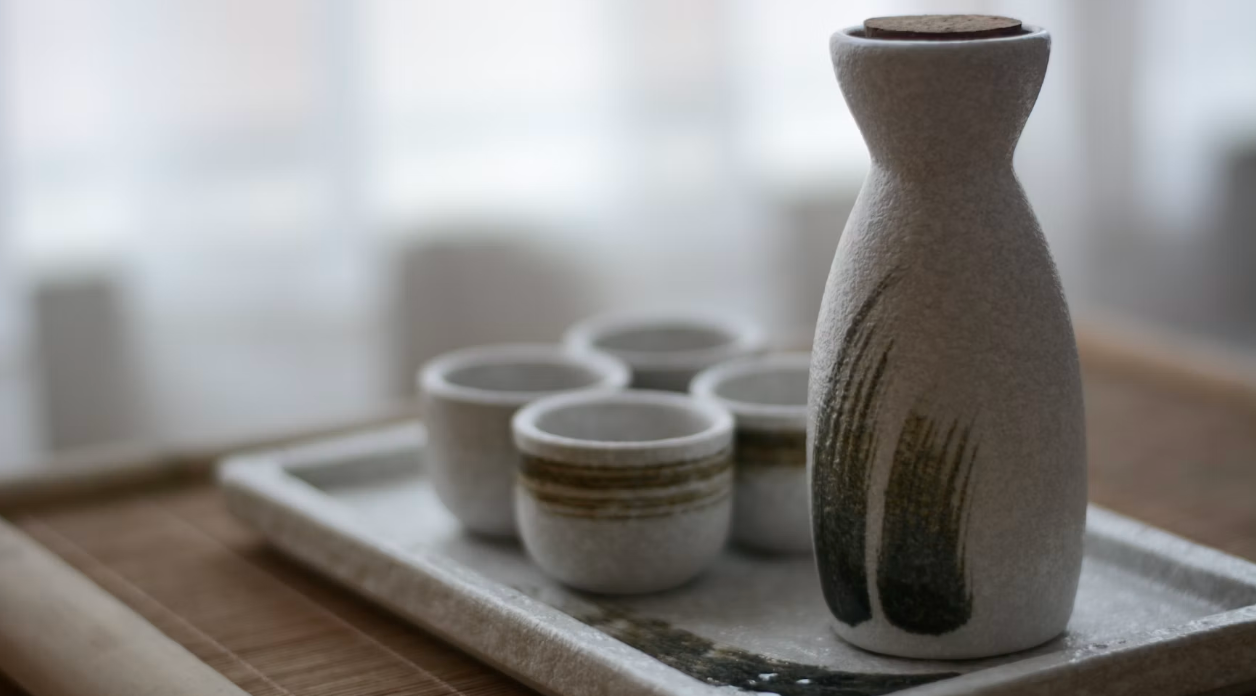
A Japanese sake set is a group of vessels used to serve and drink sake, usually consisting of a serving vessel such as a tokkuri and one or more sake cups.
There is no single mandatory configuration. A traditional-looking set may pair a tokkuri with small ochoko, while another might combine a katakuchi with larger guinomi. Ceramics are especially common, but Japanese sake ware is also made from porcelain, glass, lacquered wood, tin and other materials. The Japan Sake and Shochu Makers Association notes that sake is commonly served in ceramic vessels and small cups, while glass, lacquerware, wooden vessels and metal warming vessels all have established roles.
The important point is that sake set describes a function rather than one rigid historical design.
What does a traditional sake set include?
For home use, the most familiar combination is:
- one tokkuri for serving
- two to four ochoko or other sake cups
Larger sets may also include a warmer, tray or additional cups. Alternatively, a katakuchi may replace the tokkuri, particularly when the drinker prefers a wide, open serving vessel.
At Oriental Artisan, the existing Sake Ware Collection includes configurations ranging from a simple tokkuri-and-two-cup set to larger sets with warmers, trays and four cups, illustrating how varied the category can be.
The Five Sake Vessels Worth Knowing
You do not need to memorize dozens of Japanese terms. Five will explain most sake sets you encounter.
| Vessel | What it is | Best for |
|---|---|---|
| Tokkuri 徳利 | Narrow-necked serving flask | Everyday serving, especially warm sake |
| Ochoko お猪口 | Small drinking cup | Social drinking, frequent small pours |
| Guinomi ぐい呑み | Usually larger than an ochoko | Relaxed drinking and larger sips |
| Sakazuki 盃 | Wide, shallow cup | Ceremonial use or slow, deliberate sipping |
| Katakuchi 片口 | Open vessel with one pouring spout | Chilled/room-temperature sake, aroma and table presentation |
The distinctions are useful, but they should not be treated as legally standardized size categories. Individual makers interpret these forms differently.
Ochoko: The Classic Small Sake Cup
An ochoko is a small sake cup intended for relatively small pours, often encouraging a slower and more social rhythm of drinking.
The Japanese government's Highlighting Japan describes ochoko as small vessels intended for approximately a single sip, while the Japan Sake and Shochu Makers Association distinguishes them from the somewhat larger guinomi.
Because the cup empties relatively quickly, an ochoko also creates repeated opportunities to pour for one another. That helps explain why the form feels so natural within a shared Japanese dining setting.
For a beginner, ochoko are particularly good when:
- you usually drink with another person
- you enjoy warm sake
- you prefer small, controlled servings
- you want a recognizably traditional sake-set experience
The disadvantage is that very small cups require frequent refilling. Someone drinking alone while reading, cooking or eating a long meal may find a guinomi more convenient.
Guinomi: A More Generous Cup
A guinomi is generally larger than an ochoko and is designed for several sips rather than one small pour.
The distinction is not governed by one universal capacity, but government guidance describes guinomi as slightly larger than ochoko and suitable for several small sips.
A guinomi can be especially satisfying when the cup itself is an important part of the experience. Because there is more surface area to hold, handmade clay, throwing marks, glaze pooling and rim shape become more noticeable.
Choose guinomi if you:
- dislike constantly refilling a tiny cup
- often drink sake alone
- appreciate tactile handmade ceramics
- want to spend more time examining aroma between pours
- enjoy fuller-bodied sake alongside food
Many ceramic collectors eventually accumulate guinomi individually rather than insisting that every cup match the carafe.
That is worth remembering: a sake set does not have to match perfectly to feel considered.
Ochoko vs Guinomi: What Is the Difference?
Ochoko are generally smaller and encourage frequent, social pours; guinomi are usually larger and allow several sips from each serving.
Neither is inherently more authentic or better.
Choose ochoko for intimate shared service and warm sake rituals. Choose guinomi when you want more capacity, a more substantial feel in the hand or greater appreciation of an artisan cup as an individual object.
For many enthusiasts, owning both is more useful than searching for one “perfect” cup.
Sakazuki: The Ceremonial Sake Cup
A sakazuki is a shallow, wide-rimmed sake cup strongly associated with ceremonial and celebratory drinking, although it can also be used casually.
Its broad shape creates a very different gesture from drinking from an ochoko. Rather than enclosing the sake, the vessel spreads it across a shallow surface.
Sakazuki have important ceremonial associations. In Shinto-style wedding traditions, the san-san-kudo ritual involves the bride and groom drinking sake from sakazuki as part of the formal joining of the couple and families. Decorative lacquered sakazuki remain associated with celebrations and formal occasions.
That does not mean you need a ceremony to use one.
A beautifully made sakazuki can be an excellent choice for someone who values the visual act of drinking and prefers a wide, shallow vessel.
Tokkuri: The Traditional Sake Carafe
A tokkuri is a narrow-necked Japanese sake serving vessel used to transfer sake from the bottle to the table and pour it into smaller cups.
The classic silhouette has a fuller body and narrowed neck, although shapes vary considerably.
The Japan Sake and Shochu Makers Association describes a typical tokkuri as holding around 180 mL / 6.1 US fl oz, while table-service vessels of up to approximately 300 mL / 10.1 US fl oz are also common.
The narrow neck is especially useful for controlled pouring and makes a tokkuri practical for warming sake in a water bath.
When should you choose a tokkuri?
Choose one if you want:
- a traditional sake-set configuration
- warm-sake capability
- controlled pouring
- a compact shared serving vessel
- less exposed surface area than a wide carafe
For two people, a roughly 180–300 mL vessel is usually comfortable. A much larger carafe may seem more convenient, but chilled sake can warm before you finish it and warmed sake can cool.
Smaller vessels therefore have a sensory advantage: they encourage serving sake in fresh, temperature-controlled batches.
Katakuchi: The Open Alternative
A katakuchi is an open serving vessel with a pouring spout formed on one side of the rim.
Unlike the bottle-like tokkuri, it resembles a small bowl or pitcher.
Its wide opening makes pouring effortless and exposes more of the sake to the air. Kikkoman's culinary glossary notes that katakuchi are traditionally used for sake as well as other foods and liquids; the larger exposed surface also changes how the drink's aroma is experienced.
A katakuchi is particularly appealing for:
- chilled sake
- room-temperature sake
- aromatic styles
- contemporary table settings
- drinkers who want to see the liquid
- dramatic handmade glazes
It is less inherently suited to retaining heat than a narrow-necked tokkuri.
For this reason, a useful rule is:
Tokkuri for temperature control; katakuchi for openness and presentation.
Not an absolute rule, but a good shopping shortcut.
Does the Shape of a Sake Cup Matter?
Yes. Cup shape changes how sake reaches the nose and mouth, how quickly it warms, how large each sip feels and therefore how you perceive the drink.
A wider opening releases aroma more freely and presents more sake across the palate. Narrower openings can make the drinking experience feel more focused and restrained.
A 2025 Japanese government feature on sake vessels notes that different shapes can produce noticeably different impressions from the same sake, with wider openings tending to emphasize fullness and umami while narrower openings can produce a cleaner impression.
The important word is tending.
Sake is complex, and vessel shape is only one variable. Temperature, sake style, rim thickness and the drinker's own palate matter too.
A practical shape guide
If you enjoy highly aromatic ginjo or daiginjo, try a cup with enough opening for the aroma to develop.
If you enjoy warm junmai or richer, savory sake, a ceramic guinomi with a slightly wider mouth can create a satisfying, full-bodied experience.
If you enjoy crisp, cold sake and prefer a clean impression, try a smaller glass or porcelain cup with a narrower opening.
If unsure, choose a moderately sized cup with a gently open rim. It will be far more versatile than an extreme shape.
Ceramic vs Porcelain vs Glass: Which Sake Set Is Best?
There is no universally best material. Ceramic emphasizes texture and warmth; porcelain offers refinement and a smoother surface; glass suits chilled and aromatic sake particularly well; lacquerware brings ceremonial and tactile character; and metal is especially useful when temperature responsiveness matters.
Quick material comparison
| Material | Character | Temperature | Best suited to |
|---|---|---|---|
| Porcelain | Smooth, refined, often thin | Chilled to warm* | Versatility, decorated ware |
| Stoneware / pottery | Tactile, substantial | Especially satisfying warm | Casual rituals, artisan ceramics |
| Glass | Clear, visually light | Chilled / room temperature | Aromatic sake, summer service |
| Lacquerware | Light, warm-touch, ceremonial | Maker dependent | Celebrations, traditional settings |
| Tin / metal | Highly temperature responsive | Chilled or warming applications | Specialist sake service |
*Always follow the individual maker's temperature and microwave instructions.
Porcelain Sake Ware
Porcelain is a strong choice for someone who wants refinement without sacrificing practicality.
Compared with many coarse clay bodies, porcelain typically provides:
- a smoother surface
- a relatively fine rim
- a visually clean background
- good suitability for painted decoration
- less tactile roughness
Arita and Imari porcelain, for example, are known for their white porcelain bodies and decorated surfaces. Traditional production can involve wheel or mold forming, bisque firing, underglaze painting, glazing, high-temperature firing and additional firing for overglaze decoration.
Kutani ware takes another decorative direction, with a tradition particularly associated with richly colored overglaze painting. Sake sets are among the traditional products of Kutani production.
Porcelain is a compelling choice if you appreciate:
precision, hand painting, refined decoration and a clean drinking surface.
Stoneware and Japanese Pottery
Ceramic sake ware is where regional Japanese clay traditions become especially fascinating.
The difference is not simply that pottery looks “rustic.” Clay composition, forming, glaze, firing atmosphere and kiln placement can all affect the final surface.
Bizen Ware
Bizen is traditionally associated with unglazed pottery shaped by clay, intense firing, ash and flame effects. Traditional Bizen production can involve prolonged wood firing without applied glaze or painting, creating surfaces that vary according to position and conditions inside the kiln. Sake ware is one of its established product categories.
For the buyer, that means variation is not merely decorative imitation. It can emerge from the firing itself.
Hagi Ware
Hagi ware offers a very different experience. Official craft documentation emphasizes its softer clay character and comparatively high absorption; over time, use can subtly affect the appearance of the vessel, a phenomenon historically appreciated by tea practitioners.
Karatsu Ware
Karatsu is strongly associated with clay texture and restrained decoration. Traditional production includes wheel throwing and other forming methods, with techniques such as brushwork, carving, slip decoration and glazing before firing.
These traditions demonstrate why “Japanese ceramic sake cup” is an extremely broad category.
A serious handmade cup is not valuable simply because it is imperfect. What matters is how material, process, intention and use come together.
Glass Sake Ware
Glass is particularly well suited to chilled sake and styles whose aroma or appearance you want to appreciate clearly.
The Japan Sake and Shochu Makers Association notes that glassware is commonly used for chilled sake and that wine glasses can be especially useful for aromatic sake. Small sake glasses up to around 110 mL / 3.7 US fl oz are common.
Glass is therefore a strong choice for:
- ginjo and daiginjo
- sparkling sake
- summer drinking
- transparent or lightly colored sake
- people accustomed to wine glasses
It also creates opportunities for Japanese decorative glass traditions.
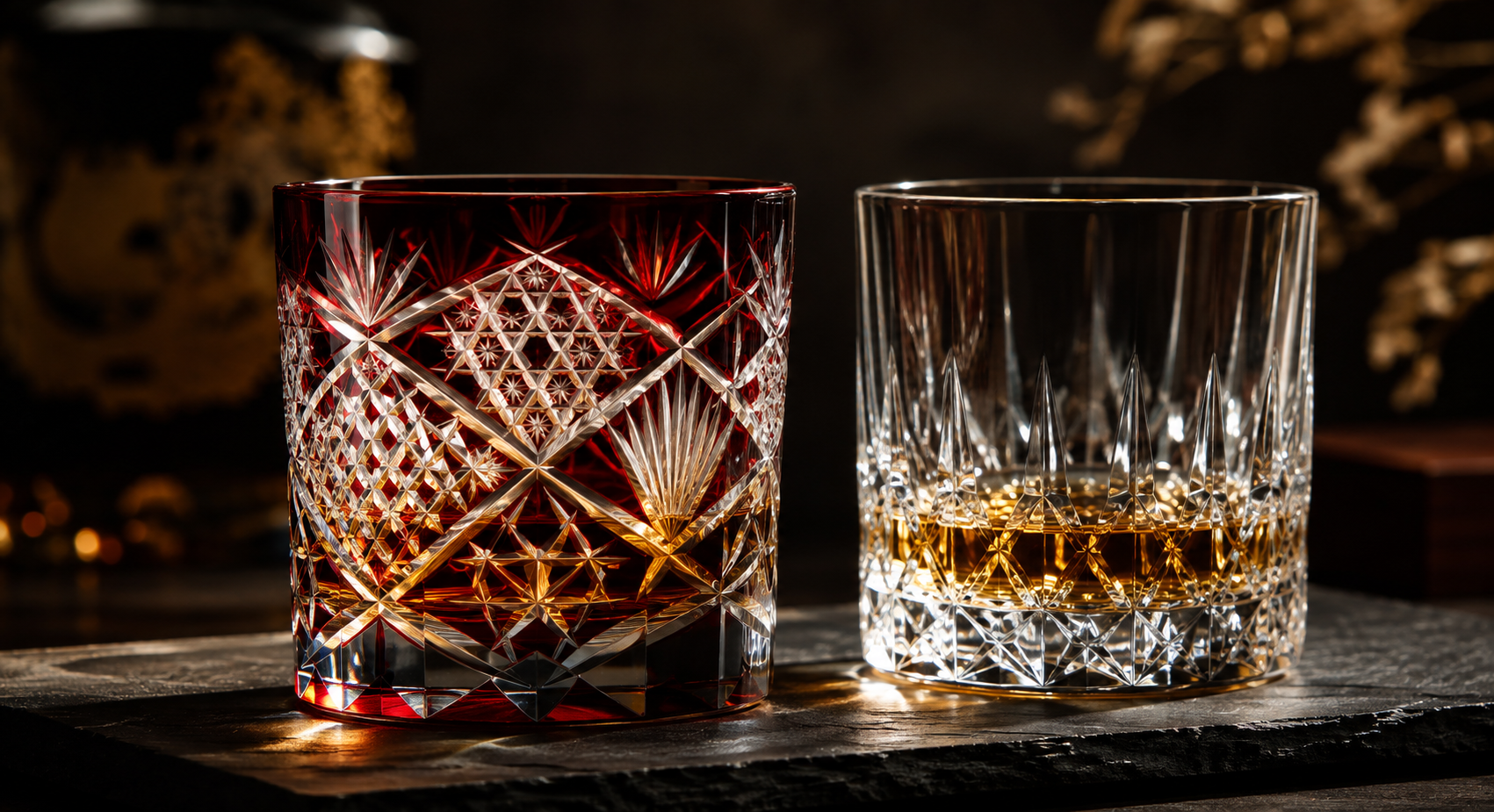
An Edo Kiriko cup, for example, introduces hand-cut pattern, light and color into the sake experience. Japanese government material specifically features Edo Kiriko among examples of glass sake vessels.
For Oriental Artisan, this creates a particularly natural internal link from the article to the Edo Kiriko collection and the existing Ultimate Guide to Edo Kiriko.
The important caveat: not every beautiful cut-glass tumbler is automatically an ideal sake cup. Consider its capacity, weight and rim first.
Lacquerware Sake Cups
Lacquerware brings a lightweight, warm tactile quality to sake service and has especially strong associations with ceremonial occasions.
The JSS notes the historical use of lacquerware at banquets and ceremonies and its continued association with weddings and New Year celebrations.
Traditional lacquerware is far more technically involved than simply applying a glossy coating.
Wajima-nuri, for example, can involve preparing a wooden substrate, reinforcing vulnerable areas with cloth, applying multiple foundation layers, sanding, intermediate and top coats, and finally decorative work such as maki-e or chinkin.
That layered construction is part of what distinguishes serious lacquer craftsmanship from a superficial imitation finish.
Choose lacquerware when the vessel's weight, touch, symbolism and ceremony matter as much as transparency or glaze.
Tin and Other Metal Sake Ware
Metal sake ware deserves more attention than it usually receives.
Japan has established traditions of tin sake vessels. Osaka Naniwa tinware, for example, includes sake vessels among its recognized products, and its production relies heavily on skilled casting, shaping and polishing because tin is comparatively soft.
Metal's practical advantage is temperature response. A tin cup quickly communicates whether its contents are cool or warm to the hand.
For warming, another specialist vessel is the chirori, traditionally made from metals including tin or copper and placed into hot water to bring the sake to serving temperature.
Metal is therefore less of a default beginner purchase and more of an excellent specialist choice once you know how you prefer to serve sake.
Choosing Sake Ware for Hot vs Cold Sake
This is the single most important functional decision.
Does sake have to be served hot?
No. Sake may be enjoyed chilled, at room temperature or warmed, and the appropriate temperature depends on the sake and the experience you want.
The Japan Sake and Shochu Makers Association gives broad serving categories of approximately:
| Style | Temperature |
|---|---|
| Chilled | 8–15°C / 46–59°F |
| Room temperature | 15–25°C / 59–77°F |
| Warmed | 40–50°C / 104–122°F |
More detailed Japanese terminology exists for specific temperatures within this spectrum.
Temperature can influence perceived sweetness, acidity, umami, bitterness, aroma intensity and texture. JSS professional guidance, for example, describes chilled sake as tending toward sharper, fresher impressions while warmer sake can appear rounder and broader.
So choosing a sake set without considering temperature is rather like buying cookware without considering what you intend to cook.
If You Primarily Drink Chilled Premium Sake
Consider:
glass, thin porcelain or refined ceramic cups with moderately open rims.
Aromatic ginjo and daiginjo are frequently enjoyed chilled or around ambient temperature because cooling can preserve a fresh, delicate impression. JSS notes that many drinkers prefer ginjo and daiginjo around 8–12°C / 46–54°F, although gentle warming can also reveal another side of them.
A glass serving vessel or katakuchi can work especially well.
You do not necessarily need a traditional bottle-shaped tokkuri.
Best beginner configuration
One glass or porcelain carafe + two moderately sized cups.
If You Primarily Enjoy Warm Sake
Choose:
a heat-compatible ceramic tokkuri + small ceramic cups.
Ceramic is comfortable in the hand and a narrow-necked tokkuri is convenient for hot-water warming.
For home service, JSS recommends warming sake by placing the filled vessel into hot water with the heat switched off, allowing it to reach the desired temperature gradually. Microwave warming is also possible with an appropriate vessel, although stirring afterward helps equalize temperature.
Do not assume the hottest temperature is the best.
A sake that feels beautifully rounded at 40°C / 104°F may become harsh when taken much hotter.
And sparkling sake generally should not be heated, because heating releases its carbonation.
If You Want Maximum Versatility
Choose:
a glazed ceramic or porcelain tokkuri around 180–300 mL and cups around 40–80 mL with neither extremely narrow nor extremely wide rims.
This combination works comfortably across:
- lightly chilled sake
- room-temperature sake
- gently warmed sake
- social drinking
- solo drinking
- food pairing
It is the configuration I would recommend to most first-time buyers.
CTA: Explore Handcrafted Japanese Sake Sets
Recommended internal link: Sake Ware Collection
What Size Sake Set Should You Buy?
Size affects much more than convenience.
Sake cup size
Small cups encourage frequent pouring and keep individual servings from sitting long enough to change temperature dramatically.
Larger cups reduce refilling and give aroma more room to develop, but very large vessels can remove some of the intimate rhythm associated with traditional sake service.
As a practical shopping framework rather than a strict definition:
| Approximate capacity | Experience |
|---|---|
| 30–50 mL / 1.0–1.7 oz | Small, traditional-feeling pours |
| 50–80 mL / 1.7–2.7 oz | Versatile everyday range |
| 80–110 mL / 2.7–3.7 oz | More generous sipping / aromatic styles |
| 110 mL+ / 3.7 oz+ | Increasingly glass-like or tumbler-like experience |
There are no rigid borders between ochoko and guinomi, so use capacity as a practical guide rather than trying to police terminology.
Sake carafe size
A classic small tokkuri is frequently around 180 mL / 6.1 oz, roughly equivalent to one go, a traditional Japanese volume measure often encountered in sake culture. JSS also notes table vessels of up to approximately 300 mL.
For two people, roughly 180–300 mL / 6.1–10.1 oz is usually very comfortable.
For four people, you can either use a somewhat larger server or refill a smaller one.
I often prefer the second approach.
Why?
Because refilling allows the next portion to arrive at the temperature you actually intended.
How to Choose Your First Japanese Sake Set
If you remember only one section of this guide, make it this one.
1. What sake do you drink most often?
Mostly ginjo or daiginjo
Look toward glass, thin porcelain or refined ceramic cups.
Junmai, kimoto, yamahai or richer styles
Consider tactile ceramic guinomi or ochoko, particularly if you sometimes warm the sake.
You are still exploring
Choose a neutral, versatile glazed ceramic or porcelain set.
2. Do you prefer chilled or warm sake?
Mostly chilled
Glass or porcelain; open or medium-width cup.
Mostly warm
Heat-compatible ceramic tokkuri; smaller ceramic cups.
Both
Glazed ceramic or porcelain with straightforward care instructions.
3. How many people normally drink with you?
One
A guinomi and small serving vessel may be enough.
Two
One tokkuri or katakuchi plus two cups is ideal.
Four
Choose four cups, but do not automatically buy an enormous carafe.
Entertaining larger groups
Consider several smaller vessels instead of one oversized server.
4. Do you prefer ceramic, porcelain or glass?
Choose ceramic if texture and individuality matter.
Choose porcelain if you like refinement, painting and a smoother drinking surface.
Choose glass if chilled sake, aroma and visual clarity dominate.
Choose lacquer if ceremony and tactile lightness matter.
Choose tin if you are already interested in more specialized sake service.
5. Do you want everyday functionality or artisan craftsmanship?
These are not mutually exclusive.
The best artisan sake ware remains functional.
Check:
- does the cup sit securely?
- is the rim comfortable?
- does the tokkuri pour cleanly?
- is the handle or neck easy to hold?
- can the interior be washed?
- does the maker specify temperature limitations?
A beautiful object that is annoying to use eventually becomes decoration.
6. Are you buying for yourself or as a gift?
For yourself, prioritize use.
For a gift, add:
- maker or regional provenance
- presentation box
- a story the recipient can understand
- versatile dimensions
- replacement practicality
- personalization where appropriate
7. How much maintenance are you comfortable with?
If you want maximum convenience, avoid delicate metallic decoration and specialist lacquerware unless you genuinely enjoy caring for handmade objects.
If you already hand-wash fine glassware and ceramics, the additional maintenance may be negligible.
A Simple Recommendation Matrix
| You are… | Consider |
|---|---|
| Complete beginner | Glazed ceramic tokkuri + 2 cups |
| Chilled-sake drinker | Glass carafe + glass or porcelain cups |
| Warm-sake enthusiast | Heat-compatible ceramic tokkuri + ochoko |
| Solo drinker | Small katakuchi + one guinomi |
| Couple | 180–300 mL tokkuri + 2 cups |
| Frequent entertainer | 2 small servers + 4–6 cups |
| Ceramic collector | Handmade guinomi from a regional kiln |
| Gift buyer | Artisan set with presentation and clear provenance |
| Design enthusiast | Katakuchi + individually selected cups |
| Sake connoisseur | Multiple cup shapes rather than one matching set |
The Ritual of Pouring and Drinking Sake
The most appealing part of sake service may be the pause it creates between bottle and cup.
You could pour directly from the sake bottle.
The tokkuri or katakuchi is therefore not strictly necessary.
Its value lies in changing the pace.
You transfer a smaller amount. You notice its temperature. Someone lifts a cup. Someone else pours. The vessel returns to the table.
That small sequence is why handcrafted sake ware fits naturally with Oriental Artisan's idea of Crafted for Quiet Moments.
Not because every drink needs to become a ceremony, but because a useful object can encourage attention.
Japanese Sake Etiquette Explained
Should you pour sake for other people?
Traditionally, pouring for companions is a gesture of attentiveness, especially in social or formal settings. It is not an inflexible rule in casual modern life.
This distinction matters.
The Japan Sake and Shochu Makers Association explicitly notes that there are no strict rules for casual sake drinking, while also explaining the custom of watching companions' cups and offering to refill them.
So do not treat sake etiquette like a performance test.
When receiving sake
In a more formal setting, hold the cup and support it with your other hand while another person pours.
When pouring
Traditionally, using both hands to stabilize the vessel communicates care and respect.
Can you pour your own sake?
Yes.
There is no universal prohibition against doing so, particularly at home or in relaxed contemporary settings.
Pouring for each other is better understood as hospitality than as law.
How do you say cheers in Japanese?
Kanpai is the standard toast.
Although the characters literally suggest emptying the cup, you are not required to finish your sake in one drink. JSS specifically notes that it is perfectly acceptable to sip at your own pace.
That makes good sense with fine sake.
The objective is appreciation, not speed.
Why Handmade Sake Ware Is Different
The phrase “handmade” only matters when we understand what hands actually do.
A handmade ceramic vessel may involve:
- preparing and wedging clay
- wheel throwing or hand forming
- trimming
- drying
- carving or surface decoration
- bisque firing
- glazing or hand painting
- kiln loading
- final firing
- inspection and finishing
Each stage introduces decisions.
A potter determines wall thickness, balance, foot proportion and rim profile. A glaze may be dipped, poured or brushed. A wood-fired object may emerge differently depending on its location in the kiln. A painter must control brush pressure over a curved surface.
That is where variation becomes meaningful.
Handmade does not mean careless
An irregular rim is not automatically evidence of craftsmanship.
Neither is a random glaze drip.
What you should look for is intentional variation within functional control.
Does it stand correctly?
Does it pour cleanly?
Is the cup pleasant against the lip?
Does the glaze complement the form?
Do several pieces feel related without looking mechanically identical?
Those questions tell you more about craft quality than the word “artisan” on a product listing.
The Artisan's Hand in Glass
Handcrafted glass requires a different kind of control.
Depending on the tradition, artisans may form, cut, grind, polish or decorate the glass.
In cut-glass traditions such as Edo Kiriko, the pattern interacts with light, the thickness of the vessel and the act of holding it. The drinking experience therefore becomes visual as well as tactile.
A glass cup is a particularly good place to notice the distinction between decoration printed onto an object and decoration created through the material itself.
Recommended internal link: Edo Kiriko — Ultimate Guide to Japanese Cut Glass
Japanese Aesthetics and the Sake Vessel
Japanese sake ware is often described online with the word wabi-sabi. That term deserves restraint.
Not every rough ceramic object is wabi-sabi.
Not every flaw is beautiful simply because it is handmade.
Japanese ceramic traditions developed within distinct regional histories, material conditions, tea cultures and aesthetic systems. Shigaraki, for example, became valued for natural firing effects and forms appreciated within tea culture; Bizen developed its own vocabulary around unglazed clay and fire; Hagi developed another relationship between clay, glaze and use.
For a contemporary buyer, the more useful lesson is simpler:
allow the material to remain visible.
Clay can look like clay.
Glass can interact with light.
Lacquer can feel different from glaze.
A handmade object does not need unnecessary ornament to justify its presence.
That sensibility also explains the importance of seasonality in Japanese table settings. A cool transparent glass can feel natural in summer; a warm earthy ceramic cup can change the atmosphere of a winter table.
The sake itself has not changed.
The setting has.
How to Choose a Japanese Sake Set as a Gift
A sake set is a particularly good gift when the recipient already enjoys sake or has a genuine interest in Japanese food and craftsmanship.
Unlike a bottle that disappears after one evening, the vessels remain part of future meals and conversations.
Suitable occasions include:
- weddings
- anniversaries
- housewarmings
- birthdays
- Father's Day
- retirement
- corporate gifting
- milestone celebrations
What makes a good sake-set gift?
1. Useful configuration
For most recipients, one server and two cups is safer than a highly specialized ceremonial set.
2. Versatility
If you do not know whether they drink warm or chilled sake, glazed ceramic or porcelain is generally more adaptable than a very specialized vessel.
3. Genuine provenance
“Japanese style” is not the same as “made in Japan.”
Look for clear information about country of origin, craft region, maker or production technique.
4. Presentation
A good box transforms a functional object into a complete gifting experience and protects it in storage.
5. Personalization
Names, dates or messages can work beautifully when used discreetly, particularly for weddings, anniversaries and corporate gifts.
6. A story worth giving
A regional ceramic tradition, unusual glaze, hand painting or specialist glass technique gives the recipient something meaningful to discover.
Oriental Artisan already carries handmade Japanese sake sets, Mino ware and Kutani sake ware in addition to glass collections, making the Gift Collections, Sake Ware Collection and relevant craft guides natural destinations from this section.
CTA: Discover Sake Ware Made for the Ritual
Common Mistakes When Buying a Japanese Sake Set
1. Choosing purely by appearance
A dramatic tokkuri with an awkward neck or poorly balanced cup quickly becomes shelf decoration.
Function comes first.
2. Assuming all sake should be heated
Sake can be enjoyed across a remarkably broad temperature range. The sake itself should guide the decision.
3. Assuming premium sake must never be warmed
Also incorrect.
Some aromatic sake is especially appealing chilled, but warming is not automatically a sign of low quality. Even ginjo and daiginjo can sometimes be gently warmed successfully.
4. Buying an oversized cup
If you want a traditional social rhythm, a whisky-sized tumbler may feel cumbersome.
5. Buying an oversized carafe
Temperature control usually matters more than reducing the number of refills.
6. Ignoring the rim
You interact with the rim every time you take a sip.
Look at thickness, shape and smoothness.
7. Assuming “Japanese-style” means Japanese-made
Read origin information carefully.
8. Confusing printed decoration with craft technique
Ask whether decoration is hand painted, cut, carved, glazed, transferred or printed.
They are not equivalent processes.
9. Treating every irregularity as evidence of craftsmanship
Handmaking should produce character, not excuse poor function.
10. Ignoring care instructions
This is particularly important for porous ceramics, metallic decoration, lacquerware and specialist glass.
How to Care for Japanese Sake Ware
Follow the maker's instructions first. Material and decoration matter more than the generic label “ceramic.”
Ceramic and porcelain
Wash gently with a soft sponge and mild detergent.
Avoid sudden thermal shock.
Hand-painted or overglaze-decorated ware may require hand washing.
Gold, silver and platinum decoration should generally not be microwaved unless the manufacturer specifically states otherwise. Japanese ceramic guidance warns that metallic decoration can spark or deteriorate in microwave use.
Glass
Avoid sudden temperature changes unless the glass is specifically rated for hot use.
Hand-cut glass deserves particular care around rims and cut surfaces.
Lacquerware
Traditional lacquerware should usually be washed gently, dried promptly and kept away from dishwashers, microwaves and prolonged soaking.
The Akita lacquerware cooperative recommends lukewarm water, soft cleaning materials and avoiding prolonged immersion and high heat.
Handmade pottery
Some clay bodies are more absorbent than porcelain.
Allow them to dry thoroughly before storing and follow any maker-specific instructions regarding initial preparation or soaking.
Frequently Asked Questions
What is a Japanese sake set called?
There is no single Japanese term referring only to one standardized configuration. Sake vessels collectively may be described as shuki or sake ware. A typical home set often consists of a tokkuri serving flask and ochoko drinking cups.
What does a sake set include?
Most sake sets contain one serving vessel and two or more drinking cups. A traditional configuration often uses a tokkuri plus ochoko, although katakuchi, guinomi, sakazuki, trays and sake warmers may also be included.
What is the difference between ochoko and guinomi?
An ochoko is generally smaller and intended for small pours, while a guinomi is usually somewhat larger and holds several sips. The distinction is traditional rather than governed by a strict standardized capacity.
What is a tokkuri?
A tokkuri is a narrow-necked Japanese serving flask used to bring sake to the table and pour it into smaller cups. A traditional small tokkuri often holds around 180 mL / 6.1 US fl oz.
What is the best material for a sake set?
For most beginners, glazed ceramic or porcelain offers the best versatility. Glass is particularly good for chilled and aromatic sake, while ceramic is satisfying for warm sake and tactile drinking experiences.
Can ceramic sake sets be used for both hot and cold sake?
Often yes, but check the individual maker's instructions. Metallic decoration, unusual glazes and some handmade ceramics may have restrictions on microwave use or sudden temperature changes.
Why are sake cups so small?
Small cups help keep individual servings at their intended temperature and encourage frequent pouring during social drinking. They also allow sake to be enjoyed in smaller, deliberate portions.
Do you drink sake from a cup or a glass?
Both are correct. Ceramic cups are very common, while glassware is especially useful for chilled and aromatic sake. JSS also recommends wine-style glasses as an option for appreciating fragrance.
How do you warm sake in a tokkuri?
Fill a heat-compatible tokkuri with sake, place it into hot water with the heat turned off and allow it to warm gradually to the desired temperature. A thermometer provides greater control. JSS also describes microwave warming as an alternative for suitable vessels.
Is a sake set a good gift?
Yes, particularly for someone who already enjoys sake, Japanese food or traditional craftsmanship. Look for useful capacity, clear provenance, quality presentation and a material suited to the recipient's drinking habits.
How do I know if a sake set is authentically Japanese?
Look beyond aesthetic language. Check country of origin, production region, maker or kiln, material, craft technique and documentation. “Japanese-style” alone does not establish Japanese manufacture.
What is the best sake set for a beginner?
For most beginners, choose a 180–300 mL glazed ceramic or porcelain tokkuri with two 40–80 mL cups. It is versatile enough for room-temperature, lightly chilled and many warmed sakes while remaining easy to use and maintain.
Finding a Sake Set You'll Love Using
The right sake set is not necessarily the most expensive one, the most traditional-looking one or the one with the most pieces.
It is the one that fits your ritual.
If you drink aromatic sake cold, allow the cup to reveal it.
If you enjoy sake warmed beside dinner, choose a vessel that is comfortable to heat, pour and hold.
If you drink with someone you love, two small cups and one beautifully made tokkuri may be all you need.
And if craftsmanship matters to you, look beyond decoration. Notice the clay, the rim, the glaze, the cut, the balance and the evidence of decisions made by the person who formed the object.
That is where sake ware becomes more than equipment.
It becomes part of the moment itself.
Crafted for Quiet Moments.

Leave a comment
This site is protected by hCaptcha and the hCaptcha Privacy Policy and Terms of Service apply.