


Gaiwan vs. Teapot: Which One Makes Better Tea? The Complete Buyer’s and Brewing Guide
There is a particular beauty in preparing tea with almost nothing between the leaf and the hand.
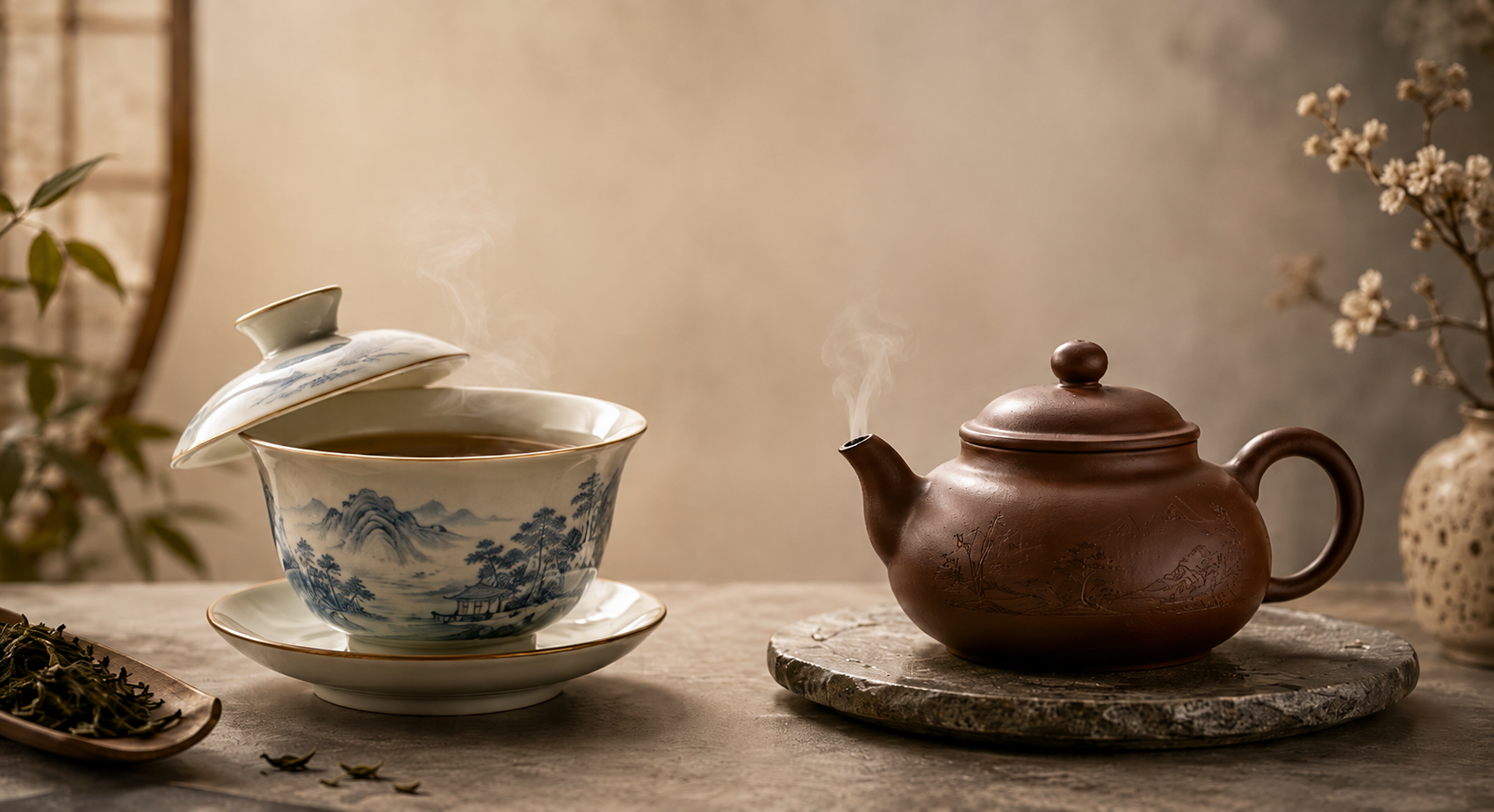
A Gaiwan offers a bowl, a lid, and complete visibility. A teapot encloses the leaves within a carefully shaped chamber, concentrating warmth and guiding the infusion through its spout.
Both vessels emerged from China’s long refinement of whole-leaf tea. Both can produce extraordinary results. Yet they do not approach tea in precisely the same way.
The Gaiwan reveals.
The teapot shapes.
One gives the brewer direct control over every second of extraction. The other creates a more contained environment in which heat, clay, form, and memory can subtly influence the cup.
So which one makes better tea?
Executive Summary: Is a Gaiwan or Teapot Better?
A Gaiwan is generally the better all-purpose brewing vessel because it is neutral, versatile, easy to inspect, simple to clean, and highly responsive to changes in brewing time and temperature. A well-matched teapot, however, may produce a rounder, warmer, more integrated infusion—especially with roasted oolong, aged tea, black tea, and Pu-erh.
Neither vessel is universally superior.
Choose a porcelain Gaiwan when you want:
-
Maximum brewing control
-
Clear, unaltered flavor
-
One vessel for many tea categories
-
Easy cleaning
-
A closer view of the leaves
-
An affordable introduction to Gongfu brewing
Choose a teapot when you want:
-
Greater heat stability
-
A more comfortable handle and pour
-
Convenient service for several people
-
A fuller or rounder mouthfeel
-
A dedicated vessel for a favorite tea
-
The character and collectability of Yixing clay
For most beginners, a porcelain Gaiwan between approximately 90 and 120 milliliters is the most educational first purchase. For daily family tea, office brewing, hospitality, or drinkers who value convenience over maximum control, a well-made porcelain or glass teapot may be more practical.
Serious tea enthusiasts eventually benefit from owning both.
The Shortest Possible Answer
| Your priority | Better choice |
|---|---|
| One vessel for almost every tea | Porcelain Gaiwan |
| Learning how tea responds to brewing | Gaiwan |
| Maximum aroma clarity | Porcelain Gaiwan |
| Easy handling | Teapot |
| Strong heat retention | Clay or stoneware teapot |
| Brewing for several people | Teapot |
| Roasted oolong or aged Pu-erh | Often a suitable clay teapot |
| Green, white, floral, or highly aromatic tea | Usually a porcelain or glass Gaiwan |
| Evaluating an unfamiliar tea | Porcelain Gaiwan |
| Collecting culturally significant teaware | Handmade Gaiwan or Yixing teapot |
| First Gongfu brewing vessel | Gaiwan |
| Long-term dedicated pairing with one tea | Yixing teapot |
Why the Choice of Brewing Vessel Matters
Tea is an extraction.
When hot water meets the leaf, soluble compounds begin moving into the infusion. Amino acids contribute sweetness and umami. Polyphenols create structure, bitterness, and astringency. Aromatic compounds rise with heat. Minerals, sugars, caffeine, pigments, and other constituents shape the liquor’s color, texture, and finish.
Temperature and infusion time significantly affect how these compounds are extracted. Higher temperatures and longer steeping generally increase extraction, although the most chemically concentrated infusion is not necessarily the most pleasurable one. Leaf shape matters as well: tightly rolled leaves usually open and release their compounds more gradually than broken or already expanded leaves. (PubMed Central (PMC))
The brewing vessel influences this process by affecting:
-
How quickly heat escapes
-
How freely leaves expand
-
How rapidly the liquor can be poured away
-
How aroma gathers beneath the lid
-
Whether the vessel contributes, absorbs, or modifies flavor
-
How precisely the brewer can observe and interrupt extraction
The difference between a Gaiwan and a teapot is therefore not merely aesthetic. It is a difference in thermal behavior, physical access, pouring mechanics, sensory feedback, and—particularly with unglazed clay—material interaction.
What Is a Gaiwan?
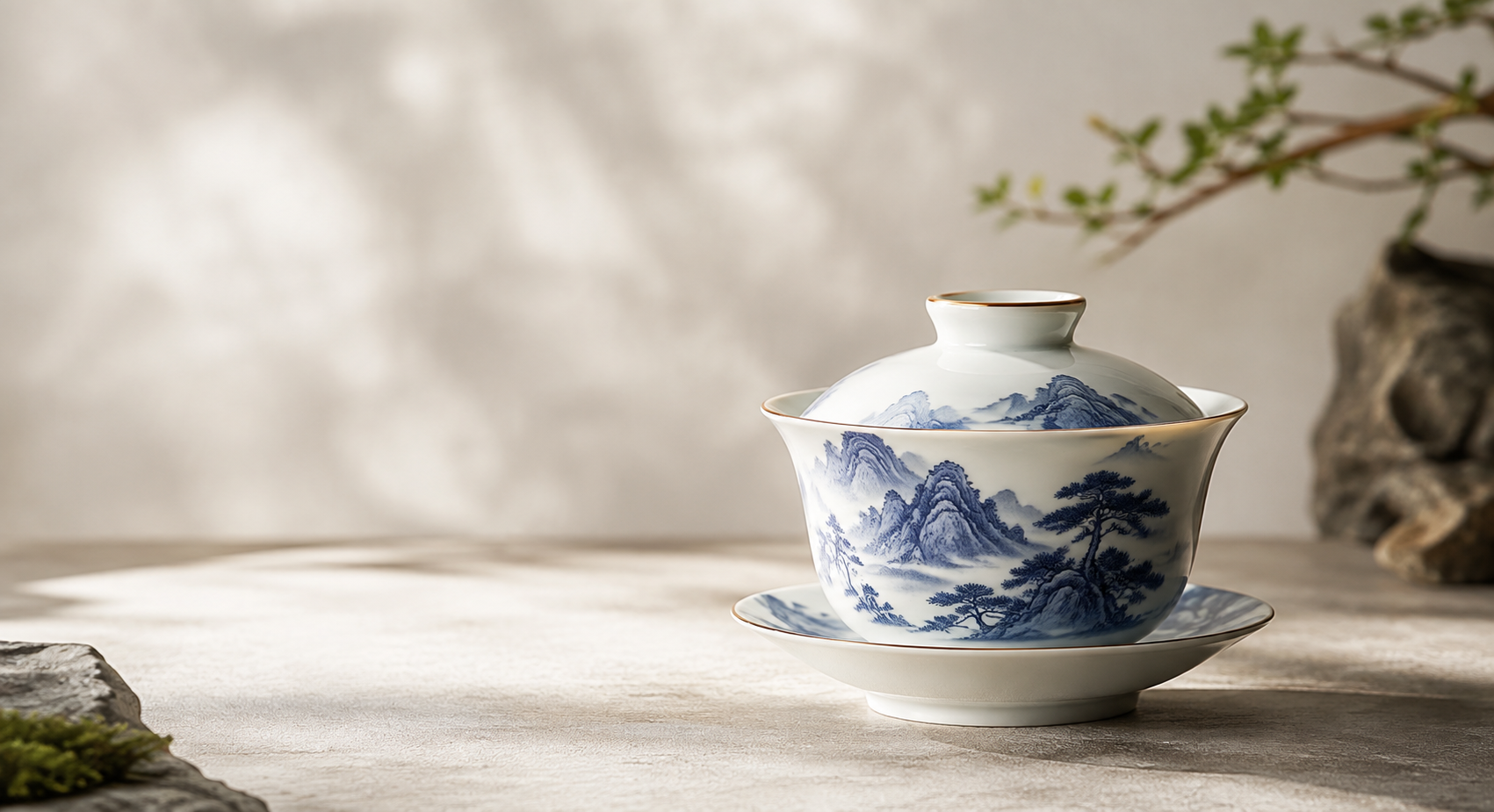
A Gaiwan, written 盖碗 or 蓋碗 and pronounced approximately guy-wan, literally means “lidded bowl.”
In its familiar form, it consists of three elements:
-
A bowl that holds the tea and water
-
A lid that controls heat, filters leaves, and gathers aroma
-
A saucer that supports the bowl and protects the hand from heat
The Gaiwan has no fixed handle and no separate spout. To pour, the brewer tilts the lid slightly, creating a narrow opening through which the tea escapes while most leaves remain inside.
It is at once a bowl, brewer, strainer, aroma vessel, and—in traditional use—a drinking cup.
When Was the Gaiwan Invented?
The simplified statement that “the Gaiwan was invented during the Ming dynasty” is broadly useful but historically incomplete.
During the Ming dynasty, Chinese tea culture underwent a decisive transformation toward steeping whole leaves in water. Teapots and smaller drinking cups became central to the tea service, while porcelain and Yixing stoneware gained prominence. The National Palace Museum describes Ming tea leaves being brewed in teapots much as they are today, with white and blue-and-white porcelain cups used to observe the liquor. (南部院區)
Covered cups, bowls, stands, and related combinations existed in different forms during this period. Ming porcelain cup stands survive in museum collections, demonstrating that the relationship between bowl and supporting stand was already well established. (大英博物馆)
However, the precise three-piece Gaiwan familiar to modern tea drinkers developed over time. Covered tea bowls became especially visible during the Qing dynasty, while the standardized lid-bowl-saucer ensemble became more firmly established later. Nineteenth-century examples show the mature form clearly. (chitracollection.com)
It is therefore more accurate to say:
The Gaiwan grew from Ming-era changes in whole-leaf tea preparation and earlier covered-bowl traditions, then developed into its familiar three-piece form through the Qing and later periods.
Tea history rarely moves through a single moment of invention. Forms evolve because customs, materials, kilns, social rituals, and techniques evolve with them.
The Gaiwan and the Rise of Whole-Leaf Tea
Earlier Chinese tea traditions often involved compressed, ground, boiled, or whisked tea. During the Song dynasty, powdered tea was placed in a bowl, combined with hot water, and whisked into foam. Black-glazed bowls were particularly admired because their dark surfaces emphasized the pale froth. (南部院區)
By the Ming period, steeped whole-leaf tea had become increasingly important. Historical scholarship associates this transition with the Hongwu Emperor’s 1391 requirement that tribute tea be supplied as loose leaf rather than compressed cake. (OUP Academic)
Once whole leaves were infused rather than whisked, teaware needed to perform different tasks. Leaves required room to open. The brewer needed a way to separate liquor from leaf. The color and clarity of the infusion became easier to appreciate in pale porcelain.
Both the Gaiwan and teapot answered these needs.
Why Tea Professionals Love the Gaiwan
The Gaiwan places very little distance between the brewer and the tea.
Remove the lid and you can examine the leaves immediately. Tilt it and you can smell the aromatic condensation gathered underneath. Open the gap wider and the infusion pours faster. Close it and the flow slows. Lift the lid entirely and heat escapes almost at once.
This immediacy makes the Gaiwan exceptionally informative.
A brewer can observe:
-
How quickly tightly rolled oolong opens
-
Whether young Sheng Pu-erh is becoming too astringent
-
How the aroma changes from infusion to infusion
-
Whether the leaves need more heat
-
Whether the next steep should be shorter or longer
-
How fully the liquor has drained
This is why the Gaiwan is not only a tool for making tea. It is a tool for learning tea.
Is a Gaiwan Part of Gongfu Tea?
Yes. Small Gaiwans are among the most widely used vessels in contemporary Gongfu tea preparation.
In this context, Gongfu refers to skill developed through attention and practice. Gongfu brewing usually uses a relatively high proportion of leaves, a small amount of water, short infusions, and repeated steeping.
The objective is not simply to make stronger tea. It is to explore the tea across time.
The first infusion may reveal fragrance. The second may deepen in texture. Later infusions may become sweeter, softer, more mineral, or more cooling. A Gaiwan allows the brewer to adjust each stage with precision.
Explore this practice further in Oriental Artisan’s Gongfu Tea Ceremony Guide and How to Use a Gaiwan.
What Materials Are Gaiwans Made From?
Porcelain Gaiwans
Porcelain is the most versatile choice.
Its glazed surface is comparatively neutral, does not readily retain the character of previously brewed teas, and allows the same Gaiwan to be used for green tea in the morning, oolong in the afternoon, and Pu-erh in the evening.
White porcelain also reveals the color of the liquor and the condition of the leaves.
For most tea drinkers, a handmade porcelain Gaiwan is the best place to begin.
Glass Gaiwans
Glass offers exceptional visibility. It is particularly attractive for:
-
Flowering teas
-
Jasmine tea
-
Green tea
-
White tea
-
Teas with beautiful whole leaves
Glass does not retain flavor, but it can lose heat quickly and may become uncomfortable to handle. Very thin glass requires greater care.
Unglazed Clay Gaiwans
Clay Gaiwans combine the open shape of a Gaiwan with some of the thermal and flavor characteristics associated with clay.
They are less universal than porcelain because unglazed surfaces may interact with tea and retain traces of repeated use. They are best chosen after the brewer understands both the clay and the tea it will serve.
Stoneware Gaiwans
Glazed stoneware can offer a heavier hand, slower cooling, and a grounded, tactile presence. It may suit roasted oolong, black tea, aged white tea, and darker styles of Pu-erh.
Its thicker walls, however, can reduce the rapid responsiveness that makes a thin porcelain Gaiwan so useful.
What Is a Chinese Teapot?
A Chinese teapot is a lidded brewing vessel with a body, handle, and spout. Unlike a Gaiwan, it encloses the leaves within a more fixed chamber and directs the infusion through a dedicated opening.
Chinese teapots range from very small Gongfu vessels to large household pots. They may be made from:
-
Yixing clay
-
Porcelain
-
Glass
-
Glazed stoneware
-
Unglazed pottery
-
Metal
-
Contemporary heat-resistant materials
Each material and shape behaves differently.
A Brief History of the Chinese Teapot
The rise of the teapot is closely connected to the increasing use of steeped whole-leaf tea.
The Victoria and Albert Museum notes that steeping tea leaves in hot water became established by the fourteenth century and that purpose-made vessels developed alongside this method. It also records an early written reference to a purple-clay teapot during the Yuan dynasty. (Victoria and Albert Museum)
By the Ming dynasty, teapots and cups had become principal elements of elite tea service. Porcelain vessels were admired for their refinement, while Yixing’s purple and red clay teapots became especially desirable. (南部院區)
The teapot was not simply a practical container. In the hands of Chinese scholars and potters, it became sculpture, calligraphy, material study, and personal expression.
Porcelain Teapots
Porcelain teapots are among the most versatile options for everyday brewing.
Like porcelain Gaiwans, glazed porcelain pots are relatively neutral and can accommodate many types of tea. Compared with an open Gaiwan, their enclosed form often holds heat somewhat longer, depending on wall thickness, lid fit, size, and shape.
They are ideal for drinkers who want:
-
Neutral flavor
-
A familiar handle
-
Easy service
-
Decorative artistry
-
A vessel suitable for several tea categories
A small porcelain teapot can perform many of the same functions as a Gaiwan while providing a more secure grip.
Glass Teapots
Glass teapots make the infusion visible and are easy to dedicate to different teas without significant flavor carryover.
They work especially well for:
-
Green tea
-
White tea
-
Jasmine tea
-
Floral infusions
-
Herbal tisanes
-
Large-leaf teas whose opening is visually beautiful
Many modern glass pots include removable filters. This makes them convenient, although a cramped filter can restrict leaf expansion. A spacious pot with a broad internal strainer is usually preferable to a narrow infuser basket.
Glazed Stoneware Teapots
Stoneware tends to feel substantial and often retains heat well. When glazed internally, it can remain reasonably versatile.
It suits:
-
Black tea
-
Roasted oolong
-
Aged white tea
-
Dark tea
-
Everyday household brewing
Because stoneware varies greatly in thickness, firing, glaze, and clay composition, two pots that appear similar may perform differently.
What Is a Yixing Teapot?
A Yixing teapot is made from clay associated with the Yixing region of Jiangsu, China. The term zisha, often translated as “purple clay” or “purple sand,” refers to a family of mineral-rich clays used to create unglazed stoneware.
Yixing teapots gained extraordinary prestige during the Ming and Qing dynasties. The National Palace Museum describes them as celebrated works admired by Ming and Qing social elites. (行政院农委会)
Unlike wheel-thrown porcelain, traditional Yixing teapots are commonly constructed by hand from clay slabs and carefully assembled. The finest examples are valued for:
-
Clay quality
-
Proportion
-
Lid fit
-
Pour
-
Surface texture
-
Balance
-
Artist’s seal
-
Calligraphy or inscription
-
Historical lineage
-
Sculptural originality
A Yixing teapot is therefore both a brewing instrument and a collectible work of ceramic art.
Gaiwan vs. Teapot: Side-by-Side Comparison
| Category | Gaiwan | Teapot |
|---|---|---|
| Ease of use | Requires a little hand technique | Usually easier to grip and pour |
| Brewing control | Exceptional; lid can be adjusted instantly | Good, but the closed body provides less direct access |
| Flavor clarity | Excellent in glazed porcelain or glass | Excellent in porcelain or glass; clay may modify flavor |
| Heat retention | Usually moderate and highly adjustable | Often stronger, especially in thick clay or stoneware |
| Aroma access | Excellent; lid can be smelled directly | Concentrated internally but sometimes less accessible |
| Leaf visibility | Excellent | Limited unless made from glass |
| Versatility | Very high in glazed porcelain | High in glazed porcelain or glass; lower in dedicated clay |
| Tea compatibility | Almost all whole-leaf teas | Depends strongly on material, size, and shape |
| Pouring speed | Potentially very fast | Depends on spout, filter, air hole, and craftsmanship |
| Cleaning | Extremely easy | More difficult around spout and internal filter |
| Durability | Exposed rim and lid require care | Handle and spout can be vulnerable |
| Portability | Compact but lid may shift | Secure when packed properly, though less compact |
| Learning curve | Moderate | Low for basic use |
| Aesthetic character | Minimal, intimate, architectural | Sculptural and often visually expressive |
| Collectability | High in fine porcelain and studio ceramics | Exceptionally high in Yixing and historic ceramics |
| Best for beginners | Yes, especially 90–120 ml porcelain | Yes, particularly a simple porcelain or glass pot |
| Best for experts | Excellent for control and evaluation | Excellent when carefully matched to a tea |
| Brewing for one | Ideal | Ideal in smaller sizes |
| Brewing for a group | Possible but less convenient | Usually better |
| Daily convenience | High after technique is learned | Very high |
Brewing Performance: How Gaiwans and Teapots Affect Tea
1. Water Circulation
Water circulation depends more on vessel geometry than on whether the vessel has a handle.
A broad Gaiwan allows water to move freely around large leaves. Its open mouth makes it easy to direct the pour, whether around the side of the bowl or directly onto the tea.
A round teapot can create excellent circulation, particularly for rolled oolong. A tall pot may suit long, twisted leaves, while a broad, low chamber may accommodate compressed or tightly rolled tea more comfortably.
The principle is simple:
Leaves should have sufficient room to hydrate, open, and exchange soluble compounds with the surrounding water.
A poorly shaped Gaiwan can crowd leaves. A spacious teapot can give them freedom. Neither category guarantees superior circulation by itself.
2. Leaf Expansion
The Gaiwan makes expansion easy to see and manage.
This matters with teas such as:
-
Tieguanyin
-
Taiwanese high-mountain oolong
-
Rolled Dancong
-
Compressed white tea
-
Sheng Pu-erh
-
Shou Pu-erh
-
Large-leaf black tea
When leaves expand too tightly against the walls, extraction becomes less even and pouring may slow.
With a Gaiwan, the lid can be removed and the leaves gently repositioned. With a teapot, the brewer must rely on choosing the correct shape and capacity before brewing.
3. Heat Retention
Heat retention is often treated as though every Gaiwan cools quickly and every teapot stays hot. Reality is more complex.
Thermal behavior depends on:
-
Material
-
Wall thickness
-
Total mass
-
Vessel size
-
Surface area
-
Lid fit
-
Room temperature
-
Whether the vessel was preheated
-
Quantity and temperature of water
A thin porcelain Gaiwan usually releases heat relatively quickly. This can protect delicate green, white, floral, or lightly oxidized teas from prolonged thermal exposure.
A thick stoneware or clay teapot generally loses heat more slowly. This can help open tightly rolled, heavily roasted, compressed, or aged leaves.
The brewer can also alter the Gaiwan’s heat behavior instantly. Leaving the lid fully closed conserves more warmth; removing or tilting it releases heat rapidly.
4. Extraction
Hotter water and longer contact generally extract more soluble material. This can increase strength, body, color, bitterness, caffeine, and polyphenol concentration, although each tea responds differently. Research on green, white, and oolong teas consistently shows that time and temperature materially affect chemical and sensory outcomes. (PubMed)
The Gaiwan’s advantage is interruption speed. Once the infusion is ready, the liquor can be poured out rapidly—provided the brewer uses an appropriate lid gap and technique.
A teapot’s extraction depends heavily on pour speed. If a small pot takes 15 seconds to empty, those 15 seconds are part of the infusion. A slow or clogged teapot can therefore overextract tea even when the nominal steeping time appears short.
When evaluating a teapot, always test how quickly and cleanly it empties.
5. Aroma Concentration
Both vessels can gather aroma beneath a lid.
The Gaiwan gives direct access to three aromatic zones:
-
The wet leaves
-
The underside of the lid
-
The empty cup or fairness pitcher
The lid is especially useful because volatile aromatic compounds condense on its cooler inner surface. Smelling it between infusions can reveal floral, creamy, roasted, fruity, mineral, resinous, or woody notes that may be less obvious in the liquor.
A teapot can concentrate aroma strongly within its chamber, but the opening is smaller and less convenient for direct inspection. Clay may also soften certain high aromatic notes while increasing the perception of warmth or integration.
6. Mouthfeel and Texture
Porcelain and glass tend to present tea with clarity. They reveal both strengths and imperfections.
Astringency may feel more distinct. High floral notes may seem brighter. Mineral sensations may appear more sharply defined.
A suitable clay teapot can make certain teas feel:
-
Rounder
-
Softer
-
Thicker
-
More cohesive
-
Less sharp
-
More settled
This should not be understood as automatic improvement. A clay that softens harshness may also mute the fragrance that makes a tea special.
One controlled study comparing teapot materials found differences in the chemical composition of oolong infusions made in Yixing clay, ceramic, glass, stainless steel, and plastic vessels. The authors concluded that Yixing pots produced infusions that could be perceived as less bitter and more fragrant, while also noting that not every comparison was statistically significant. (PubMed)
The effect of clay is real enough to investigate, but too complex to reduce to “clay always makes better tea.”
7. Multiple Infusions
Both vessels are excellent for repeated steeping.
The Gaiwan makes progression particularly easy to study. Because the material is neutral and the leaves remain visible, the brewer can observe each stage without wondering how much of the result comes from the vessel.
A well-paired teapot may create a more consistent thermal environment across infusions, which can be valuable for compressed Pu-erh, roasted oolong, and aged teas.
Which Teas Work Best in a Gaiwan or Teapot?
Tea Compatibility Guide
| Tea type | Recommended vessel | Why |
|---|---|---|
| Green tea | Porcelain or glass Gaiwan; glass teapot | Fast cooling and clear visibility reduce oversteeping risk |
| White tea | Porcelain Gaiwan; porcelain teapot | Neutral material preserves delicate sweetness and aroma |
| Yellow tea | Porcelain or glass Gaiwan | Gentle heat management and clarity |
| Light oolong | Porcelain Gaiwan | Highlights floral fragrance and fresh high notes |
| Roasted oolong | Gaiwan or suitable clay teapot | Gaiwan reveals detail; clay may round roast and texture |
| Wuyi rock tea | Porcelain Gaiwan or small Yixing teapot | Choose clarity or deeper integration |
| Dancong oolong | Thin porcelain Gaiwan | Fast pour helps control bitterness and preserve fragrance |
| Chinese black tea | Porcelain Gaiwan or teapot | Both work; pot may offer greater warmth and body |
| Sheng Pu-erh | Porcelain Gaiwan, especially for young tea | Precise control helps manage bitterness and astringency |
| Aged Sheng Pu-erh | Gaiwan or suitable clay teapot | Clay may deepen texture; Gaiwan preserves transparency |
| Shou Pu-erh | Clay, stoneware, or porcelain teapot; Gaiwan also works | Heat retention can support dense, earthy infusions |
| Jasmine tea | Porcelain or glass Gaiwan | Neutral surface protects floral fragrance |
| Flowering tea | Glass teapot or glass Gaiwan | Allows the unfurling tea to be seen |
| Aged white tea | Porcelain, stoneware, or clay teapot | More sustained warmth can develop sweetness and body |
| Herbal or floral tisane | Glass or glazed porcelain teapot | Easy cleaning and larger capacity |
Best Vessel for Green Tea
A thin porcelain or glass Gaiwan is usually the safer choice.
Green tea can become overly bitter, vegetal, or astringent when exposed to excessive heat for too long. An open vessel allows heat to escape, while the leaves remain visible.
For very delicate green tea, the Gaiwan may be used without fully covering it. The lid can rest at an angle or be removed between infusions.
A glass teapot is also excellent, particularly when using a lower leaf-to-water ratio and a longer infusion.
Best Vessel for White Tea
A porcelain Gaiwan is ideal when you want to examine fragrance, sweetness, and leaf quality without material influence.
Young silver-needle and white-peony styles often benefit from a neutral, responsive vessel. Mature Shou Mei or compressed aged white tea may perform beautifully in a warmer stoneware or clay teapot.
White tea is highly sensitive to infusion conditions. Research on Fuding white teas has found that temperature, time, tea-to-water ratio, and repeated brewing all affect the extraction of catechins, caffeine, theanine, amino acids, and other taste components. (PubMed)
Best Vessel for Oolong Tea
Oolong is where the Gaiwan-versus-teapot question becomes most interesting.
For lightly oxidized, floral oolong, choose porcelain. It preserves orchid, gardenia, cream, lilac, fresh fruit, and alpine notes with clarity.
For roasted Tieguanyin, Wuyi rock tea, traditional Dong Ding, or aged oolong, a suitable clay pot may soften the roast, concentrate warmth, and produce a more seamless texture.
The Gaiwan remains invaluable for evaluation. Brew a new oolong in porcelain first. Only consider a dedicated clay pot after understanding the tea’s character.
Best Vessel for Pu-erh Tea
For young Sheng Pu-erh, a Gaiwan often offers better control. Its quick response makes it easier to manage bitterness, dryness, smoke, and powerful energy.
For aged Sheng, either vessel can succeed. Porcelain reveals storage character and aromatic detail. A good clay teapot may soften rough edges and deepen the mouthfeel.
For Shou Pu-erh, heat-retentive clay or stoneware can support dark, dense, earthy infusions. Porcelain remains useful when assessing cleanliness, fermentation quality, and storage.
Best Vessel for Black Tea
Chinese black tea—known as hong cha, or “red tea,” in China—works well in both vessels.
Use a Gaiwan for:
-
Bright fragrance
-
Honeyed high notes
-
Fruit definition
-
Precise control
Use a teapot for:
-
Greater warmth
-
Family service
-
Fuller body
-
Longer infusions
-
A softer, more unified cup
Best Vessel for Jasmine and Floral Tea
Choose glazed porcelain or glass.
Floral teas benefit from neutral surfaces because their most desirable qualities are aromatic. An unglazed vessel may retain previous aromas or soften the delicate top notes.
A porcelain Gaiwan is particularly traditional for jasmine tea because the lid gathers fragrance and can be used to hold back floating leaves while drinking.
Flavor Comparison: What Changes in the Cup?
Aroma
Gaiwan: Usually brighter, more immediate, and easier to analyze.
Porcelain or glass teapot: Similar clarity, with slightly different heat behavior.
Unglazed clay teapot: May soften volatile high notes while making the aroma feel warmer or more integrated.
Body
Gaiwan: Often feels transparent and precisely outlined.
Teapot: May produce greater continuity and body, especially when the vessel retains heat strongly.
Sweetness
Sweetness depends mainly on the leaf, water, and extraction. A vessel can nevertheless influence whether sweetness appears bright and crystalline or deep and rounded.
A Gaiwan may make sweetness feel cleaner. A suitable clay pot may make it feel broader and more persistent.
Aftertaste
A Gaiwan often exposes the structure of the finish clearly: cooling sensations, returning sweetness, mineral dryness, floral echoes, or lingering bitterness.
A clay pot may smooth transitions between the initial taste and aftertaste. Whether this is desirable depends on the tea.
Mineral Notes
Mineral character in Wuyi oolong, aged Sheng, and certain high-mountain teas can appear especially vivid in porcelain.
Clay may transform this impression from sharply stony to warmer, deeper, or more tactile.
Complexity
For analytical complexity, porcelain has the advantage because it minimizes added variables.
For experiential complexity, a well-paired teapot can create a compelling relationship among leaf, clay, heat, shape, and repeated use.
Why Do Tea Masters Prefer Gaiwans?
Not every tea master always prefers a Gaiwan. Many use both Gaiwans and teapots according to context.
Yet the Gaiwan is frequently chosen for teaching, tasting, comparison, and unfamiliar teas because it offers five important advantages.
1. Maximum Control
The brewer controls:
-
The angle of the lid
-
The size of the pouring gap
-
The speed of the pour
-
The amount of retained heat
-
The degree of leaf agitation
-
The time between infusions
Few vessels provide so many immediate adjustments.
2. Neutral Brewing
Glazed porcelain contributes relatively little flavor of its own.
This helps answer an essential question:
What does the tea itself taste like?
3. Direct Evaluation
A Gaiwan allows the brewer to inspect color, expansion, breakage, stems, buds, rolling, roasting, oxidation, compression, and the condition of the wet leaf.
4. Aroma Study
The lid captures aromatic condensation and can be smelled throughout the session.
5. Faster Learning
Mistakes become obvious.
If the tea is bitter, shorten the infusion. If the leaves remain closed, increase heat. If the aroma feels thin, preheat the vessel more thoroughly. If the tea becomes heavy, pour faster or reduce the leaf quantity.
The Gaiwan gives immediate feedback, accelerating the development of brewing skill.
Are Gaiwans Used in Professional Tea Judging?
They can be, particularly for oolong and comparative tasting, but professional sensory evaluation is not universally conducted with a Gaiwan.
Formal standards often use standardized porcelain or earthenware infusion pots and white tasting bowls so that samples can be compared under controlled conditions. ISO 3103 specifies a standardized method for preparing tea liquor for sensory testing. Chinese sensory standards similarly define evaluation methodology and equipment. (ISO)
A recent review of Chinese tea evaluation practices notes that covered bowls may be used for evaluating oolong tea. (Wiley Online Library)
The Gaiwan is therefore highly valuable for professional-style comparative tasting, but it should not be described as the exclusive vessel of formal judging.
Why Do Collectors Love Yixing Teapots?
A fine Yixing teapot is more than a warm container.
It is a meeting of geology, fire, proportion, craftsmanship, calligraphy, connoisseurship, and time.
Clay Character
Different Yixing clays vary in mineral composition, particle structure, firing behavior, color, texture, and thermal performance.
These variations can influence:
-
Heat retention
-
Cooling rate
-
Surface interaction
-
Aroma presentation
-
Mouthfeel
-
Visual patina
The category is far more complex than “purple clay.”
Seasoning and Flavor Memory
Unglazed teapots develop with repeated use.
Tea compounds and mineral deposits can accumulate on the surface, while the exterior gradually gains a richer sheen. This development is commonly called seasoning.
The language of “absorption” is often oversimplified. Some interactions occur at and near the clay’s surface, and the precise effects vary with the pot, firing, tea, water, cleaning, and frequency of use.
The practical result is that many collectors dedicate one Yixing pot to a specific tea family, such as:
-
Wuyi rock tea
-
Dancong oolong
-
Traditional Tieguanyin
-
Aged Sheng Pu-erh
-
Shou Pu-erh
-
Chinese black tea
Patina
A mature Yixing pot does not become glossy through varnish. Its surface changes through handling, brewing, wiping, and time.
The finest patina appears quiet rather than artificial—a subtle deepening of color and touch that records use without erasing the clay’s original character.
Relationship Through Repetition
A porcelain Gaiwan serves many teas faithfully.
A dedicated Yixing pot develops a relationship with one category.
This specialization is part of its emotional appeal. The pot becomes associated with particular leaves, seasons, guests, rooms, and stages of the owner’s life.
Collectible Value
Yixing teapots may be collected according to:
-
Artist
-
Period
-
Clay
-
Form
-
Seal
-
Inscription
-
Provenance
-
Firing
-
Workshop
-
Historical importance
Collectors should remain cautious. The market contains inaccurate attributions, molds presented as fully handmade work, artificial aging, questionable clay claims, and forged seals.
Buy from a knowledgeable and transparent source rather than relying on stamps alone.
Is a Gaiwan Better for Beginners?
For most beginners who genuinely want to understand Chinese tea, yes.
The Gaiwan is inexpensive compared with fine clay teapots, works with almost every tea, and reveals how brewing decisions affect flavor.
It also teaches habits that remain useful with every future vessel:
-
Measuring capacity
-
Controlling water temperature
-
Watching leaf expansion
-
Timing short infusions
-
Pouring completely
-
Smelling the wet leaf
-
Comparing successive steeps
However, a Gaiwan is not automatically easier on the first attempt.
Will a Gaiwan Burn My Fingers?
It can—but usually because of technique, design, or overfilling.
Your fingers should touch only the relatively cooler points of the vessel:
-
The lid knob
-
The flared rim
-
The saucer, when using a two-handed pour
Do not grip the body of the bowl.
How to Avoid Burning Your Fingers
-
Choose a Gaiwan with a visibly flared rim.
-
Avoid filling water to the very top.
-
Keep your fingers on the rim, not the wall.
-
Hold the lid knob at its upper surface.
-
Pour decisively rather than hesitating.
-
Begin with warm water before practicing with boiling water.
-
Use a two-handed saucer method until confident.
-
Select a 90–120 ml size rather than an oversized bowl.
The Three-Finger Pour
The common one-handed technique uses:
-
Thumb on one side of the rim
-
Middle finger on the opposite side
-
Index finger resting on the lid knob
Tilt the lid to create a narrow gap, lift the Gaiwan, and pour in one smooth movement.
The lid should be secure but not pressed down so tightly that the steam has nowhere to escape.
The Two-Handed Saucer Pour
Place the Gaiwan on its saucer.
Support the saucer with one hand while the other stabilizes the lid. Lift the complete set and pour.
This method is graceful and protects the fingers, although it can feel less direct.
Common Beginner Mistakes
Overfilling
Water above the natural line of the rim heats the area where the fingers need to rest.
Pouring Too Slowly
A hesitant pour extends the infusion and keeps the hand near steam for longer.
Choosing a Thick, Heavy Gaiwan
Very heavy Gaiwans can be awkward to balance and may retain more heat around the rim.
Choosing a Gaiwan That Is Too Large
A 150–200 ml Gaiwan can become heavy and difficult to control when filled.
Holding the Bowl
The walls are usually the hottest part.
Using an Oversized Lid Gap
A large opening allows leaves to escape and can cause the lid to shift.
When Is a Teapot the Better Choice?
Daily Family Tea
A medium-sized teapot is easier when several people want tea at once.
The handle allows repeated pouring without learning Gaiwan technique, while a larger capacity reduces the number of brewing cycles.
Office Brewing
A glass or porcelain teapot with a generous filter is practical at a desk.
It contains the leaves, reduces spills, and can be moved more easily between kettle and cup.
Hospitality
When serving guests who are unfamiliar with Gongfu tea, a teapot can make the experience feel comfortable and intuitive.
It also directs the host’s attention toward conversation rather than constant handling.
Larger Gatherings
A small Gaiwan can serve several guests, but the host may need to prepare many rapid infusions.
A larger porcelain or stoneware teapot may be more appropriate when ceremony is secondary to generous service.
Physical Comfort
People with limited hand mobility, reduced grip strength, tremors, or heat sensitivity may find a handled teapot much safer.
Tea practice should adapt to the person. There is no virtue in choosing a vessel that makes brewing uncomfortable.
A Dedicated Favorite Tea
Once you drink one style regularly, a carefully chosen teapot can deepen the experience.
A dedicated teapot may be especially rewarding for:
-
Wuyi yancha
-
Roasted oolong
-
Aged oolong
-
Aged Sheng Pu-erh
-
Shou Pu-erh
-
Rich Chinese black tea
Should You Own Both a Gaiwan and a Teapot?
For a committed loose-leaf tea drinker, yes.
The two vessels do not compete so much as complete one another.
Use the Gaiwan to understand the tea.
Use the teapot to cultivate a particular expression of it.
What Should I Buy First?
Buy a Gaiwan First When:
-
You are exploring several tea categories.
-
You want to learn Gongfu brewing.
-
You do not yet know which tea you prefer.
-
You value aroma clarity.
-
You want maximum control.
-
You have a limited budget.
-
You want one highly versatile vessel.
Buy a Teapot First When:
-
You mainly brew for a family or group.
-
You want a handle.
-
You prefer longer, more relaxed infusions.
-
You need office convenience.
-
You already drink one tea category regularly.
-
You have difficulty holding a Gaiwan safely.
Decision Tree for Beginners
Do you want to explore many kinds of Chinese tea?
-
Yes → Buy a glazed porcelain Gaiwan.
-
No → Continue.
Do you mainly brew for more than two people?
-
Yes → Buy a porcelain or glass teapot.
-
No → Continue.
Do you already drink roasted oolong or Pu-erh almost every day?
-
Yes → Begin with porcelain, then consider a dedicated clay teapot.
-
No → Buy a porcelain Gaiwan.
Decision Tree by Lifestyle
The Curious Beginner
Start with:
-
100–120 ml porcelain Gaiwan
-
Fairness pitcher
-
One or two small cups
The Busy Professional
Start with:
-
200–400 ml glass or porcelain teapot
-
Broad internal filter
-
Comfortable handle
-
Simple cup
Add a small Gaiwan for weekend sessions.
The Oolong Enthusiast
Start with a porcelain Gaiwan to understand different oolongs.
Then add a small clay teapot once you know whether you favor floral, roasted, Wuyi, Dancong, or Taiwanese styles.
The Pu-erh Collector
Own both.
Use porcelain to assess storage, cleanliness, age, and development. Use an appropriate clay teapot to explore texture and softened integration.
The Design Collector
Choose according to craftsmanship as well as performance.
A hand-painted Jingdezhen Gaiwan may offer porcelain clarity and visual refinement. A masterfully formed Yixing teapot may serve as both functional sculpture and brewing instrument.
The Gift Buyer
Choose a Gaiwan when the recipient enjoys:
-
Personal rituals
-
Tea discovery
-
Chinese culture
-
Fine porcelain
-
Mindful living
Choose a teapot when the recipient values:
-
Hospitality
-
Daily family tea
-
Practical handles
-
Display-worthy ceramics
-
A more familiar brewing form
Five Common Myths About Gaiwans and Teapots
Myth 1: Gaiwans Are Only for Experts
A Gaiwan requires practice, not mastery.
Most beginners can learn a safe pour within a few sessions. A thoughtfully designed Gaiwan with a flared rim is often easier than a poorly designed teapot with a slow spout.
Myth 2: Teapots Always Make Better Tea
A teapot can make excellent tea, but so can a Gaiwan.
The quality of the leaf, water, temperature, ratio, timing, and pouring technique usually matters more than the presence of a handle.
Myth 3: Yixing Is Suitable for Every Tea
Yixing clay is not automatically ideal for delicate green tea, highly floral oolong, jasmine tea, or any tea whose volatile fragrance you want to preserve with maximum clarity.
A clay that improves one tea may flatten another.
Myth 4: Gaiwans Are Extremely Fragile
Porcelain can break, but a well-fired Gaiwan is not too delicate for daily use.
Most breakages happen through impact: dropping the lid, striking the rim, or placing the pieces carelessly together.
A teapot’s handle and spout can be equally vulnerable.
Myth 5: More Expensive Teaware Always Brews Better
Price can reflect artistry, rarity, artist reputation, handwork, decoration, provenance, or collectability.
These qualities are meaningful, but they do not guarantee superior brewing.
A modest, well-proportioned porcelain Gaiwan may outperform an expensive but poorly pouring teapot.
How to Choose a Gaiwan
1. Choose the Right Size
For one or two drinkers, approximately 90–120 ml is the most versatile range.
Smaller Gaiwans concentrate the session and make high leaf-to-water ratios economical. Larger Gaiwans work for relaxed brewing or several guests but become heavier when filled.
Be aware that listed capacity may refer to filling the vessel to the brim. Functional brewing capacity is usually lower.
2. Inspect the Rim
A flared rim keeps the fingers farther from hot water.
Avoid designs in which the bowl rises almost vertically to the lip.
3. Check the Lid Fit
The lid should move smoothly enough to adjust the pouring gap but should not feel wildly loose.
A lid that seals completely is unnecessary. The Gaiwan is controlled by the hand rather than by an airtight fit.
4. Consider Wall Thickness
Thin porcelain responds quickly and highlights aroma.
Thicker porcelain or stoneware retains more heat and feels substantial but may become hotter and less agile.
5. Look for Balance
A good Gaiwan should not feel top-heavy. The lid knob should be comfortable, and the bowl should sit securely on its saucer.
6. Choose a Neutral Interior
A white or pale interior makes it easier to see liquor color, leaf condition, and cleanliness.
7. Assess Craftsmanship
Handmade variations are part of an artisan vessel’s character, but functional areas still matter:
-
The rim should feel smooth.
-
The lid should not scrape harshly.
-
The saucer should support the bowl steadily.
-
Glaze should not obstruct handling.
-
Decoration should complement rather than compromise use.
Discover more in Oriental Artisan’s Complete Guide to Gaiwans, Jingdezhen Porcelain Guide, and Dehua Blanc de Chine Guide.
How to Choose a Chinese Teapot
1. Begin With the Tea
Do not purchase a specialized teapot before deciding what it will brew.
A neutral porcelain teapot can serve many teas. An unglazed clay pot should ideally be chosen for a narrower purpose.
2. Match Capacity to Your Session
For Gongfu brewing:
-
70–100 ml: highly concentrated solo sessions
-
100–150 ml: one to three drinkers
-
150–250 ml: several guests or more relaxed brewing
For household brewing, larger sizes may be appropriate.
3. Examine the Pour
A well-designed teapot should:
-
Begin pouring promptly
-
Produce a coherent stream
-
Empty efficiently
-
Avoid excessive dribbling
-
Allow air to enter smoothly
-
Resist clogging with appropriate leaves
The pour is not merely a performance detail. It determines extraction accuracy.
4. Choose the Shape for the Leaf
Round or Spherical
Suitable for rolled oolong because the leaves can expand outward.
Broad and Low
Useful for large or compressed leaves and teas that benefit from faster cooling.
Tall
Can suit long, twisted leaves, although the opening must still allow convenient cleaning.
5. Consider Heat Behavior
Choose stronger heat retention for:
-
Roasted oolong
-
Aged tea
-
Shou Pu-erh
-
Dense compressed leaves
Choose more moderate heat for:
-
Green tea
-
Floral oolong
-
Young white tea
-
Highly aromatic tea
6. Investigate Clay Claims Carefully
For a Yixing purchase, ask:
-
Is the pot fully handmade, half-handmade, molded, or slip-cast?
-
What clay is claimed?
-
Who made it?
-
Is the attribution documented?
-
What is the firing quality?
-
Does it pour well?
-
Is the seller transparent about uncertainty?
A seal is not proof of authorship.
7. Evaluate the Interior
The opening should be large enough to add and remove leaves. Internal filters should be cleanly formed and suitable for the tea.
Complex filters can trap small leaf fragments and become difficult to clean.
How to Brew Tea in a Gaiwan
-
Warm the Gaiwan with hot water.
-
Empty it completely.
-
Add the tea leaves.
-
Smell the warmed dry leaves.
-
Add water at an appropriate temperature.
-
Position the lid.
-
Infuse for the desired time.
-
Tilt the lid to create a filtering gap.
-
Pour completely into a fairness pitcher or cup.
-
Smell the lid and wet leaves.
-
Repeat, adjusting time and temperature as the tea evolves.
Complete pouring is important. Water left behind continues extracting and can make the next infusion unexpectedly strong.
For more detailed technique, visit Oriental Artisan’s How to Use a Gaiwan guide.
How to Brew Tea in a Teapot
-
Warm the teapot and cups.
-
Empty the pot.
-
Add the leaves.
-
Smell the warmed leaves.
-
Add water.
-
Close the lid.
-
Infuse according to the tea and pot.
-
Pour completely into a fairness pitcher or cups.
-
Reopen the lid between infusions when the tea needs to cool.
-
Repeat, lengthening later infusions as needed.
Do not assume the teapot must remain tightly closed between every infusion. Delicate or young teas may benefit from releasing trapped heat.
Gaiwan vs. Yixing Teapot: The Essential Difference
The most meaningful comparison is not between all Gaiwans and all teapots. It is between a neutral porcelain Gaiwan and an unglazed Yixing teapot.
The porcelain Gaiwan asks:
What is present in this tea?
The Yixing teapot asks:
What relationship can this clay create with this tea?
Use the Gaiwan for discovery, calibration, comparison, and transparency.
Use the Yixing teapot for specialization, continuity, texture, and the pleasure of a vessel that changes through use.
Neither replaces the other.
Frequently Asked Questions
1. What is the main difference between a Gaiwan and a teapot?
A Gaiwan is an open lidded bowl without a fixed handle or spout. A teapot encloses the leaves in a body with a handle and dedicated spout. Gaiwans offer greater access and control; teapots usually offer easier handling and stronger heat stability.
2. Does a Gaiwan make better tea than a teapot?
Not universally. A porcelain Gaiwan usually provides clearer, more neutral, and more controllable brewing. A suitable teapot may produce a rounder or more integrated result with certain teas.
3. Which vessel is more versatile?
A glazed porcelain Gaiwan is generally the most versatile because it can brew almost every whole-leaf tea without retaining significant flavor from previous sessions.
4. Is a Gaiwan difficult to use?
It requires a brief learning period. Proper size, a flared rim, moderate filling, and a decisive pour make it much easier.
5. Can beginners use a Gaiwan?
Yes. A 90–120 ml porcelain Gaiwan is one of the best tools for learning loose-leaf and Gongfu tea brewing.
6. Why do tea masters use Gaiwans?
They offer direct access to the leaves, rapid heat adjustment, precise pouring, neutral flavor, and easy aroma evaluation.
7. Why does my Gaiwan burn my fingers?
You may be overfilling it, gripping the bowl instead of the rim, using a poorly flared design, or pouring too slowly.
8. What size Gaiwan should a beginner buy?
Approximately 90–120 ml is ideal for most beginners. It is manageable, economical with leaves, and suitable for one to three people.
9. Should I buy a Gaiwan with or without a saucer?
A saucer offers insulation, stability, and the option of a two-handed pour. A two-piece Gaiwan without a saucer can be simpler and more compact.
10. Is porcelain or glass better for a Gaiwan?
Porcelain is usually more comfortable, more traditional, and slightly less revealing of water stains. Glass provides complete visual access but may lose heat quickly and become hot to handle.
11. Is a Yixing teapot better than a porcelain Gaiwan?
It may be better for a particular tea after a successful pairing. It is not better as a universal brewing vessel.
12. Can I brew every tea in one Yixing teapot?
You can, but doing so may mix aromatic residues and undermine the benefit of dedicating the pot. Most enthusiasts assign an unglazed pot to one tea family.
13. Does a teapot change the flavor of tea?
Porcelain and glass teapots are relatively neutral. Unglazed clay teapots can influence heat, extraction, aroma presentation, and mouthfeel.
14. Does a Gaiwan change tea flavor?
A glazed porcelain or glass Gaiwan has relatively little direct material influence, although its shape and cooling rate still affect extraction.
15. Which is better for oolong tea?
A porcelain Gaiwan is best for evaluating oolong and preserving floral aroma. A suitable clay teapot may be preferable for roasted, aged, or mineral-rich oolong.
16. Which is better for Pu-erh tea?
A Gaiwan offers control and transparency, particularly for young Sheng. A heat-retentive clay teapot can work beautifully for aged Sheng or Shou Pu-erh.
17. Which is better for green tea?
A porcelain or glass Gaiwan is usually preferable because it allows heat to dissipate and makes the leaves visible.
18. Which is better for black tea?
Both work well. Use a Gaiwan for clarity and fragrance or a teapot for warmth, body, and convenient service.
19. Which vessel is easier to clean?
The Gaiwan. Its broad opening provides complete access, while teapot spouts and internal filters can trap fragments.
20. Which vessel retains heat longer?
A thick clay or stoneware teapot usually retains heat longer than a thin porcelain Gaiwan. Actual performance depends on size, thickness, material, shape, and preheating.
21. Which vessel is better for multiple infusions?
Both are excellent. The Gaiwan offers easier observation and adjustment, while the teapot may provide a more stable thermal environment.
22. Do I need a fairness pitcher with a Gaiwan?
It is not essential, but it helps ensure that every cup receives tea of equal concentration and allows the Gaiwan to be emptied promptly.
23. Can I drink directly from a Gaiwan?
Yes. Traditionally, the lid can be used to hold leaves away from the lips while the tea is sipped directly from the bowl.
24. Is a Gaiwan more fragile than a teapot?
Not necessarily. A Gaiwan’s lid and rim are exposed, while a teapot’s handle and spout are vulnerable. Both require thoughtful handling.
25. Should I spend more on tea or teaware?
For better flavor, tea and water usually deserve priority. Invest in expensive teaware when craftsmanship, artistic value, cultural heritage, or collectability adds meaning to the experience.
26. What teaware should I buy first?
For most people, begin with a small porcelain Gaiwan. Choose a porcelain or glass teapot first when handling convenience or group service is more important.
27. Should a serious tea drinker own both?
Yes. A Gaiwan is ideal for discovery and control. A teapot provides convenience, specialization, and a different expression of familiar teas.
Final Verdict: Which One Makes Better Tea?
The finest vessel is not the one declared superior in isolation.
It is the one that serves the leaf, the brewer, and the moment.
A Gaiwan may be best when opening a newly arrived oolong for the first time. Its porcelain walls reveal every fragrance, every shift in color, every edge of bitterness and returning sweetness.
A clay teapot may be best on a quiet winter evening, when an aged tea asks for warmth, continuity, and a vessel already familiar with its character.
A glass teapot may be best when jasmine flowers unfurl at the center of a table.
A porcelain pot may be best when tea is poured generously for family and friends.
Chinese tea culture has never been defined by a single correct object. Its refinement lies in responsiveness: understanding how water, leaf, fire, clay, porcelain, time, and human attention meet.
For the curious beginner, a handcrafted porcelain Gaiwan is often the wisest beginning. It is honest, versatile, and endlessly instructive. It does not conceal the tea. It invites you to look closer.
For the experienced drinker, a fine teapot offers another form of intimacy—one built through repetition and the gradual recognition that no two vessels, no two leaves, and no two tea sessions are ever exactly alike.
Neither the Gaiwan nor the teapot makes better tea alone.
Better tea emerges when the right vessel meets the right leaf in attentive hands.
Explore Oriental Artisan’s collection of handcrafted Chinese Gaiwans and fine teaware, created by skilled artisans who preserve traditional ceramic knowledge through shaping, glazing, painting, carving, and kiln firing.
More than functional objects, these pieces carry the quiet intelligence of generations.
A Gaiwan may begin as a brewing vessel.
With time, it becomes part of the ritual—and part of the life built around it.
The web citations can remain as research endnotes or be converted into a conventional bibliography before publication.

Leave a comment
This site is protected by hCaptcha and the hCaptcha Privacy Policy and Terms of Service apply.