


Gaiwan: The Definitive Guide to China’s Most Elegant Tea Vessel
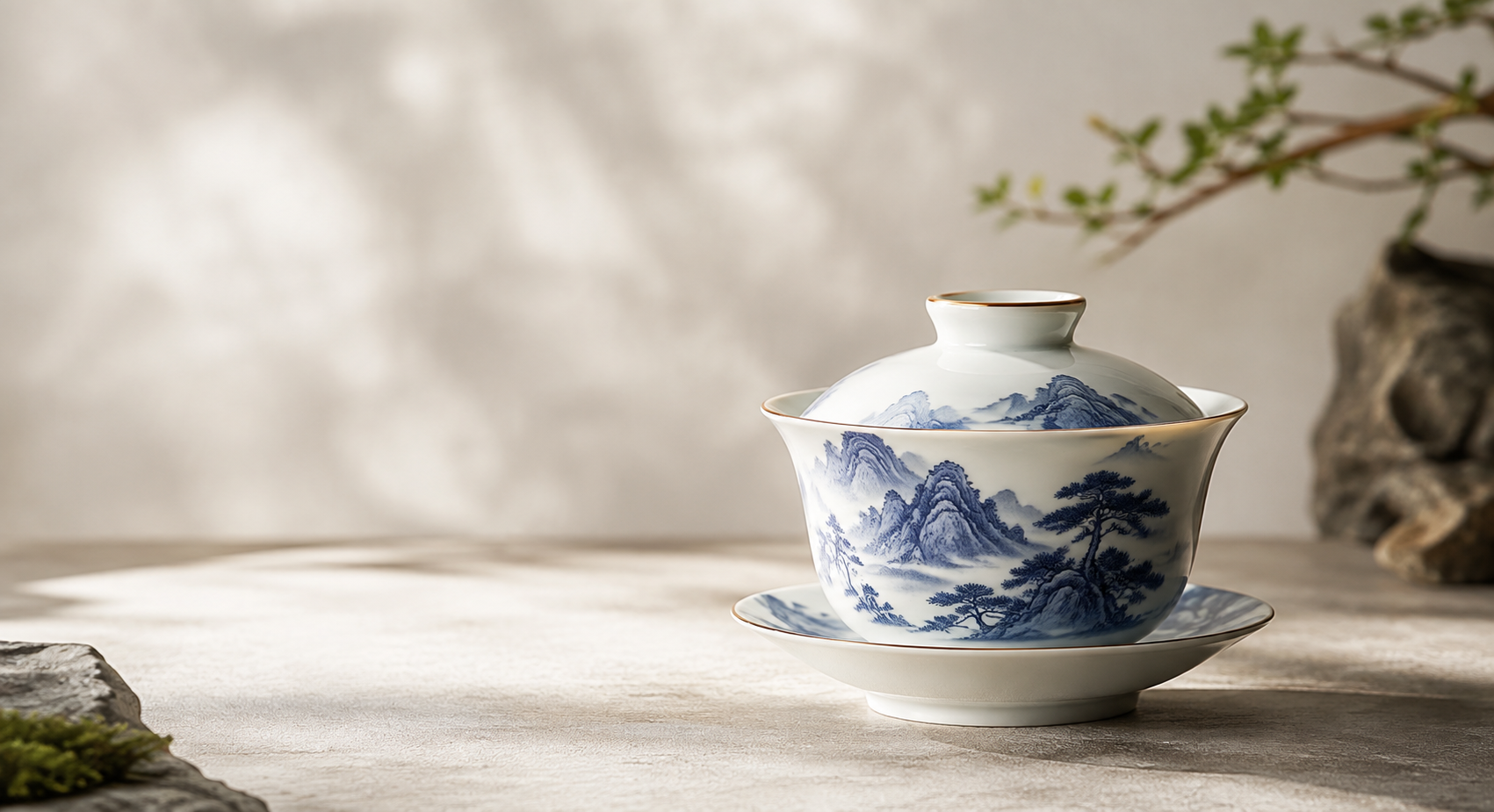
Three pieces of porcelain rest upon a tea table: a bowl, a lid and a saucer.
There is no handle. No spout. No built-in filter. Nothing appears mechanically complicated. Yet in practiced hands, this remarkably simple vessel can reveal a tea with a degree of clarity, precision and intimacy that few brewing tools can equal.
This is the Gaiwan—盖碗, literally a “lidded bowl.”
For generations, covered tea bowls have appeared in Chinese homes, scholars’ studios, imperial collections and tea houses. Today, the Gaiwan has become one of the defining vessels of contemporary Gongfu tea practice. It allows the drinker to see the leaves unfurl, inhale their fragrance from the warmed lid, adjust infusion strength almost instantly and pour with exceptional control.
Its elegance lies not in ornament alone, but in the intelligence of its form.
A Gaiwan does not conceal the act of brewing. It brings the drinker closer to it.
What Is a Gaiwan?
A Gaiwan is a traditional Chinese vessel consisting of a bowl and lid, usually accompanied by a saucer. It can be used both to brew tea and to drink tea directly.
The Chinese name is written 盖碗:
-
盖, gài: lid or cover
-
碗, wǎn: bowl
The name therefore translates directly as “lidded bowl” or “covered bowl.”
Unlike a conventional teapot, the Gaiwan has no fixed spout. Instead, the drinker slides the lid slightly away from the rim, creating an adjustable opening through which tea can be poured while most of the leaves remain inside.
Museum examples confirm that Qing-dynasty covered tea bowls were designed to steep tea, retain heat and separate the infusion from the leaves. An early-19th-century Qing example in the Spencer Museum of Art is described as a vessel capable of simultaneously steeping, straining and retaining heat.
The Three Parts of a Gaiwan
A complete traditional Gaiwan has three components.
1. The Lid
The lid helps retain heat, guides the flow of tea and holds leaves back while pouring.
It is also an aromatic instrument.
After hot water enters the bowl, fragrant compounds rise with the steam and collect beneath the lid. Tea drinkers often lift the lid and smell its underside before tasting the infusion. In a fine oolong, the fragrance may move through orchids, ripe fruit, toasted grain, honey or cool mineral notes over successive brews.
The lid also allows the brewer to:
-
Stir or gently move floating leaves
-
Control the pouring gap
-
examine aroma between infusions
-
reduce heat loss
-
prevent larger leaves from escaping
A well-made lid should sit evenly and move smoothly. It does not need to create an airtight seal. In fact, a small, controllable gap is essential to the Gaiwan’s function.
2. The Bowl
The bowl holds the leaves and water.
Its open shape gives the brewer an unobstructed view of the tea. This is particularly valuable when evaluating whole-leaf teas, because the appearance of the leaves reveals information about processing, oxidation, roasting, rolling and storage.
A wide bowl cools more quickly than a thick, enclosed teapot. This can be helpful for delicate green and white teas. A taller or thicker bowl may retain more heat, making it better suited to roasted oolong, dark tea or Pu-erh.
The curve of the walls also influences how comfortably the Gaiwan pours. A flared rim generally keeps the fingertips farther from the hottest part of the vessel.
3. The Saucer
The saucer stabilizes the bowl, catches occasional drips and protects the hand or tea table from heat.
When drinking directly from a Gaiwan, the saucer allows the vessel to be lifted gracefully without gripping the hot bowl. In formal serving, one hand may support the saucer while the other steadies the lid.
Many modern brewing Gaiwans omit the saucer, especially compact models intended for Gongfu tea. These two-piece vessels remain functional, but the traditional three-piece form offers greater historical resonance and ceremonial presence.
The Philosophy of the Three-Part Gaiwan
The lid, bowl and saucer are often interpreted through the Chinese concept of the Three Powers, or Sancai:
-
The lid represents Heaven
-
The bowl represents Humanity
-
The saucer represents Earth
In this reading, the human figure is positioned between Heaven and Earth—not separate from the natural world, but participating within it.
This symbolism is best understood as a meaningful cultural interpretation rather than a securely documented explanation for the vessel’s original invention. The practical form came first: a bowl to hold tea, a lid to manage heat and leaves, and a saucer to support the vessel. Yet the interpretation endures because it expresses something essential about Chinese tea culture.
Water, leaf, clay, fire and human attention meet within one small space.
The Gaiwan therefore embodies a recurring principle in Chinese aesthetics: an everyday object can be useful, beautiful and contemplative at the same time.
A Brief Answer: Why Is the Gaiwan So Important?
The Gaiwan is important because it offers unusually direct control over tea brewing.
Its open bowl makes the leaves visible. Its movable lid creates an adjustable filter. Its neutral glazed surface allows different teas to be brewed without retaining previous flavours. Its compact size supports short, concentrated infusions, while its simple construction makes it easy to rinse and inspect.
For beginners, it is one of the best tools for learning how water temperature, infusion time and leaf quantity alter flavour.
For experienced tea drinkers, it offers precision without unnecessary machinery.
The History of the Gaiwan
The history of the Gaiwan is often simplified into a single sentence: “The Gaiwan was invented during the Ming dynasty.”
The more accurate story is subtler.
Before the Gaiwan: Tea Bowls and Powdered Tea
Chinese tea drinking is far older than the Gaiwan.
During the Tang and Song dynasties, tea was frequently compressed, ground or prepared in forms very different from the loose-leaf infusions familiar today. In the Song period, finely ground tea powder was whisked in bowls. Dark Jian ware bowls were particularly valued because their glazes provided a dramatic background against which the pale foam of prepared tea could be admired.
These earlier tea bowls were direct ancestors of later drinking vessels, but they did not function in precisely the same way as a modern Gaiwan.
The Ming Dynasty and the Rise of Loose-Leaf Tea
The Ming dynasty, lasting from 1368 to 1644, transformed Chinese tea preparation.
Loose leaves increasingly came to be steeped in hot water rather than ground and whisked as powder. This change encouraged the development and refinement of vessels specifically designed for infusion. Teapots became increasingly important, and Yixing potters are often credited with adapting small ceramic vessels to the needs of loose-leaf tea drinkers during the 16th century.
The shift toward loose-leaf tea created the practical conditions from which the Gaiwan could emerge:
-
Leaves needed room to expand
-
Brewing vessels needed covers
-
Drinkers needed a way to separate liquid from leaf
-
Porcelain offered a clean surface for evaluating colour and aroma
-
Small vessels allowed tea to be prepared in controlled quantities
Lidded cups and bowls existed in different forms, and the Ming period supplied the essential brewing culture behind the Gaiwan. However, the recognizable covered tea bowl became much more clearly established during the Qing dynasty.
The Qing Dynasty: The Gaiwan Takes Its Familiar Form
The three-piece Gaiwan is most securely associated with the Qing dynasty, which lasted from 1644 to 1911.
The Palace Museum in Beijing describes the Gaiwan as a type of tea utensil that began appearing during the Qing period, emphasizing its roles in retaining heat and filtering tea.
Surviving Qing examples demonstrate the vessel’s use in both courtly and domestic settings. A Tongzhi-period Gaiwan in the Palace Museum, for example, has a domed lid fitted within the bowl’s rim and is decorated with colourful butterflies over a yellow ground. The museum connects related yellow-ground wares with ceramics commissioned for the Tongzhi emperor’s wedding in 1868.
This was not merely functional teaware. It could also be:
-
An expression of imperial taste
-
A vehicle for auspicious symbolism
-
A display of porcelain technology
-
A diplomatic or wedding gift
-
A sign of refinement in a scholar’s studio
-
A personal drinking vessel
Qing artisans decorated covered bowls with dragons, flowers, landscapes, poems, bats, butterflies, longevity characters and seasonal plants. A Gaiwan could communicate rank, hope, scholarship, celebration or personal taste before any tea was poured.
The Gaiwan in Imperial Tea Culture
Tea occupied a significant place in Qing court life.
The Qianlong emperor was especially associated with tea, poetry and the commissioning of refined tea utensils. Palace Museum records describe travelling tea sets that combined Yixing vessels with porcelain Gaiwans and tea canisters, packed into fitted wooden or woven cases for imperial journeys.
The Gaiwan was ideally suited to this environment. It was compact, versatile, visually expressive and appropriate for individual service.
Its form also permitted a style of drinking that remained common in northern China: tea was infused and consumed from the same covered bowl. The lid could be used to move floating leaves aside as the drinker sipped from the rim.
From Individual Drinking Bowl to Gongfu Brewing Vessel
The Gaiwan was not originally limited to what contemporary tea drinkers call Gongfu Cha.
Historically, it could function as an individual lidded cup. In modern tea practice, however, it is frequently used as a brewing vessel from which the entire infusion is poured into a fairness pitcher or a series of small cups.
This modern role suits the Gaiwan perfectly.
The brewer can use a relatively high proportion of leaf, add water, steep briefly and decant completely. The process is then repeated, allowing the tea to reveal itself over many infusions.
Today, the Gaiwan stands beside the small Yixing teapot as one of the principal vessels associated with Gongfu tea.
What Is Gongfu Cha?
Gongfu Cha, or 功夫茶, is a method of preparing tea with skill, attention and control, usually using a small vessel, a relatively generous quantity of leaves and a series of short infusions.
The word gongfu refers to cultivated skill achieved through effort and practice. It does not simply mean that the ceremony is elaborate.
A quiet session involving only a Gaiwan, cup and kettle may express Gongfu more fully than a crowded table of ornamental tools. What matters is the quality of attention:
-
Understanding the tea
-
Controlling temperature
-
Pouring consistently
-
observing how the leaves change
-
serving guests thoughtfully
-
adapting rather than following rules mechanically
China’s traditional tea-processing techniques and associated social practices were inscribed on UNESCO’s Representative List of the Intangible Cultural Heritage of Humanity in 2022. UNESCO’s description encompasses tea cultivation, picking, manual processing, drinking and sharing, and recognizes six principal tea categories: green, yellow, dark, white, oolong and black. The inscription concerns the broader living culture of tea rather than the Gaiwan alone.
Why Tea Masters Prefer a Gaiwan
A Gaiwan is not automatically superior to every teapot. Its importance comes from the type of information and control it provides.
1. It Reveals Aroma Clearly
The wide opening allows fragrance to rise freely.
After an infusion, aroma gathers beneath the lid. Smelling the lid can reveal notes that are less obvious in the liquid itself, particularly high floral, creamy, fruity or roasted aromas.
Because glazed porcelain contributes little aroma of its own, the brewer encounters the tea with minimal interference.
2. It Offers Precise Infusion Control
The moment water enters the bowl, extraction begins.
A Gaiwan can be poured quickly, allowing the brewer to manage short infusions with considerable accuracy. This matters when using a high ratio of leaves to water, because a delay of even several seconds may noticeably change strength and bitterness.
Scientific studies confirm the broader principle behind this observation: water temperature and infusion time significantly influence the extraction of caffeine, polyphenols, aromatic compounds and other soluble components from tea leaves. Higher temperatures and longer contact generally increase extraction, although the most desirable sensory result depends on the tea and the drinker.
3. It Makes the Leaves Visible
A Gaiwan encourages observation.
You can watch a tightly rolled oolong expand until it fills the bowl. You can examine the tender buds of a white tea, the darkened edges of an oxidized leaf or the consistency of a Pu-erh cake as it loosens.
For collectors and serious drinkers, the infused leaf is evidence.
It can reveal:
-
Whether the material is whole or heavily broken
-
How evenly it was processed
-
The degree of oxidation
-
The quality of rolling
-
Whether stems are present
-
How quickly compressed tea opens
-
Whether the leaves remain resilient over repeated infusions
4. It Is Easy to Clean
A Gaiwan has no narrow spout or internal filter.
Leaves can be removed directly, and the entire interior can be inspected. This makes it particularly useful when tasting several teas in succession.
5. It Can Brew Almost Any True Tea
A glazed porcelain Gaiwan does not need to be dedicated permanently to one tea family. It can move from green tea to oolong, Pu-erh or black tea after careful rinsing.
This versatility makes it an excellent first serious brewing vessel.
6. It Teaches the Brewer
A teapot can conceal the leaves and retain heat in ways that make mistakes harder to diagnose.
A Gaiwan is more transparent. If the tea becomes harsh, the brewer can ask:
-
Was the water too hot?
-
Was the infusion too long?
-
Did I use too many leaves?
-
Did I fail to pour completely?
-
Is the vessel retaining more heat than expected?
The Gaiwan turns brewing into a visible conversation between water, leaf and time.
How to Use a Gaiwan
The Gaiwan appears difficult until the holding and pouring movements become familiar. Most beginners need only a few sessions to gain confidence.
What You Need
For a simple session, prepare:
-
A Gaiwan
-
Loose-leaf tea
-
A kettle
-
A cup or several cups
-
A fairness pitcher, optional
-
A tea towel or tray, optional
-
A scale, optional but useful
A fairness pitcher, also called a Gong Dao Bei, receives the entire infusion before it is distributed among cups. This prevents the first cup poured from being weaker than the last.
Step 1: Warm the Gaiwan
Pour hot water into the empty Gaiwan, place the lid on top and allow the porcelain to warm for several seconds.
Discard the water.
Warming serves three purposes:
-
It reduces sudden temperature loss when brewing begins.
-
It warms the cups if the rinse water is transferred to them.
-
It prepares the Gaiwan for appreciating the fragrance of the dry leaves.
Place the tea into the warmed, empty bowl, cover it and gently shake once or twice. Lift the lid and smell. The heat often awakens aromas that are barely perceptible in the dry leaf.
Step 2: Measure the Tea
There is no universal leaf quantity, but the following proportions are useful starting points for a 100–120 millilitre Gaiwan:
| Tea | Suggested Starting Amount |
|---|---|
| Green tea | 3–5 grams |
| White tea | 4–6 grams |
| Rolled oolong | 5–7 grams |
| Dancong or Wuyi oolong | 5–7 grams |
| Black tea | 4–6 grams |
| Raw Pu-erh | 5–7 grams |
| Ripe Pu-erh | 5–7 grams |
| Dark tea | 5–7 grams |
These are not laws. Leaf size, compression, age, roast and personal preference all matter.
Large, airy white tea leaves may fill much of the bowl while weighing very little. Dense rolled oolong may appear modest when dry but expand dramatically. Broken black tea extracts much faster than intact whole leaves and may require a lower dose.
Step 3: Choose the Water Temperature
Use these ranges as starting points:
| Tea | Suggested Water Temperature |
|---|---|
| Tender green tea | 70–80°C / 158–176°F |
| Mature green tea | 80–85°C / 176–185°F |
| Yellow tea | 75–85°C / 167–185°F |
| Delicate white tea | 80–90°C / 176–194°F |
| Aged white tea | 90–100°C / 194–212°F |
| Light oolong | 85–95°C / 185–203°F |
| Roasted or Wuyi oolong | 95–100°C / 203–212°F |
| Black tea | 90–100°C / 194–212°F |
| Raw Pu-erh | 90–100°C / 194–212°F |
| Ripe Pu-erh | 95–100°C / 203–212°F |
| Dark tea | 95–100°C / 203–212°F |
Lower temperatures generally produce gentler extraction and can emphasize sweetness or umami while reducing bitterness in delicate teas. Higher temperatures extract more quickly and can be useful for compressed, roasted, aged or heavily oxidized leaves. Research into tea infusion chemistry supports the strong influence of temperature, time and water composition on both extraction and sensory character.
The best temperature is the one that reveals the tea attractively. A fine green tea may become harsh under boiling water, while an aged white tea may taste thin if the water is not hot enough.
Step 4: Add the Water
Pour water evenly over the leaves.
For delicate teas, direct the stream toward the side of the bowl rather than striking tender buds aggressively. For rolled or compressed teas, a stronger pour can help agitate and open the leaves.
Avoid filling the Gaiwan to the absolute rim. Leave enough space to position the lid and pour without spilling.
Step 5: Place the Lid
Set the lid slightly inside the bowl.
Before pouring, move it just far enough to create a narrow opening. The opening should be:
-
Wide enough for tea to flow smoothly
-
Narrow enough to hold most leaves inside
-
Appropriate to the leaf size
Very small broken leaves require a narrower gap. Large oolong or white tea leaves permit a wider opening.
Step 6: Time the Infusion
When using Gongfu-style proportions, begin with short infusions.
A practical first infusion may range from approximately five to twenty seconds, depending on the tea. Later infusions are gradually extended as the leaves release flavour more slowly.
Possible starting points include:
-
Rolled oolong: 10–20 seconds
-
Wuyi oolong: 5–15 seconds
-
Black tea: 5–15 seconds
-
Raw Pu-erh: 5–15 seconds
-
Ripe Pu-erh: 10–20 seconds
-
White tea: 15–30 seconds
-
Green tea: 15–30 seconds with cooler water
The clock is less important than consistency and observation. If the first infusion is too light, increase time, temperature or leaf quantity. If it is bitter or drying, shorten the infusion or reduce the temperature.
Step 7: Hold the Gaiwan Correctly
The most common grip uses three points of contact:
-
Place the thumb and middle finger on opposite sides of the flared rim.
-
Rest the index finger lightly on the lid’s knob.
-
Tilt and pour in one controlled movement.
Keep the fingertips on the rim, not against the hot body.
The index finger should stabilize the lid rather than press it forcefully. Excessive pressure can trap steam or make the lid shift unpredictably.
An Alternative Saucer Grip
With a traditional three-piece Gaiwan:
-
Support the saucer with one hand.
-
Use the other hand to steady the lid.
-
Tilt the complete vessel carefully.
This method can be elegant for direct drinking or formal service, although many Gongfu brewers prefer the three-finger rim grip for faster decanting.
Step 8: Pour Completely
Decant the infusion into a fairness pitcher or cups.
Try to empty the Gaiwan thoroughly. Water left among the leaves continues extracting and may make the next infusion unexpectedly strong or bitter.
A decisive pour is usually safer than an excessively slow one. Hesitation keeps the hot liquid close to the fingers and lengthens the steep.
Step 9: Serve the Tea
When serving several guests, pour the entire infusion into a fairness pitcher before distributing it.
Without a pitcher, divide the tea among cups in alternating passes rather than filling one cup completely at a time. This helps distribute the stronger and lighter portions more evenly.
Present cups carefully, ideally with the decorative or most attractive side facing the guest.
Step 10: Observe Before Brewing Again
Lift the lid and smell the leaves.
Notice:
-
How quickly they are opening
-
Whether the aroma has changed
-
How much liquid remains
-
Whether the leaves look scorched or vibrant
-
Whether the next infusion should be longer or shorter
Gongfu brewing is not repetition. Each infusion responds to the one before it.
How to Avoid Burning Your Fingers
Burned fingers are usually caused by technique, vessel design or overfilling—not by an inherent flaw in the Gaiwan.
Use a Gaiwan with a Flared Rim
A rim that extends outward creates distance between the fingertips and the hot liquid.
Straight-sided, thick-walled or rimless designs may be visually striking but can be less forgiving for beginners.
Do Not Overfill
Water should remain below the rim when the lid is in place.
Overfilling heats the upper edge and may send water over the fingers as the vessel tilts.
Keep the Lid Level
If the lid tilts downward toward one side, hot water may escape unexpectedly.
Pour Decisively
A confident, continuous pour keeps the Gaiwan moving. A very slow pour exposes the fingers to heat for longer.
Choose a Moderate Capacity
A very large Gaiwan becomes heavy and difficult to control. For most beginners, approximately 100–120 millilitres offers an effective balance between capacity and handling.
Which Teas Can Be Brewed in a Gaiwan?
Almost any loose-leaf tea can be prepared in a Gaiwan. The vessel’s neutrality and adjustable lid make it unusually adaptable.
Oolong Tea
Oolong and the Gaiwan are natural partners.
The open bowl accommodates expanding leaves, while the lid captures complex aromas. This is especially valuable for:
-
Tieguanyin
-
Taiwanese high-mountain oolong
-
Wuyi rock tea
-
Phoenix Dancong
-
Oriental Beauty
-
Traditional roasted oolong
Rolled oolongs require room to expand. Do not judge the leaf quantity by appearance alone.
Dancong and Wuyi teas can become intense quickly. Fast pouring and complete decanting help preserve fragrance without excessive astringency.
Pu-erh Tea
Both raw and ripe Pu-erh can be brewed effectively in a Gaiwan.
The open bowl makes it easy to observe a compressed piece as it loosens. It also permits efficient cleaning after brewing dark, sediment-rich ripe Pu-erh.
A brief rinse is commonly used for tightly compressed or mature Pu-erh, although rinsing is a matter of tea type, storage and personal practice rather than an absolute requirement.
Young raw Pu-erh can become bitter under long infusions. Short steeps and controlled pouring are particularly valuable.
Green Tea
A Gaiwan can brew green tea beautifully when heat is managed carefully.
Use:
-
Lower-temperature water
-
A moderate quantity of leaves
-
Short or medium infusions
-
A thinner Gaiwan that releases heat
-
An uncovered or partially covered resting period between brews
Keeping tender green leaves sealed under a hot lid for too long can flatten fresh aromas and increase bitterness.
Some green teas are traditionally appreciated directly from a glass or bowl, where the leaves remain in the water. The Gaiwan is therefore one excellent method, not the only correct method.
White Tea
The large leaves of white tea sit attractively in an open Gaiwan.
Young Silver Needle and White Peony often benefit from moderate temperatures and patient infusions. Aged white tea can tolerate hotter water and longer steeps.
Because loose white tea is bulky, choose a Gaiwan wide enough to hold the leaves without compressing them tightly.
Black Tea
Chinese black tea—called hong cha, or “red tea,” in Chinese—can be exceptionally aromatic in porcelain.
A Gaiwan reveals the honey, malt, cocoa, fruit, rose or sweet-potato notes found in styles such as:
-
Dianhong
-
Qimen or Keemun
-
Jin Jun Mei
-
Zhengshan Xiaozhong
-
Yingde black tea
Whole-leaf black tea responds well to repeated short infusions. Broken tea should be dosed more conservatively because it extracts rapidly and can escape through the pouring gap.
Yellow Tea
Yellow tea is rare and often delicate.
A porcelain Gaiwan allows its soft colour, sweetness and subtle aroma to be appreciated without introducing the seasoning of unglazed clay. Moderate water temperatures are generally advisable.
Dark Tea
Post-fermented dark teas such as Liu Bao, Fu brick tea and other hei cha can be prepared in a Gaiwan.
Hot water helps awaken compressed or aged material. The open form also makes it easy to manage fragments and inspect the leaves.
Flower and Scented Tea
Jasmine tea, osmanthus tea and flower-scented teas can be brewed in porcelain without permanently scenting the vessel.
True flower tea should be distinguished from heavily flavoured blends containing oils, sweeteners or very fine particles. These can leave stronger residues and may be more difficult to filter through a lid.
Gaiwan vs Teapot
Neither vessel is universally better. They offer different forms of control and expression.
| Consideration | Gaiwan | Teapot |
|---|---|---|
| Aroma evaluation | Excellent; aroma collects beneath the lid | Excellent, but the interior is less accessible |
| View of leaves | Fully visible | Usually concealed |
| Pouring speed | Very fast with practice | Depends on spout and filter |
| Heat retention | Usually moderate | Often higher, depending on material and shape |
| Cleaning | Extremely easy | Spout and filter require more attention |
| Versatility | High, especially in glazed porcelain | Glazed pots are versatile; unglazed pots may be dedicated |
| Learning curve | Requires grip practice | Usually easier initially |
| Leaf control | Adjustable lid gap | Fixed filter or spout |
| Travel | Compact but lid may move | Handles and spouts can be vulnerable |
| Formal beauty | Minimal, architectural and intimate | Sculptural and highly varied |
| Best for comparative tasting | Excellent | Less convenient |
| Best for heat-loving tea | Good, especially in thicker forms | Often excellent |
| Direct drinking | Possible | Normally poured into a cup |
Gaiwan vs Porcelain Teapot
A glazed porcelain teapot offers many of the Gaiwan’s neutral qualities while adding a handle and spout.
Choose a porcelain teapot when:
-
You prefer a familiar pouring motion
-
You serve larger groups
-
You want slightly greater heat stability
-
You do not need to inspect the leaves constantly
Choose a Gaiwan when:
-
You want maximum visibility
-
You taste many different teas
-
You value rapid pouring
-
You want direct access to the leaves
-
You are learning how brewing variables affect flavour
Gaiwan vs Yixing Teapot
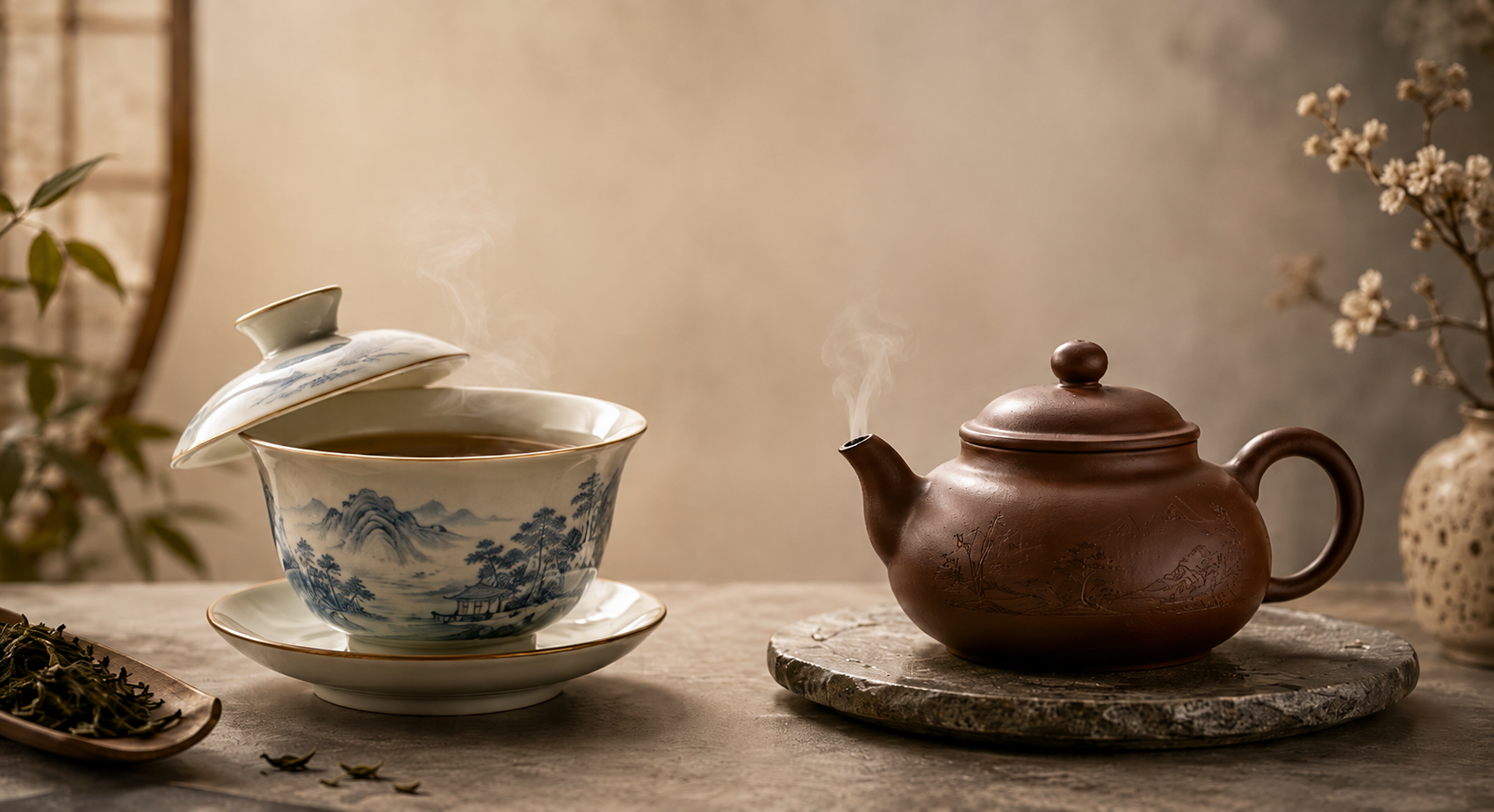
Yixing teapots are traditionally made from unglazed stoneware associated with Yixing in Jiangsu. Museum examples document the use of unglazed local clays in small vessels created for tea.
Because unglazed Yixing clay can retain traces of tea over time, many drinkers dedicate a pot to a particular tea family. A university museum description notes that such unglazed stoneware gradually absorbs traces of flavour through repeated use.
A porcelain Gaiwan behaves differently:
-
It is less absorptive
-
It is easier to reset between teas
-
It presents flavour with greater neutrality
-
It makes comparative tasting simpler
-
It does not require long-term seasoning
An Yixing pot can soften, integrate or emphasize particular qualities in a familiar tea. A Gaiwan is often preferred when the goal is to understand the tea before choosing a specialized pot.
A useful principle is:
Use porcelain to learn the tea. Use unglazed clay when you understand what relationship you want the vessel to have with it.
Why Porcelain Is an Ideal Material for a Gaiwan
Gaiwans are made from porcelain, stoneware, celadon, glass and other materials. Yet porcelain remains the most versatile choice for most tea drinkers.
Porcelain Is Flavour-Neutral
A fully glazed porcelain surface is relatively non-absorptive.
It does not readily retain the aroma of yesterday’s roasted oolong or ripe Pu-erh after proper cleaning. This makes one porcelain Gaiwan suitable for a broad range of teas.
Porcelain Makes Colour Visible
A white interior reveals the colour and clarity of the infusion.
This is useful when evaluating:
-
The pale green-gold of a spring green tea
-
The amber of roasted oolong
-
The orange-red of aged raw Pu-erh
-
The deep garnet of ripe Pu-erh
-
The golden brightness of fine black tea
Dark glazes can be beautiful but may conceal visual information.
Porcelain Balances Strength and Refinement
True porcelain is fired at high temperatures until the ceramic body becomes hard and vitrified. It is valued for its strength, fine surface and potential translucency. Kaolin is one of its key ingredients, and porcelain technology made Chinese ceramics internationally influential for centuries.
Thin porcelain responds quickly to heat and cools relatively rapidly. Thick porcelain stores more heat and feels more substantial.
Neither is automatically better. The ideal thickness depends on the tea and the user.
Porcelain Supports Fine Decoration
Its pale, smooth surface can receive:
-
Underglaze blue painting
-
Overglaze enamels
-
Iron-red decoration
-
Incised patterns
-
Relief carving
-
Calligraphy
-
Gold detailing
-
Monochrome glazes
The decoration of a Gaiwan can carry symbolic meaning while leaving its function intact.
Jingdezhen Porcelain Gaiwans
Jingdezhen is one of the most important names in the history of world ceramics.
By the 15th century, it had become an extraordinarily influential porcelain centre producing for the imperial court, domestic consumers and international trade. The Metropolitan Museum of Art describes it as the home of some of the world’s largest and most influential kilns during this period. (The Metropolitan Museum of Art)
UNESCO describes Jingdezhen as China’s most important ceramic production centre, with a porcelain tradition extending over more than 1,700 years.
In 2026, the Jingdezhen Handicraft Porcelain Industry Sites were inscribed on the UNESCO World Heritage List. The serial property records the development of handicraft porcelain production from the 10th through the 19th centuries, including raw-material extraction, kiln innovation, transportation networks, imperial and civilian kilns, and the division of labour that supported production on an immense scale. UNESCO also highlights Jingdezhen’s influential combination of kaolin and porcelain stone and the global impact of its blue-and-white porcelain. (UNESCO World Heritage Centre)
A Jingdezhen Gaiwan may draw upon this inheritance through:
-
Fine white porcelain bodies
-
Blue-and-white painting
-
Famille-rose enamels
-
Calligraphic decoration
-
Thin-walled throwing
-
Classical proportions
-
Contemporary studio ceramics
The place name alone, however, does not guarantee quality. Jingdezhen contains imperial heritage sites, individual studios, specialist painters, small workshops and large-scale factories. The workmanship of the actual piece matters more than a label.
Dehua Porcelain Gaiwans
Dehua, in Fujian province, is renowned for luminous white porcelain known in Europe as Blanc de Chine.
Archaeological evidence indicates that Dehua was producing ceramics by at least the 10th century, and its bluish-white wares entered overseas markets during the Southern Song dynasty. (Victoria and Albert Museum)
Historic Dehua porcelain is celebrated for:
-
Purity of colour
-
Smooth glaze
-
Sculptural softness
-
Jade-like or ivory-white appearance
-
Refined translucency
The British Museum holds Dehua vessels made from pure white porcelain beneath transparent glaze, illustrating the material qualities for which the region became known.
For a Gaiwan, Dehua porcelain can create a serene, minimalist effect. Its whiteness is especially well suited to tea drinkers who value quiet form, clean surfaces and the visual study of the infusion.
Celadon, Ru-Style and Other Ceramic Gaiwans
Not every ceramic Gaiwan is made from bright white porcelain.
Longquan Celadon
Longquan ware is recognized for blue-green celadon glazes. Historic examples have smooth, luminous surfaces ranging from pale misty green to deeper jade tones.
A contemporary Longquan-style Gaiwan offers:
-
A softer visual atmosphere
-
A tactile glaze
-
Greater heat retention if the body is thick
-
A connection with the celebrated celadon traditions of Zhejiang
Because many celadon bodies are stoneware rather than translucent porcelain, they may feel heavier.
Ru-Style Glazes
Historic Ru ware is among the most admired ceramic traditions of the Northern Song period. Contemporary “Ru-style” Gaiwans generally refer to pieces inspired by its restrained blue-green glaze and fine crackle patterns.
A modern Ru-style label should not imply that the object was made at an imperial Song kiln. It identifies an aesthetic lineage, not an archaeological origin.
Crackle glazes may gradually develop visible tea-coloured lines. Some drinkers treasure this changing patina; others prefer a smoother glaze that remains visually unchanged.
Glass Gaiwans
Glass offers complete visibility and does not obscure the leaf.
It is useful for:
-
Flowering teas
-
Green tea
-
White tea
-
Demonstrations
-
Observing leaf expansion
Glass loses heat quickly and can become slippery. It also lacks the tactile softness and ceramic warmth many tea drinkers value.
How Handmade Gaiwans Are Made
A fine Gaiwan appears effortless only because its difficulty has been resolved by the maker.
The bowl, lid and saucer must relate to one another in proportion, balance, shrinkage and movement. Small inaccuracies become obvious during use.
1. Preparing the Clay
Clay is refined, mixed and wedged to remove inconsistencies and create an even working body.
Air pockets, uneven moisture or contamination can cause cracking, warping or firing defects.
Porcelain is especially demanding because it may be less forgiving on the wheel than coarser clay bodies.
2. Forming the Bowl
The bowl may be:
-
Thrown on a potter’s wheel
-
Press-moulded
-
Slip-cast
-
Hand-built
-
Formed through a combination of methods
A wheel-thrown bowl is centred, opened and pulled upward. The maker establishes the wall thickness, curve, rim and foot.
“Handmade” should not be treated as a single technical category. A piece may involve hand throwing, mould forming, hand trimming, hand painting or several artisanal stages. Trustworthy descriptions should explain what was actually done.
3. Forming the Lid
The lid must correspond to the bowl after both pieces shrink in drying and firing.
The maker considers:
-
Diameter
-
Depth
-
Curvature
-
Flange position
-
Knob size
-
Expected shrinkage
-
Ease of movement
A lid that fits before firing may not fit afterward.
The aim is not an airtight seal. The lid should rest securely, move without grinding and permit a controlled pouring gap.
4. Trimming
When the clay becomes leather-hard, excess material is removed.
Trimming refines the foot, balances the walls and sharpens the profile. The underside of the lid and the receiving edge of the bowl may be adjusted to improve their relationship.
This stage strongly influences how light and comfortable the finished Gaiwan feels.
5. Drying
The pieces must dry slowly and evenly.
Uneven drying can distort the rim or lid. Because a Gaiwan depends on multiple pieces fitting together, slight warping may render an otherwise beautiful set inconvenient to use.
6. Initial Firing
Many porcelain pieces undergo a first or biscuit firing before glazing.
This transforms fragile dried clay into a ceramic body strong enough to handle during glazing and decoration.
7. Glazing
Glaze may be dipped, poured, sprayed or brushed onto the body.
The glaze must be applied evenly while preserving clean contact surfaces where required. Excess glaze can cause pieces to fuse to kiln furniture or interfere with lid movement.
8. Hand Painting
For decorated Gaiwans, artisans may paint motifs before or after the main glaze firing.
Underglaze cobalt decoration is applied beneath a transparent glaze. Overglaze enamels and gold are generally fired at lower temperatures in later stages.
A hand-painted composition must respond to a curved, three-dimensional object. The painter considers how the design travels across the lid, bowl and saucer and how it appears when the pieces are assembled.
9. High-Temperature Firing
During firing, the body and glaze undergo irreversible transformation.
The final result depends upon:
-
Kiln atmosphere
-
Peak temperature
-
Heating rate
-
Cooling rate
-
Placement in the kiln
-
Material composition
-
Interaction between body, pigment and glaze
Porcelain shrinks substantially during production. Experienced makers anticipate this rather than merely react to it.
10. Inspection and Fitting
After firing, each component is examined.
A functional inspection should consider:
-
Does the lid sit evenly?
-
Can it move smoothly?
-
Is the rim comfortable?
-
Does the vessel pour cleanly?
-
Does the bowl rock on the saucer?
-
Are there cracks or sharp areas?
-
Is the foot stable?
-
Is the glaze food-safe and properly fired?
-
Is the piece balanced when filled?
A perfectly uniform factory-made Gaiwan may be practical. A handmade Gaiwan may carry subtle variations that reveal the maker’s touch. Variation is valuable when it enriches character without compromising function.
Handmade vs Factory-Made Gaiwans
A handmade Gaiwan is not automatically better, and a factory-made Gaiwan is not automatically inferior.
The meaningful differences are found in design, material, execution and honesty.
Factory-Made Gaiwans
A well-produced factory Gaiwan may offer:
-
Consistent dimensions
-
Reliable lid interchangeability
-
Lower cost
-
Standardized capacity
-
Practical durability
-
Easy replacement
It can be an excellent choice for beginners, travel or daily use.
Handmade Gaiwans
A fine handmade Gaiwan may offer:
-
More individual proportions
-
Greater sensitivity in wall thickness
-
Hand-painted decoration
-
Distinctive glaze effects
-
Evidence of the maker’s touch
-
A stronger relationship with regional craft traditions
-
Collectible artistic value
The difference should be visible in the work—not merely asserted in marketing language.
Look for clear information about the artisan, studio, region, forming method, painting process and materials.
How to Choose the Perfect Gaiwan
The best Gaiwan is not necessarily the most expensive. It is the one that feels secure in the hand and suits the teas you actually drink.
1. Choose the Right Capacity
| Capacity | Best For |
|---|---|
| 60–80 ml | Concentrated solo tasting, rare teas, experienced users |
| 90–110 ml | Solo use, comparative tasting, Gongfu brewing |
| 110–130 ml | Beginners, one or two drinkers, versatile daily use |
| 130–160 ml | Two to four drinkers, large-leaf tea |
| 170 ml and above | Group service, direct bowl drinking, less concentrated brewing |
For most beginners, 100–120 millilitres is an excellent starting range.
Remember that stated capacity may refer to the vessel filled to the rim. Practical brewing capacity will be lower once leaves and safe pouring space are considered.
2. Examine the Rim
A gently flared rim is easier to grip and less likely to overheat the fingertips.
Very thin rims can feel refined but may chip more easily. Extremely thick rims may feel heavy and clumsy.
3. Test the Lid
The lid should:
-
Sit evenly
-
Rotate without scraping
-
Slide easily enough to control the gap
-
Remain stable during pouring
-
Have a knob large enough to touch comfortably
Do not demand a watertight fit. A Gaiwan is not a sealed storage jar.
4. Consider Wall Thickness
Thin-Walled Gaiwans
Best for:
-
Green tea
-
Fragrant light oolong
-
Comparative tasting
-
Rapid heat response
-
Drinkers who enjoy delicate handling
Medium-Walled Gaiwans
Best for:
-
General use
-
Beginners
-
Most oolongs
-
Black tea
-
White tea
Thick-Walled Gaiwans
Best for:
-
Roasted oolong
-
Ripe Pu-erh
-
Dark tea
-
Heat retention
-
Drinkers who prefer a substantial feel
Thicker does not always mean more durable. Poorly designed thick porcelain may contain stress or feel unbalanced.
5. Look at the Interior Colour
A white or pale interior is most useful for evaluating tea colour.
Dark, metallic or heavily patterned interiors may prioritize visual effect over analytical clarity.
6. Check the Pour
Fill the Gaiwan with cool water before first use.
Confirm that:
-
The stream is smooth
-
The lid remains controllable
-
Water does not run toward the fingers
-
The vessel empties at a reasonable speed
-
The saucer remains stable
7. Consider the Knob
A high lid knob keeps the finger farther from steam.
A very small or shallow knob may become hot quickly. Decorative knobs should remain functional.
8. Match the Gaiwan to Your Tea
For delicate green tea, choose a thinner, wider vessel.
For aromatic oolong, choose porcelain with a comfortably fitted lid.
For heat-loving dark tea, choose medium or thick porcelain.
For collectors, consider hand painting, rare glaze effects, artist signatures, provenance and the coherence of the complete form.
Caring for a Gaiwan
A good Gaiwan can remain in use for many years when handled thoughtfully.
Cleaning
Rinse promptly after use with warm water.
For glazed porcelain, a small amount of mild, fragrance-free detergent may be used when necessary. Rinse thoroughly so that no scent remains.
Avoid heavily perfumed soap, abrasive powders and metal scrubbers.
Tea Stains
Light tea staining is usually cosmetic.
A soft cloth or non-abrasive sponge is sufficient for regular care. Persistent stains can often be removed with a gentle baking-soda solution, provided the piece has no delicate gilding or vulnerable overglaze decoration.
Dishwasher Use
Plain, commercially produced porcelain may sometimes be labelled dishwasher-safe.
Hand washing remains the safer choice for:
-
Handmade Gaiwans
-
Hand-painted pieces
-
Gold or silver decoration
-
Crackle glazes
-
Antique or collectible vessels
-
Thin porcelain
-
Pieces with unknown glaze stability
Storage
Store the bowl, lid and saucer so that hard ceramic surfaces do not strike each other.
Place a soft piece of cloth or paper between components when packing a Gaiwan for travel. Do not wedge the lid tightly into the bowl.
Avoiding Chips
Most damage occurs at the rim, lid edge and knob.
Handle the lid over a table or tray rather than carrying it separately across a room. Do not place a hot Gaiwan directly onto a cold or wet stone surface, as sudden temperature changes may stress the ceramic.
Common Beginner Mistakes
Overfilling the Bowl
Overfilling makes the rim hot and increases the risk of spills.
Leave enough headspace for safe lid placement.
Using Too Much Leaf Without Shortening the Infusion
A high leaf-to-water ratio requires shorter brewing.
Increasing the leaf quantity while keeping a long steep often produces overwhelming strength.
Pouring Too Slowly
A hesitant pour extends extraction and keeps the fingers near hot porcelain.
Aim for a controlled, continuous movement.
Pressing the Lid Too Hard
The index finger should guide the lid, not force it downward.
Leaving Water Between Infusions
Residual water continues extracting.
Pour as completely as possible.
Treating Temperature Charts as Laws
Tea varies by cultivar, leaf grade, age, storage and processing.
Use recommended temperatures as starting points, then taste and adjust.
Buying an Oversized Gaiwan
Large vessels are difficult to hold and require more tea.
A smaller Gaiwan is usually more economical, precise and comfortable.
Choosing Appearance Over Ergonomics
A dramatic shape may be beautiful but awkward.
The Gaiwan should first function as a brewing vessel.
Assuming Every Imperfection Proves Handcraft
Uneven glazing, unstable feet and poorly fitting lids are not signs of artistry merely because they differ from machine production.
Meaningful handcraft balances individuality with disciplined function.
Frequently Asked Questions About Gaiwans
1. What is a Gaiwan?
A Gaiwan is a Chinese lidded tea bowl, usually composed of a lid, bowl and saucer. It can be used to brew tea, drink tea directly or decant tea into smaller cups.
2. What does Gaiwan mean in Chinese?
Gaiwan is written 盖碗. Gai means lid or cover, while wan means bowl. The term literally means “lidded bowl.”
3. When was the Gaiwan invented?
The loose-leaf brewing culture that made the Gaiwan possible developed strongly during the Ming dynasty. The recognizable Gaiwan became firmly established during the Qing dynasty, when covered tea bowls appeared widely in courtly and domestic contexts. The Palace Museum specifically identifies the Gaiwan as a tea utensil that began appearing in the Qing period.
4. What size Gaiwan should a beginner buy?
A capacity of approximately 100–120 millilitres is ideal for most beginners. It is large enough for one or two drinkers but still light enough to control.
5. Can beginners use a Gaiwan?
Yes. A beginner normally needs only a few practice sessions with cool or warm water to learn the grip. Choose a moderate-sized porcelain Gaiwan with a flared rim and high lid knob.
6. Why does my Gaiwan get so hot?
The bowl may be overfilled, the walls may be thick, the rim may not flare outward or the water may be reaching the finger-contact points. Reduce the fill level and keep the fingers on the outer rim.
7. How do I hold a Gaiwan without burning myself?
Place the thumb and middle finger on opposite sides of the rim and the index finger on the lid knob. Keep the fingers away from the body and pour in a smooth, decisive motion.
8. Is a Gaiwan better than a teapot?
A Gaiwan is better for visual inspection, comparative tasting, rapid pouring and easy cleaning. A teapot may be easier to handle and can retain heat more consistently. The better vessel depends on the tea and the drinker.
9. Why do tea masters use porcelain Gaiwans?
Porcelain is relatively neutral, easy to clean and suitable for many tea types. Its pale interior also helps the brewer assess infusion colour and leaf quality.
10. Does a Gaiwan filter tea leaves?
The lid functions as an adjustable filter. By changing the gap between the lid and bowl, the brewer can hold back most whole leaves while pouring.
Very fine particles may still pass through. A separate strainer can be used when necessary.
11. Why does lid fit matter?
The lid must sit securely enough to remain controlled during pouring while moving freely enough to create an adjustable opening. Poor fit can cause wobbling, scraping or unpredictable spills.
It does not need to be airtight.
12. Can I drink directly from a Gaiwan?
Yes. Traditionally, tea can be infused and drunk from the same bowl. Hold the saucer, use the lid to move leaves aside and sip carefully from the rim.
In contemporary Gongfu tea, the infusion is more often poured into a pitcher or small cups.
13. Can I brew green tea in a Gaiwan?
Yes. Use cooler water, moderate leaf quantity and a vessel that releases heat reasonably quickly. Avoid keeping tender green leaves sealed under a very hot lid for long periods.
14. Can I brew Pu-erh in a Gaiwan?
Yes. A Gaiwan is excellent for both raw and ripe Pu-erh because it allows fast pouring, easy inspection and convenient cleaning.
15. Can I brew coffee in a Gaiwan?
Coffee can technically be infused in a Gaiwan, but the vessel is not designed for coffee extraction or fine coffee grounds. Particles will pass through the lid gap, and coffee oils may leave persistent aromas.
Use a dedicated Gaiwan rather than one reserved for fine tea.
16. What teas should not be brewed in a Gaiwan?
No major tea category is categorically unsuitable.
Very fine tea dust, broken CTC black tea, powdered matcha and blends containing numerous small particles are less convenient because they pass through the lid opening. Matcha should be whisked in a suitable bowl rather than strained through a Gaiwan.
17. How much tea should I use?
For a 100–120 millilitre Gaiwan, begin with approximately three to seven grams depending on the tea.
Use less for broken or strongly extracting leaves and more for large, airy leaves. Adjust according to taste.
18. How long should tea steep in a Gaiwan?
Gongfu-style infusions commonly begin between five and thirty seconds. Later infusions are gradually extended.
There is no universal time because leaf quantity, temperature and tea type all influence extraction.
19. Should I rinse tea before brewing?
A brief rinse is common for compressed Pu-erh, dark tea and some tightly rolled oolongs. It can help warm the leaves and begin opening them.
Delicate green, yellow and high-grade black teas are not normally rinsed unless there is a specific reason.
20. Is a Gaiwan dishwasher-safe?
Some plain porcelain Gaiwans may be technically dishwasher-safe, but hand washing is recommended for handmade, hand-painted, gilded, thin or collectible pieces.
21. Can I use one Gaiwan for every tea?
A fully glazed porcelain Gaiwan can be used for almost every tea after proper cleaning. This is one of its principal advantages over unglazed clay vessels.
22. Does a porcelain Gaiwan need to be seasoned?
No. Glazed porcelain should be kept clean rather than intentionally seasoned.
Seasoning is associated more closely with certain unglazed clay teapots.
23. Why is tea poured into a fairness pitcher?
A fairness pitcher combines the complete infusion before serving. This ensures that each guest receives tea of approximately equal strength.
24. How long does a handmade Gaiwan last?
There is no fixed lifespan. Properly fired porcelain is durable and can remain usable for generations, but the lid and rim are vulnerable to impact.
Longevity depends primarily on craftsmanship, firing quality and handling.
25. Are handmade Gaiwans worth the price?
They can be when the price reflects genuine hand forming, painting, material quality, functional refinement and artistic authorship.
A vague “handmade” label without information about the maker or process should not be accepted as proof of quality.
26. What is the best material for a beginner’s Gaiwan?
White glazed porcelain is generally the best starting material. It is neutral, versatile, easy to clean and helpful for observing the colour of the tea.
27. Is a saucer necessary?
No. A two-piece Gaiwan consisting of a bowl and lid can brew tea effectively.
The saucer adds stability, heat protection and traditional elegance, especially when drinking directly from the bowl.
28. Why are some Gaiwans so thin?
Thin porcelain reacts quickly to temperature and can feel exceptionally refined. It is useful for delicate or aromatic teas but requires more careful handling.
29. Why are some Gaiwans deliberately irregular?
Studio potters may preserve subtle throwing lines, glaze variations or asymmetry to express the material and the maker’s hand.
Irregularity should not prevent stable placement, secure lid movement or comfortable pouring.
30. How can I tell whether a Gaiwan is well made?
Check the lid movement, rim comfort, balance, glaze, foot stability and pouring speed. A good Gaiwan should feel composed as a complete object and controlled during actual use.
The Gaiwan as an Object of Collecting
A Gaiwan can be valued at several levels simultaneously.
It may be:
-
A daily tool
-
A work of ceramic art
-
A record of regional craftsmanship
-
A carrier of symbolic decoration
-
A personal ritual object
-
A gift marking an important occasion
-
A future heirloom
Collectors often look beyond surface beauty to consider the relationship among all three components.
Does the decoration continue meaningfully from lid to bowl? Does the saucer complete the composition? Is the knob proportionate? Does the painted line follow the form naturally? Does the object remain satisfying after the tea session has ended?
A collectible Gaiwan should not cease to be useful. In Chinese decorative arts, technical intelligence and visual refinement have rarely been true opposites.
Why the Gaiwan Still Matters
The modern world offers countless devices that promise convenience.
Tea can be prepared automatically, filtered instantly and consumed while attention is directed elsewhere. The Gaiwan offers something different.
It asks the drinker to notice.
You notice the sound of water entering porcelain. You notice the leaves lifting and sinking. You notice fragrance on the underside of the lid. You notice that the third infusion is softer than the second, or that the fifth has revealed a sweetness absent at the beginning.
The Gaiwan slows time not by stopping it, but by giving it form.
Its simplicity is therefore deceptive. The vessel contains no mechanism, yet it teaches timing. It has no built-in thermometer, yet it teaches heat. It has no permanent filter, yet it teaches the hand how to control the leaves. It does not determine the result in advance.
It leaves room for skill.
Conclusion: A Small Vessel Containing a Vast Tradition
A Gaiwan is one of the clearest expressions of Chinese tea philosophy.
It is practical without being ordinary, refined without being ostentatious and symbolic without losing its usefulness. Its lid gathers fragrance. Its bowl reveals the leaves. Its saucer brings balance and composure. Together, the three parts transform the preparation of tea into an act of attention.
The Gaiwan’s deeper history belongs to the evolution of Chinese tea itself: from earlier powdered preparations to the rise of loose-leaf infusion during the Ming dynasty, and from Qing imperial tea culture to the intimate Gongfu sessions practiced around the world today.
Yet a Gaiwan is not a relic.
In the hands of a contemporary tea drinker, it remains fully alive.
A handmade Gaiwan from Jingdezhen or Dehua carries more than regional prestige. At its best, it preserves knowledge: how porcelain should be formed, how a lid should move, how a rim should meet the fingers, how pigment should follow a curved surface and how fire can transform clay into something at once delicate and enduring.
Oriental Artisan’s collection of handcrafted Gaiwans brings together vessels shaped within these living ceramic traditions—pieces intended not only to be admired, but to become part of daily ritual.
Because the finest Gaiwan is not merely the one displayed behind glass.
It is the one lifted each morning, warmed with water and slowly made familiar through use.

Leave a comment
This site is protected by hCaptcha and the hCaptcha Privacy Policy and Terms of Service apply.