


Ultimate Guide to Chinese Mahjong: Rules, Tiles, Setup and How to Play
There is a sound that belongs unmistakably to Mahjong.
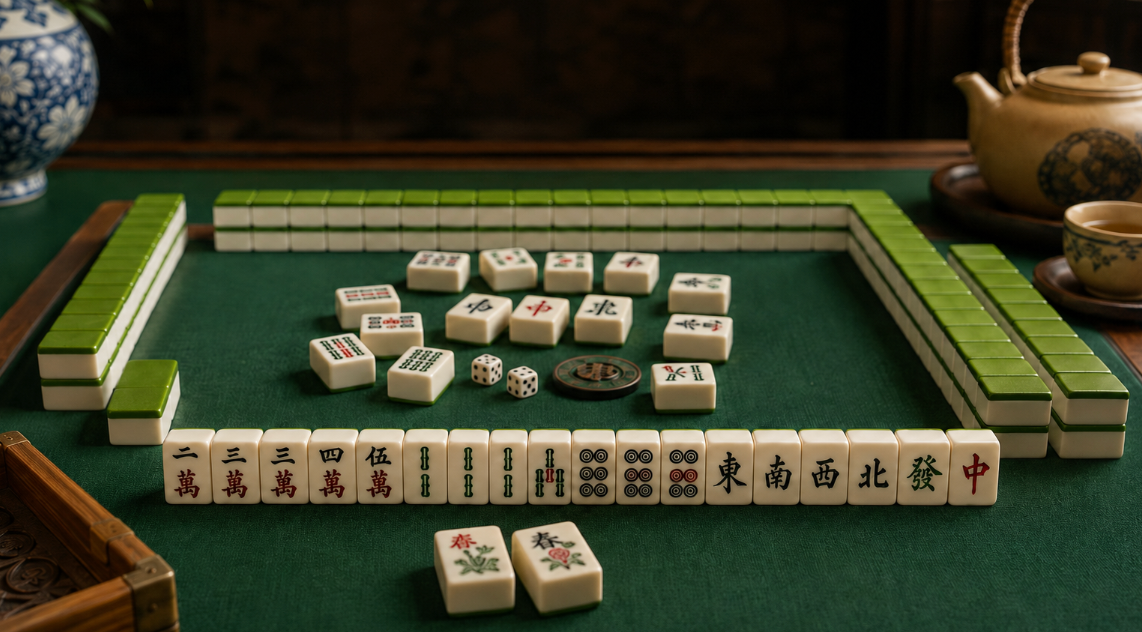
A hundred tiles tumble face-down across a tabletop, clicking against one another as four pairs of hands sweep them into the center. Walls rise from the disorder. Dice roll. Tea is poured. Someone recognizes a familiar character upside down before another hand quickly turns it away.
Then, almost abruptly, the table becomes quiet.
The first tile is discarded.
For generations of players, Mahjong has been far more than a strategy game. It has been a reason to sit together: at family tables, neighborhood gatherings, holiday celebrations, teahouses and living rooms across China, the Chinese-speaking world and communities far beyond it. As the game traveled internationally, it acquired new rules, new social meanings and entirely new traditions of its own. Historian Annelise Heinz has documented how Mahjong became woven into Chinese American heritage as well as other distinctly American social cultures during the twentieth century.
Yet to a beginner, a Mahjong table can look intimidating: 136 or 144 unfamiliar tiles, Chinese characters, rapid calls and players apparently rearranging their hands according to rules no one has explained.
The reassuring truth is this:
Mahjong may look complicated, but its fundamental objective is surprisingly simple.
In most traditional forms of the game, you draw and discard tiles while trying to complete a legal hand. The most familiar basic winning structure consists of four groups, called melds, and one pair.
Once you understand the tiles, that structure and the rhythm of draw → evaluate → discard, the game begins to make sense remarkably quickly.
This guide will take you from opening the box to declaring your first Mahjong—while also explaining why there is no single universal version of “Chinese Mahjong,” where the game came from, what its tiles mean and how to choose a set worth gathering around.
What Is Chinese Mahjong?
Mahjong is a Chinese tile-based strategy game most commonly played by four people. Players draw and discard tiles while trying to complete a legal winning hand, usually built from four groups and one pair.
In Mandarin Chinese, the game is commonly written 麻将 in simplified Chinese and 麻將 in traditional Chinese, pronounced májiàng.
Mahjong combines skill and chance. You cannot control which tile you draw, but you continually decide which tiles to keep, which to discard, whether to claim another player's discard, what kind of hand to pursue and how much information to reveal.
Academic research on Mahjong likewise treats it as a multiplayer game of incomplete information in which players typically begin with 13 tiles and repeatedly draw and discard until completing a legal hand.
Mahjong at a Glance
| Question | Beginner Answer |
|---|---|
| How many people play Mahjong? | Usually four |
| How many tiles are used? | Commonly 136 core tiles, or 144 when eight bonus tiles are included |
| How many tiles does each player hold? | Normally 13 between turns |
| What is the basic goal? | Complete a legal hand, commonly four melds plus one pair |
| What happens on a normal turn? | Draw one tile, evaluate your hand, discard one tile |
| What is a meld? | Usually a sequence, triplet or four-of-a-kind set |
| Is Mahjong mainly luck? | No. Random draws matter, but hand-building, observation and risk decisions matter enormously |
| Are all Mahjong rules the same? | Absolutely not |
That final point is essential.
“Mahjong” describes a family of related games, not one universally standardized ruleset.
Hong Kong-style Mahjong, Guangdong traditions, Sichuan Mahjong, Chinese Official or Mahjong Competition Rules (MCR), Taiwanese Mahjong, Japanese Riichi Mahjong and American Mah Jongg can differ substantially. The Mahjong International League itself recognizes MCR, Riichi and Sichuan rules as distinct major competitive systems while acknowledging additional local traditions.
Accordingly, this guide separates shared Mahjong fundamentals from variant-specific rules.
For the step-by-step beginner tutorial, we will use a deliberately simple traditional Chinese-style learning framework:
- four players;
- the 136 core tiles;
- flowers and seasons temporarily removed;
- 13 tiles per player;
- four melds plus one pair as the basic winning structure;
- no complicated minimum-score requirement during your first practice game.
This is a teaching framework, not a claim that every Chinese Mahjong table uses these exact rules.
A Brief History of Mahjong
Mahjong is Chinese, but it is not thousands of years old.
That distinction matters because twentieth-century advertising helped surround the game with attractive stories of emperors, ancient courts and secret aristocratic traditions for which there is little reliable evidence.
The British Museum places Mahjong's emergence during China's Qing dynasty (1644–1912) and states that the game was invented in China in the nineteenth century.
Exactly where and when it first appeared remains debated.
Historical research points toward the second half of the nineteenth century, with early Mahjong-like tile sets appearing in eastern and southern Chinese commercial networks. Ningbo is frequently associated with the game's development, but other origin theories exist, and the documentary record does not justify identifying one legendary inventor or exact birthday for Mahjong. Modern scholarship generally connects Mahjong to earlier Chinese draw-and-discard games and money-suited playing-card traditions rather than to an ancient imperial pastime.
By the late Qing and early Republican eras, Mahjong had spread widely through Chinese urban and social life. International circulation accelerated dramatically in the early twentieth century.
Historian Annelise Heinz's research shows that Mahjong became a transpacific phenomenon in the 1920s. Growing American demand even stimulated large-scale production in Shanghai: by 1923, Chinese and Western merchants were operating factories that combined standardized production with artisanal finishing for international markets.
Mahjong then developed lives of its own outside China.
In the United States, competing rules proliferated until the National Mah Jongg League was founded in 1937 to standardize an American form of the game. That American tradition continues to use distinctive mechanisms such as an annually changing card of approved hands, Jokers and the Charleston tile-passing sequence.
Mahjong's history is therefore not a straight line from “ancient China” to the present. It is a story of nineteenth-century Chinese game culture, regional adaptation, commerce, migration, family practice and international reinvention.
Understanding a Chinese Mahjong Set
A Mahjong set initially appears to contain a bewildering number of symbols. In reality, its core structure is highly systematic.
A common 144-tile Chinese-style set contains 108 suited tiles, 28 honor tiles and eight bonus tiles. Mahjong Competition Rules likewise specify a 144-piece set.
Remove the eight flowers and seasons and you are left with the 136 core playing tiles used by many Mahjong traditions.
Mahjong Tile Types
| Tile Type | Chinese Name | Number in a Common 144-Tile Set | What It Does |
| Characters | 万子 / 萬子 | 36 | Numbered suit, 1–9, four of each |
| Bamboo | 索子 / 条子 | 36 | Numbered suit, 1–9, four of each |
| Dots / Circles | 筒子 | 36 | Numbered suit, 1–9, four of each |
| Winds | 风牌 / 風牌 | 16 | East, South, West, North; four of each |
| Dragons | 三元牌 | 12 | Red, Green, White; four of each |
| Flowers / Seasons | 花牌 | 8 | Bonus tiles in rules that use them |
The three numbered suits contribute 108 tiles:
3 suits × 9 ranks × 4 copies = 108 tiles
Winds and Dragons add another 28:
4 winds × 4 = 16
3 dragons × 4 = 12
That gives us the 136-tile core.
Add eight commonly included flower and season tiles, and the set reaches 144.
Characters — 万子 / 萬子
The Character suit is numbered from one through nine.
Each tile normally displays a Chinese numeral above the character 萬 / 万, meaning “ten thousand” or “myriad.”
A Three Characters tile therefore essentially reads “three myriads.”
For Western beginners, this is usually the suit requiring the most memorization because the numbers themselves are written in Chinese.
Bamboo — 索子 / 条子
The Bamboo suit also runs from one through nine.
Tiles Two through Nine are normally represented by repeated stick-like forms.
The One Bamboo tile is the exception: many sets replace the single stick with a bird. The species and artistic treatment vary considerably from set to set, which is why one One Bamboo may look like a peacock while another resembles an entirely different bird. The European Mahjong Association's Riichi rules similarly note that One Bamboo is commonly decorated with a bird whose design varies between sets.
This variation makes One Bamboo one of the most visually distinctive tiles in Mahjong.
Dots / Circles — 筒子
Dots are the easiest suit for many beginners.
Simply count the circles.
One Dot has one large circular motif, Five Dots has five and Nine Dots has nine.
No Chinese literacy is required.
Winds — 风牌 / 風牌
There are four wind tiles:
- East — 东 / 東 — dōng
- South — 南 — nán
- West — 西 — xī
- North — 北 — běi
There are four copies of each.
Winds can form pairs, Pongs and Kongs, but unlike suited tiles they cannot form numerical sequences.
Winds also play additional roles in many Mahjong scoring systems, where a player's seat wind or the current round wind may make certain combinations more valuable.
Dragons — 三元牌
There are three types of Dragon tile:
- Red Dragon — 中 — zhōng
- Green Dragon — 发 / 發 — fā
- White Dragon — 白 — bái
There are four copies of each.
The names “Red Dragon,” “Green Dragon” and “White Dragon” are conventional English Mahjong terminology. The Chinese characters themselves should not be treated as literal names for mythological dragons.
The White Dragon can be particularly confusing for beginners because on some sets it is represented by an empty white face or a simple border.
Flowers and Seasons
Many traditional Chinese-style sets include eight bonus tiles.
They are often divided into:
- four flower tiles;
- four season tiles.
Unlike ordinary tiles, they usually do not remain part of the final four-meld-plus-pair structure. When a ruleset uses bonus tiles, a player who draws one typically reveals it and receives a replacement tile. The exact replacement procedure and scoring value depend on the variant.
This is one reason beginners are often better off learning their first few hands without flowers.
Flowers are not universal. Some traditions use them extensively; others omit them entirely. Sichuan competitive rules, for example, may play with only the 108 suited tiles, demonstrating just how radically tile composition can change between Chinese variants.
How to Read Mahjong Tiles
You do not need to speak or read Chinese to play Mahjong.
You need only recognize a small number of recurring characters.
The Chinese Numerals You Need
| Number | Chinese |
| 1 | 一 |
| 2 | 二 |
| 3 | 三 |
| 4 | 四 |
| 5 | 五 |
| 6 | 六 |
| 7 | 七 |
| 8 | 八 |
| 9 | 九 |
These appear on the Character suit.
Then memorize four winds:
東 / 东 · 南 · 西 · 北
And two immediately recognizable Dragon characters:
中 · 發 / 发
The White Dragon is generally blank, white or bordered.
That is enough visual vocabulary to identify the core Mahjong set.
The Fastest Beginner Recognition Method
Think of the tiles in this order:
Dots: count them.
Bamboo: count the sticks; remember that One Bamboo is often the bird.
Characters: read the Chinese numeral on top.
Winds: memorize 東南西北.
Dragons: recognize 中, 發 and the blank White Dragon.
After several rounds, players generally stop consciously translating the symbols. The shapes themselves become recognizable game pieces.
What Is the Goal of Mahjong?
The basic goal of Mahjong is to complete a legal winning hand before the other players.
The most familiar standard structure is:
4 melds + 1 pair
A meld is a completed group of tiles.
There are three fundamental types.
Chow / Chi
A Chow is a sequence of three consecutive numbers in the same suit.
Examples:
2 Bamboo + 3 Bamboo + 4 Bamboo
6 Dots + 7 Dots + 8 Dots
You cannot make:
8 Characters + 9 Characters + 1 Characters
Sequences do not wrap around.
You also cannot make sequences from Winds or Dragons.
Pong / Pung
A Pong is three identical tiles.
Examples:
Red Dragon + Red Dragon + Red Dragon
or
5 Dots + 5 Dots + 5 Dots
Kong
A Kong is four identical tiles.
Because a Kong contains an extra physical tile but counts as one meld, rules normally provide a replacement draw so that the hand can still reach the correct structural size. Exact procedures vary.
Mahjong Competition Rules distinguish concealed Kongs from other Kong formations and treat the four identical tiles as a completed group.
Pair
A standard winning hand also needs one pair:
two identical tiles.
For example:
East + East
Example of a Winning Mahjong Hand
Imagine this finished hand:
2–3–4 Characters
5–6–7 Characters
3–4–5 Bamboo
6–7–8 Dots
East + East
That is:
- four completed melds;
- one pair;
- 14 tiles.
This is the structural idea to remember.
Mahjong = four groups and a pair.
There are important exceptions. Many variants recognize special hands that do not follow this structure, and formal scoring systems may require the completed hand to meet additional conditions.
But four melds plus a pair is the right foundation for a beginner.
Concealed vs Exposed Sets
A concealed meld is built entirely from tiles you drew yourself and kept hidden in your hand.
An exposed meld is created by claiming another player's discard and placing the completed group face-up on the table.
That difference can affect scoring significantly depending on the rules.
It also affects information.
An exposed 5–6–7 Bamboo tells every opponent that those tiles are now permanently part of your hand.
A concealed group tells them nothing.
How to Play Chinese Mahjong: Step by Step
Before beginning, remember that the following is a beginner learning framework, not a universal Chinese Mahjong ruleset.
For your first game:
- use four players;
- use 136 tiles;
- remove flowers and seasons;
- ignore advanced scoring requirements;
- treat the first player to complete four melds and one pair as the winner.
Once everyone understands the rhythm of play, choose a specific regional or competitive ruleset and add its scoring system.
Step 1 — Gather Four Players
Traditional Mahjong is most commonly a four-player game.
Each player occupies one wind position:
- East
- South
- West
- North
East serves as the dealer.
In formal MCR seating, the positions proceed from East through South, West and North in counter-clockwise order.
For a casual first game, you can determine East randomly with dice or simply choose a player and rotate later.
Step 2 — Shuffle the Tiles
Place every tile face-down in the center of the table.
All four players mix them together using both hands.
This is the moment that gives Mahjong one of its most recognizable sensory signatures: the dense clicking and rolling of tiles moving against the tabletop.
Do not underestimate the usefulness of this ritual.
Unlike shuffling cards, everyone participates at once. The table is physically reset together.
Step 3 — Build the Walls
Each player takes tiles and builds a wall in front of their seat.
With 136 tiles:
34 tiles per player = 17 stacks of two tiles
Bring the four walls together into a square.
With a traditional 144-tile set including flowers:
36 tiles per player = 18 stacks of two
Formal rules use dice and specific procedures to determine exactly where the wall is broken. For a first learning game, it is perfectly reasonable to simplify this step and begin dealing from an agreed point.
The important concept is that the wall acts as Mahjong's draw pile.
Step 4 — Determine the Dealer
The dealer is traditionally called East.
Methods for choosing East vary. Dice are common, while house traditions may use different procedures.
Do not worry about memorizing dealer-retention rules during your first game because they differ between Mahjong systems.
Simply establish who is East before dealing.
Step 5 — Deal the Tiles
Each non-dealer receives 13 tiles.
East begins with 14.
This 14-versus-13 structure also appears in formal Mahjong Competition Rules: after the deal, the dealer holds 14 tiles while each other player holds 13.
Why?
Because East begins play by discarding.
After East's first discard, everyone will normally have 13 tiles between turns.
Step 6 — Begin the Turn
The essential Mahjong turn is:
Draw → Evaluate → Discard
Draw one tile from the wall.
You now temporarily have 14 tiles.
Examine your hand.
Ask:
- Did the new tile complete a meld?
- Did it improve an unfinished sequence?
- Did it complete a pair?
- Which tile now contributes least to the hand I am building?
Then discard one tile face-up.
You return to 13 tiles.
The next player draws.
This cycle continues throughout the hand.
Step 7 — Claiming Discards
A discarded tile does not always remain dead.
Another player may be able to use it immediately.
The three most important calls are Chow, Pong and Kong.
Calling Chow
Use the discard to complete a three-tile sequence.
Example:
You hold:
3 Bamboo + 4 Bamboo
The player immediately before you in the turn sequence discards:
5 Bamboo
You may call “Chow” or “Chi”, reveal your 3 and 4 Bamboo, take the discarded 5 and place the complete sequence face-up.
Chow is normally more restricted than Pong because it is associated with turn order rather than being claimable from everyone.
Calling Pong
If you already hold two copies of the discarded tile, you may claim the third.
You hold:
North + North
Another player discards:
North
Call “Pong” or “Pung.”
Reveal the pair and add the discard.
You now have an exposed triplet.
Calling Kong
If a discard completes four identical tiles under the rules being used, you may be able to declare Kong.
Replacement-draw procedures differ, so agree on them before playing.
Claim Priority
Rule systems differ in details, but completing Mahjong generally outranks an ordinary meld claim.
Under Mahjong Competition Rules, a Pung claim takes priority over a Chow claim.
For a simple learning game, use:
Mahjong → Pong/Kong → Chow
If multiple players attempt to win from the same discard, follow the specific variant or house rule you have agreed upon.
Step 8 — Form Your Hand
As play continues, your 13-tile hand should gradually become more structured.
Instead of seeing:
13 separate tiles
begin seeing:
completed groups + unfinished groups + pair candidates
A hand might evolve into:
- completed 5–6–7 Characters;
- completed 3–4–5 Bamboo;
- completed 6–7–8 Dots;
- unfinished 2–3 Characters;
- pair of East.
Now the hand has a clear destination.
A 1 Characters or 4 Characters would complete the final sequence.
You are one tile away from Mahjong.
Step 9 — Declare Mahjong
When your draw—or a legal opponent discard—completes your winning hand, declare:
“Mahjong!”
Reveal the hand.
For our beginner exercise, verify that it contains:
- four valid melds;
- one valid pair.
If it does, the hand is over.
Formal rules may impose additional scoring requirements. For example, Mahjong Competition Rules require a hand to meet a minimum scoring threshold rather than allowing every structurally complete four-meld-plus-pair hand to win.
That complexity should come after a beginner understands how hands are built.
Step 10 — Score and Begin Again
This is where Mahjong traditions diverge dramatically.
Hong Kong scoring is not the same as Chinese Official/MCR scoring.
Sichuan Mahjong is not the same as Hong Kong Mahjong.
Riichi has its own scoring architecture.
American Mah Jongg is different again.
For your first practice session, skip scoring altogether.
Winning the hand is enough.
Once everyone can confidently:
- recognize the tiles;
- draw and discard correctly;
- build sequences and triplets;
- call Chow, Pong and Kong;
- identify a four-meld-plus-pair hand;
choose one actual Mahjong tradition and learn its scoring system.
That approach is far easier than attempting to absorb every rule simultaneously.
Example Mahjong Round
Suppose your starting hand contains:
2 Characters
3 Characters
5 Characters
6 Characters
7 Characters
3 Bamboo
4 Bamboo
6 Dots
7 Dots
8 Dots
East
East
Red Dragon
You can already see several useful structures:
- 5–6–7 Characters is complete.
- 6–7–8 Dots is complete.
- 3–4 Bamboo wants a 2 or 5.
- 2–3 Characters wants a 1 or 4.
- East + East is a useful pair.
- The lone Red Dragon currently connects to nothing.
Your turn arrives.
You draw:
5 Bamboo
Now your 3–4 Bamboo becomes:
3–4–5 Bamboo
Excellent.
You discard the isolated Red Dragon.
Your hand is now effectively:
2–3 Characters
5–6–7 Characters
3–4–5 Bamboo
6–7–8 Dots
East + East
You already have:
- three complete melds;
- one incomplete sequence;
- one pair.
Only one meld remains.
A 1 Characters would make 1–2–3.
A 4 Characters would make 2–3–4.
Several turns pass.
Another player calls Pong on someone else's discard, revealing three matching tiles and interrupting the normal draw sequence.
Play continues.
Then an opponent discards:
4 Characters
That tile completes your fourth meld.
You declare:
Mahjong.
Your final hand is:
2–3–4 Characters
5–6–7 Characters
3–4–5 Bamboo
6–7–8 Dots
East + East
The mysterious-looking game has become something much simpler:
you found incomplete patterns, improved them and waited for one final tile.
That is the heart of learning how Mahjong works.
Chow vs Pong vs Kong
These three terms are easy to confuse at first.
Here is the simplest comparison.
| Combination | Tiles Required | Example | How It Is Formed |
| Chow / Chi | 3 | 4–5–6 Bamboo | Three consecutive numbers in the same suit |
| Pong / Pung | 3 | 7 Dots × 3 | Three identical tiles |
| Kong | 4 | Red Dragon × 4 | Four identical tiles |
Chow
A numerical sequence.
Only suited tiles can Chow.
Winds and Dragons cannot.
Pong
Three identical tiles.
Suited tiles, Winds and Dragons can all Pong.
Kong
Four identical tiles.
It counts as a meld but normally triggers a replacement draw because four physical tiles have been committed to a structure that occupies one meld position.
Why Do the Names Vary?
English-language Mahjong terminology developed across different transliteration systems, languages and regional traditions.
You may therefore encounter:
- Chow / Chi
- Pong / Pung
- Kong / Kan
Do not let terminology obscure the underlying patterns.
Sequence. Triplet. Quad.
That is what matters.
How Do You Win Mahjong?
In the most familiar basic form, you win Mahjong by completing four melds and one pair for a 14-tile winning structure.
The four melds may contain combinations of:
- Chows;
- Pongs;
- Kongs.
The remaining two tiles form the pair.
But there are two major cautions.
First: Special Hands Exist
Many Mahjong traditions recognize special winning patterns that do not resemble the normal four-meld-plus-pair structure.
These are variant-specific.
Second: A Complete Shape May Not Be Enough
In some formal rules, a hand can look structurally complete but still fail to meet the minimum scoring requirement.
MCR, for example, includes a substantial catalogue of scoring combinations and requires qualifying points.
Japanese Riichi likewise requires a valid scoring pattern, called a yaku, rather than allowing every structurally complete hand to win; Riichi also has its own distinctive concepts such as furiten and the declaration of riichi.
That is why beginners should learn two ideas separately:
Step 1: Learn how a Mahjong hand is constructed.
Step 2: Learn what makes that hand legal and valuable under your chosen ruleset.
Mahjong Rules Beginners Commonly Get Wrong
1. Assuming There Is One Universal Mahjong Rulebook
This is the biggest mistake.
Before joining a table, ask:
“Which Mahjong rules are we playing?”
That one question prevents countless disagreements.
2. Mixing Different Suits in a Chow
This is not valid:
3 Bamboo + 4 Characters + 5 Dots
A Chow must use consecutive tiles within one suit.
3. Trying to Make a Sequence With Winds
East, South and West may sound sequential, but they do not form a Chow.
Neither do:
Red + Green + White Dragon
Honor tiles form pairs, Pongs and Kongs—not numerical sequences.
4. Forgetting the Draw-Discard Rhythm
On a normal turn:
draw first, discard second.
You normally hold 13 tiles between turns and temporarily reach 14 after drawing.
5. Calling Chow From the Wrong Player
Unlike Pong, Chow is ordinarily tied to the player immediately preceding you in the turn sequence.
Do not assume you can take any convenient sequence-completing discard from anywhere on the table.
6. Forgetting That Claimed Melds Become Exposed
If you take someone's discard to form a Chow or Pong, that group is generally placed face-up.
You cannot quietly return it to your concealed hand.
7. Treating Flower Tiles Like Normal Hand Tiles
When flowers or seasons are in use, they are typically bonus tiles and are handled separately, with replacement procedures defined by the specific rules.
8. Assuming Four Melds and a Pair Always Guarantees a Legal Win
It does in our simplified learning exercise.
It does not necessarily do so under formal scoring systems.
9. Accidentally Playing Rules From Another Variant
This happens constantly among people who learned through apps.
A Japanese Riichi app may teach you:
- riichi;
- dora;
- furiten;
- Japanese scoring conventions.
Those rules should not automatically be carried into a Hong Kong or Chinese family table.
Mahjong Strategy for Beginners
The first strategic breakthrough in Mahjong is realizing that you are not merely collecting pretty combinations.
You are managing flexibility.
Prefer Flexible Shapes
Compare:
3–4 Bamboo
with:
1–2 Bamboo
The first shape can be completed by either:
2 Bamboo or 5 Bamboo
The second relies only on:
3 Bamboo
The more tiles that can improve your hand, the healthier your structure usually is.
Notice Isolated Tiles
A lone 5 Characters surrounded by nothing useful may eventually connect to many tiles.
A lone honor tile has fewer possible roles: it generally needs matching copies to become useful.
That does not mean honors are always bad—many scoring systems reward them—but beginners should understand their reduced sequence flexibility.
Do Not Break Pairs Automatically
Pairs are valuable because every standard hand needs one.
They can also become Pongs.
If you have several pairs, however, eventually you may need to decide which one should remain your final pair and which should be transformed or abandoned.
Count Visible Tiles
There are normally four copies of each core tile.
If you desperately need a 6 Bamboo but three 6 Bamboo tiles are already visible in opponents' exposed melds or the discard area, only one remains unseen.
That is useful information.
Mahjong is an imperfect-information game, but the information that becomes public should not be ignored.
Watch What People Discard
Discard patterns can suggest which suits or tile ranges opponents are abandoning.
They cannot tell you everything.
But Mahjong is not solitaire with three distractions sitting around the table.
Your opponents' decisions are information.
Understand “Safe” Carefully
More advanced players often discuss safer and more dangerous discards.
Do not assume this concept operates identically across every Mahjong tradition.
Japanese Riichi, for example, has explicit furiten rules that create strategic relationships between a player's own discards and their ability to win from another player's discard.
Chinese variants can approach defensive play differently.
For beginners, start with one principle:
Before discarding a tile late in the hand, look at what your opponents have exposed and what they appear to be collecting.
Speed vs Value
A spectacular hand that never finishes earns nothing.
A very fast hand may be worth little under scoring systems that reward more ambitious combinations.
Learning when to pursue value and when to simply finish efficiently is one of Mahjong's enduring strategic tensions.
For your first games, prioritize completion.
Learn elegance later.
Chinese Mahjong vs Japanese Mahjong vs American Mahjong
There is no single “Chinese Mahjong” column that can represent every Chinese regional tradition. The comparison below therefore describes broad tendencies rather than universal laws.
| Feature | Chinese Mahjong Traditions | Japanese Riichi Mahjong | American Mah Jongg |
| Origins | China | Developed in Japan from Mahjong | Developed in the United States from Chinese Mahjong |
| Players | Usually 4 | Usually 4 | Usually 4 |
| Tile set | Often 136 or 144; regional variation substantial | Typically based on the 136 core tiles; sets may include red fives | Larger sets commonly include Jokers |
| Flowers | Used in some traditions, omitted in others | Normally not part of standard Riichi play | Flowers are part of the system |
| Winning principle | Depends on variant; often meld-based with specific scoring rules | Legal hand requires at least one yaku | Match a hand shown on the current standard card |
| Distinctive concepts | Highly regional: fan, flowers, special hands, local scoring systems | Riichi, yaku, dora, furiten | Charleston, Jokers, annual card |
| Scoring | Can range from relatively approachable to very elaborate | Detailed han/fu-based system with limit hands | Determined by approved card combinations |
| Characteristic feel | Extremely diverse | Highly codified offensive and defensive strategy | Pattern-building around prescribed annual hands |
The European Mahjong Association maintains separate official competition frameworks for MCR and Riichi, underscoring that they are not interchangeable.
American Mah Jongg is even more structurally distinct. The National Mah Jongg League states that its version uses an annually changed Standard Hands and Rules card, Jokers and the Charleston passing sequence.
Even “Chinese Mahjong” Contains Many Mahjongs
Within China and Chinese communities alone you may encounter:
- Hong Kong-style Mahjong;
- Guangdong/Cantonese house traditions;
- Sichuan Mahjong;
- Shanghai variants;
- Taiwanese Mahjong;
- Chinese Official/MCR;
- numerous local and family rule systems.
Sichuan “Bloody” Mahjong offers a particularly vivid example. In a competitive version described by the Mahjong International League, only 108 suited tiles are used and play can continue after the first person wins until three players have gone out.
That is dramatically different from the beginner framework taught above.
So when someone says:
“These are the rules of Mahjong.”
the useful next question is:
“Which Mahjong?”
Mahjong Etiquette and Table Culture
Mahjong is played with rules, but it is learned through people.
That makes etiquette unusually important.
Know the House Rules
Before the first wall is built, establish:
- which variant you are playing;
- whether flowers are used;
- which hands qualify to win;
- scoring conventions;
- Kong replacement rules;
- how dealer rotation works;
- whether money is involved.
Never assume your family's version is everyone else's version.
Keep the Game Moving
Know when your turn is approaching.
Draw efficiently.
Think while other players are playing rather than only after your tile arrives.
Do not rush a beginner—but do not disappear into a private calculation every turn either.
Mahjong has a rhythm, and the table is more enjoyable when everyone contributes to it.
Announce Claims Clearly
When calling:
- Chow;
- Pong;
- Kong;
- Mahjong;
say it clearly enough for the table to hear.
Ambiguous claims create disputes that are entirely avoidable.
Treat the Tiles as Shared Objects
Do not slam, throw or unnecessarily damage the tiles.
Particularly with older or well-made sets, the playing pieces are objects designed for years of repeated handling.
Good Mahjong tiles should survive enthusiasm without requiring abuse.
Learn From the Table
Some of the most useful Mahjong knowledge is transmitted orally:
“This family counts that differently.”
“We replace flowers from this end.”
“You cannot win that hand here.”
House rules are not evidence that somebody has misunderstood Mahjong. They are part of how the game has historically evolved.
Contemporary museum programming has likewise presented Mahjong through both gameplay and the telling of family rules and oral traditions, reflecting the game's continuing social transmission.
Mahjong, Family and Gathering
Mahjong frequently appears around celebrations and family gatherings, including Lunar New Year in many communities, but it should not be reduced to a single holiday ritual.
Its cultural importance is broader.
It creates a structure for sitting together.
A Mahjong table allows conversation to happen without requiring conversation to be the sole activity. Four people can compete fiercely, pause for tea, argue over an old rule, tell a story, resume play and discover that several hours have passed.
Across migration and diaspora, the game has also served as a vessel for memory and community. Heinz's research documents how Mahjong accumulated distinct meanings around Chinese American heritage, friendship and other social identities as it traveled.
That is a more useful way to understand Mahjong culturally than treating it as an exotic relic from an imagined ancient China.
It is a living game because people still live with it.
Why Mahjong Tiles Feel So Satisfying
A digital Mahjong game can teach rules.
It cannot reproduce the table.
Physical Mahjong depends heavily on sensory feedback.
A good tile has enough substance to feel intentional when lifted between finger and thumb. Its edges should feel smooth without becoming slippery. Its face should be readable at a glance. If the design is engraved rather than merely printed onto the surface, the markings acquire physical depth.
Then there is the sound.
Thin, lightweight pieces can produce a sharper, emptier note.
Denser tiles produce something more substantial—a clipped knock as walls are built and a broader clatter during the shuffle.
Neither sound determines whether the game is mathematically playable.
But both change how the game feels.
The same applies to balance. If tiles differ noticeably in size or weight, the inconsistency becomes distracting. Well-finished pieces disappear into the movement of play.
You stop noticing the object precisely because the object works.
What to Look For
A satisfying Mahjong tile generally benefits from:
- consistent dimensions;
- comfortable weight;
- smooth edges;
- crisp, legible markings;
- durable color filling;
- stable upright proportions;
- surfaces that tolerate repeated handling;
- enough tactile distinction to make drawing and arranging pleasurable.
This is where Mahjong moves from game equipment into material culture.
The object matters because it is touched thousands of times.
What Are Traditional Mahjong Tiles Made From?
Mahjong materials have changed alongside technology, trade and taste.
Historical Chinese sets were frequently made from bone backed with bamboo. The British Museum holds an early Mahjong set made from bone, bamboo and pigment; its surviving tiles measure about 2.5 cm high and weigh approximately six grams each.
That construction tells us something important about Mahjong as an object.
The playing surface could be carved and colored while the bamboo backing added thickness, contrast and a distinct tactile character.
As Mahjong expanded internationally during the twentieth century, manufacturers experimented with modern manufactured materials. Historian Annelise Heinz describes the 1920s Mahjong industry as a meeting point between artisanal appearance and increasingly standardized mass production.
Early and mid-twentieth-century sets can therefore appear in various synthetic materials, including generations of early plastics, while contemporary sets are typically made from modern resins and other durable synthetics.
What About Ivory?
Historical Mahjong objects were sometimes made from or marketed as ivory.
That history can be discussed academically, but it should not be romanticized as a purchasing recommendation.
Today, wildlife materials such as elephant ivory are subject to extensive legal and ethical restrictions in many jurisdictions. A modern buyer has no practical need for them: excellent Mahjong tiles can be produced using high-quality contemporary materials.
Bone-and-bamboo museum collections are also a reminder that people frequently misidentify antique pale materials. “Old and cream-colored” does not automatically mean ivory.
Does Engraving Matter?
It can.
There is a meaningful tactile and durability difference between:
a design carved or molded into the tile and color-filled
and
an image applied only to the surface.
A well-executed recessed marking:
- can remain readable as the tile wears;
- provides tactile feedback;
- creates light and shadow;
- gives Chinese calligraphy greater visual presence.
That does not mean every engraved set is automatically excellent.
Poorly carved markings can be inconsistent.
Likewise, sophisticated modern printing can be extremely durable.
Look at the execution rather than relying on one marketing word.
How to Choose a Mahjong Set
Once you understand how the game works, choosing a set becomes much easier.
You are no longer buying “144 decorative blocks.”
You are choosing an object four people will repeatedly touch, read, stack, shuffle and store.
1. Choose the Right Tile Size
Bigger is not automatically better.
Larger tiles can provide:
- easier reading;
- more substantial handling;
- a satisfying table presence.
Smaller tiles offer:
- portability;
- lighter cases;
- easier travel;
- less table space.
Chinese-style Mahjong is also often played without the racks familiar to American Mah Jongg, so tiles need proportions that are comfortable to stand and arrange directly on the table.
Most importantly:
compare actual dimensions rather than labels such as “large” or “XL.”
There is no universal consumer standard governing those names.
2. Consider Weight
Weight strongly influences perceived quality—but there is a practical limit.
A substantial tile can feel satisfying during:
- shuffling;
- stacking;
- drawing;
- discarding.
But a complete Mahjong set contains well over a hundred tiles.
Add too much weight to every piece and the carrying case quickly becomes cumbersome.
Choose the balance appropriate to how the set will be used.
3. Examine the Material
Ask:
- Does it feel dense or hollow?
- Is the surface pleasant in the hand?
- Does it scratch easily?
- Does it yellow or stain?
- Are all tiles consistent?
- Is the material clearly disclosed?
Material should serve use—not merely luxury marketing.
4. Look Closely at the Markings
The symbols should be clear from normal playing distance.
Pay particular attention to:
- Character numerals;
- Wind characters;
- Green Dragon;
- fine details on Bamboo tiles.
A beautiful but unreadable Mahjong set fails at its primary job.
5. Decide Whether You Need Arabic Numerals
Traditional Chinese-only tiles can be aesthetically beautiful, but they require beginners to learn the Chinese numerals and Winds.
Sets made for international players often add small Arabic numerals or letters.
Neither is inherently superior.
Choose Chinese-only tiles if:
- you appreciate traditional visual presentation;
- you are willing to learn the symbols;
- you prefer a cleaner face.
Choose indexed tiles if:
- complete beginners will play frequently;
- you want guests to join quickly;
- accessibility matters more than visual purity.
6. Check What Is Actually Included
A Mahjong set may include:
- tiles;
- dice;
- wind indicators;
- scoring sticks or chips;
- racks;
- spare tiles;
- rule booklet;
- carrying case;
- storage box.
Do not assume every accessory is necessary.
Traditional Chinese-style play does not require American-style racks.
The accessories should match the version you actually intend to play.
7. Inspect the Storage
A good case does more than look impressive.
It should prevent:
- tiles rubbing unnecessarily;
- pieces escaping;
- components becoming mixed;
- hinges or closures failing under the set's weight.
For a gift, presentation matters.
For a family game used every week, durability matters even more.
Ideally, you get both.
8. Choose for the People Who Will Use It
Best for Beginners
Look for:
- clear markings;
- comfortable medium-to-large tiles;
- Arabic indexes if desired;
- straightforward accessories;
- a useful rule reference.
Best for Families
Prioritize:
- durability;
- washable surfaces;
- replacement availability;
- robust storage;
- comfortable handling across age groups.
Best for Frequent Players
Look closely at:
- consistency;
- balance;
- edge finishing;
- sound;
- wear resistance.
Small frustrations become large frustrations after hundreds of hands.
Best for Collectors
Consider:
- distinctive design;
- historical inspiration;
- unusual engraving;
- craft technique;
- provenance;
- presentation.
But never sacrifice playability merely because an object photographs beautifully.
Best for Luxury Gifting
Prioritize the complete experience:
- quality of the tiles;
- craftsmanship;
- presentation box;
- cultural context;
- longevity;
- whether the recipients will genuinely use it.
A Mahjong set becomes a meaningful gift when it creates occasions rather than merely occupying a shelf.
Cheap vs Well-Made Mahjong Sets
Price alone cannot tell you whether a Mahjong set is good.
A relatively affordable set can play beautifully.
An expensive set can be awkward, overdecorated or poorly balanced.
Judge the object.
| Feature | Lower-Quality Set | Thoughtfully Made Set |
| Tile consistency | Noticeable variation | Uniform proportions |
| Weight | Very light or inconsistent | Balanced and consistent |
| Edges | Sharp, rough or irregular | Smooth and comfortable |
| Markings | Shallow printing that may wear | Crisp, durable execution |
| Readability | Decorative but unclear | Immediately legible |
| Sound | Thin or uneven | Consistent and satisfying |
| Storage | Minimal protection | Organized, durable case |
| Finishing | Rough seams or corners | Careful surface finishing |
| Long-term use | Disposable feeling | Designed for repeated play |
The best question is not:
“How expensive is this set?”
It is:
“What exactly has been done better?”
If the seller cannot answer that, the premium may be primarily cosmetic.
Mahjong as an Object of Chinese Craft and Design
Every Mahjong tile is a tiny piece of graphic design.
Consider how much information must fit onto a surface scarcely larger than a few fingertips:
- number;
- suit;
- orientation;
- color;
- symbolism;
- visual hierarchy.
And every tile must remain instantly recognizable among dozens of others.
That constraint has produced a striking visual language.
The block-like form of 中.
The complexity of 萬.
The strong directional personalities of 東, 南, 西 and 北.
The abstract repetition of circles.
The almost botanical rhythm of Bamboo.
Then there is One Bamboo, where an individual maker can suddenly introduce a bird—and with it a surprising moment of illustration inside an otherwise systematic visual system.
A Mahjong set is therefore simultaneously:
- a game;
- a typographic system;
- a collection of symbols;
- a tactile design object.
Its storage matters too.
Open a carefully arranged Mahjong box and the experience resembles opening a set of tools, writing instruments or tea utensils. Each object has a place because the ritual depends upon preparation as much as use.
This is one reason the most enduring Mahjong sets are not necessarily the most extravagant ones.
They are the sets people want to bring out again.
A beautiful Mahjong set earns its place in the home through repetition:
the Lunar New Year game;
the friends who stay after dinner;
the grandparent explaining why your discard was terrible;
the child who finally recognizes 北 without checking a guide;
the familiar sound of the wall being rebuilt.
Objects become meaningful when memory accumulates around them.
Discover Mahjong at Oriental Artisan
At Oriental Artisan, we are interested in objects that become richer through use.
Mahjong belongs naturally within that philosophy.
A thoughtfully chosen Chinese Mahjong set is not simply equipment for winning a game. It is an invitation to build a table, gather four people and continue a tradition whose meaning has always been shaped by those who play it.
Look for pieces that balance:
- tactile pleasure;
- clear design;
- durable materials;
- thoughtful presentation;
- respect for the game's Chinese cultural origins;
- genuine usability.
For someone learning for the first time, the right set can turn an abstract rulebook into something intuitive.
For experienced players, material and balance quietly affect hundreds of small movements across an evening.
For families and friends, the best set may eventually matter less as an object than as a record of the gatherings that happened around it.
Discover Chinese Mahjong Sets at Oriental Artisan
Bring the Mahjong Table Home.
Frequently Asked Questions About Mahjong
1. What is Mahjong?
Mahjong is a Chinese tile-based strategy game most commonly played by four people. Players draw and discard tiles while trying to complete a legal winning hand. The game originated in nineteenth-century China rather than in remote antiquity.
2. How do you play Chinese Mahjong?
In most forms of Chinese Mahjong, players begin with 13 tiles and take turns drawing one tile and discarding one. The basic objective is commonly to build four completed groups and one pair, although exact winning and scoring requirements depend on the variant being played.
3. Is Mahjong difficult to learn?
Mahjong is easier to learn than its appearance suggests. A beginner can quickly understand the three suits, Winds, Dragons, four-meld-plus-pair structure and draw-discard turn sequence. Scoring systems and advanced strategy take considerably longer to master.
4. How many people play Mahjong?
Traditional Mahjong is most commonly played by four players, although three-player and other adaptations exist.
5. How many tiles are in a Chinese Mahjong set?
A common Chinese Mahjong set contains 144 tiles: 136 core suited and honor tiles plus eight bonus flower and season tiles. Some rules use only 136 tiles, while regional variants may use different numbers. MCR specifies a 144-piece set.
6. What is the goal of Mahjong?
The goal is to complete a legal winning hand before your opponents. A common basic structure contains four melds—sequences, triplets or Kongs—and one pair.
7. How do you win Mahjong?
In many variants, a standard winning hand consists of four melds and one pair. However, special hands exist, and some formal systems require a minimum scoring value before a structurally complete hand may legally win.
8. What does Pong mean in Mahjong?
A Pong, also spelled Pung, is a group of three identical tiles, such as three East Winds or three 7 Dots.
9. What does Chow mean in Mahjong?
A Chow, also called Chi, is a sequence of three consecutive numbered tiles from the same suit, such as 4–5–6 Bamboo.
10. What does Kong mean in Mahjong?
A Kong is four identical tiles. It counts as a completed meld, although rules require a replacement draw because the group contains four physical tiles rather than three.
11. What do the Chinese characters on Mahjong tiles mean?
The Character suit uses Chinese numerals from one through nine above 萬 / 万, meaning ten thousand. The Winds are East 東, South 南, West 西 and North 北. The Dragon tiles are conventionally represented by 中, 發 / 发 and the White Dragon.
12. What is the difference between Chinese and American Mahjong?
Chinese Mahjong describes many regional systems generally based around forming melds and scoring combinations. American Mah Jongg uses an annually changing card of standard hands, Jokers and a tile-passing procedure called the Charleston.
13. What is the difference between Chinese Mahjong and Japanese Riichi Mahjong?
Japanese Riichi developed from Mahjong but has a highly codified rules system including yaku, riichi declarations, dora and furiten. Chinese Mahjong encompasses numerous traditions with different scoring structures, tile use and local rules.
14. Can two people play Mahjong?
Traditional Mahjong is designed primarily for four players. Two-player adaptations exist, but they alter the normal game's decision-making, tile availability and social dynamics.
15. How long does a Mahjong game take?
There is no fixed duration. A single hand may finish quickly, while a full session containing many hands or multiple wind rounds can last hours. Variant, player experience, scoring and pace all affect playing time.
16. Do you need to know Chinese to play Mahjong?
No. You only need to recognize a small set of characters, primarily the numerals one through nine, the four Winds and Dragon symbols. International sets may also include Arabic numbers or letters.
17. What is the best Mahjong set for beginners?
A beginner-friendly set should have clear markings, comfortable tile size, durable construction and useful storage. Arabic-number indexes can make learning easier, although they are not necessary once players recognize the Chinese characters.
18. What should I look for when buying a Mahjong set?
Consider actual tile dimensions, weight, material, engraving or printing quality, readability, consistency, included accessories and storage. Do not assume that the most expensive set is automatically the best.
19. Why do some Mahjong sets have flowers?
Flower and season tiles are bonus tiles used by certain Mahjong traditions. They are normally revealed and replaced rather than incorporated directly into the basic four-meld-plus-pair hand. Other variants omit them, so their use depends on the rules being played.
20. Why is Mahjong important in Chinese culture?
Mahjong has become an enduring form of social play in Chinese communities and across the Chinese diaspora, creating opportunities for family gathering, friendship, competition and intergenerational transmission. Its international history has also produced new cultural traditions far beyond China.
The Simplest Way to Remember How Mahjong Works
If everything in this guide feels like too much information, remember five things:
1. Mahjong is usually played by four people.
2. Learn the three suits: Characters, Bamboo and Dots.
3. On your turn: draw one, discard one.
4. Build Chows, Pongs and Kongs.
5. The basic winning shape is four melds and a pair.
That is enough to sit down and begin learning.
Everything else—scoring patterns, regional traditions, defensive theory, special hands—can be added one layer at a time.
The first wall does not need to be perfect.
Build it anyway.
Shuffle the tiles.
Pour the tea.
And play.

Leave a comment
This site is protected by hCaptcha and the hCaptcha Privacy Policy and Terms of Service apply.