


Chinese Seals Explained: The Art, History and Meaning of Yìnzhāng
Before signatures were written in ink at the bottom of a page, identity in China could be impressed into paper with a small carved object. The Chinese seal—known as yìnzhāng (印章), yìn (印), or, in the context of seal carving, zhuànkè (篆刻)—is at once a name mark, a work of calligraphy, a sculpture in miniature, and a record of cultural memory.
For more than two millennia, seals have authenticated documents, identified artists and collectors, marked ownership, and added a final visual note to paintings and calligraphy. Today, a hand-carved personal seal can still serve a practical purpose, but its deeper appeal lies in something rarer: it turns a name into an enduring object.
What is a Chinese seal?
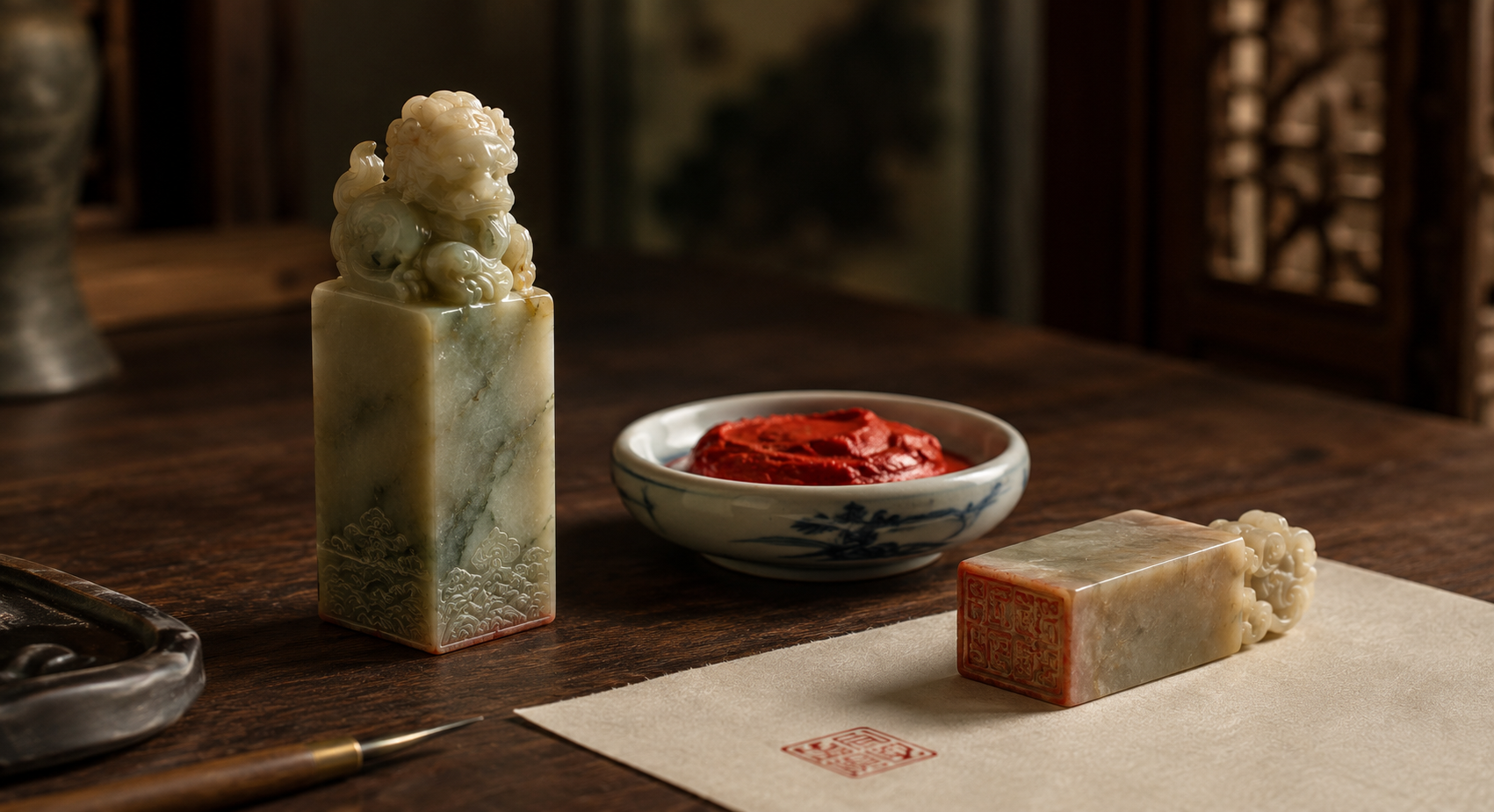
A Chinese seal is a stamp carved with a name, studio title, phrase, emblem, or other inscription. The carved face is pressed into seal paste—traditionally a dense red paste made with cinnabar pigment and binding materials—and then impressed onto paper, silk, artwork, or documents.
Unlike a rubber stamp, a traditional seal is conceived as a piece of art. The carver must consider the script, the balance of empty and filled space, the natural character of the stone, and the relationship between every stroke. Even a seal measuring only a few centimeters can require careful design and precise handwork.
A brief history of Chinese seals
The earliest Chinese seals emerged in antiquity and became firmly established as instruments of authority and identification during the imperial era. Official seals could signify government rank or administrative power, while private seals identified individuals, families, studios, and collections.
Over time, seals moved beyond bureaucracy and became inseparable from the arts of the scholar’s studio. Painters and calligraphers used them as signatures. Collectors placed appreciation seals on works they owned or admired. A historic painting may therefore carry multiple red impressions, each recording a chapter in the object’s journey.
During the Ming and Qing dynasties, seal carving developed into a highly regarded literati art. Carvers studied ancient inscriptions and calligraphic traditions while cultivating individual styles. The art came to be appreciated through the traditional unity of poetry, calligraphy, painting, and seal carving.
What does a Chinese seal symbolize?
At its simplest, a seal says, “This is mine” or “This is from me.” Yet its meaning is more intimate than an ordinary signature. Because the inscription is designed and carved for one person, the seal becomes a compact portrait of identity.
Personal seals may represent:
- Identity: a Chinese name, translated name, surname, or artist’s name.
- Authority: the right to approve, authenticate, or represent.
- Creative authorship: a maker’s finishing mark on calligraphy, painting, pottery, books, and other works.
- Aspiration: a short phrase expressing a value, wish, or personal philosophy.
- Continuity: a durable object that can accompany its owner for decades and be passed on.
This is why a custom seal makes a thoughtful gift for a wedding, graduation, new business, creative milestone, or anyone forming a meaningful connection with Chinese language and culture.
The art of seal carving: zhuànkè
Zhuànkè literally refers to carving seal script. Although a finished impression may look spontaneous, the process is disciplined. The artisan first determines the inscription and composition, transfers or draws the design onto the seal face, and then cuts the characters with specialized knives. The surface is tested, adjusted, and printed repeatedly until the relationship between line, rhythm, and negative space feels resolved.
Seal script (zhuànshū, 篆书) is often used because its ancient, rounded structures adapt beautifully to the square or circular seal face. Carvers may also draw from other script traditions or create a design suited to a modern name. A good result is not simply legible text reduced to a tiny size; it is an independent composition.
Zhuwen and baiwen: two principal carving styles
Traditional impressions are commonly described as either zhūwén (朱文) or báiwén (白文):
- Zhuwen, or relief carving: the background is cut away so the characters remain raised. When stamped, the characters appear red.
- Baiwen, or intaglio carving: the character strokes are cut into the seal face. When stamped, the characters appear as white paper surrounded by a red field.
Neither style is inherently superior. Zhuwen can feel light and elegant; baiwen often has greater visual weight. The best choice depends on the inscription, the material, and the character the owner wants the seal to convey.
What are Chinese seals made from?
Chinese seals have been made from many materials, including bronze, wood, ceramic, horn, jade, and carving stones. Each changes the experience of the object.
Seal stone
Fine-grained carving stones are especially valued because they allow the artisan to cut controlled lines while revealing natural colors, veining, and translucency. Stones associated with Chinese seal culture include varieties from Shoushan, Qingtian, Changhua, and Balin. Individual pieces vary naturally, so color and pattern should be understood as part of the stone’s identity rather than as manufacturing defects.
For a soft, poetic palette, explore the hand-carved Balin pink stone seal or the sky blue stone seal. For richer color, Oriental Artisan also offers green jade, yellow jade, and purple-white jade personal seals.
Jade
Jade has long carried associations with refinement, integrity, and preciousness in Chinese culture. It has a cool, substantial presence in the hand and makes a particularly ceremonial personal gift. Because “jade” is used broadly in commerce, buyers should read the material description carefully rather than relying on color alone.
Horn, wood, and other materials
Horn and wood can be lighter and understated. A black buffalo horn round seal, for example, offers a smooth, restrained appearance suited to frequent personal use. Material choice should reflect how the seal will be handled, displayed, and cared for—not simply which option is most expensive.
Chinese seals and Japanese hanko: are they the same?
They are related traditions, but the terms should not be treated as perfectly interchangeable. Chinese seals developed within Chinese systems of administration, scholarship, calligraphy, painting, and collecting. In Japan, personal seals are commonly called hanko or inkan and have their own social and legal conventions.
For an international buyer, “hanko” is sometimes used as a familiar search term for a personalized East Asian name stamp. Culturally, however, a Chinese-style hand-carved stone seal is best understood through the traditions of yìnzhāng and zhuànkè. A decorative or artistic seal purchased abroad should not be assumed to satisfy official registration requirements in any jurisdiction.
How to choose a personal Chinese seal
1. Decide what the seal should say
The most common choice is a personal name. You might use a Chinese name, a transliteration of a non-Chinese name, a surname, an artist’s name, or a studio name. Short auspicious phrases can also work, but the dimensions of the seal face limit how much text can be carved gracefully.
2. Ask how a foreign name will be translated
A phonetic transliteration attempts to echo the sound of a name, while a meaning-based interpretation chooses characters for their associations. These can produce very different results. Before carving begins, confirm the exact characters, their pronunciation, and their meaning. Avoid automatic translation for a permanent personalized object.
3. Choose the shape and impression style
Square seals are classic and give the carver a stable field for composition. Round seals often feel softer and more contemporary. Consider whether you prefer red characters in relief or white characters within a red ground, and ask the artisan which approach suits the selected inscription.
4. Select the material by character, not color alone
Look at texture, veining, translucency, weight, durability, and the intended use. Natural materials are not visually identical from piece to piece. For a gift, the presentation box and tassel or cord may be as important as the stone itself.
5. Review the design before carving
Because carving removes material, personalization should be confirmed carefully. Check character order, orientation, spelling, and whether the impression is designed to be read correctly after stamping. A thoughtful maker should be able to guide you through these decisions.
How to use a Chinese seal
- Place the paper on a resilient seal pad or a small stack of smooth paper. A hard tabletop alone may produce an uneven impression.
- Touch the seal face lightly and evenly to the seal paste. Do not grind it deeply into the paste.
- Position the seal vertically over the paper.
- Press down with steady, balanced pressure. A very gentle rocking motion can help the corners make contact, but avoid sliding.
- Lift the seal straight upward and allow the impression to settle without smudging.
Practice first on spare paper. Different papers absorb paste differently, and handmade papers may require a lighter touch than smooth card.
Where should a seal be placed on artwork?
In calligraphy and painting, placement is part of the composition. A name seal often appears near the signature, while leisure or studio seals may balance another area of the work. The red impression should support the movement of the artwork rather than compete with it.
If you are new to traditional composition, resist the temptation to stamp every empty corner. One carefully placed seal is usually more elegant than several impressions added without purpose.
How to care for a stone seal
- Wipe the carved face gently after use with soft paper or cloth.
- Do not use aggressive solvents or sharp tools to remove dried paste.
- Keep the seal away from drops, hard impacts, and rapid temperature changes.
- Store it upright or in a fitted box so carved edges and decorative finials are protected.
- Keep seal paste tightly closed and away from excessive heat or direct sunlight.
Natural stone can chip if knocked against a hard surface. A well-fitted wooden box is therefore more than presentation—it is part of the seal’s long-term care.
Why a hand-carved seal remains meaningful
Modern identity is increasingly frictionless: a typed name, a digital signature, a profile icon. A hand-carved seal moves in the opposite direction. It asks for decisions—about language, material, form, and meaning—and then fixes those decisions into an object made to endure.
The impression is never perfectly mechanical. Pressure, paper, paste, and the hand of the user subtly alter each mark. That small variation is part of its humanity. A seal does not merely reproduce a name; it creates a ritual of authorship.
Explore Oriental Artisan’s personalized seals to discover hand-carved stones, jade pieces, horn seals, and gift-ready designs created around the name or inscription you choose.
Frequently asked questions
What is a Chinese name stamp called?
It is commonly called a Chinese seal, yìnzhāng (印章), or simply yìn (印). The art of seal carving is known as zhuànkè (篆刻).
Can a non-Chinese person have a Chinese seal?
Yes. A name can be transliterated into Chinese characters or interpreted through carefully chosen characters. The final inscription should be reviewed by someone knowledgeable in Chinese language and naming.
Can I use a Chinese seal as my signature?
You can use it as a personal or artistic mark, but its legal validity depends on the country, document, and institution. A decorative custom seal should not automatically be treated as an officially registered seal.
What color ink is used for Chinese seals?
Red seal paste is traditional. Its dense consistency is different from ordinary liquid stamp-pad ink and is designed to hold fine carved detail.
How many characters fit on a personal seal?
Many name seals use two to four Chinese characters, although other arrangements are possible. The appropriate number depends on the seal-face dimensions, script, and composition.
Is a square or round seal better?
Neither is universally better. Square seals are traditional and compositionally versatile; round seals can feel softer and more contemporary. Choose according to the inscription and intended use.
,%20y%C3%ACn%20(%E5%8D%B0),%20or,%20in%20t...)
Leave a comment
This site is protected by hCaptcha and the hCaptcha Privacy Policy and Terms of Service apply.