
Wood, Bamboo or Metal Chopsticks? The Choice That Changes Every Meal
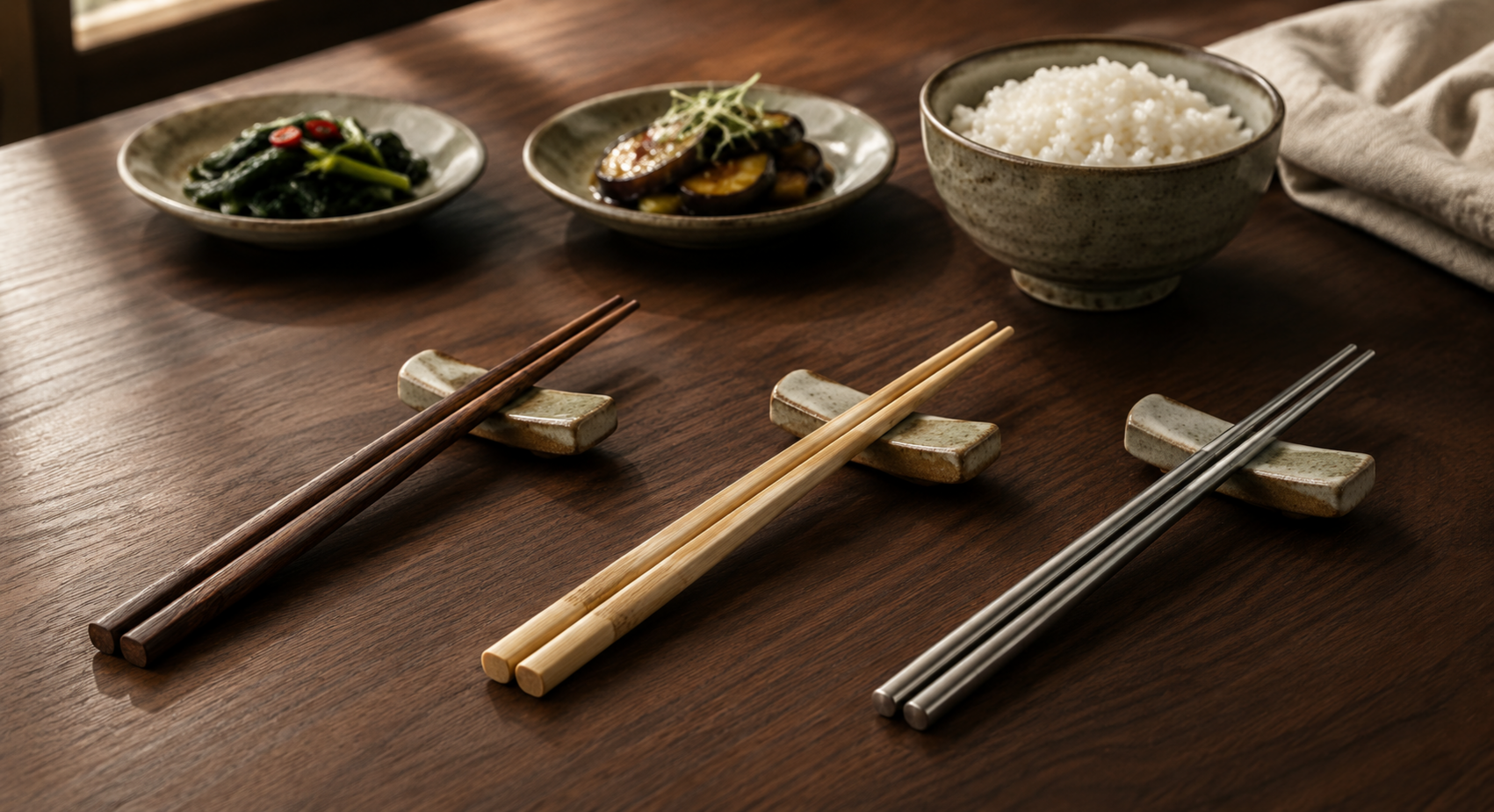
A pair of chopsticks may look like the simplest object on the table, yet its material changes almost everything your hand notices: weight, warmth, grip, balance, sound, and the amount of care required after dinner. Wooden chopsticks feel warm and forgiving. Bamboo feels exceptionally light and precise. Metal feels cool, durable, and distinctly substantial.
The short answer: wood is the best all-round choice for most people, bamboo is ideal when you want the lightest weight and strongest natural grip, and metal is best when durability and easy cleaning matter more than warmth or traction. The right choice is not a hierarchy of “good, better, best.” It is a match between material, food, hand, and ritual.
Wood, bamboo or metal chopsticks: the quick verdict
| Material | Feels like | Best for | Main advantage | Main trade-off |
|---|---|---|---|---|
| Wood | Warm, balanced, gently tactile | Everyday meals, noodles, rice, dumplings, gifting | Comfortable grip and refined appearance | Usually requires hand-washing and careful drying |
| Bamboo | Very light, crisp, naturally grippy | Beginners, slippery foods, travel, casual daily use | Excellent control with minimal hand fatigue | Can roughen, stain, split, or warp as it ages |
| Metal | Cool, slim, firm, comparatively heavy | Korean dining, frequent use, modern table settings | Durable, non-absorbent, and easy to clean | Can feel slippery and may conduct heat |
If you are buying your first reusable pair, choose well-finished wood with a subtly textured tip. If you struggle to hold noodles or dumplings, try bamboo. If you want a pair that tolerates years of frequent washing and you enjoy a cooler, more precise feel, choose food-grade stainless steel.
Why chopstick material changes a meal
Chopsticks are held at one end but controlled at the other. Small differences in weight, surface texture, stiffness, and taper are amplified across their entire length. A few grams of additional weight can make the tips feel steadier to one diner and tiring to another. A glossy surface may look beautiful but release a noodle that an unfinished bamboo tip would hold easily.
Material also shapes the sensory atmosphere of the table. Wood meets ceramic quietly. Metal produces a brighter contact sound. Bamboo almost disappears in the hand. None of these qualities changes the flavor of rice or broth in a literal sense, but each changes the pace and physical experience of eating.
This relationship between utensil and cuisine is not accidental. Japan’s Ministry of Agriculture, Forestry and Fisheries describes chopsticks as representative utensils of Japanese food culture and notes the wide variation in their materials, finishes, lengths, and uses—from eating to serving and cooking. Across East Asia, different forms evolved around different table customs rather than around a single universal design.
Wooden chopsticks: the best all-round choice
For most diners, wood offers the easiest balance of comfort, control, and beauty. It is lighter and warmer than metal but generally more substantial than bamboo. Its fine natural grain gives the fingertips and food enough friction without feeling coarse.
What wooden chopsticks feel like
Wooden chopsticks tend to feel calm in the hand. They do not become noticeably cold in an air-conditioned room, and they do not transmit the heat of a bowl or hot pot as readily as metal. When properly shaped, the gentle weight of wood helps the tips feel stable without forcing the fingers to work hard.
The exact experience depends on more than species. Black walnut can look deep and architectural; ash may feel lighter and more linear; woods with dense, even grain can be shaped to fine tips. Yet straightness, balance, sanding, and finish often matter more in daily use than a prestigious wood name.
Where wood performs best
- Noodles that need a combination of grip and smooth release
- Dumplings, tofu, and delicate pieces that should not be pinched aggressively
- Rice dishes and shared family meals
- Quiet ceramic table settings where the sound of metal would feel too sharp
- Personal or wedding gifts, especially when craftsmanship and presentation matter
Possible drawbacks
Wood responds to moisture. Long soaking, harsh dishwasher cycles, and storage while damp can encourage warping, cracking, fading, or lifting finishes. A lacquered or sealed surface may resist staining better than unfinished wood, but the care instructions depend on the finish. “Wooden” does not automatically mean dishwasher-safe.
For a warm, understated daily pair, explore Oriental Artisan’s black walnut and ash wood chopsticks or the handcrafted wooden chopsticks set of five. If the chopsticks are intended as a more decorative gift, mother-of-pearl inlaid wooden chopsticks bring craft detail to the same tactile foundation.
Bamboo chopsticks: light, grippy, and easy to learn with
Bamboo is technically a grass, not a wood, but it is often grouped with wooden chopsticks because both feel warm and organic. Its long fibers allow chopsticks to be made slender and remarkably light. For beginners, that low weight can make it easier to understand the movement of the upper chopstick without tiring the hand.
What bamboo chopsticks feel like
Bamboo usually has more natural traction than polished wood or metal. That makes it particularly capable with slippery noodles, glossy vegetables, fish balls, and dumplings. The material feels quick rather than substantial: the tips respond immediately, and the chopsticks add very little weight to the hand.
Where bamboo performs best
- Learning chopstick technique
- Foods coated in sauce or oil
- Noodles and small, slippery ingredients
- Long meals where a very light utensil reduces fatigue
- Travel sets and relaxed everyday dining
Possible drawbacks
Bamboo’s lightness can feel insubstantial to people who prefer the steadiness of dense wood. Lower-quality pairs may develop raised fibers, rough patches, stains, or splits. As with wood, repeated soaking and dishwasher heat can shorten the life of many bamboo chopsticks.
Bamboo is often marketed as automatically sustainable because the plant grows quickly. That is only part of the picture. Farming practice, processing, adhesives, coatings, packaging, transport, and usable lifespan all affect the final environmental cost. A well-made pair used for years is a more meaningful choice than a poorly finished pair replaced repeatedly.
Oriental Artisan’s natural bamboo chopsticks are a fitting choice for diners who prioritize low weight, tactile control, and a quiet, organic table setting.
Metal chopsticks: durable, precise, and distinctly Korean
Reusable metal chopsticks are strongly associated with Korean dining culture. Historic materials and forms have varied, while contemporary pairs are commonly made from stainless steel or traditional Korean metal alloys. Korea’s official cultural portal notes the continued use of stainless steel as a practical modern material for Korean chopsticks.
Metal should not be understood as a modern substitute for “more traditional” wood. It belongs to its own dining lineage, typically used alongside a spoon in a Korean place setting.
What metal chopsticks feel like
Metal chopsticks feel cooler and more rigid. They are often slimmer than wood and can be round, square, or characteristically flat in Korean styles. Their weight creates a firm, precise sensation, although a polished surface offers less friction against food.
Experienced users may enjoy that exactness. Beginners may find themselves gripping too tightly to compensate for the smooth surface. A lightly textured tip or flat profile can make metal easier to control.
Where metal performs best
- Korean meals served with a spoon
- Frequent daily use where long-term durability matters
- Modern, minimal, or mixed-material table settings
- Diners who prefer a slim and substantial utensil
- Households that want a non-absorbent surface
Possible drawbacks
Metal conducts heat. A pair left resting in very hot broth or against a hot vessel can become uncomfortable, so metal eating chopsticks should not be confused with long cooking chopsticks. They can also be noisier against ceramic bowls and less forgiving with smooth noodles or delicate tofu.
Many stainless-steel pairs are dishwasher-safe, but decorative handles, colored finishes, adhesives, or mixed materials may not be. Follow the maker’s instructions for the complete object, not simply the base metal. For a contemporary hybrid, Oriental Artisan’s stainless-steel utensil set with wooden handles combines metal durability with a warmer point of contact.
Which chopsticks are best for different foods?
| Food or occasion | Best starting choice | Why |
|---|---|---|
| Ramen, soba, and udon | Wood or bamboo | Natural surface texture helps hold noodles |
| Dumplings and xiaolongbao | Wood | Balanced grip with a gentler feel against delicate wrappers |
| Sushi and sashimi | Fine-tipped wood | Precise without feeling cold or overly slippery |
| Korean barbecue and banchan | Metal | Culturally familiar, durable, and suited to the spoon-and-chopstick setting |
| Tofu and slippery vegetables | Bamboo or textured wood | Higher traction reduces the need to squeeze |
| Everyday mixed meals | Wood | The most versatile compromise of comfort, grip, and weight |
| Beginners and children | Light bamboo or short textured wood | Low weight and grip support easier control |
| Formal gifting | Crafted or lacquered wood | Offers the widest range of finishes, inlay, symbolism, and presentation |
Material is only half the decision
Two pairs made from the same material can behave completely differently. Before buying, examine these five details.
1. Tip texture
Textured or finely ridged tips improve grip. Highly polished tips release food cleanly but can be challenging with noodles. A refined everyday pair often combines a smooth handle with a subtly tactile eating end.
2. Shape
Round chopsticks rotate easily in the fingers but may roll off the table. Square or hexagonal handles resist rolling and offer clear tactile orientation. Flat Korean metal chopsticks demand a slightly different grip but provide a distinctive sense of control once familiar.
3. Taper
Fine tips help with bones, garnishes, and small pieces. Broader tips feel stable and are often easier for beginners. Extremely sharp points are not necessary for ordinary dining and may feel less comfortable.
4. Length
Eating chopsticks are commonly around 8 to 10 inches long, although regional designs and personal preferences vary. Japanese eating chopsticks are often shorter and more tapered; Chinese styles are commonly longer; Korean metal chopsticks may be flatter and used with a spoon. Cooking chopsticks are longer again and should be purchased specifically for cooking.
5. Finish
Finish determines both beauty and care. Natural oil, wax, lacquer, paint, resin, and modern sealants behave differently. Look for a smooth, intact, food-contact-safe surface and clear care instructions. Avoid pieces with flaking coatings, sharp seams, persistent chemical odors, or unexplained materials.
Are wooden and bamboo chopsticks hygienic?
Yes—reusable wooden and bamboo chopsticks can be used hygienically when they are intact, washed properly, dried completely, and replaced when damaged. Porous does not mean impossible to clean, just as non-porous does not mean self-cleaning.
The United States Department of Agriculture advises washing utensils with hot, soapy water after contact with food. For chopsticks, the practical routine is simple:
- Wash soon after the meal with warm water, dish soap, and a soft sponge.
- Rinse away all soap and food residue.
- Dry with a clean cloth, then allow the pair to air-dry fully before enclosing it in a case or drawer.
- Do not soak wood or bamboo for long periods.
- Use the dishwasher only when the manufacturer explicitly says the complete pair is dishwasher-safe.
Replace wooden or bamboo chopsticks if they develop deep cracks, splinters, persistent odors, dark areas that do not clean away, or a peeling finish. Replace metal chopsticks if they become sharply bent, badly corroded, or if a decorative coating begins to detach.
Which material is the most sustainable?
There is no responsible answer based on material name alone.
Bamboo grows quickly and can be made into very light utensils, but processing, finishes, and durability vary. Wood can be an excellent long-lived choice when responsibly sourced and carefully made. Metal requires more intensive industrial processing, but a durable stainless-steel pair may remain in service for decades and can reduce repeated replacement.
The most sustainable practical strategy is to choose a reusable pair you genuinely enjoy, care for it correctly, and keep it in use. Ask about source material, finish, repairability, packaging, and expected lifespan. “Natural” and “reusable” are useful clues, not complete environmental assessments.
How to choose the right chopsticks for you
Use this decision path:
- Choose wood if you want one beautiful, versatile pair for almost every meal.
- Choose bamboo if you want maximum grip, minimum weight, or an easy first pair.
- Choose metal if you value durability, easy cleaning, Korean dining traditions, or a modern table.
- Choose textured tips if noodles and slippery foods are your priority.
- Choose a square or hexagonal handle if round chopsticks roll or rotate too easily.
- Choose shorter or lighter chopsticks for smaller hands and beginners.
- Choose crafted wood when the pair is intended as a meaningful gift.
The quiet object you touch at every meal
Tableware is often chosen with the eyes first: the glaze of a bowl, the curve of a cup, the color of linen. Chopsticks return attention to touch. The best pair becomes familiar so gradually that its balance is noticed most clearly when it is absent.
Wood brings warmth. Bamboo brings lightness. Metal brings permanence. The right pair is the one that makes the movement from dish to mouth feel effortless—and makes an ordinary meal feel considered.
Explore Oriental Artisan’s chopsticks collection to discover handcrafted wooden, bamboo, inlaid, gift-ready, and contemporary designs chosen for the everyday rituals of the table.
Frequently asked questions
Are wooden or metal chopsticks better?
Wooden chopsticks are usually easier to grip and more comfortable for general use. Metal chopsticks are more durable and non-absorbent but can feel heavier, colder, and more slippery. Choose wood for versatility and metal for longevity or Korean-style dining.
Are bamboo chopsticks better than wooden chopsticks?
Bamboo chopsticks are generally lighter and naturally grippier. Wooden chopsticks often feel more balanced and substantial and can offer more refined finishes. Bamboo is excellent for beginners; wood is the stronger all-round choice for most diners.
What chopsticks are best for beginners?
Light bamboo or wooden chopsticks with textured tips and square or hexagonal handles are easiest for most beginners. Avoid very glossy round chopsticks until your technique feels stable.
What chopsticks are best for noodles?
Bamboo and textured wooden chopsticks are usually best for noodles because their surfaces provide more traction than polished metal.
Why do Koreans use metal chopsticks?
Metal chopsticks are part of Korea’s distinct dining tradition and are commonly paired with a spoon. Modern versions are often stainless steel, while historic forms and materials varied by period and social context.
Can wooden and bamboo chopsticks go in the dishwasher?
Only if the maker specifically labels them dishwasher-safe. Dishwasher heat, prolonged moisture, and strong detergent can damage many natural materials, adhesives, lacquer, inlay, and decorative finishes.
How often should reusable chopsticks be replaced?
There is no universal schedule. Replace them when they crack, splinter, warp severely, retain odors, corrode, or develop peeling finishes. An intact, well-cared-for pair can remain useful for years.
Do metal chopsticks make food taste metallic?
Good-quality stainless-steel chopsticks should not noticeably change the taste of ordinary food. Sensitivity to the cool feel and contact sensation varies, so some diners may still prefer the neutrality of wood or bamboo.
What is the best chopstick material for a gift?
Handcrafted wood is often the most expressive gift choice because it can carry lacquer, inlay, carving, symbolic motifs, and elegant presentation. A paired set is especially appropriate for weddings and anniversaries.

Leave a comment
This site is protected by hCaptcha and the hCaptcha Privacy Policy and Terms of Service apply.